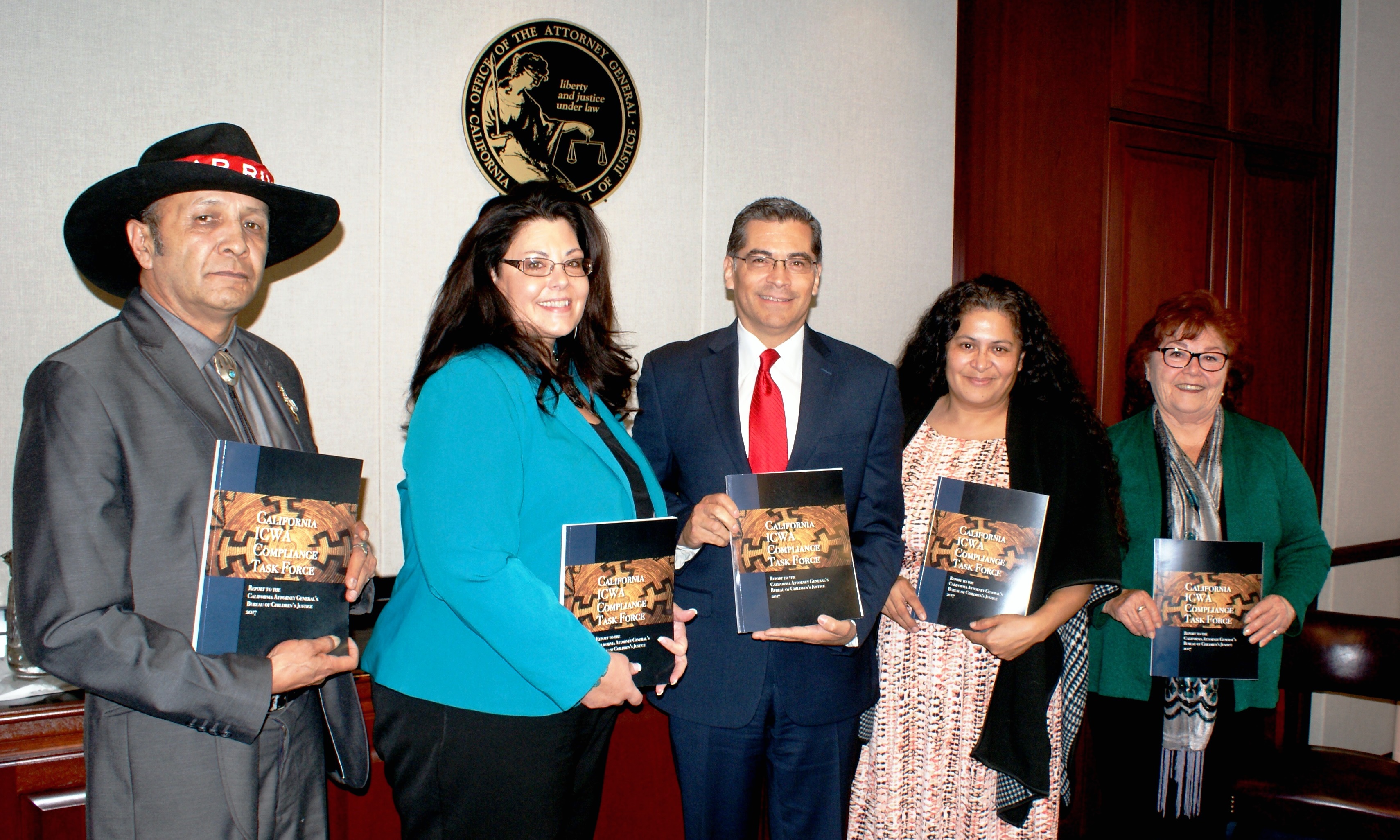
Report: ICWA Compliance Task Force – Final Report 2017
Press Release: Task Force Presents California Attorney General with Recommendations for Protecting Safety, Civil Rights of Tribal Children
This is the attempted class action litigation claiming ICWA violated the Constitution.This is a big win for ICWA and the legal advocates who worked on this case at the state, federal, and tribal levels.
Here is the Order.
The legal questions Plaintiffs wish to adjudicate here in advance of injury to themselves will be automatically remediable for anyone actually injured. The very allegations of wrongfulness are that such injuries will arise in state court child custody proceedings, directly in the court processes or in actions taken by state officers under the control and direction of judges in those proceedings. Any true injury to any child or interested adult can be addressed in the state court proceeding itself, based on actual facts before the court, not on hypothetical concerns. If any Plaintiffs encounter future real harm in their own proceedings, the judge in their own case can discern the rules of decision. They do not have standing to have this Court pre-adjudicate for state court judges how to rule on facts that may arise and that may be governed by statutes or guidelines that this Court may think invalid.
Here is the joint press release from the ICWA Defense Project.
If you sat in on a class I taught last week, you’d know this is my new favorite article:
Here.
This paper turns attention away from discussions of the race and economic poverty of the families most affected by the system, and instead looks at the impact of the race and privilege of these volunteer child advocates on child welfare decision-making
Court Appointed Special Advocates (CASA) are volunteers appointed by the court in child welfare cases to argue for a child’s best interests. There are many issues with this system, and I have been in many loud arguments about it (some of you have witnessed them). This article identifies many of those concerns and grounds them in the history of state child welfare systems–including how those systems affect Indian children.
As a side note, I know people personally who have worked hard to develop Tribal CASA programs. Those programs are particularly sensitive to ensuring their volunteers understand the culture of the tribe and their children, which counters the issues inherent in state systems. This article is specifically discussing the issue of CASAs in state systems.
Here.
Not an ICWA/Indian child case, but one that is important nonetheless given its ruling ensuring Title IV-E maintenance payments. The lack of these payments sometimes make kinship care very difficult on relative placements–Title IV-E maintenance payments cover, among other things, the child’s food, clothing, and shelter. 42 U.S.C. 675(4)(A). After determining that the aunt/foster parent established a cause of action, the court held that:
The family argues that the Cabinet approved R.O. [child’s aunt] to be a foster parent. Prior to placement, the Cabinet verified that R.O. met relevant non-safety standards by conducting a home evaluation and a background check. After determining that her home was safe, the family court moved the children from another foster provider to her care. R.O. therefore argues that the Cabinet “approved” her as a foster parent for the children.
Kentucky offers several arguments in response. Kentucky distinguishes between “foster care” and “kinship care.” According to Kentucky, “foster care” refers to licensed foster family homes. “Kinship care,” by contrast, refers to relative caregivers. Although the Cabinet must remit maintenance payments to foster parents, the Cabinet need only pay kinship care providers “[t]o the extent funds are available.” Ky. Rev. Stat. Ann. § 605.120(5) (West 2016). Due to inadequate appropriations, Kentucky ceased funding its kinship care program.
To the extent the Cabinet’s failure to make maintenance payments turns on the distinction between relative and non-relative foster care providers, it plainly violates federal law. In Miller v. Youakim, 440 U.S. 125 (1979), Illinois placed two children with their older sister, Linda Youakim, and her husband. Id. at 130. “The Department investigated the Youakim home and approved it as meeting the licensing standards established for unrelated foster family homes . . . .” Id. Yet, “[d]espite this approval, the State refused to make Foster Care payments on behalf of the children because they were related to Linda Youakim.” Id. The Court reviewed the definition of “foster family home.” Id. at 130–31. After noting that the statute “defines this phrase in sweeping language,” the Court found that “Congress manifestly did not limit the term to encompass only the homes of nonrelated caretakers. Rather, any home that a State approves as meeting its licensing standards falls within the ambit of this definitional provision.” Id. at 135.
UPDATE (2/22/17 10:46AM) Download(PDF) Briefs: Brief of Appellants, Brief of Defendant-Appellee Vickie Yates Brown Glisson, Reply Brief of D.O., A.O. and R.O.
Here. The Fourth Appellate District does more research than DPSS (the agency tasked with notice), and put it into the decision:
Respondent argues that there is no federally recognized “Innuit Eskimo” tribe, so notice was not required. It is not quite so simple. The term “Innuit” is a collective term (the plural of Inuk), for a group of culturally similar indigenous peoples inhabiting the Arctic regions of Alaska, Greenland, Canada, and Siberia. (http://www.newworldencyclopedia.org/entry/Inuit.) The Alaskan Innuit comprises the Alutiiq, Yup’ik (or Yupiat) and Inupiat tribes. (http://www.encyclopedia.com/history/united-states-and-canada-north-american-indigenous-peoples/.) The term “Eskimo,” as it pertains to Alaskan indigenous peoples, has been replaced by “Inuit.” (Ibid.) There are 229 federally recognized Alaskan villages. (http://www.alaskannature.com/inuit.htm; see also, 81 Fed. Reg. 5023-5025, (No. 19, January 29, 2016).) For this reason, one will not find “Eskimo” or “Innuit” in the Federal Register’s list of federally recognized Native Entities.
The Federal Register lists the 229 Alaskan villages. The names, addresses and telephone numbers of approximately 15 Tribal Leaders and BIA Servicing Centers may be found in the BIA Tribal Leaders Directory. (See, http://www.bia.gov/cs/groups/public/documents/text/idc002652.pdf.) At the very minimum, the social worker should have provided notice to the Native Alaskan Entities through the BIA, if not to the individual tribal entities.[5]
And, in case you were wondering what that footnote five is all about, it’s worth posting as well:
[5] By way of a letter, DPSS requests that we identify the specific Native American entity to which notice should be provided. We have identified four entities listed in the Federal Register in our opinion, whose names comprise a form of the words “Innuit” or “Inuk.” We also recommended contact with the BIA. However, the duty to identity and locate the appropriate Native American entity is more appropriately borne by the DPSS working with the court.
A friend posted she heard this on Minnesota Public Radio recently.
Here is the story with a link to the documentary. I was able to listen to more than half of it and it’s really well-done.
Here.
From the Ontario Supreme Court of Justice:
The background facts, as set out in the six previous decisions, are by now well-known, not only to the parties but to many Canadians, and will not be repeated here. In any event, the factual background is not in dispute.
[4] The Sixties Scoop happened and great harm was done.
[5] There is no dispute about the fact that thousands of aboriginal children living on reserves in Ontario were apprehended and removed from their families by provincial child welfare authorities over the course of the class period – from 1965 to 1984 – and were placed in non-aboriginal foster homes or adopted by non-aboriginal parents.
[6] There is also no dispute about the fact that great harm was done. The “scooped”3 children lost contact with their families. They lost their aboriginal language, culture and identity. Neither the children nor their foster or adoptive parents were given information about the children’s aboriginal heritage or about the various educational and other benefits that they were entitled to receive. The removed children vanished “with scarcely a trace.” As a former Chief of the Chippewas Nawash put it: “[i]t was a tragedy. They just disappeared.”***
The issue is not what was known in the 1960’s about the harm of trans-racial adoption or the risk of abuse in the foster home. The issue is what was known in the 1960’s about the existential importance to the First Nations peoples of protecting and preserving their distinctive cultures and traditions, including their concept of the extended family. There can be no doubt that this was well understood by Canada at the time. For example, focusing on adoption alone, Canada knew or should have known that the adoption of aboriginal children by non-aboriginal parents constituted “a serious intrusion into the Indian family relationship” that could “obliterate the [Indian] family and…destroy [Indian] status.”
***
In my view, the common issue must be answered as follows.
[85] For the reasons set out above, when Canada entered into the 1965 Agreement and over the years of the class period, Canada had a common law duty of care to take reasonable steps to prevent on-reserve Indian children in Ontario, who had been placed in the care of non-aboriginal foster or adoptive parents, from losing their aboriginal identity. Canada breached this common law duty of care.
Disposition
[86] The common issue is answered in favour of the plaintiff. Canada is liable in law for breaching a common law duty of care to the class members. This is not an issue that requires a trial.
[87] The class action now moves forward to the damages assessment stage. Counsel should schedule a case conference to discuss next steps.
[88] The plaintiff is entitled to the costs of this summary judgment motion. These costs are likely to be substantial. If the parties cannot agree on the costs I would be pleased to receive brief written submissions from the plaintiff within fourteen days and from the defendant within fourteen days thereafter.
Download(PDF): Doc. 332 – Order (2/9/2017)
Link: Previous posts
New from the Capacity Building Center for Tribes: ICWA Guide for Tribal Governments and Leaders. Available here, pdf here.
Our Children, Our Sovereignty, Our Culture, Our Choice
A word from the authors: Our tribes are threatened by the removal of our youngest and most vulnerable members, our children. As leaders we want to make informed decisions to protect the future of our tribe, our culture, our children and families. Historically, we have seen state and federal programs compromise our dignity and culture by breaking up our families and tribes. Even today we hear of unwarranted removal of our Indian children and the attempts to keep them separated from their culture and tribal identity. The Indian Child Welfare Act (ICWA), when complied with, can help prevent these unwarranted removals and ensure Indian children are kept safe while remaining with their families. The purpose of this Guide is to recommend actions that tribal leadership can take towards ensuring compliance with ICWA.
The recommendations that appear in this guide were made by Tribal Court judges, Tribal attorneys, Tribal educators who train on ICWA, Tribal legislators, a former Tribal Governor/Social Services Director, Counsel for the County (who was also a Tribal member), and Directors of Social Services for Tribal child welfare programs. It is important to note that these are recommendations, not mandates, made by individuals who work in various arenas in child welfare.
 Turtle Talk
You must be logged in to post a comment.