NCJFCJ Releases Updated Disproportionality Rates for Children of Color in Foster Care Technical Assistance Bulletin

Since 2011, the NCJFCJ has published Disproportionality Rates for Children of Color in Foster Care Technical Assistance Bulletins, which identify national and state level disproportionality rates. The reports have gained national attention and have been used in a number of ways by a broad spectrum of stakeholders and interested parties.

Due to the ongoing need for dialogue surrounding the most currently available statistics on disproportionality, the NCJFCJ has published an updated Disproportionality Rates for Children of Color in Foster Care (Fiscal Year 2013) Technical Assistance Bulletin. This Bulletin, released June 2015, utilizes the most current (2013) Adoption and Foster Care Analysis and Reporting System (AFCARS) data and 2013 census population estimates data to calculate current disproportionality indexes for the nation, every state, and Washington, D.C.. The Bulletin makes comparisons between 2000 and 2013 disproportionality rates to illustrate changes that have occurred in the last decade regarding overrepresentation of children of color in the foster care system. African American and Native American disproportionality rates are illustrated in color coded maps demonstrate trends over time.

New this year, the Bulletin identifies some of the limitations of the data to help users be more informed consumers of the information and better understand what the data mean and do not mean.
2013 Dispro TAB Final

NACC Blog Post by Prof. Sankaran on State Child Welfare Court Systems

Here.

While judges are legally required to play the role of the rights-protector, in practice, they are sent a different message. They are encouraged to collaborate with child welfare agencies, even while litigation is pending before them involving that same agency. They are implicitly – or explicitly – told not to make negative findings against the agency for fear that such a finding could jeopardize the agency’s funding. In fact, judges are invited to participate in inter-agency task forces on how to make “better” findings to appease federal auditors. And they celebrate when their state agency secures federal funding based on the drafting of their orders.

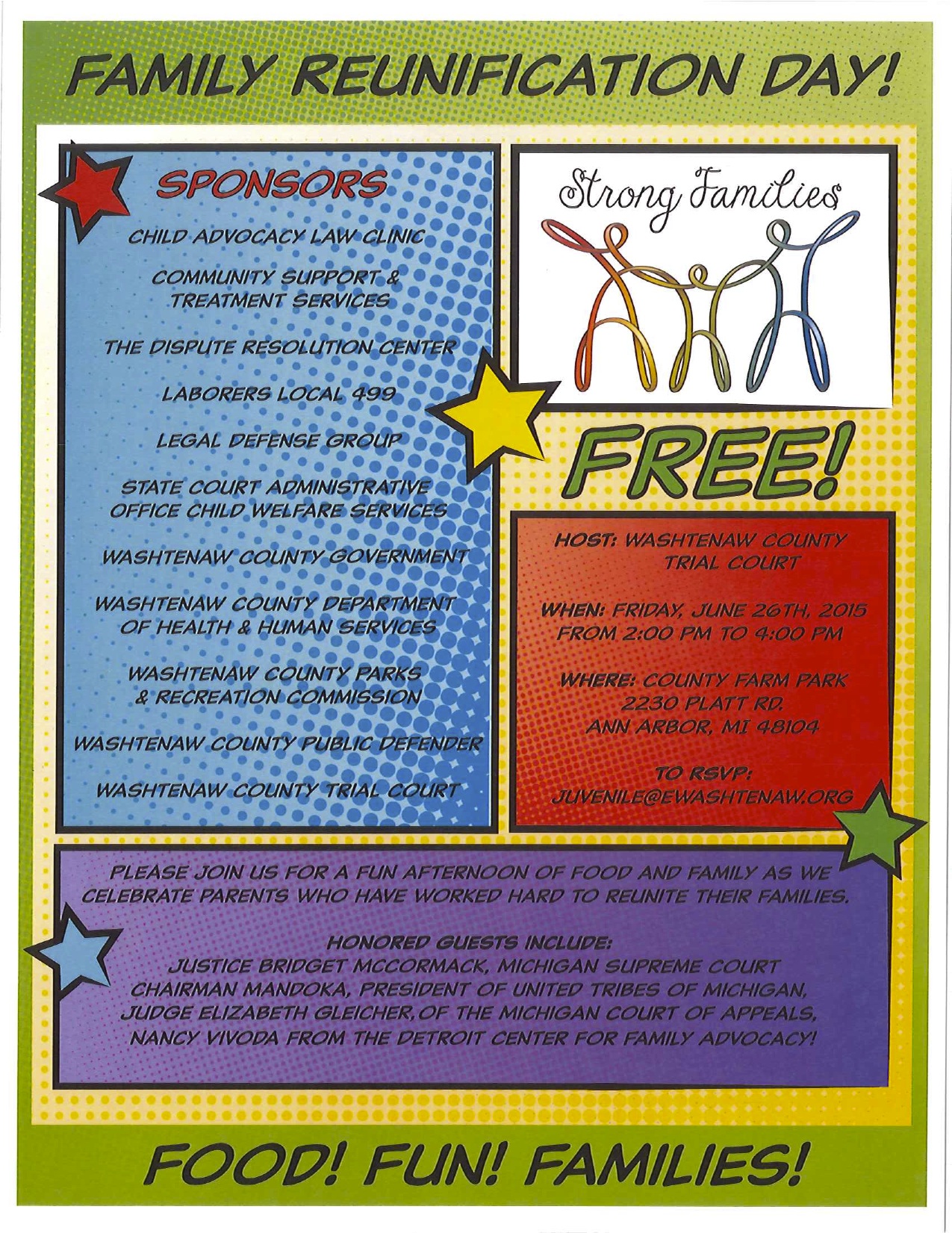
Family Reunification Day at Washtenaw County Trial Court

201506121526

GAL Attempts to Appeal Determination ICWA Applies to Nebraska Supreme Court

Here. Child’s GAL argued Adoptive Couple v. Baby Girl meant that ICWA/NICWA should not apply to the case (because mother had tried to create a guardianship with a cousin who lived on the reservation and thus “the case would not result in the dissolution of the Indian family”).

The GAL appealed from an order merely finding that ICWA and NICWA applied to the adjudication proceeding. But the juvenile court took no action implementing or contravening the heightened protections afforded by the acts. Although we are sensitive to the need to expedite juvenile matters, without some dispositive action, we see no impact upon the juvenile’s substantial rights. Consequently, the juvenile court’s order does not constitute a final order within the meaning of § 25-1902. In the absence of a final order, we must dismiss the appeal for lack of jurisdiction. Because these proceedings have already been delayed for an inordinate time, we have expedited the disposition of this appeal

Qualified Expert Witness ICWA Case out of Michigan Court of Appeals

Here.

In this case, the trial court explicitly recognized that Hillert, the only expert witness at the termination hearing, did not support termination and specifically testified that returning AP andDP to Stenman’s care would not likely result in serious emotional or physical damage to either child. Nonetheless, considering the other evidence presented, the trial court determined that returning AP and DP to Stenman’s care would result in such damage beyond a reasonable doubt. In so doing, the trial court essentially disregarded Hillert’s testimony, contrary to the plain language of 25 USC 1912(f), MCL 712B.15(4), and MCR 3.977(G)(2). Accordingly, we conclude that the trial court failed to adhere to the requirements of ICWA and its Michigan counterparts, and remand for further proceedings with respect to AP and DP.

The testimony of a qualified expert witness under ICWA is part of the necessary proof to demonstrate beyond a reasonable doubt that return of the child to her mother will cause serious emotional or physical damage. Without that testimony, the state has not met its burden to terminate parental rights. If the state cannot provide a QEW that agrees with termination, the court cannot terminate parental rights. In situations like this, where the QEW not only testifies that he does not agree with the termination in this case, nor in termination generally as a tribe, this ought to force the state to look to other long term permanency solutions that don’t require the termination of parental rights, like Michigan’s long term juvenile guardianships, or at ways other states have addressed this issue (like California).

Report Released by the Maine Wabanaki-State Truth and Reconciliation Commission

Here. (78 pages, pdf).

We further assert that these conditions and the fact of disproportionate entry into care can be held within the context of continued cultural genocide, as defined by the Convention on the Prevention and Punishment of the Crime of Genocide, adopted by the United Nations General Assembly in 1948. In particular, the convention notes that genocide means “any of the following acts committed with intent to destroy, in whole or in part, a national, ethnical, racial or religious group.” We posit that Article 2, Sections b and e –“Causing serious bodily or mental harm to members of the group” and “Forcibly transferring children of the group to another group” – apply to what Wabanaki communities face here in Maine.
***
This, too, we found to be true: providing and sustaining preventive support to Native families might be of the greatest use of all. One Wabanaki service provider commented, as did many, that tribal people view child rearing as the responsibility of an extended network of kin and connections. This person noted that the best way to help children is to “strengthen families as a whole and communities as a whole to be able to step up and care for kids when things aren’t optimal in their home lives so they don’t ever even need to enter the system.” (11/4/14)

Many of those who work in the state child-welfare system share this exact desire. When reflecting on the process of being involved with the Commission, a DHHS supervisor wrote, “This has been an amazing journey to bring truths to light. To bravely state fact, to move through and past pain toward healing. My vision for the future is a strong family system without the need for foster care.” (4/9/15)

The report ends with 14 recommendations, and comes out amid tensions between tribes and the state over fishing, water quality standards, and jurisdictional concerns.

NYTs Op/Ed by Thomas King: “No Justice for Canada’s First Peoples”

Here.

We posted the truth and reconciliation report here.

Unpublished ICWA Related Opinion out of California

Here.

There’s a fair amount going on in the description of this case (active efforts, involvement of the tribe, CA statutory tribal adoption), but we were interested in this near the end of the opinion:

Mother relies on the tribal representative’s response to the termination of reunification services. In an October 23, 2014, e-mail correspondence, the tribal representative wrote, “[W]e … believe that it was a HUGE disservice to the family to discontinue active efforts. Here in the State of Alaska, the department must provide active efforts right up until the day of reunification, guardianship is finalized or termination of parental rights.”
The tribal representative’s concern appears to have been the California practice of discontinuing reunification services at the review hearing held several months prior to the selection and implementation hearing. Whether a “disservice” or not, the juvenile court terminated services at the point contemplated by our dependency scheme.

ICWA Notice Case out of Washington Court of Appeals

Here.

The Blackfoot/Blackfeet notice issue comes up pretty regularly. Depending on what court the parent is in, the Department may or may not be ordered to notice Blackfeet even if a parent says Blackfoot. In this case, the Washington Court of Appeals said the was no need to notice Blackfeet when dad said Blackfoot and Cree. According to the opinion, notice went out to “several Cherokee, Cree, and Hopi Indian tribes.”

Additional Comments on Proposed ICWA Regulations

More than 1,000 additional comments were posted this week to regulations.gov on the proposed ICWA regulations, bringing the total number of comments to 1,869. We have updated the tribal nations comments page here, and the organizations page here.

Here are a few additional individual comments we noted as we scrolled through them:

361_-_Erdrich,_Karen_Louise
942_-_Jones,_Laura
919_-_Spotted_Elk,_Sheldon
2097_-_Blanchard,_Evelyn
298_Hirsch_Bertram
1525_-_Houska,_Tara
886_-_Lidot,_Tom
1280_-_Drobnick,_Heidi_A
Sweet_Victoria