Repost: National ICWA Attorney Survey

Posting this one more time because it worked smashingly for a tribe yesterday. Fill it out! Forward it on!


In an attempt to better protect ICWA, tribes, and AI/AN families,
NICWA and the ILPC have put together a short survey to collected ICWA attorney information nationwide. If you are in-house or outside counsel, if you are a parents’ attorney interested in taking ICWA cases, if you are legal aid agency who represents tribes, if you stumbled on this post and would be willing to represent a tribe from another state in an ICWA proceeding, please fill this out this poll.

The information will be sent to NICWA, and not sold or otherwise distributed beyond what is indicated. Please forward this questionnaire to the ICWA attorneys in your network and encourage them to submit their information as well.

Here is the link.
Federal ICWA Litigation Documents

We don’t post every time a document is filed in the current federal ICWA cases (EDVA, AZ, MN, NDOK), but will be posting updates as orders are filed or briefing is completed on an issue, as usual.

However, many filings for all four cases are being updated regularly here.

Letter(S) to the Editor Regarding ICWA in the Washington Post

Here.

Bolstering accountability of the U.S. justice system and providing regulations for its interaction with Indian child-welfare cases secures the safety, health and well-being of Indian children and their tribal nations. The act is a public-health policy that prompts prevention-based measures to restore wellness for Indian children and their families. A sharp focus on the legal status of native children as citizens of self-determining tribal nations is fundamental. Indian children possess an inherent political status that predates the United States, a reality supported by centuries of U.S. law and policy.

Edited to add Senator Dorgan’s letter in the WaPo as well. Here:

When we talk about “blood-stained” laws, we should talk about the history of the treatment of Native Americans: laws of genocide, sterilization, forced removal and assimilation; compulsory boarding schools; underfunding of critical health care; and a trail of broken promises.

These were written in response to a particularly egregious and racist syndicated column by George Will we did not post.

On Friday he put up a second column about the Washington football team. If you want to know what he’s saying, given that his columns are syndicated and run nationwide, here are links to them that don’t boost them on a google search:

Anti-ICWA Column

Name of Washington Football Team Column

Alaska Supreme Court Decides ICWA Burden of Proof Case

Here is the opinion in Diana P. v. State Dept. of Health & Social Services. An excerpt:

A mother appeals the termination of her parental rights to her four daughters, all Indian children under the Indian Child Welfare Act (ICWA). She argues that the trial court erred in finding that the Office of Children’s Services (OCS) proved beyond a reasonable doubt that placing her children in her custody would likely put the children at risk of serious harm. We affirm the trial court’s decision.

Doe v. Pruitt, Another (Fourth) Federal ICWA Case Filed (N.D. Okla)

Here is the complaint.

This case mirrors the ongoing Doe v. Jesson case (where Mille Lacs defeated the preliminary injunction, and we are currently waiting for a decision on summary judgment). Filed after we wrote the ICWA Legal Defense memo discussing the other three ongoing cases, this case involves a voluntary adoption, the Oklahoma state ICWA, and Cherokee Nation of Oklahoma. The arguments involve right to privacy, and due process and equal protection concerns.

ICWA Defense Project Memo on Recent Federal ICWA Cases

Here.

In February 2015, the Bureau of Indian Affairs (BIA) published its revisions to the Guidelines for State Courts and Agencies in Indian Child Custody Proceedings. The new guidelines address areas of Indian Child Welfare Act (ICWA) non-compliance that have occurred over the past 36 years. In March 2015, the BIA announced its intent to advance further reform by proposing for the first time ever, legally binding federal regulations, Regulations for State Courts and Agencies in Indian Child Custody Proceedings, to govern the implementation of ICWA in state courts and agencies. The BIA received over 2,100 public comments during the notice and comment period that closed mid- May. The BIA will review these comments and then promulgate final regulations, likely by early spring 2016. A network of ICWA opponents has responded to the reforms by filing multiple lawsuits challenging the guidelines and ICWA’s constitutionality.

The National Indian Child Welfare Association (NICWA), the Native American Rights Fund (NARF), the National Congress of American Indians (NCAI), and the ICWA Appellate Clinic at Michigan State University College of Law—collectively known as the ICWA Defense Project—are working collaboratively to defend ICWA and the long overdue reforms to it introduced this year. This memo will summarize the pending litigation and describe some of the legal and communications strategies these partner organizations have developed to inform, advance, and unify a coordinated effort across Indian Country to respond to these attacks.

Also, here is the NICWA Board Resolution and
talking points for conversations with state Attorneys General.

Government’s Motion to Transfer Venue in Nat’l Council for Adoption v. Jewell (ICWA Guidelines Litigation) Denied

The Feds wanted to move the case to Arizona (the location of Goldwater v. Washburn, the class action case).

Order here.

Pleadings:

MotiontoTransfer_MemoinSupport

MotioninOppositiontoXfer

ReplyinSupportMotiontoXfer

Here is the Government’s answer to the initial complaint43 – Answer

The plaintiffs also filed a motion for summary judgment before time had run for the Government to respond to the initial complaint:

PartialSummaryJudgment_MotioninSupport

Documents filed in this case are also all being kept here (under the “Kathryn E. Fort” tab at the top of Turtle Talk’s main page).

Published California ICWA Opinion on QEW and Active Efforts

Here.

Among other things, this case demonstrates some of the confusion going on in the courts about WHEN certain provisions of ICWA are required. Must there be a qualified expert witness at disposition hearings? What if the court makes a finding about returning a child to a parent at a disposition hearing? And finally, who is responsible for getting QEW testimony?

(The answer to the last one is the State. Not the tribe, not the parent, and it’s not waive-able [though that happens] since it’s the evidentiary burden of the State to have a QEW who agrees with termination or foster care.)

Federal Grants Available for Tribal-State ICWA Programs

Here.

The purpose of this funding opportunity announcement is to support the creation of effective practice model partnerships between state courts and/or Court Improvement Program, state public child welfare agency and a tribe, group of tribes, or tribal consortia, including both the tribal child welfare agency and tribal court for effective implementation of the Indian Child Welfare Act (ICWA) of 1978 (Pub.L. 95-608).

Demonstration sites will be required to jointly develop protocols and practices to promote effective and timely:

– Identification of Indian children;
– Notice to tribes;
– Tribal participation as parties in hearings involving Indian children;
– Tribal intervention in dependency cases;
– Transfer of ICWA cases to tribal courts; and
– Placement of Indian children according to tribal preferences.

Partnership models must be co-created by states and tribes, jointly implemented, and designed to generate and capture clear, measurable outcomes such as:

– Compliance with identification methods;
– The number of Indian children identified;
– Length of time from removal or petition filed until identification is made;
– Number of notices sent;
– Length of time from identification until notice sent (state measure)
– Number of notices received (tribal measure)
– Length of time for tribal intervention or participation; (tribal measure)
– Number of cases in which a tribe intervenes; (joint measure)
– Number of transfers; (joint measure); and
– Number of Indian children placed according to tribal placement preferences (joint measure).

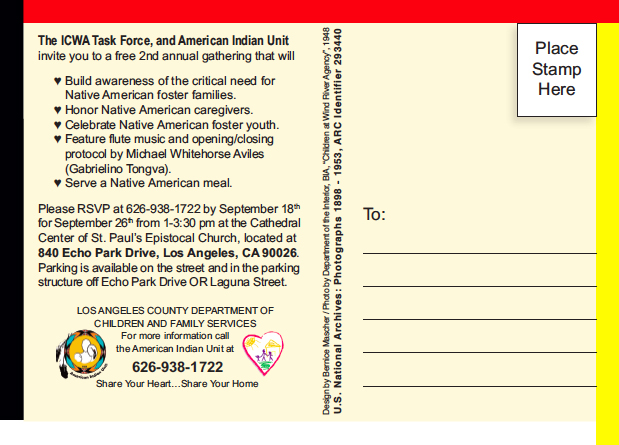
Los Angeles “Tiospaye” Native Foster Family Recruitment Event

The Los Angeles County Department of Children and Family Services American Indian Unit is sponsoring its 2nd Annual Native foster family/parent recruitment event. This event is an attempt to be proactive in searching to find native homes in an urban environment for those native children in foster/adoptive care.

***SAVE THE DATE: September 26,2015***
“TIOSPAYE”: Los Angeles Foster Family Recruitment Event
Sponsored by: The Los Angeles County Department of Children and Family Services American Indian Unit
RSVP by September 18, 2015 at 626-938-1722
Place: Cathedral Center of St. Paul’s Episcopal Church (ECHO PARK)
Address: 840 Echo Park Ave, Los Angeles, CA 90026

Sept_26_2015 LA foster recruitment Back Program

Sept_26_2015 LA foster recruitment Front