Minnesota Court of Appeals Decides ICWA Notice Appeal

Here is the unpublished opinion in In re Welfare of Child A.N.T. (Minn. App.):

In re ANT

An excerpt:

The district court properly inquired into whether ICWA applies here. After extensive testimony, the district court’s reopening of the ICWA issue, and dozens of tribal notifications, including one to the United States Bureau of Indian Affairs, no evidence was located to suggest that daughter is eligible for membership in any Indian tribe. Mother, through her mother, provided scant information pertaining only to practices and purported Native American heritage, but nothing concerning tribal membership or eligibility for membership. OCCS, despite extensive and documented efforts, was unable to verify that daughter is an Indian Child as defined by ICWA.
We have held that a district court does not err when it declines to apply ICWA where “there is no evidence that the children are eligible for membership in any Indian tribe.” In re Welfare of Children of M.L.A., 730 N.W.2d 54, 59 (Minn.App.2007). Further, in In re Matter of Baby Boy Doe, 849 P.2d 925, 931 (Idaho 1993), cert. denied 510 U.S. 860, 114 S.Ct. 173 (1993), the Idaho Supreme Court held that “[t]he party asserting the applicability of ICWA has the burden of producing the necessary evidence for the trial court to make” the determination of whether ICWA applies.
Mother failed to meet her burden of production concerning the application of ICWA. Therefore, the district court did not err in concluding that ICWA does not apply here.

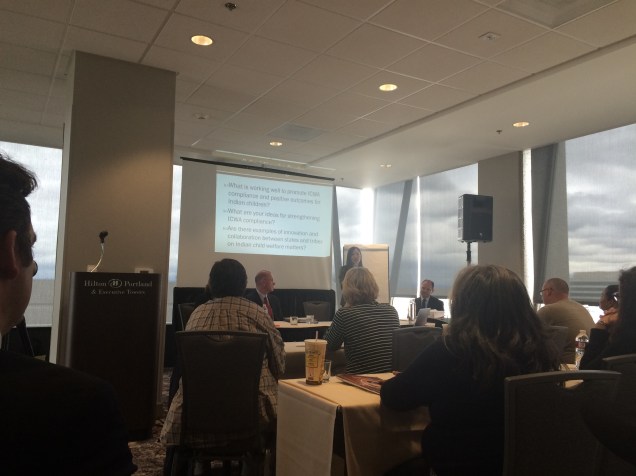
NICWA Federal Listening Session on ICWA Compliance

Sarah Kastelic (NICWA), Sam Hirsch (DOJ), JooYeun Chang (Children’s Bureau), and Kevin Washburn (Interior).


NICWA Presentation on Transitions for Foster Youth

Adrea Korthase (ILPC Alum, Oregon DHS) and the incomparable Nadja Jones (Oregon DHS) on ways to provide seamless transitions to youth aging out of foster care. 


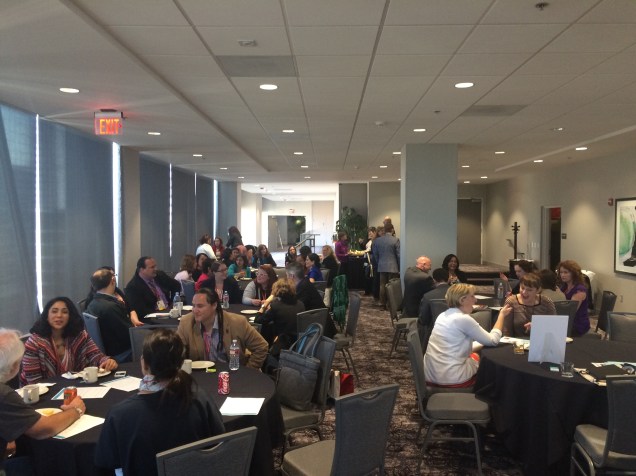
NICWA Conference Presentation and Legal Professionals Reception 

Kate Fort and Victoria Sweet (ILPC Alum, NCJFCJ) on tribal strategies in state ICWA cases.  

The Legal Professionals Reception co-hosted by ILPC, TICA, and Tilden McCoy & Dilweg. 


Florida Law Review: Prof. Atwood’s Response to Prof. Berger’s Adoptive Couple Article

Prof. Berger’s article here.

Prof. Atwood’s response here.

Professor Berger, however, does not address another danger inherent in the Court’s § 1915 holding. If applied to involuntary child welfare proceedings, the holding threatens to seriously undermine the effectiveness of ICWA. In a recent decision from the Alaska Supreme Court, the risks inherent in Adoptive Couple’s broad § 1915 holding were demonstrated. In Native Village of Tununak v. State Department of Health & Social Services, the court applied Justice Alito’s reasoning to a case that arose not as a private adoption but within the child welfare system. 13 The court held that the proposed adoption of a Native child by his Anglo foster parents could go forward without the necessary finding of good cause under ICWA because no other formal adoption petition had been filed.14 In that case the child’s maternal grandmother had taken only informal steps to request that she be allowed to adopt but had not filed a formal petition.15 As noted by the dissent, in rural Alaska where villages are remote and legal representation is nonexistent, the requirement that a formal adoption petition be filed may mean that potential ICWA placements will go undiscovered.16

Other articles and cases related to Adoptive Couple are available here.

Developments in Alaska ICWA Case, Native Village of Tununak v. State of Alaska

State’s (AG) Response to Tribe’s Pet for Rehearing

Earlier briefs on the rehearing petition are here.

The Alaska executive branch published emergency regulations addressing formal petitions for adoptions in cases involving Indian children: Emergency Regulations 7 AAC 54.600

Here is the draft state bill sent to the Legislature by the Governor: Draft Bill

These emergency regulations allow for a simple request by a relative, tribal member or other Indian family at any court hearing, or a request by the same conveyed to the department by phone, mail, fax, email or in person, or by the request of the child’s tribe on behalf of a relative or tribal member to constitute a proxy for a formal petition for adoption.

In addition, the Governor is holding a press conference on this today (10:30am/2:30pm EDT) :

MEDIA ADVISORY

Contact:

Grace Jang, Press Secretary – (907) 465-3976

Katie Marquette, Deputy Press Secretary – (907) 465-5801

Governor Walker to Hold News Conference Tomorrow

WHO: Governor Bill Walker, Lt. Governor Byron Mallott, DHSS Commissioner Val Davidson and Alaska Federation of Natives President Julie Kitka

WHAT: News conference to discuss Indian Child Welfare Act-related emergency regulations

WHEN: Thursday, April 16, 2015, 10:30 a.m. to 11:00 a.m.

WHERE: Governor’s Cabinet Room, Capitol Building, Juneau

TELECONFERENCE NUMBER: (800) 755-6634

LIVESTREAM: gov.alaska.gov/livestream<http://gov.alaska.gov/Walker/multimedia/livestream.html>

###

Briefs in California Supreme Court ICWA Notice Case

Lower court decision

Case Summary:

Petition for review after the Court of Appeal affirmed an order terminating parental rights. This case presents the following issue: Does a parent’s failure to appeal from a juvenile court order finding that notice under the Indian Child Welfare Act was unnecessary preclude the parent from subsequently challenging that finding more than a year later in the course of appealing an order terminating parental rights?

Petitioner/Mother’s Brief

Respondent LA County DCFS

United States Amicus Brief

Stephen Pevar on the Oglala Sioux v. Van Hunnik Victory

Here.

All of the cards were stacked against the parents in these proceedings and the parents lost 100 percent of the time.

That’s right, you didn’t misread that. The state won 100 percent of the time, which isn’t surprising given that only the state was allowed to present any evidence and all of that evidence was submitted secretly to the judge. But two South Dakota Indian tribes — the Oglala Sioux Tribe and the Rosebud Sioux Tribe — and three Indian parents fought back.

California Unpublished Stipulated Complete Lack of Notice Case

Here. The Department and trial court ignored federal law, state law, the new Guidelines, and the proposed Regulations:

In September 2013, paternal grandmother indicated that the child may have ancestry in the Soboba Indian Tribe. There is no indication of notice to the Soboba Indian Tribe in the record. Regardless, at the detention hearing held September 18, 2013, the juvenile court found that ICWA did not apply.
The court terminated father’s parental rights as to L.C. at the Welfare and Institutions Code section 366.26 hearing.

Fourth District, Riverside County.

Kevin Maillard’s Atlantic Article on Putative Father Registries

Here.

Since the 1970s, 33 states have created Putative Father Registries, designed as a way to link unmarried men to the mother of their child. States expect men to report—voluntarily and honestly—information about all their sexual partners; otherwise, they forfeit their right to be contacted if a partner pursues adoption. The registry is not a petition for custody or a determination of paternity—only a right to notification. Without registry, the wishes of the biological father are irrelevant.