legal history
Ezra Rosser on Hawaii Housing Authority v. Midkiff
Ezra Rosser has published “Progress and the Taking of Indigenous Land” in the Ohio State Law Journal.
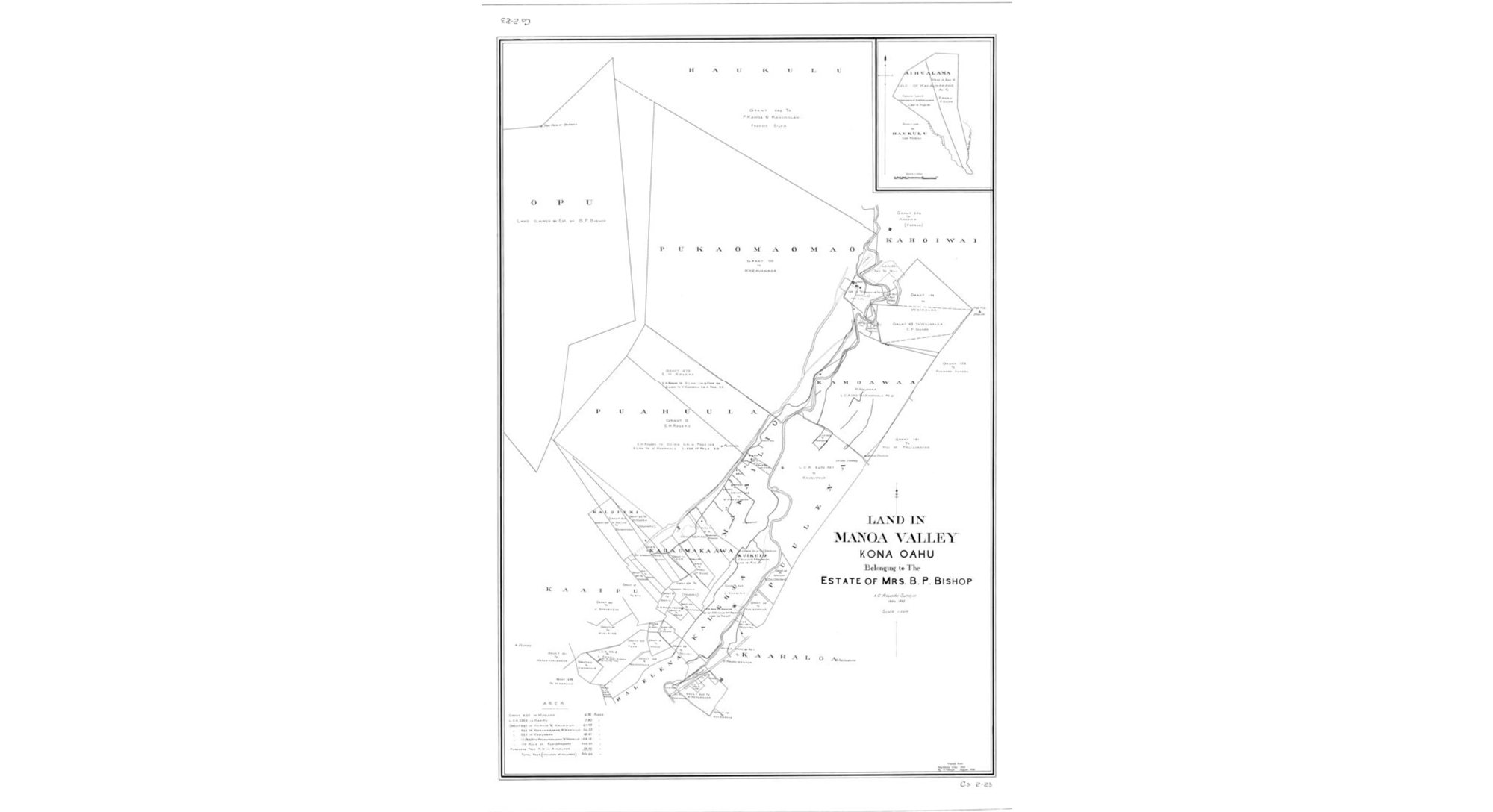
Here is the abstract and some images supplied by Ezra:
The taking of Indigenous land in furtherance of other societal goals is so ubiquitous and so fundamental to the American project that sometimes acts of dispossession are not even recognized as such. This Article argues that the generally accepted understanding of Hawaii Housing Authority v. Midkiff, a key case of the American takings law canon, is wrong because it overlooks Native Hawaiian claims to the land taken. Hawai‘i’s Land Reform Act allowed tenants a right to purchase land over the objections of the owner of the underlying property and in Midkiff the U.S. Supreme Court said that states had the right to use their eminent domain authority in such a way. The common understanding of the case is that it is a progressive victory, an example of how government can fight back against inequality and the power of large landowners. But beneath the surface, this Article argues, the case is really about dispossession. By showing how land reform predictably worked to transfer Indigenous land to upper class, relatively wealthy tenants, the Article situates Midkiff within a long history of taking Native land in order to accomplish progressive ends. By seeing Midkiff for what it is—a judicially authorized taking of Indigenous land—the significance of the case within the Property and Indian Law cannons can be more fully appreciated. Indigenous peoples are often forced to pay—in the form of diminishment of their property rights—for progressive victories, with their losses swept under the rug by courts and scholars alike. The Midkiff decision is part of a pattern of treating the property rights of Indigenous peoples as impediments to progress.

The Attack on Talton v. Mayes During the Navajo Peyote Ban Case
Arthur Lazarus, the general counsel of the Association on American Indian Affairs (and the drafter of the original bill that became the Indian Child Welfare Act), filed amicus briefs in a suit by a Navajo tribal citizen challenging the power of the Secretary of the Interior to approve the Navajo Tribal Council’s ban on peyote use by the Native America Church. The case was filed as Oliver v. Seaton (D.D.C.):

The challenge really was against the Navajo ban, but Mr. Oliver challenged the Secretary’s approval of the ban, alleging that the approval violated the Exercise Clause. An important aspect of the AAIA’s amicus brief was that Talton v. Mayes, which seemingly held the federal Constitution did not regulate tribal power, did not govern the violation of “fundamental rights.”

There’s an interesting effort to compare tribal nations to the American territories here. We know from cases as recent as Puerto Rico v. Sanchez-Valle regarding Puerto Rico’s sovereignty that tribal sovereignty is more robust that Lazarus credits here. Note the conclusion, invoking the axiom that the “Constitution . . . follows the flag,” usually invoked in war crimes commission law like in the Guantanamo Bay cases.

Needless to say, the Navajo Nation was upset that the AAIA threw its support behind the Native American Church and not the tribe.

Mr. Oliver ultimately did not prevail. See Oliver v. Udall, 306 F.2d 819 (D.C. Cir. 1962).
“Just Fine with Us”

Postscript — Frank Kelley was wrong.
Yale Law Journal Comment on the Law of Nations Origin to the Marshall Trilogy
Eric Eisner has published “The Law-of-Nations Origins of the Marshall Trilogy” in the Yale Law Journal. PDF
Here is the abstract:
Federal Indian law is sometimes seen as a purely domestic part of American law, but its origins are in the law of nations. The Marshall Trilogy—Johnson v. M’Intosh, Cherokee Nation v. Georgia, and Worcester v. Georgia, three Supreme Court decisions authored by Chief Justice Marshall that are foundational for American federal Indian law—relied on law-of-nations sources. In particular, The Law of Nations, an eighteenth-century treatise by Emer de Vattel, provided a central influence on Marshall’s opinion in Worcester. In early national American legal thought, Vattel was a leading authority on the law governing the rights and obligations subsisting among nations. Recognizing the important role that the law of nations played in the foundations of federal Indian law under-scores the deep roots of tribal sovereignty in American law and clarifies current doctrinal disputes.
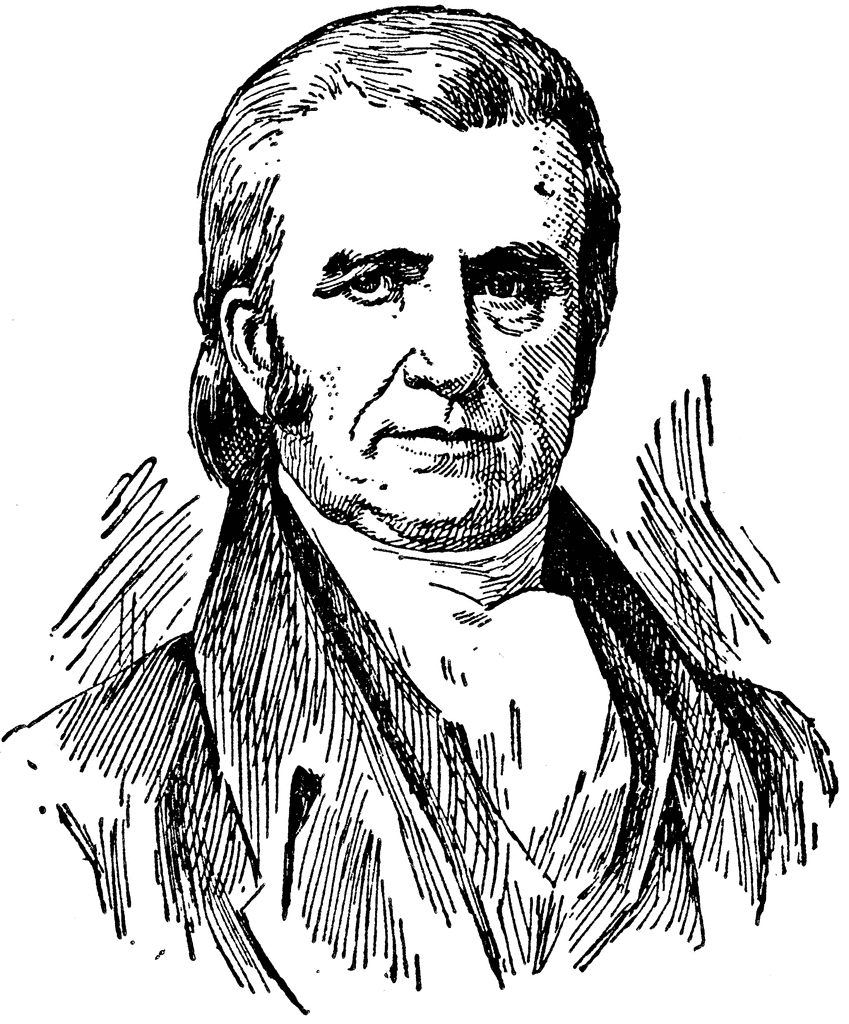
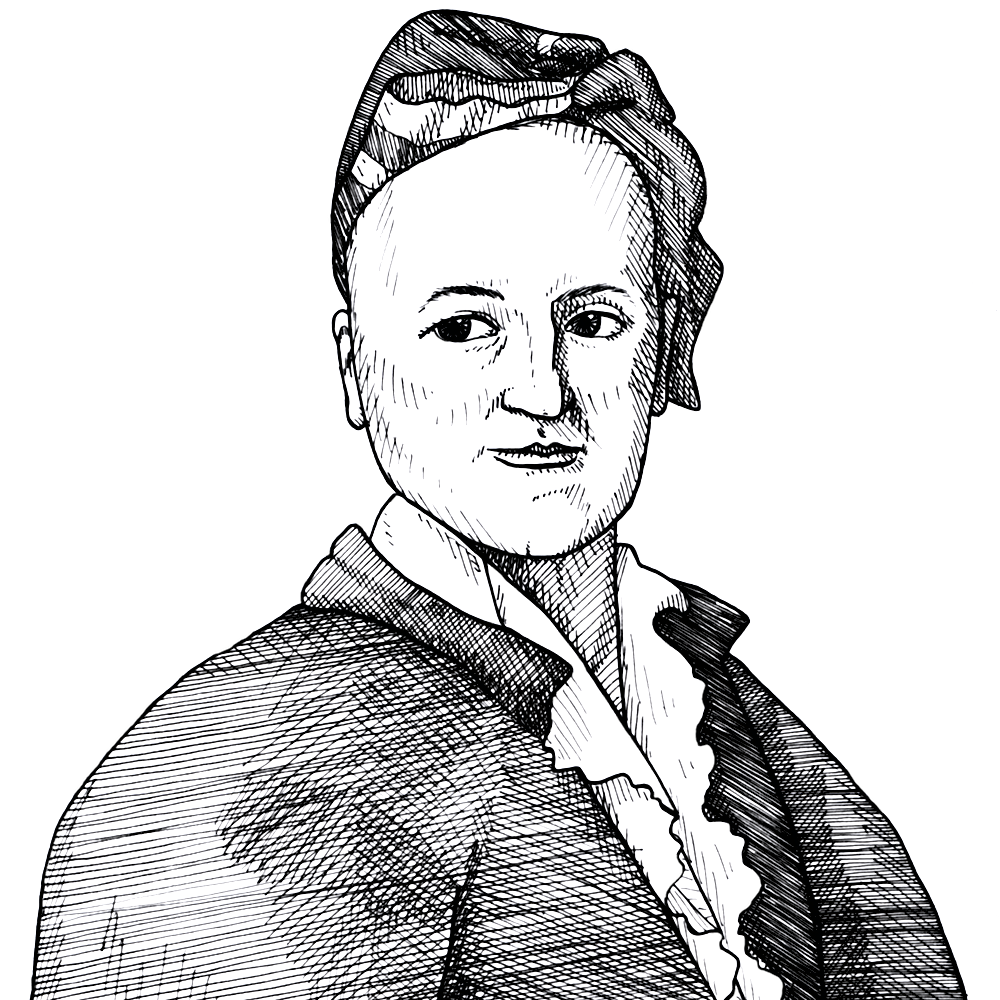
Who would win in a fight?
Charles Wilkinson on the History of the Boldt Decision
Charles F. Wilkinson and the University of Washington Press have published “Treaty Justice: The Northwest Tribes, the Boldt Decision, and the Recognition of Fishing Rights.”
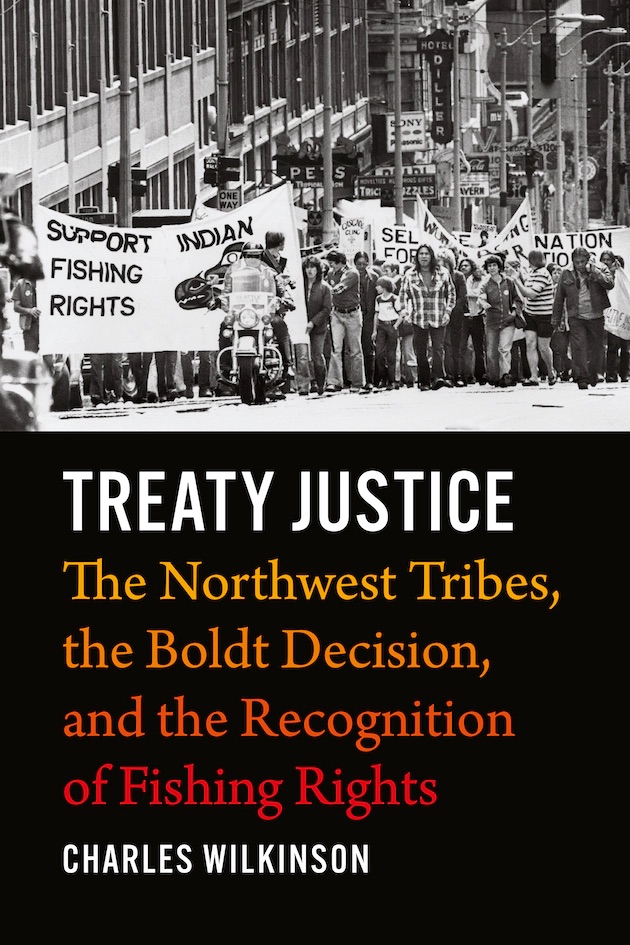
Blurb:
In 1974, Judge George Boldt issued a ruling that affirmed the fishing rights and tribal sovereignty of Native nations in Washington State. The Boldt Decision transformed Indigenous law and resource management across the United States and beyond. Like Brown v. Board of Education, the case also brought about far-reaching societal changes, reinforcing tribal sovereignty and remedying decades of injustice.
Eminent legal historian and tribal advocate Charles Wilkinson tells the dramatic story of the Boldt Decision against the backdrop of salmon’s central place in the cultures and economies of the Pacific Northwest. In the 1960s, Native people reasserted their fishing rights as delineated in nineteenth-century treaties. In response, state officials worked with non-Indian commercial and sport fishing interests to forcefully—and often violently—oppose Native actions. These “fish wars” spurred twenty tribes and the US government to file suit in federal court. Moved by the testimony of tribal leaders and other experts, Boldt pointedly waited until Lincoln’s birthday to hand down a decision recognizing the tribes’ right to half of the state’s fish. The case’s long aftermath led from the Supreme Court’s affirmation of Boldt’s opinion to collaborative management of the harvest of salmon and other marine resources.
Expert and compelling, Treaty Justice weaves personalities and local detail into the definitive account of one of the twentieth century’s most important civil rights cases.
From the Archives — Osage Murders, 1926
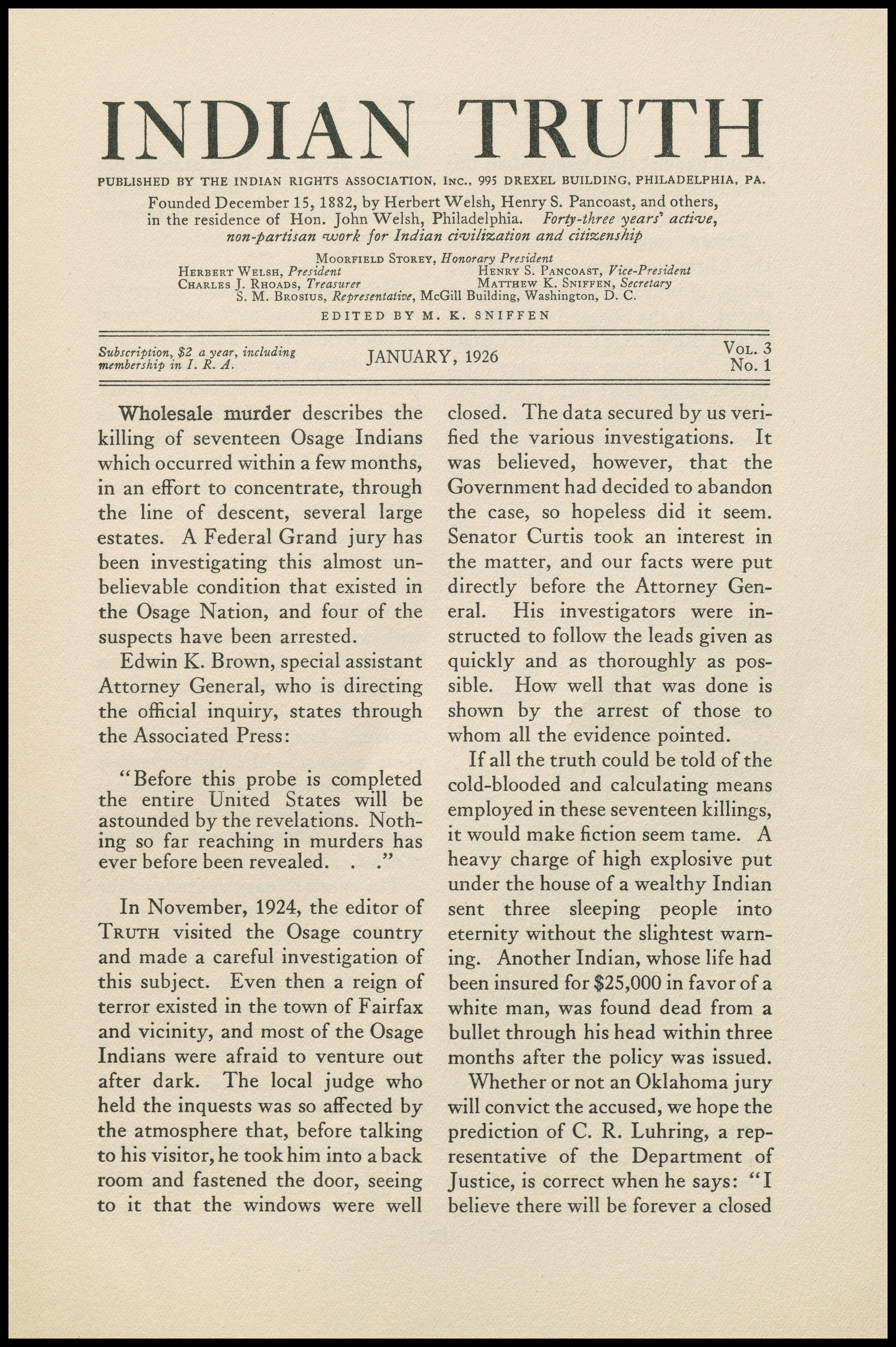


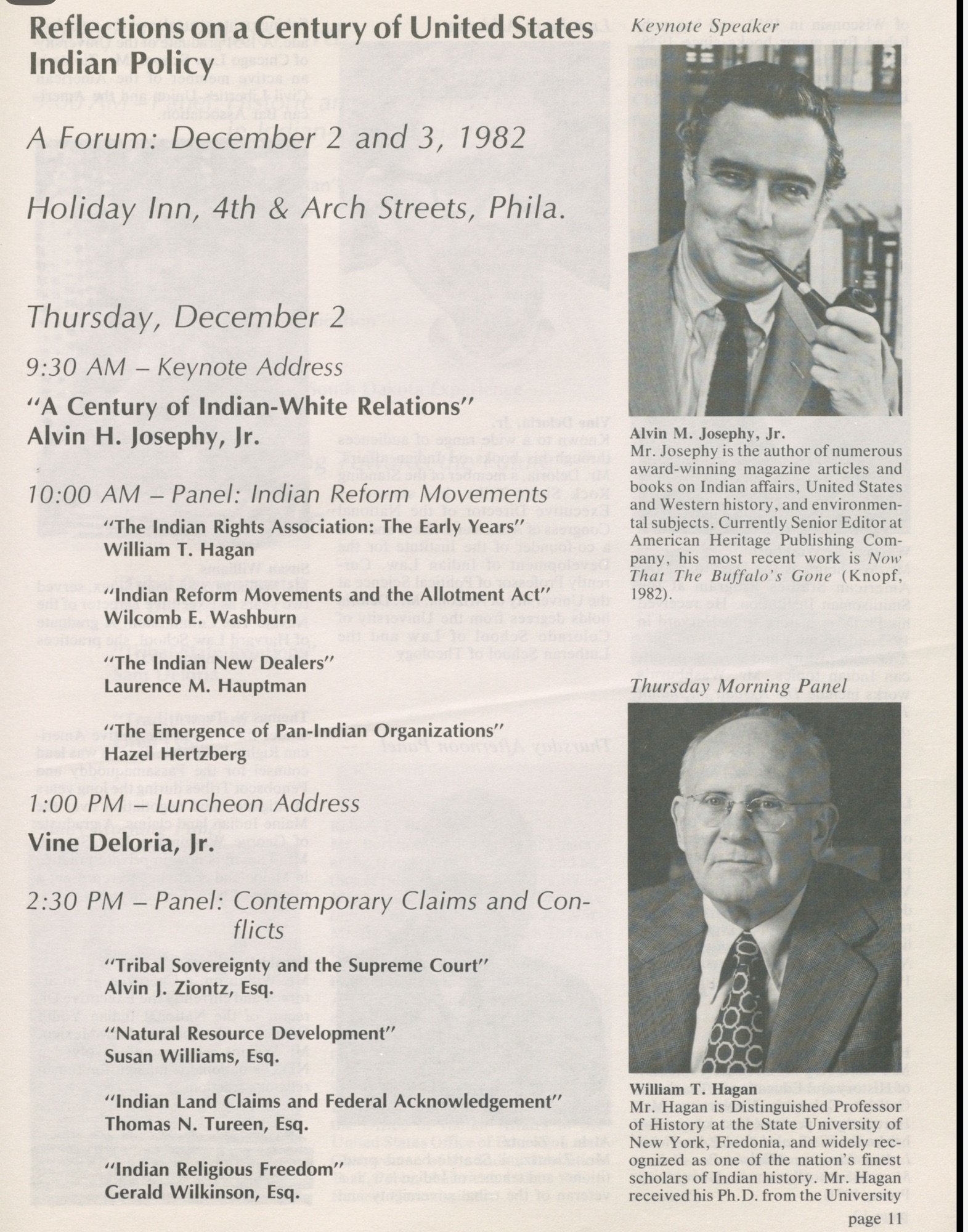
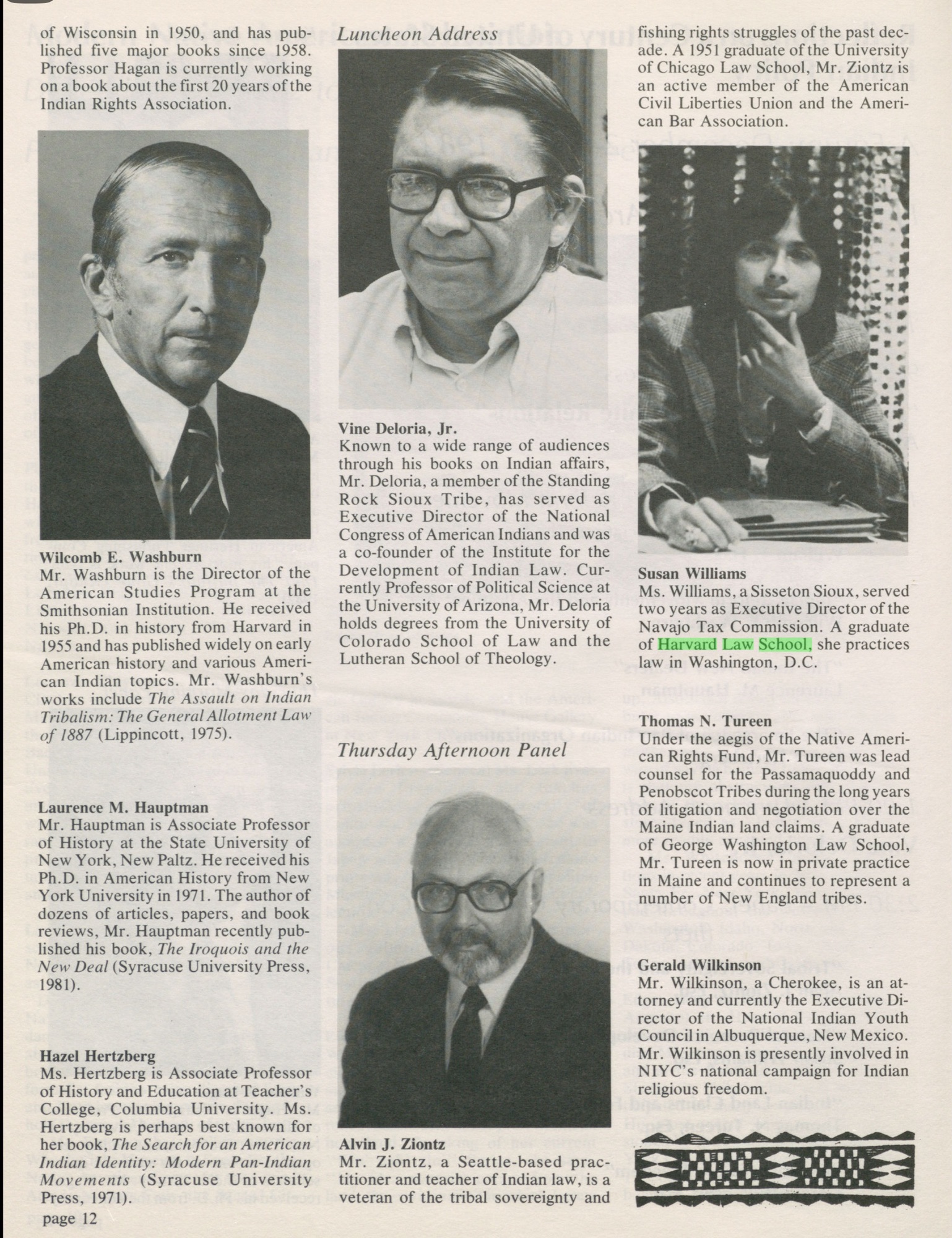
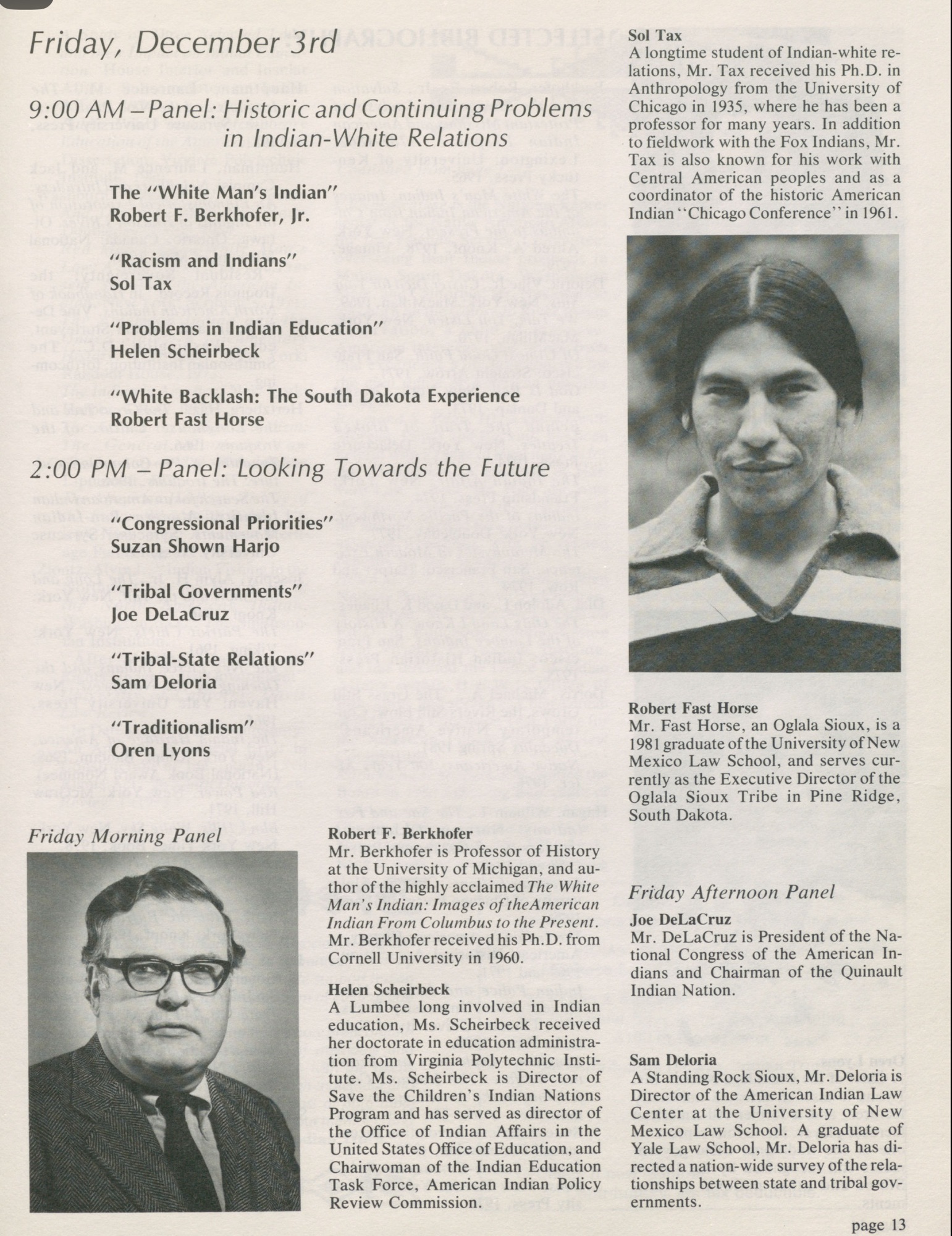
Blast from Past — 1982 Conference on 100th Anniversary of Indian Rights Association [Indian Truth, Dec. 1982]

Oklahoma City Federal Courthouse to Host CLE Seminar and Exhibit on Osage Reign of Terror
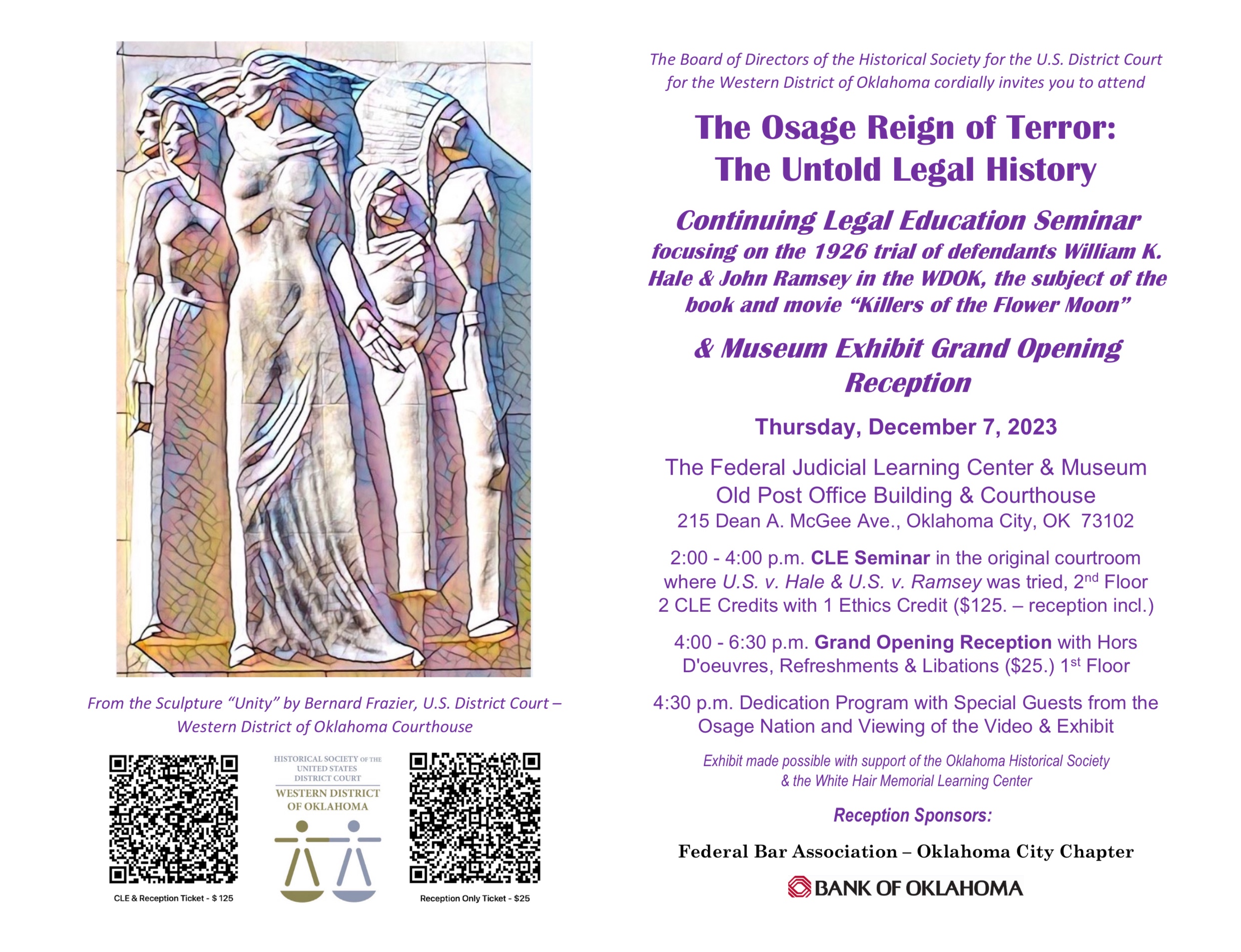
From the court:
The federal murder trials of two men charged with killing Osage Indians in the early 1920’s will be featured in a seminar and exhibit opening December 7 at the Old U.S. Post Office Building and Courthouse. Presented by the Historical Society of the U.S. District Court for the Western District of Oklahoma, “The Osage Reign of Terror: The Untold Legal History” tracksthe murders of wealthy Osage tribal members, the arrival of agents with the Bureau of Investigation who investigated, and the Federal Prosecutors who charged William K. Hale and John Ramsey with a number of the murders. The federal trials that followed resulted in a landmark Supreme Court ruling, charges of witness and juror tampering, and high courtroom drama. The events took place in Fairfax, Pawhuska, Guthrie and Oklahoma City and are featured in a book and movie of the same name, “Killers of the Flower Moon.”
A reception hosted by the Historical Society and featuring a documentary film about the trials as well as Federal Court and Osage dignitaries will be held on December 7 at 4 pm in the Federal Judicial Learning Center and Museum. The event is co-sponsored by the Bank of Oklahoma and The Federal Bar Association – Oklahoma City Chapter. The exhibit is open to the public beginning December 8, 2023, through October 2024.
Email Leigh Dudley, Executive Director at leigh@fjlcm.org or Arvo Mikkanen arvo.mikkanen@usdoj.gov for more information. Contact via text at 405/697-6117 or 405/420-9912.
Tanner Allread on SCOTUS’ Improper Use of Indian Removal Era Analysis in Modern Day Indian Law Cases
W. Tanner Allread has published “The Specter of Indian Removal: The Persistence of State Supremacy Arguments in Federal Indian Law” in the Columbia Law Review. PDF
Abstract:
In the 2022 case of Oklahoma v. Castro-Huerta, the Supreme Court departed from one of the foundational cases in federal Indian law, Worcester v. Georgia. Chief Justice John Marshall’s 1832 opinion had dismissed state power over Indian Country. But in Castro-Huerta, the Court took precisely the kind of arguments about state power that Chief Justice Marshall rejected in Worcester and turned them into the law of the land—without any recognition of the arguments’ Indian Removal–era origins.
This Article corrects the Court’s oversight. Relying on rarely utilized archival sources, it provides a historical narrative of the development of what the Article terms the theory of state supremacy, first articulated by the southern state legislatures in the Removal Era to justify state power over Native nations and eradicate Native sovereignty. Even though Worcester rejected this theory, Supreme Court Justices and state litigants have continued to invoke its tenets in Indian law cases from the late nineteenth century to the present. Castro-Huerta, then, is just the latest and most egregious example. And the decision’s use of Removal-era arguments revives the specter of Indian Removal in the present day.
This Article reveals that the continued use of state supremacy arguments defies constitutional law and federal Indian affairs policy, produces an inaccurate history of Native nations and federal Indian law, and perpetuates the racism and violence that characterized the Removal Era. Ultimately, this Article seeks to counter future attacks on tribal sovereignty and combat the broader revival of long-rejected federalism arguments.

 Turtle Talk
You must be logged in to post a comment.