Richard Barnes on the Indian Law Jurisprudence of Justices Marshall and O’Connor

In short, “incoherence.”

The paper is titled, “Marshall and O’Connor: Categorical First Justices and Their Impact on Federal Indian Law.” The paper is available on BEPress. Here is the abstract:

Thurgood Marshall was the first African-American appointed to the United States Supreme Court. Sandra Day O’Connor was the first woman appointed. As firsts in their category their historical role is assured, but their legacy is broader. This Article examines one piece of their legacies: Is it plausible to find some of their character as ‘Firsts’ in their opinions for the Court in Indian cases? Specifically can we find a legacy of categorical pioneering in the Justices’ treatment of American Indians as another category of people underrepresented on the Court?

My working hypothesis was that the sympathy some might expect from one minority group to another would not be found. As expected predictions of outcome are shaky, but the examination below shows something at least as valuable. Many of the case results are foreshadowed by the structure of the Justices’ opinions. In addition, the structural approach chosen by each justice says more about a wider agenda for both of these important historical figures. In short the history and richness that is Indian Law added to the richness of the roles these justices played in Court life and Supreme Court jurisprudence.

Marshall’s and O’Connor’s opinions in the complex and sui generis area of Federal Indian Law beat a path through Indian cases that says much about their political views, but little about the foundations of Indian law itself. Reading their bodies of opinions and comparing their works tells us something about their sympathies, but does not explain why Indian law should be treated as a board game for political strategies. The Court’s treatment of Indian law during the periods these two first-justices served will be shown to be a pivotal time on the Court yet it becomes apparent in looking at their opinions that neither is truly engaged in the rich and intricate world of Indian law. Something else is at work.

After a description of the exceptionalism created by the Marshall trilogy this Article lays out a metric for examining Indian law opinions. Using this metric based on Indian Law exceptionalism the Article evaluates the work of the justices to see if a pattern of favoritism emerges. Along the way we will find that the four doctrines give us a useful way to test the Court’s work in any case decided since the Marshall trilogy of the early 19th century.

Part of what is offered here is a way to judge, systematically, the truth of a claim that the ‘decision was a victory for Indians.’ The greater part here is directed to knowing when the Court is manipulating its doctrines to achieve a result. What will be demonstrated below is that Marshall was not only more true to the tribes than O’Connor, but more true to the doctrines. But it must be added that Justice O’Connor seemed to grow into the doctrine while Justice Marshall seemed to lose sight of it.
New/Old Indian Law Papers on SSRN

Normally, we don’t highlight papers made available on SSRN if they are not new products, but today we make an exception to highlight a couple papers.

First, Patty Ferguson-Bohnee’s paper, “Testimony before the Senate Committee on Indian Affairs: Oversight Hearing on Fixing the Federal Acknowledgment Process,” is now available on SSRN. This paper includes a nice background on the acknowledgement process.

Second, Nathan Goetting’s paper, “The Marshall Trilogy and the Constitutional Dehumanization of American Indians,” which was originally published in the NLG’s Guild Notes, is now available on SSRN.

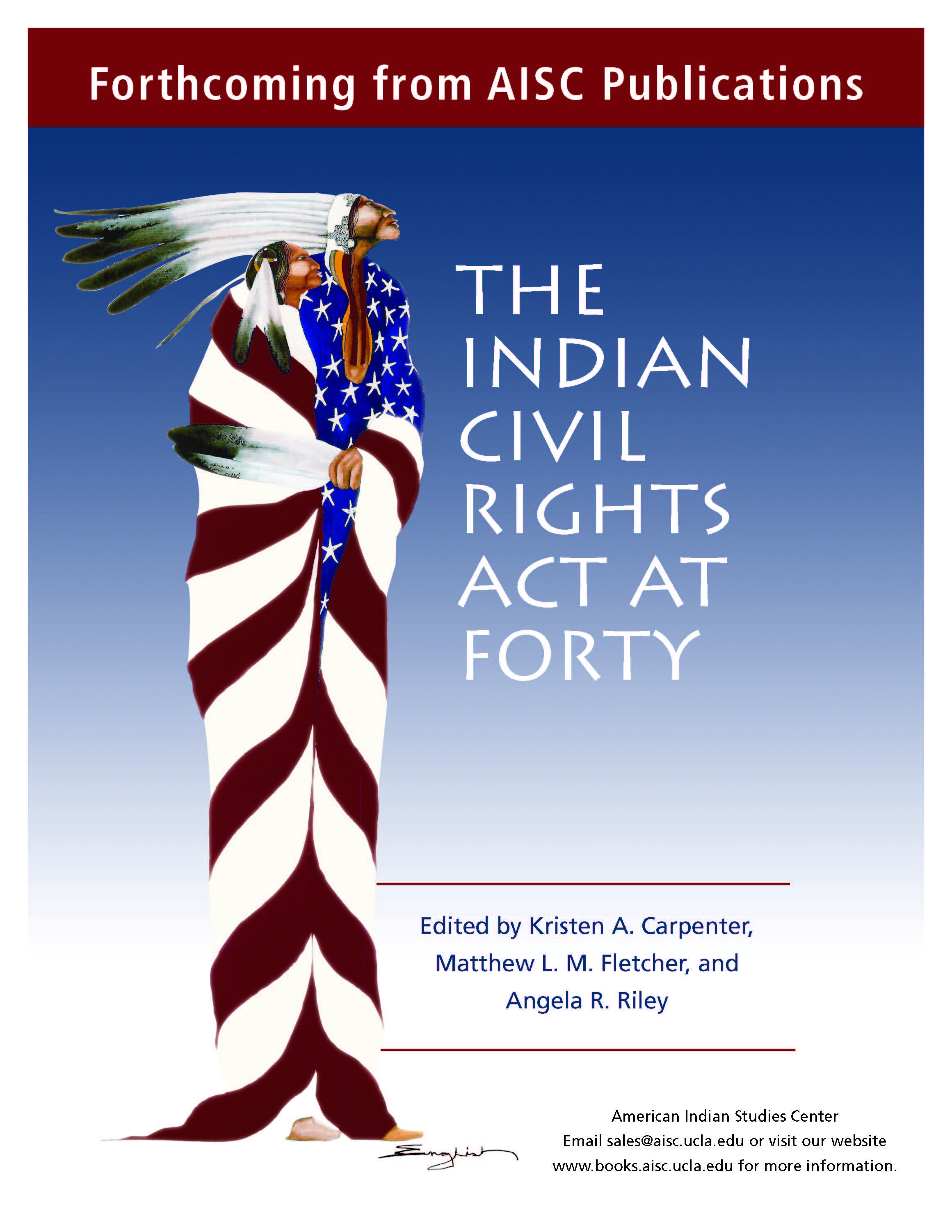
Announcing Forthcoming Book on ICRA: “The Indian Civil Rights Act at Forty”

Continue reading

Iowa Law Review Note on Possible Carcieri Fixes

Amanda Hettler has published her note “Beyond a Carcieri Fix: The Need for Broader Reform of the Land-Into-Trust Process of the Indian Reorganization Act of 1934” in the Iowa Law Review.

Here is the abstract:

: In Carcieri v. Salazar, the Supreme Court held that under the Indian Reorganization Act of 1934 the Secretary of the Interior can take land into trust only for those tribes that were federally recognized prior to 1934. In light of this decision, many tribes and leaders called for a legislative Carcieri fix. While a fix is necessary, this decision has provided lawmakers with a historic opportunity to reform both the statutory and regulatory frameworks for the land-into-trust program. The current process is inadequate and often leaves state and local governments with little voice in the process. It is often administered inefficiently, harming tribal interests and state and local governmental interests. Congress can and should provide a balanced fix that not only remedies the Carcieri issue, but also reforms the regulations governing this process and sets out new purposes and goals for this program.

Cami Fraser on Advising Parents in ICWA Cases

Cami Fraser has published an outstanding paper in the Spring 2011 edition of the Michigan Child Welfare Journal titled “Should this ICWA case be Transferred to Tribal Court? Issues for Parents’ Attorneys to Consider and Discuss with their Clients.” It appears here on page 2.

Commentary on Richard Pomp’s “The Unfulfilled Promise of the Indian Commerce Clause and State Taxation”

A few words on probably the most important recent law review article in Indian law — Richard D. Pomp’s The Unfulfilled Promise of the Indian Commerce Clause and State Taxation, 63 Tax Lawyer 897 (2010).

In The Brethren, the 1979 book that opened the door the mysteries of the interior of the Supreme Court (and served as a source of deep embarrassment to several Justices), Bob Woodward and Scott Armstrong found that the Justices of the 1970s, unusually hospitable to the claims of Indian tribes given the history of American Indian law and policy, considered being assigned to draft the majority opinion in an Indian case a sign of disrespect. No Justice wanted those assignments. H.W. Perry, Jr.’s Deciding to Decide (1991), which was the first book detailing the insides of the Court after The Brethren, confirmed that assignments to write majority opinions in Indian cases and tax cases – “the crud” – tended to go to the junior Justices. For example, Chief Justice Burger, according to Woodward and Armstrong, assigned then-Justice Rehnquist an Indian tax case (Moe v. Confederated Salish and Kootenai Tribes, 426 U.S. 463 (1976)) as punishment for a 1975 Supreme Court Christmas party joke gone wrong.

If Indian cases are bad, and tax cases are bad, then Indian tax cases must be the worst.

Or are they?

Richard Pomp’s entertaining paper, The Unfulfilled Promise of the Indian Commerce Clause and State Taxation, blows the lid off of the myth that Indian tax cases are boring.

It turns out that one of the most exciting things about the Indian Commerce Clause is the history of the Clause, which generated more debate at the Constitutional Convention than the Interstate and Foreign Commerce Clauses combined. For some reason (perhaps because Pomp’s article hadn’t yet been written), the Supreme Court has simply refused to engage at all on the “original meaning” of the Indian Commerce Clause. The Court had a chance to in Seminole Tribe v. Florida, 517 U.S. 44 (1996), but Chief Justice Rehnquist just ignored the question by concluding that the three Commerce Clauses were the same for Eleventh Amendment purposes. But maybe since the Supreme Court frequently enters into the thicket of early American history to interpret many Constitutional provisions, the history of the Indian Commerce Clause is worth a second look, as Pomp does here.

Continue reading

Penn. Law Review Note on Judicial Abolition of Indian Slavery in Virginia

Here is a pdf link to the article, which is titled, “Making Indians “White”: The Judicial Abolition of Native Slavery in Revolutionary Virginia and its Racial Legacy.” Also available on SSRN.

An excerpt:

In 1772, George Mason, later famous as the “Father of the Bill of Rights,” represented a slave named Robin and eleven other enslaved plaintiffs in the General Court of Virginia, the colony’s highest court. The slaves claimed that maternal descent from an American Indian made their enslavement illegal, and Mason marshaled arguments from natural law and statutory history to support that contention. In a terse one-paragraph opinion typical of the era, the court agreed, freeing the plaintiffs and ordering their former master to pay them nominal damages.

Freedom suits were common in colonial Virginia. Although defined as property for almost all legal purposes and denied rights of citizenship, slaves could allege illegal enslavement and sue for their freedom. Courts recognized such claims throughout the slaveholding South from slavery’s seventeenth-century beginnings onward; these suits offered one of the few routes to manumission in early America.

The ordinary posture of the Robin v. Hardaway case, though, belied its extraordinary result. The court’s decision marked a watershed in the legal history of Virginian slavery; it was the first recorded holding of an Anglo-American court that maternal descent from an American Indian alone established the right to freedom. This outcome was remarkable in the context of early America, where, despite present-day conceptions that all slaves were Africans, Indian slavery was ubiquitous. Indian slaves could be found in all thirteen mainland British colonies in 1772, as well as in the French and Spanish colonies of North America. In Virginia alone, thousands of descendants of enslaved Indians toiled alongside African slaves on plantations. Robin v. Hardaway repudiated this history and deemed the previously common institution illegal in all but a few circumstances, inaugurating a line of cases that culminated in 1806. In the end, Virginia courts concluded that enslaved descendants of Native Americans were “prima facie free,” judicially abolishing Indian slavery in Virginia. This precedent spread: throughout the antebellum period, courts in Connecticut, Louisiana, Missouri, New Jersey, South Carolina, and Tennessee all grappled with Virginia’s decisions and debated whether maternal descent from American Indians was sufficient to establish freedom.

Fordham Law Review Note on Seneca-New York Tax Disputes

Here is the pdf of the article, titled “A Tale of Three Sovereigns: The Nebulous Boundaries of the Federal Government, New York State, and the Seneca Nation of Indians Concerning State Taxation of Indian Reservation Cigarette Sales to Non-Indians.”

And the abstract:

This Note examines the conflict between New York State and the Seneca Nation of Indians regarding the taxation of cigarette sales to non-Indians on Indian reservations.  In 1994, the United States Supreme Court found New York’s taxation scheme facially permissible without providing boundaries or guidance for the state’s subsequent enforcement.  Seventeen years after the Court’s decision, no taxes have been collected on these sales.

The issue involves conflicting spheres of federal, state, and tribal control. From 1965 to 1994, the Supreme Court balanced these competing interests, creating precedent that has failed to provide a definitive solution to this crisis. The Note examines the background of these decisions, the history of the treaties between the Seneca tribe and the United States, and the shift in federal Indian policy towards promoting a government-to-government relationship between the United States government and Indian tribes.

Lastly, this Note proposes a solution modeled on the example of Washington State.  Facing a crisis analogous to that of New York, Washington created a lasting solution to its taxation crisis by forging a relationship of trust between the state, its agencies, and the Indian tribes.  This Note advocates that New York follow the same path and create cigarette tax compacts between New York and the Indian tribes.

SCOTUSblog Highlights New Scholarship on the Certiorari Process

From SCOTUSblog (Amanda Frost):

The Supreme Court today has nearly complete discretion over its docket—too much discretion, some argue.  In a world in which the Court grants only about one percent of the 8000 or so petitions it receives each year, the process of “deciding to decide” is almost as important as the Court’s rulings on the merits, and yet the public knows almost nothing about how such decisions are made.

In a forthcoming article in the University of Pennsylvania Law Review, Professor Kathryn Watts argues in favor of incorporating principles of administrative law into the Court’s case selection process.  She notes that congressional delegations of power to agencies are constrained by public participation, reason-giving, transparency, and the agency’s political accountability, but that none of these factors limit the Supreme Court when selecting cases.

To improve the process, Professor Watts suggests that the Justices be required to publicly disclose their votes at the cert stage.  Doing so might inspire the Justices to explain their decisions in important cases, in part to avoid the impression that the vote indicates the Justices’ views on the merits.  Furthermore, such a rule could lead the Justices to supervise more closely the work of their law clerks, whom many view as exercising too much control over case selection.  Finally, vote disclosure might give the general public, as well as practitioners, a better sense of how the Court makes these all-important decisions.

In a similar vein, Professor Watts suggests that cert. petitions themselves be made publicly available on the Supreme Court’s website.  She hopes that this would lead to more participation by a broader array of amici at the cert. stage, which would better inform the Court’s case selection process.

Finally, Professor Watts adds her voice to that of Professor Amanda Tyler in calling for increased use of the certification process.  Although the law currently allows the federal courts of appeals to certify questions of law to the Supreme Court, the practice is rare.  As both Professors Watts and Tyler argue, the benefit of certification is that it gives the lower courts a role to play in choosing issues for Supreme Court review, adding a fresh perspective to what has become an insular and secretive process.

Fletcher & Vicaire: “Indian Wars: Old and New”

Matthew Fletcher and Peter Vicaire have posted “Indian Wars: Old and New” on SSRN (download here). This is a paper prepared for the Journal of Gender, Race, and Justice’s 15th Anniversary symposium, “War On … The Fallout of Declaring War on Social Issues.”

Here is the abstract:

This short paper analyzes American history from the modern “wars” on poverty, drugs, and terror from the perspective of American Indians and Indian tribes. These domestic “wars” are aptly named (it turns out), as the United States often blindly pursues broad policy goals without input from tribal interests, and without consideration to the impacts on Indians and tribes. With the possible exception of the “war on poverty,” these domestic wars sweep aside tribal rights, rights that are frequently in conflict with the overarching federal policy goals.

This essay explores three declared domestic wars, and their impacts on American Indian tribes and individual Indians, in loose chronological order, starting with the war on poverty. As Part 1 demonstrates, the Johnson Administration’s Great Society programs helped to bring American Indian policy out of the dark ages of the era of termination, in which Congress had declared that national policy would be to terminate the trust relationship. Part 2 describes the war on drugs, declared by the Reagan Administration, which had unusually stark impacts on reservation communities both in terms of law enforcement, but also on American Indian religious freedom. Part 3 examines the ongoing war on terror, which Bush Administration officials opined has its legal justification grounded in part on the Indian wars of the 19th century. The war on terror marks America’s return to fighting a new Indian war, where the adversary is illusive and motivated, and where the rule of law is literally obliterated.