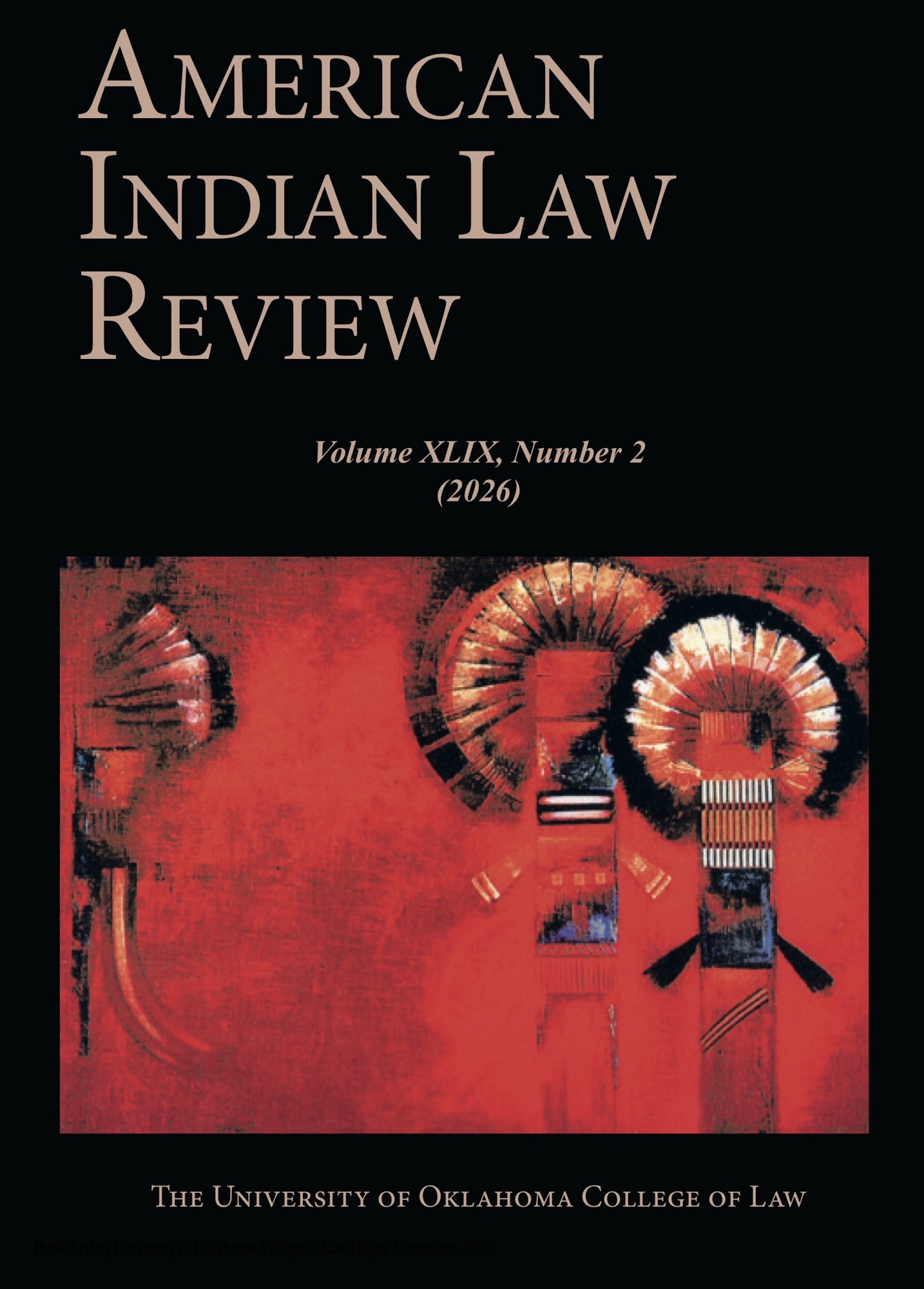
Department of Justice Journal of Federal Law and Practice Special Issue — “Beyond the Reservation: Multijurisdictional Issues Affecting Tribal Communities”

Here.

TOC:

Introduction Leslie A. Hagen . . . . . . . . . . . . . . . . . . . . . . . . . . 1

Achieving Public Safety Within Transboundary Tribes: Challenges and Paths Forward William K. Barquin, Elizabeth Thompson Tollefsbol, & Traci J. Whelan . . . . . . . . . . . . . . . . . . . . . . . . . . 5

The Violence Against Women Reauthorization Act of 2022 and the Return of Tribal Criminal Authority in Alaska Leslie A. Hagen & James V. DeBergh . . . . . . . . . . . . 19

The Department of Justice’s Role in Addressing the Incidence of Missing or Murdered Indigenous Persons Deidre Y. Aanstad . . . . . . . . . . . . . . . . . . . . . . . . 45

The “Categorical Approach” That Often Hinders Application of the Habitual Offender Statute, 18 U.S.C. § 117, to Violations of Tribal Law Robert A. Zauzmer . . . . . . . . . . . . . . . . . . . . . . . . 63

Maquiladoras, Indigenous Communities, and the Risk Posed by Traveling Sex Offenders in Two Border Cities Lori McPherson . . . . . . . . . . . . . . . . . . . . . . . . . . 79

The Tribal Warrants Loophole: The Washington Solution Michael Harder . . . . . . . . . . . . . . . . . . . . . . . . . . 91

Note from the Editor-in-Chief Christian A. Fisanick . . . . . . . . . . . . . . . . . . . . . . . 99

Getches, Wilkinson, Williams, Fletcher, Carpenter, and Singel’s Cases and Materials on Federal Indian Law, 8th Edition (Oct. 6, 2025)

Here.

The 8th Edition of the federal Indian law casebook covers recent updates in Supreme Court jurisprudence, as well as statutory and regulatory material. Major developments include the recovery of tribal jurisdiction through judicial decisions and legislative enactments, affirmation of the Indian Child Welfare Act, and law and policy addressing domestic violence in Indian Country and the epidemic of Missing and Murdered Indigenous People. The 8th Edition also considers efforts to secure treaty rights to water during an era of climate change and the fluctuating availability of funding for tribal operations amidst changing presidential administrations. 

The 8th Edition retains classic material on the history of federal Indian law and policy, including the medieval origins of the “Doctrine of Discovery,” and the shifting eras of Indian law leading to the present era of self-determination and human rights. The book covers the federal tribal relationship; tribal property rights, tribal sovereignty and jurisdiction; tribal justice systems, Indian religion and culture; water rights; treaty rights; rights of Alaska natives and native Hawaiians; and international and comparative legal perspectives, including the United Nations Declaration on the Rights of Indigenous Peoples.

Fletcher Commentary on Aaron Mills’ Work on Anishinaabe Law and Kinship

Here is “Indigenous Kinship as a Replacement for Tribal Citizenship Theory? Thoughts on the American Experience,” a blogpost for the American Journal of Comparative Law.

Prof. Mills’ original article can be found here.

John LaVelle on the Uses and Abuses of Johnson v. McIntosh by the Supreme Court

John LaVelle has published “Uses and Abuses of Johnson v. M’Intosh in Native American Land Rights Cases: Investigative Insights from the Indian Law Justice Files” in the Montana Law Review.

Here is the abstract:

The 200th anniversary of the foundational Indian law decision Johnson v. M’Intosh has come and gone, with many scholars contributing criticism and commentary. The dominant focus has been the case’s notorious embrace of the so-called “doctrine of discovery,” an odious theory for rationalizing European nations’ claims of superior rights to lands occupied by Indigenous Native American peoples. Commanding less attention, however, is the Johnson decision’s core protective legal feature, i.e., its reinforcing the United States government’s duty to guard against the alienation of Indian lands through private, unauthorized acquisitions.

This Article offers a somewhat different appraisal of Johnson v. M’Intosh in the context of controversies over Indigenous rights. Notwithstanding the case’s offensive dicta, the unanimous Johnson opinion retains efficacy in safeguarding Native American land rights, provided certain infamous abuses of the decision as precedent can be identified and rectified. Accordingly, this Article examines instances of the modern Supreme Court’s distorting and misusing Johnson v. M’Intosh to damage, weaken, or deny Indian land rights. In centering attention on this abuse, the Article draws on eye‑opening, seldom‑viewed documents found among the papers of Supreme Court Justices archived at the Library of Congress and various universities across the country. The Article also discusses a series of modern‑era opinions by Supreme Court Justices that exemplify instructive conformity to and reliance upon Johnson’s protective features. Moreover, as a response to the joint call for papers issued by the Montana Law Review and the Public Land & Resources Law Review, the Article does not take merely a rear‑view‑mirror look at Johnson v. M’Intosh. Rather, this Article aspires to cast light on judicial distortions and misrepresentations of Johnson to help illuminate a “Vision for the Future” in legal battles over Indigenous property rights.

An accompanying Compendium of Exhibits from the Papers of Supreme Court Justices is available here.

NYU Law Review Seeking Submissions

The NYU Law Review is open for Articles & Online Features. The submission guidelines and portals can be found here. Any questions about the submission process can be referred to NYULR‘s EIC, Yejin Chang (yejin@nyu.edu) and Senior Online Editor, Priya Prasad (nyulrevonline@gmail.com).

Robison on Native Nations and Water Compacts

Jason Robison has posted “Beyond Binary Co-Sovereignty: Native Nations & Water Compacts,” forthcoming in the Yale Law Journal, on SSRN.

Here is the abstract:

Former U.S. Supreme Court Justice Felix Frankfurter and former Harvard Law School Dean James Landis published in 1925 the seminal work on the U.S. Constitution’s Compact Clause. The article was, by definition, about co-sovereignty within the United States, though only in a binary sense. While shaping indelibly interstate and federal-state relations, North America’s original sovereigns, Native nations, were not visible within the influential piece. So, too, with the approximately two dozen compacts later formed to apportion water from rivers running across and along state lines, compacts acknowledging Native nations and their water (property) rights only at the margins, if at all. Revisiting Frankfurter and Landis’s seminal work exactly one century later, this Article advocates for moving beyond the binary conception of co-sovereignty apparent in that piece and entrenched in the suite of compacts created in its wake. Tracking Native nations’ growing calls for inclusion in transboundary water management, the Article advocates for these co-sovereigns to be respected as just that—sovereigns—and afforded opportunities for direct representation on compact commissions beside their state and federal counterparts. Food for thought is offered about potential forms and processes for this indigenization, all of which aim at the Article’s ultimate goal: further socializing and institutionalizing tripartite co-sovereignty.

New Scholarship Making the Case for Indigenous Self-Governance over Child Welfare in Canada

Ariana Kravetz has published “Rectifying Historical Wrongs: The Case for the Indigenous’ Inherent Right to Self–Govern Child Welfare in Canada” in the University of Miami Inter-American Law Review.

Furlong and Blumenthal on Tribal Authority over Nonmember Water Use

Wesley J. Furlong and Lori E. Blumenthal have published “Water Knows No Boundaries: Tribal Jurisdiction over Non-Indians’ Off-Reservation Conduct that Threatens On-Reservation Tribal Water Resources” in the Public Lands & Resources Law Review.

Here is the abstract:

This Article begins by discussing Manoomin and Sauk-Suiattle, orienting the reader to how these complicated jurisdictional issues have been addressed by Tribal courts. Next, this Article sets forth the current framework under Montana and Merrion for determining the extent of Tribal civil jurisdiction over non-Indians. Next, this Article examines the caselaw establishing Tribal Nations’ inherent sovereign authority to exercise civil jurisdiction over non-Indian activities and conduct occurring on-reservation that threaten or affect Tribal water resources and rights. Finally, this Article examines the caselaw that lays the groundwork for extending Tribal Nations’ civil jurisdiction over non-Indian activities and conduct occurring off-reservation that threaten or affect on-reservation Tribal water resources and rights.

Bryan on Restoring Tribal Land Use Authority in Indian Country

Micbelle Bryan has published “A Most Essential Power: The Case for Restoring Comprehensive Land Use Authority in Indian Country” in the Public Land & Resources L.Rev.

Here is the abstract:

Part I of this article provides a brief overview of allotment and its lingering jurisdictional quagmire on impacted reservations. Stepping outside of Indian Country, Part II then outlines the U.S. Supreme Court’s longstanding recognition of sweeping, area-wide government land use authority—authority it considers among the “most essential” and “least limitable.” The Court has never applied this established law when determining tribal sovereignty over land use. That application is long overdue.

Part III details how we arrived at this state of affairs—how tribes, despite starting with sovereign control over land use throughout their territories, experienced losses in that authority over time due to judicial error. This Part contrasts the Court’s double-speak regarding the “essentiality” of land use authority, depending on whether the case arises within or outside of an Indian reservation. Not surprisingly, this flawed jurisprudence has negatively impacted tribes’ welfare and undermined the current federal policy of tribal self-determination.

Part IV thus argues that the Court should restore tribes’ comprehensive land use authority, outlining three potential pathways of reasoning. While legal work-arounds also exist and should be explored— such as Congressional authorization or inter-governmental cooperative agreements—this article focuses on a judicial course correction in order to establish a more enduring baseline of sovereignty in federal Indian law. Finally, the article concludes that federal jurisprudence and policies should align in favor of comprehensive authority over land use in Indian Country, regardless of the ownership status of an individual parcel.

Lauren van Schilfgaarde on Natives as Federal Taxpayers

Lauren van Schilfgaarde has posted “Civilized Enough to Tax: Natives as Federal Income Taxpayers,” forthcoming in the California Law Review, on SSRN.

Here is the abstract:

What does it mean to condition federal tax liability on the degree to which a Native American has assimilated? Federal Indian law has long assumed that Native Americans are subject to federal income taxation absent an express exemption. This presumption obscures the complicated history by which Native Americans were incorporated into the federal tax base. While U.S. citizenship alone is not ordinarily dispositive of federal income tax liability, courts have uniquely infused Native citizenship with doctrinal significance, intertwining questions of citizenship, assimilation, sovereignty, and taxation. In doing so, they have neglected the legal reality that Native Americans hold dual citizenship—as citizens of both the United States and their own Tribal nations.

This Article situates Native tax liability within the longer trajectory of federal Indian law. It traces how allotment policy, noncompetence determinations, and the Indian Citizenship Act of 1924 collectively transformed Native Americans from “Indians not taxed” into presumed taxpayers. Courts initially tethered liability to federal declarations of “competence,” using taxation as a tool of assimilation. Competence itself was understood to mark the extinguishment of Native identity: to be a competent citizen was, in law’s eyes, to cease being Indian. Courts relied on this framework in taxation cases well into the mid-twentieth century. Over time, however, competence gave way to citizenship as the doctrinal touchstone. The Supreme Court entrenched the presumption of Native taxability, narrowing exemptions to allotment-based income while disregarding the unresolved meaning of dual citizenship—the coexistence of U.S. citizenship with continued Tribal citizenship. The result is a jurisprudence that collapses political distinctiveness into presumptive assimilation, as if Native peoples could not simultaneously belong to two sovereigns.

By excavating this history, the Article demonstrates that Native income taxation is neither inevitable nor doctrinally coherent. It argues that courts have misapplied statutory canons by privileging the presumption of taxability over the Indian canons of construction, which require clear congressional intent before imposing taxation on Tribal citizens. More fundamentally, taxation doctrine has failed to account for the implications of Native dual citizenship, erasing the sovereign-to-sovereign relationship that the law otherwise recognizes. The Article concludes by advancing a structural reform: redirecting federal income tax paid by Tribal citizens to their Tribal governments. Modeled on existing provisions such as the foreign tax credit, this reform would affirm Native dual citizenship, strengthen Tribal fiscal capacity, and restore coherence to federal tax law. In reframing taxation not as an instrument of assimilation but as an expression of recognition, federal law can more accurately reflect contemporary commitments to Tribal self-determination.