UN Seeks Indigenous Input on Who Controls Food Knowledge in the Age of AI

When Indigenous food knowledge enters an app, database, research project, digital map, or AI system, who controls what happens to it next? Too often, the institution collecting or storing the knowledge sets the terms.

The UN Special Rapporteur on the right to food, Sofía Monsalve Suárez, is seeking submissions for a thematic report on science, technology, knowledge, and food systems. She’ll present the report to the UN Human Rights Council in March 2027. The call expressly invites Indigenous Peoples’ organizations to submit data, case studies, good practices, shortcomings, and recommendations.

Important Dates

  • Deadline. October 14, 2026, at 11 p.m. Geneva time and 5 p.m. Eastern
  • Report. The Special Rapporteur will present the report to the UN Human Rights Council in March 2027
  • Limit. 2,500 words or five pages, submitted in Word format
  • Languages. English, French, or Spanish
  • Email. hrc-sr-food@un.org
  • Subject line. “Inputs for Science, Technology and Food Systems report”

Resources

Indian Affairs Proposing to make Permanent Records Temporary

Indian Affairs is consulting Tribes on a records schedule that would make many permanent records temporary. Adoption and ICWA files, trust accounting records, and murder case files would become just some of the records eligible for destruction after 50 years; school and other program records would be destroyed after 15 to 25. Because the clocks run from cutoff, decades-old records could qualify upon approval. Indian Affairs hasn’t released the crosswalk or inventories Tribes need to see what’s affected. NARA had published a report in 2024 urging modernization, not these periods. Consultations will occur on the dates below, and comments are due November 30 at consultation@bia.gov.

Online Consultation Schedule

Register for the online consultations here:

  • October 26, 2026, from 12 to 2 p.m. Eastern
  • October 27, 2026, from 2 to 4 p.m. Central
  • October 28, 2026, from 1 to 3 p.m. Mountain
  • October 29, 2026, from 2 to 4 p.m. Pacific

Written comments are due November 30, 2026, at consultation@bia.gov.

NARA is separately holding Tribal listening sessions on the Chicago and San Francisco closures on October 13 at 2 p.m. Eastern and October 15 at 3 p.m. Eastern. Register by sending an email to tribalconsultation@nara.gov with the meeting date you plan to attend to receive the virtual meeting connection information.

Resources

Gerald Clarke, “Land Acknowledgement Series: Sorry For Your Loss”

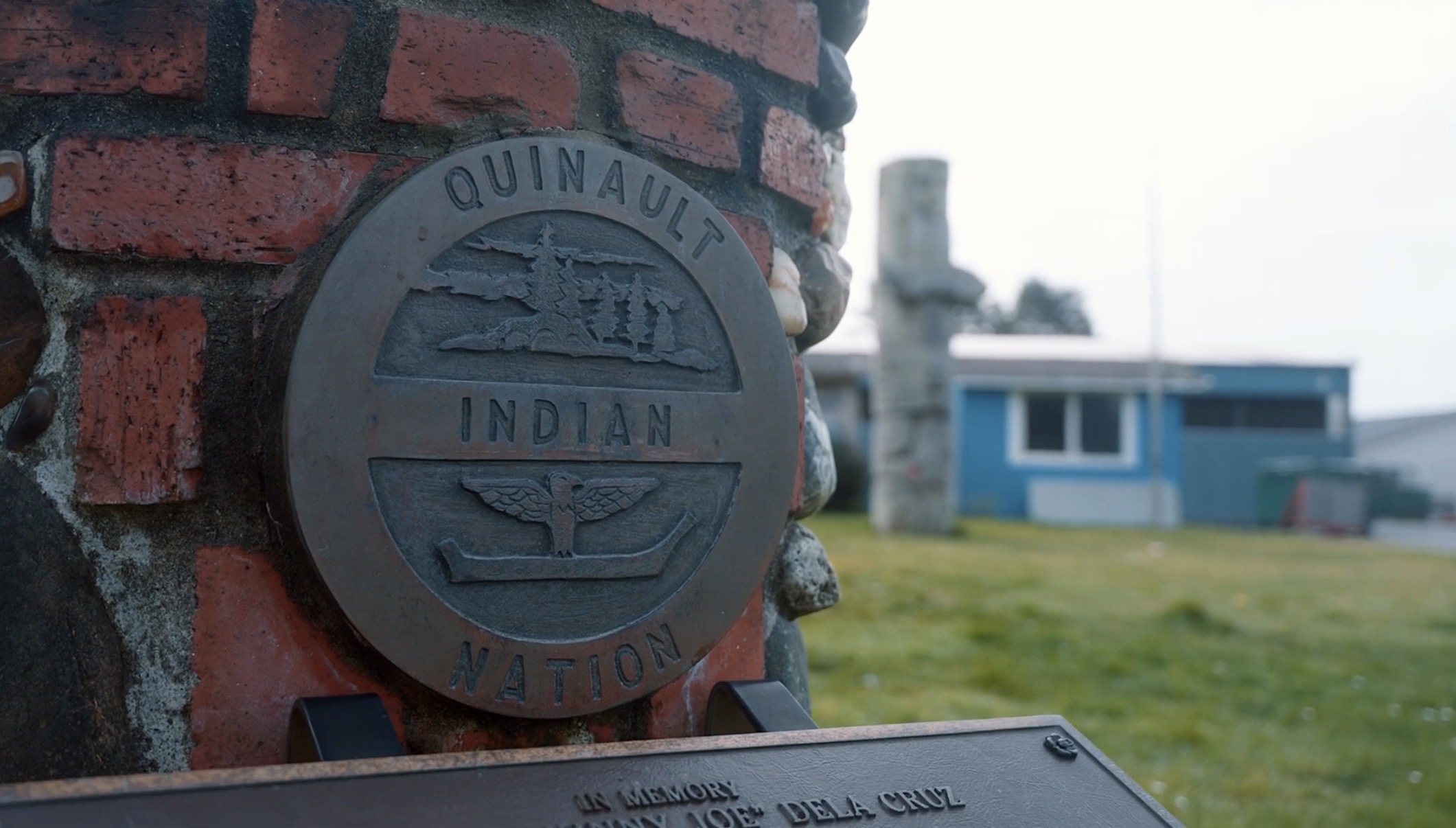
Quinault Nation Went from Lacking Broadband Access to Building the Pacific NW’s New Landing Point for Transpacific Internet Cables


Roughly one-third of the Quinault Reservation lacks internet access at home. The remaining two-thirds have service below the FCC’s minimum broadband standard. Now Quinault is building infrastructure that one of the world’s largest technology companies needs to connect North America and Asia.

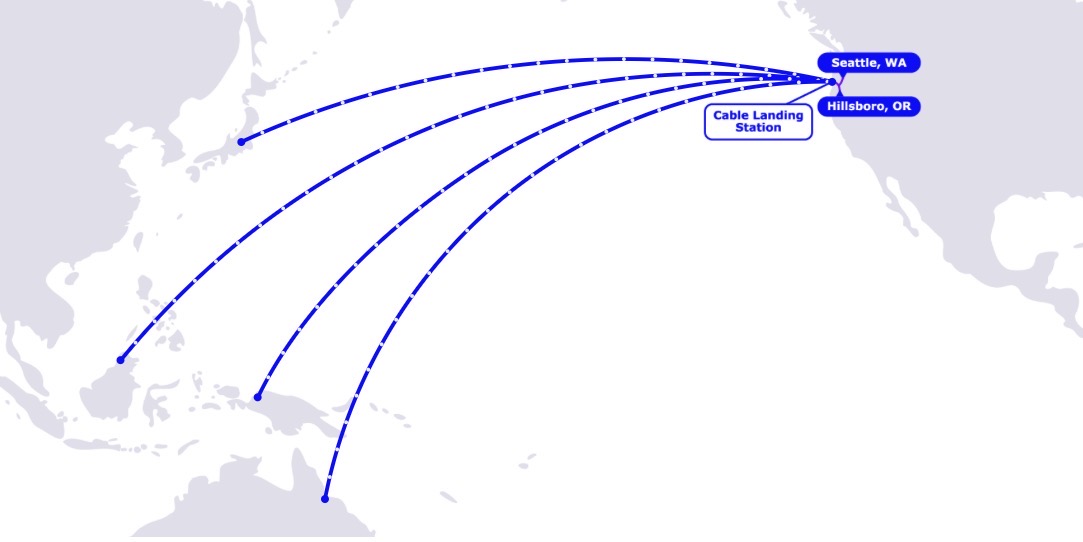
Amazon Web Services will own Sta’O’Nuk, a subsea cable planned to connect Washington and Japan in 2029. Quinault, through Toptana Technologies, is constructing the Tribally-owned landing station where that cable will connect with terrestrial fiber networks.

Sta’O’Nuk, which means “lightning serpent” in the Quinault language, will be the facility’s first cable, but Toptana is building something larger than an AWS terminal. The open-access station is designed to accommodate additional subsea systems, while its backhaul network will connect the Washington coast with major interconnection markets in Seattle and Hillsboro.

The landing station won’t itself connect individual homes, but Toptana says the infrastructure is intended to enable affordable high-speed service for Quinault and other underserved communities.

Quinault’s geography made this possible. It’s one of only four Tribal Nations in the United States with coastal access and adjudicated ocean rights. But geography alone didn’t create the project. The Nation began exploring broadband infrastructure in 2017 and created Toptana in 2022 with Quinault’s business committee approving the organizing of Toptana under the Tulalip Tribe’s LLC law in 2025.

Tribal law supplied the institutional foundation. Quinault invested in Toptana, remains its sole shareholder, supplied land and rights-of-way, and retained authority over major contracts. Tribal officials have also described an approved profit-sharing arrangement intended to return revenue to the Tribal government.

Quinault began this work because its own community lacked adequate broadband. It’s now becoming an owner of the physical infrastructure that will carry communications across the Pacific and into the Pacific Northwest.

Click on the image above to watch a 3 minute video on Toptana Technologies: Our Vision for Connectivity for All

Additional resources

Toptana Technologies Website and Video Overview

Quinault Indian Nation and Toptana Project Timeline

AWS Announcement of the Sta’O’Nuk Subsea Cable

AI Governance Is a Tribal Sovereignty Project, Not Just an Employee Policy


Recent warnings that AI is advancing faster than government can control it have focused on threats to jobs, democracy, and even humanity. Whatever you might think of the most extreme predictions, AI needs guardrails and too few jurisdictions are responding. For tribes, that’s a sovereignty question.

The Cherokee Nation’s AI policy and Data Sovereignty and Governance Task Force report⁠ offers an important model of executive action. But Tribes aren’t merely employers. Sure, they purchase technology, control data and resources, own businesses, and manage employees, but they also legislate, regulate, prosecute, adjudicate, provide remedies, and negotiate with other governments.

Tribes can begin to take action by inventorying AI uses and assessing risks to citizens, elections, decision-making processes, Indigenous data, cultural knowledge, jurisdiction, treaty rights, and future generations. One possible approach is to use a sequence like below, with steps that will overlap and that can proceed in parallel:

continuous risk assessment → executive policy → employment, contracting, and procurement protections → administrative capacity → Tribal legislation creating rights, duties, oversight, and remedies → Tribal enforcement and remedies → intergovernmental and external enforcement

Jurisdictional limits matter, especially when vendors, data, or harmful actors are beyond a Tribe’s reach. But those limits make contracts and intergovernmental agreements more important; they don’t justify inaction. The magnitude of the risks also requires inter-Tribal coordination and resource-sharing between Tribes.

The question isn’t simply how Tribal employees should use AI. It’s how Tribal governments will exercise sovereignty over it.

Some Useful Resources

Cherokee Nation Data Sovereignty and Governance Task Force Report. Provides a Tribal-specific example of executive policy development, institutional assessment, data sovereignty, cybersecurity, and AI governance.

NIST Artificial Intelligence Risk Management Framework. Offers a structured method that Tribes can adapt to identify, measure, manage, and monitor AI risks.

CARE Principles for Indigenous Data Governance. Adds an Indigenous-specific framework centered on collective benefit, authority to control, responsibility, and ethics.

GovAI Coalition Templates and Resources for Public Agencies. Supplies practical policy, procurement, assessment, and vendor review tools that Tribes can revise to reflect Tribal law, values, jurisdiction, and sovereign immunity.

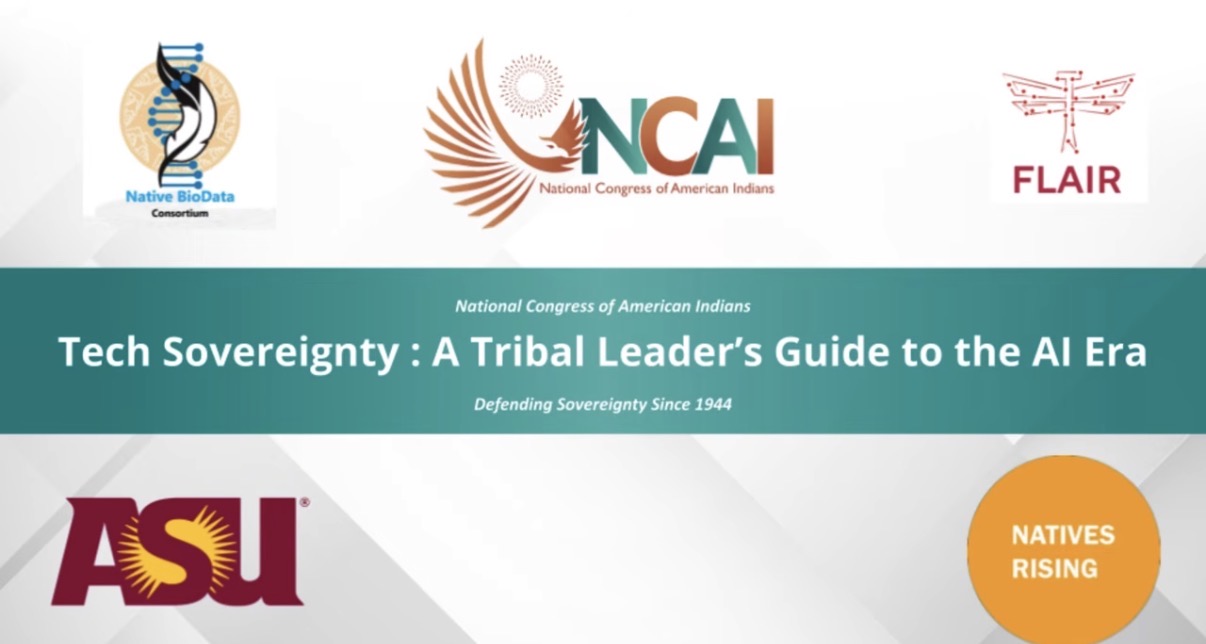
Worth a Watch: Tech Sovereignty and the AI Era

Link to video is here.

From NCAI’s YouTube channel:

As artificial intelligence (AI) continues to evolve, Tribal Nations face critical decisions about how to protect their natural resources, safeguard Tribal data sovereignty, and ensure emerging technologies align with Tribal values. By exercising governance over AI, Tribal Nations can also harness these tools to preserve and revitalize Indigenous languages, strengthen self-determination, and create high-quality economic and workforce opportunities for Native people.

Whether your Tribal Nation chooses to regulate, leverage, or reject AI, this session provides the clear-eyed roadmap you need to make informed decisions. Hear directly from the foremost Indigenous tech experts on protecting our resources and governing AI on our own terms.

Featured Speakers:

The Risks: Land & Water — Cora Tso, Arizona State University
The Risks: Data & DNA — Dr. Krystal Tsosie & Joe Yracheta, Native BioData Consortium
The Opportunity: Workforce — Danielle Forward, Natives Rising
Innovation: Language — Michael Running Wolf, FLAIR

The webinar was recorded live on July 22, 2026.

Data Centers in Indian Country

As some Tribes reject hyperscale data centers in Indian Country, others are embracing data center development. Others are imposing moratoria on data centers to allow for further studies and policy development. Below is a snapshot of what Tribes are doing. It illustrates the diversity of Tribes in the US, and it shows Tribes acting as governments, regulators, landowners, utility operators, infrastructure owners, investors, economic development actors, and political communities as they decide what tech development should look like on their lands.

  • Cherokee Nation of Oklahoma: Released a Data Center Task Force report on August 5, 2026 and is now banning hyperscale data centers on tribally owned and trust lands.

  • Seminole Nation of Oklahoma: On March 7, 2026, the Tribal Council unanimously voted for a moratorium on generative-AI and hyperscale data center development within its jurisdiction. The resolution also bars “any inquiries, discussions and/or developments concerning any entity seeking to develop a data center of any size within the Seminole Nation during the moratorium period.”

  • Sault Ste. Marie Tribe of Chippewa Indians: Supports a moratorium. The Tribe adopted a resolution on May 19, 2026 supporting the state of Michigan establishing a temporary moratorium on large-scale data centers and cryptocurrency mining until a Tribal consultation process is established, including comprehensive environmental and cultural impact assessments on any legislation involving large-scale data centers and cryptocurrency mining.

  • Muscogee (Creek) Nation: Rejected. In November 2025, the National Council rejected a measure that would have developed a data center at Looped Square Ranch, where land is being used for Tribal food sovereignty.

  • Hoopa Valley Tribe: Supports, under Tribal ownership. Hoopa opened a new data center on July 17, 2026, but it’s not a hyperscale data center. It’s a tribally-owned facility serving as the operational hub of Hoopa’s fiber-to-home broadband network and Acorn Connected, its Tribal internet service provider.

  • Forest County Potawatomi Community: Yes, and has been doing it for years. Its enterprise Data Holdings operates a commercial data center in Milwaukee on trust land and is 100% Tribally owned. It opened in 2013 as a $33 million wholesale data center and now provides colocation/private cloud services and hosts the Milwaukee Internet Exchange.

  • Navajo Nation: Yes. Navajo Tribal Utility Authority operates a data center in Shiprock on the Navajo Nation offering colocation, virtualization and high-speed optical backhaul to off-reservation points-of-presence in Albuquerque and Phoenix. NTUA is a Navajo Nation enterprise, and the facility serves both Navajo and outside government and business customers.
  • Colusa Indian Community: Actively pursuing AI infrastructure. The Community’s Colusa Indian Energy announced a partnership in March 2026 with Strata Expanse to develop an AI and energy infrastructure campus on the land of the Cachil Dehe Band of Wintun Indians of the Colusa Indian Community in Northern California. Plans include expanding on-site energy generation capacity to more than 100 MW over the next 18 months.
  • Osage Nation: Debating a data center approved in February 2026 by the City of Sand Springs on the Osage reservation. The proposed data center would be operated by Google, and construction is planned to begin in 2027. The developers are seeking support from the Osage Minerals Council, which controls the nation’s 1.47 million acre oil and gas subsurface.

Additional Resources

Tribal Nations and Data Centers: Emerging Issues and Resources, USET

AI Data Centers and Tribes: Emerging Federal and Policy State Trends and Tribal Governance Options, Tana Fitzpatrick, Director, Native Nations Center for Tribal Policy Research

Honor the Earth Data Center Tracker (interactive crowd-sourced map)

Indigenous Peoples Push Back as Data Centers Expand Across North America, John Ahni Schertow in Intercontinental Cry Magazine

The Cloud is Drying our Rivers: Water Usage of AI Data Centers, Charlotte Jennings, EthicalGeo

Honor the Earth DataCenterTracker; Earthstar Geographics; U.S. Census Bureau

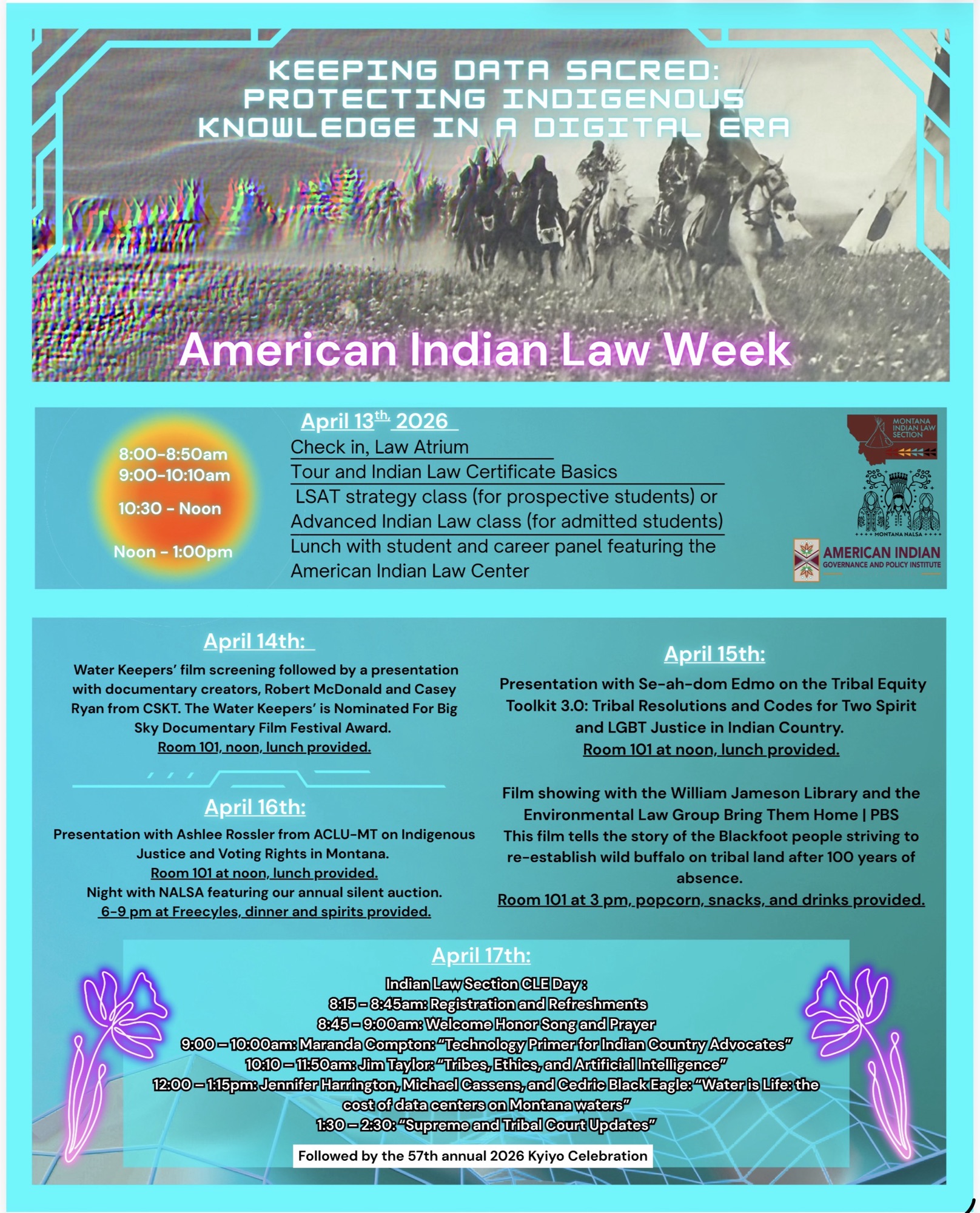
Montana Law’s American Indian Law Week: “Keeping Data Sacred” — April 13-17, 2026

Leeds, Phillips, and Bledsoe Downes on Implementing Tribal Data Sovereignty

Stacy L. Leeds, Samantha Phillips, and Micayla Bledsoe Downes have published “Proactive Solutions in Implementing Tribal Digital Sovereignty” in The Journal of Community Informatics.

Here is the abstract:

This article argues that Tribal Nations must move rapidly from ad hoc digital practices to comprehensive legal and governance frameworks that fully implement Tribal Digital Sovereignty. Drawing on lessons from Indian gaming and other economic sectors, it shows how vendor-driven arrangements, weak contracts, and incomplete jurisdictional assertions have historically created long-term vulnerabilities around data, infrastructure, and regulatory authority. The article reframes digital systems—cloud services, health information technologies, broadband and spectrum, AI tools, and data-intensive enterprises—as core sites of sovereignty rather than as technical back-office functions. It contends that delays in regulating these domains allow external actors to harden jurisdictional and economic advantages that are difficult to unwind.

To provide practical guidance, the article proposes four interlocking “buckets” of legal infrastructure: Tribal codes and regulations that assert digital jurisdiction; contracts and agreements that safeguard data ownership, limit sovereignty waivers, and require portability; easements and infrastructure arrangements that preserve Tribal authority over physical and virtual networks; and business registration systems that capture entities operating digitally in Tribal territories. It situates these tools within Indigenous Data Sovereignty frameworks such as the CARE Principles and emerging Tribal AI governance efforts, including early government policies that embed cultural values and guard against data exfiltration. The article further emphasizes workforce development, procurement strategies, and collaborative regional or inter-Tribal models as necessary conditions for sustained digital self-governance. Taken together, these approaches aim to ensure that Tribal sovereignty is exercised as powerfully in digital spaces as in the governance of land, resources, and institutions.