Since the first Indian law classes were offered in the late 1960s and early 1970s, law teachers mostly have considered the field a niche specialty, even a backwater, unnecessary to anyone not likely to go into law practice in Indian country. In those days, law teachers focused on treaty rights fights. Treaty rights are a critical but small part of Indian country practice. Lawyers in modern day Indian country handle virtually every kind of matter taught in law schools in addition to the Indian law-specific subject matters. Beginning in the 1990s, American Indian tribal nations started to become critical factors in governmental and economic activity throughout much of the United States. In the 21st century, many law schools offer Indian law — and occasionally offer additional, specialized courses — but generally are still far behind the curve. Worse, when it is offered, the Indian law canon tends to be taught in ways that ignore contemporary tribal agency by emphasizing historical events over modern issues. Modern tribal nations make their own laws. Here I give examples of tribal court cases and tribal statutes law teachers can use to incorporate Indian law into virtually any common law course.
Public health measures to combat COVID-19, especially in the first year before vaccines became widely available, required individuals to be able to access fresh water while remaining isolated from most of their fellow human beings. For the approximately 500,000 households in the United States and over two million Americans who lacked access to reliable indoor running water, these COVID-19 measures presented a considerable added challenge on top of the existing risks to their health from an insecure water supply.
Many of these people were Native Americans, whose Tribes often lack fully adjudicated, quantified, and deliverable rights to fresh water. To highlight the critical role that water rights played in Tribes’ capacities to cope with the pandemic, this essay compares the Klamath Tribes in Oregon, who after 40 years of litigation have fairly securely established themselves as the senior water rights holders in the Klamath River Basin, to the Diné (Navajo Nation), whose reservation—the largest in the United States—covers well over 27,500 square miles of Arizona, Utah, and New Mexico but largely lacks quantified water rights or the means to deliver water to households. While access to water was not the sole factor in these two Tribes’ vastly different experiences with COVID-19, it was an important one, underscoring the need for states and the federal government to stop procrastinating in actualizing the water rights for Tribes that have been legally recognized since 1908.
This Article is the first of a two-part investigation into the Indian law doctrine of reservation diminishment/disestablishment, examining Supreme Court decisions in this area in light of insights gathered from the collected papers of individual Justices archived at the Library of Congress and various university libraries. The Article first addresses Seymour v. Superintendent (1962) and Mattz v. Arnett (1973), observing that these first two diminishment/disestablishment cases are modern applications of basic, longstanding principles of Indian law which are highly protective of Indigenous people’s rights and tribal sovereignty. The Article then examines in detail DeCoteau v. District County Court, the anomalous 1975 decision in which the Supreme Court held that an 1889 land-sale agreement between the United States and the Sisseton-Wahpeton Dakota Indians, which Congress ratified in 1891, had abolished the boundaries of the Lake Traverse Reservation in South Dakota and North Dakota, a reservation that had been established as the Indians’ “permanent reservation” home in an 1867 treaty. The Article critiques DeCoteau in view of the historical context of the 1862 U.S.-Dakota War, an explosive conflict that resulted in the forced removal of the Dakota people from their reservation and aboriginal homelands in Minnesota and the abrogation of all U.S.-Dakota treaties, including treaty rights that guaranteed annual payments essential for the Indians’ subsistence and survival. The Article brings into view the full scope of the negotiations between the Sisseton- Wahpeton people and U.S. commissioners in 1889, demonstrating that the Dakota people never consented to any reduction or elimination of reservation boundaries when they agreed, under desperate circumstances, to sell to the United States the unallotted lands within the reservation. The Article further surveys additional evidence, unaddressed by the Supreme Court, regarding the 1891 Act’s legislative history, including numerous congressional debates and provisions of reports of the Senate and House of Representatives, as well as evidence from Executive Branch sources, which collectively show that the 1891 Act did not shrink or terminate the reservation. The Article posits that DeCoteau, which scholars recognize as having initiated a “magic language” mode of analysis in the reservation diminishment/disestablishment area, cannot be reconciled with fundamental principles of Indian law. Finally, the Article inspects and discusses documents from the archived papers of the Justices who took part in DeCoteau, unraveling clues that may help account for the Supreme Court’s aberrant decision.
After decades of abuse through family regulation, Congress enacted the Indian Child Welfare Act of 1978 (“ICWA”) to prevent the breakup of Indian families and promote tribal sovereignty. While ICWA seems like an outlier that addresses one category of children, it is not an outlier. Rather, I argue that ICWA is a tool of reproductive justice. By formulating a legal rights framework for reproductive justice in American jurisprudence, I discuss how the reproductive justice movement is grounded in U.S. law beyond the right to terminate a pregnancy that the Supreme Court abrogated in Dobbs v. Jackson Women’s Health Organization. By looking at the history of reproductive rights in American Indian communities, I discuss how family regulation challenges reproductive rights and tribal sovereignty considering Dobbs and Oklahoma v. Castro-Huerta. Indian child removals exist in the same history, context, and policy that disrupted the reproductive rights of American Indian families and tribal sovereignty in other areas. Before concluding that ICWA is still good law and good policy to disrupt family regulation and protect the reproductive rights of American Indian peoples, I consider where challenges to ICWA in Haaland v. Brackeen fit into this paradigm and the ongoing need for the protection of tribal sovereignty and reproductive rights for American Indian peoples. For nearly 400 years, the disruption of reproductive rights, including family regulation, has been at the heart of federal Indian policy. The current frame of family regulation as “saving” children means that it is often divorced from the notion of reproductive rights. As the history behind and contemporary challenges to ICWA demonstrate, it should not, and cannot, be separated from the other reproductive justice issues facing American Indian communities. To strengthen legal protections for American Indian people that disrupt these government interventions, like ICWA, is to realize reproductive rights more fully in the United States.
This year (2022), the Supreme Court agreed to review wide-ranging constitutional challenges to the Indian Child Welfare Act (ICWA) brought by the State of Texas and three non-Indian foster families in the October 2022 Term. The Fifth Circuit, sitting en banc, held that certain provisions of ICWA violated the anticommandeering principle implied in the Tenth Amendment and the equal protection component of the Fifth Amendment’s Due Process Clause. We argue that the anticommandeering challenges against ICWA are unfounded because all provisions of ICWA provides a set of legal standards to be applied in state which validly and expressly preempt state law without unlawfully commandeering the States’ executive or legislative branches. Congress’s power to compel state courts to apply federal law is long established and beyond question. Yet even if some provisions of ICWA did violate the Tenth, we argue that Section 5 of the Fourteenth Amendment sufficiently authorizes Congress’s enactment of ICWA so as to defeat the anti-commandeering concerns. Strangely, no party ever invoked Congress’s power under Section 5 of the Fourteenth Amendment to assess its constitutionality. ICWA seems like an obvious candidate for analysis under Congress’s enforcement powers under Section 5. States routinely discriminated against American Indian families on the basis of their race and ancestry (and their religion and culture), and ICWA is designed to remedy the abuses of state courts and agencies. We further have no doubt that the state legislatures that adopted ICWA in whole, in part, or as modified also possessed the power to do so, even in the event the Supreme Court holds all or portions of ICWA unconstitutional.
For over two hundred years the “whole course of judicial decision” in the United States has recognized that American Indian tribes possess inherent sovereignty to govern their lands and people. Federal recognition of that sovereignty was memorialized in countless treaties, congressionally ratified agreements, and executive orders setting aside reservations throughout the United States. Throughout that same period, and with only minimal exception, the judiciary faithfully applied those treaties to protect tribal property rights, recognize tribal sovereignty, and to bar states from imposing jurisdiction within Indian Country.
The jurisprudence in this arena has shifted, however, over the past few decades. Although the Supreme Court continues to faithfully apply its longstanding treaty analysis to protect tribal property rights, it has moved away from using that same analysis when evaluating tribal sovereignty and the scope of state jurisdiction in Indian Country. Instead, as demonstrated by its recent decision in Oklahoma v. Castro-Huerta, the Court has articulated a preemption test that is determined by judicial balancing of the tribal, federal, and state interests in the subject matter the state seeks to regulate. The approach has long been criticized for allowing courts to usurp the legislative power of Congress to make policy in federal Indian law in order to “reach outcomes consistent with their own notions of how much tribal autonomy there ought to be.” The purpose of this article is to establish that this so-called balancing test has no basis in the foundational principles of federal Indian law. Instead, the broad sweep of the field demonstrates that tribal freedom from state jurisdiction within Indian Country should proceed as a treaty right analysis.
That analysis requires courts to determine whether the treaty at issue preempts state law within the reservation. In making that determination, courts must interpret the treaty consistent with background principles of tribal sovereignty, which necessitates that ambiguities be resolved in favor of the tribe and that any sovereignty not expressly ceded has been retained. Applying these principles, the Supreme Court has repeatedly found that the treaty right to a “permanent home” implicitly included the right for tribes to “govern themselves, free from state interference.” Once established, a treaty right may only be taken away by Congress. Once again, however, there remains a strong presumption against the abrogation of tribal sovereignty. Thus, the Court has consistently required there be “clear evidence that Congress actually considered the conflict between its intended action on the one hand and Indian treaty rights on the other, and chose to resolve that conflict by abrogating the treaty.”
This article seeks to demonstrate that the Court’s treaty-based analysis of tribal sovereignty should be applied by the judiciary moving forward. It is preferable not only because it is more consistent with foundation principles of federal Indian law but also bedrock constitutional principles as well as basic twenty-first century domestic and international norms related to the treatment of indigenous peoples and self-determination.
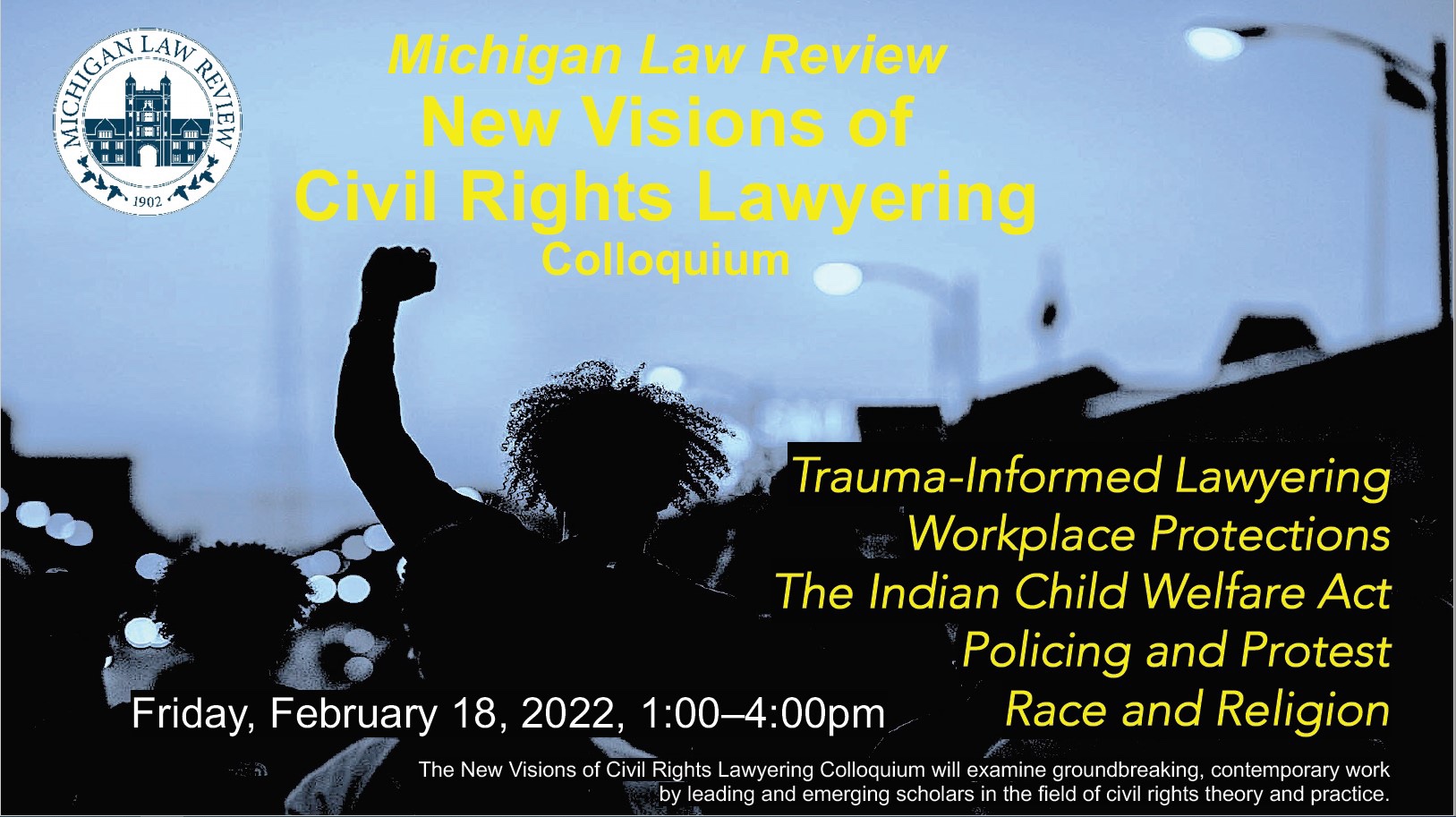
Fletcher and Singel’s paper, “Lawyering the Indian Child Welfare Act,” has been published in the Michigan Law Review. We’re honored to be part of a symposium on civil rights lawyering!
Our abstract:
This Article describes how the statutory structure of child welfare laws enables lawyers and courts to exploit deep-seated stereotypes about American Indian people rooted in systemic racism to undermine the enforcement of the rights of Indian families and tribes. Even when Indian custodians and tribes are able to protect their rights in court, their adversaries use those same advantages on appeal to attack the constitutional validity of the law. The primary goal of this Article is to help expose those structural issues and the ethically troublesome practices of adoption attorneys as the most important Indian Child Welfare Act (ICWA) case in history, Brackeen v. Haaland, reaches the Supreme Court.
Universities and law schools have begun to purge the symbols of conquest and slavery from their crests and campuses, but they have yet to come to terms with their role in reproducing the material and ideological conditions of settler colonialism and racial capitalism. This Article considers the role the property law tradition has played in shaping and legitimizing regimes of racialized dispossession past and present. It intervenes in the traditional presentation of property law by arguing that dis-possession describes an ongoing but disavowed function of property law. As a counter-narrative and critique of property, dispossession is a useful concept for challenging existing property arrangements, often rationalized within liberal and legal discourse.
Interesting. Looks to be expanding on K-Sue Park’s work.






 Turtle Talk
You must be logged in to post a comment.