Indian Law Scholarship Roundup


Taking Stock: Open Questions and Unfinished Business Under VAWA Amendments to the Indian Civil Rights Act

Hastings Law Journal, Vol. 73, No. 2, 2022, Number of pages: 54 Posted: 08 Apr 2022, Accepted Paper Series, Jordan Gross, Alexander Blewett III School of Law at the University of Montana

Akhil Amar’s Unusable Past

Michigan Law Review, Forthcoming, Number of pages: 24 Posted: 07 Apr 2022, Working Paper Series, Gregory Ablavsky, Stanford Law School

Tribal Sovereignty and Economic Efficiency Versus the Courts

Washington Law Review, Forthcoming, Number of pages: 49 Posted: 05 Apr 2022, Working Paper Series, Robert J. Miller, Arizona State University (ASU) – Sandra Day O’Connor College of Law

The Role of Truth-Telling in Indigenous Justice

Forthcoming, 11 Journal of Race, Gender and Ethnicity __, Number of pages: 21 Posted: 04 Apr 2022, Working Paper Series, Sara Ochs, University of Louisville – Louis D. Brandeis School of Law

The World’s Largest Dam Removal Project: The Klamath River Dams

Number of pages: 57 Posted: 23 Mar 2022, Working Paper Series, Michael C. Blumm and Dara Illowsky, Lewis & Clark Law School and Lewis & Clark College, Law School
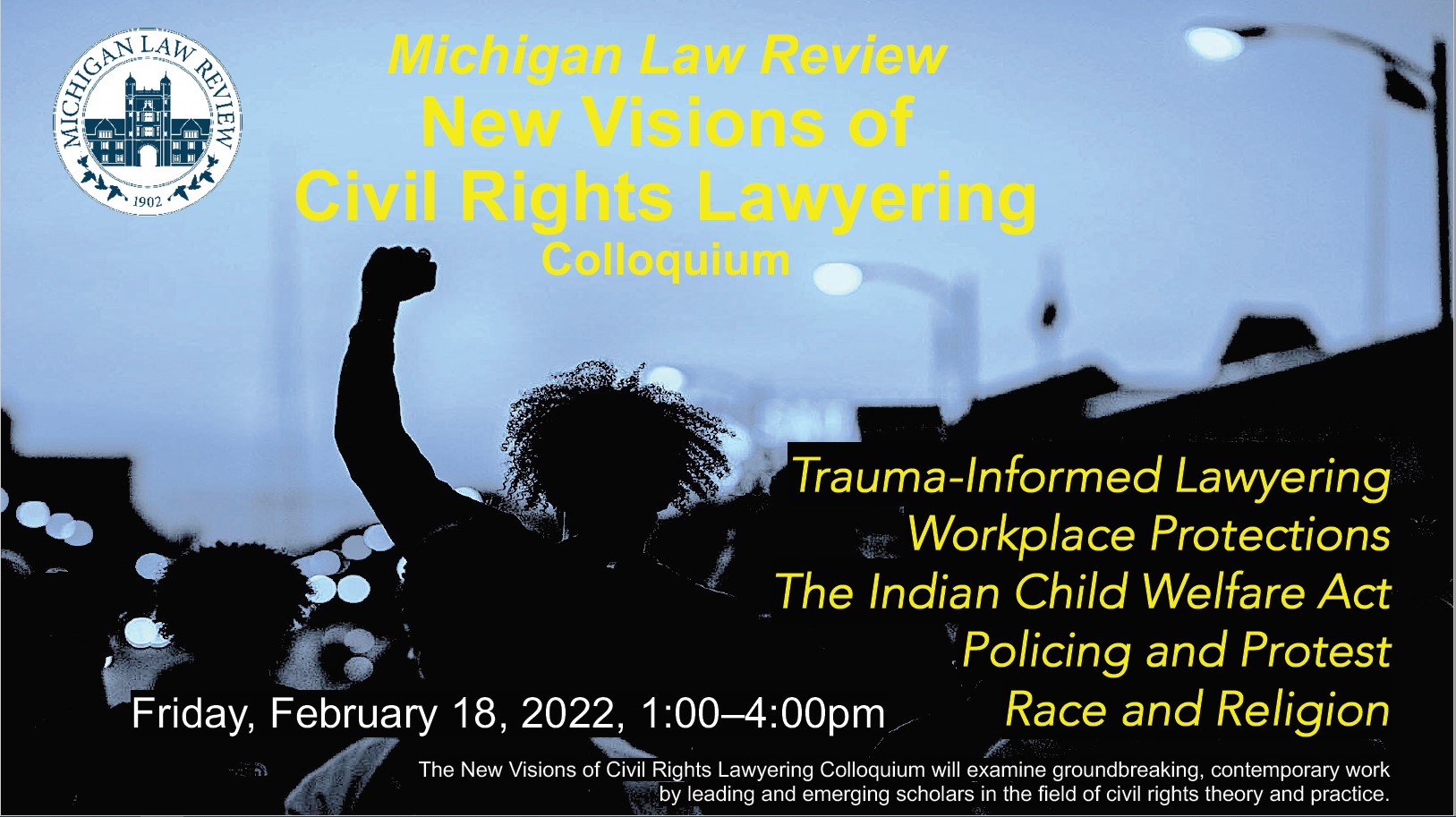
TODAY — Michigan Law Review Colloquium: “New Visions of Civil Rights Lawyering” [includes Fletcher & Singel on ICWA]

Here (zoom webinar link here):

Fletcher and Singel will discuss their forthcoming paper, “Lawyering the Indian Child Welfare Act.”

John Ragsdale on the Aboriginal Water Rights of the Jemez Pueblo

John W. Ragsdale has posted “The Aboriginal Land and Water Rights of the Jemez Pueblo,” forthcoming in the Denver University Water Law Review, on SSRN.

Here is the abstract:

Since time immemorial, the indigenous people of what became the Southwest United States have maintained sustainable, vibrant communities in the harshest of environments; one with generally arid climate, inconsistent precipitation, heat, wind, thin soil and erosion. These communities, on the razor’s edge, survived for eons because resilience and community, within and with the land, were at the center of their life, economy and order. Balance was not always perfect, but it was the target. The possibility of economic surplus and growth is perhaps a latent human instinct, but it until the fluorescence of Chaco Canyon in the eleventh century it remained subordinate. With the fall of Chaco and eventual restoration of decentralizations and the traditional aboriginal practices, balance returned.

The European invasion and the infusion of competitive individualism and economic growth changed all this. The movement west on the wings of the doctrine of discovery and the ensuing extinguishment of both aboriginal title and the stable-state economies proceeded across the Mississippi and the prairies and slammed the capitalistic wrecking ball into the most resilient of the aboriginal survivors – The Pueblo Indians of the Southwest.

The Jemez Pueblo of Central New Mexico has been one of the fiercest defenders of the traditional aboriginal community. Through the intrusion of Spain, Mexico and ultimately the United States, the Pueblo clung to its central land, its claims to aboriginal surroundings and water, and its sustainable orientation, this article traces the prehistoric courses of the Pueblo, and it centuries-long efforts to maintain both the focus and the legal existence of its aboriginal community. It has not been a complete victory in the dominant sovereigns’ courts, but the aboriginal heart of the people and possibilities for collaboration with other Tribes and, perhaps, with a more generous and enlightened dominant sovereign, remain strong.

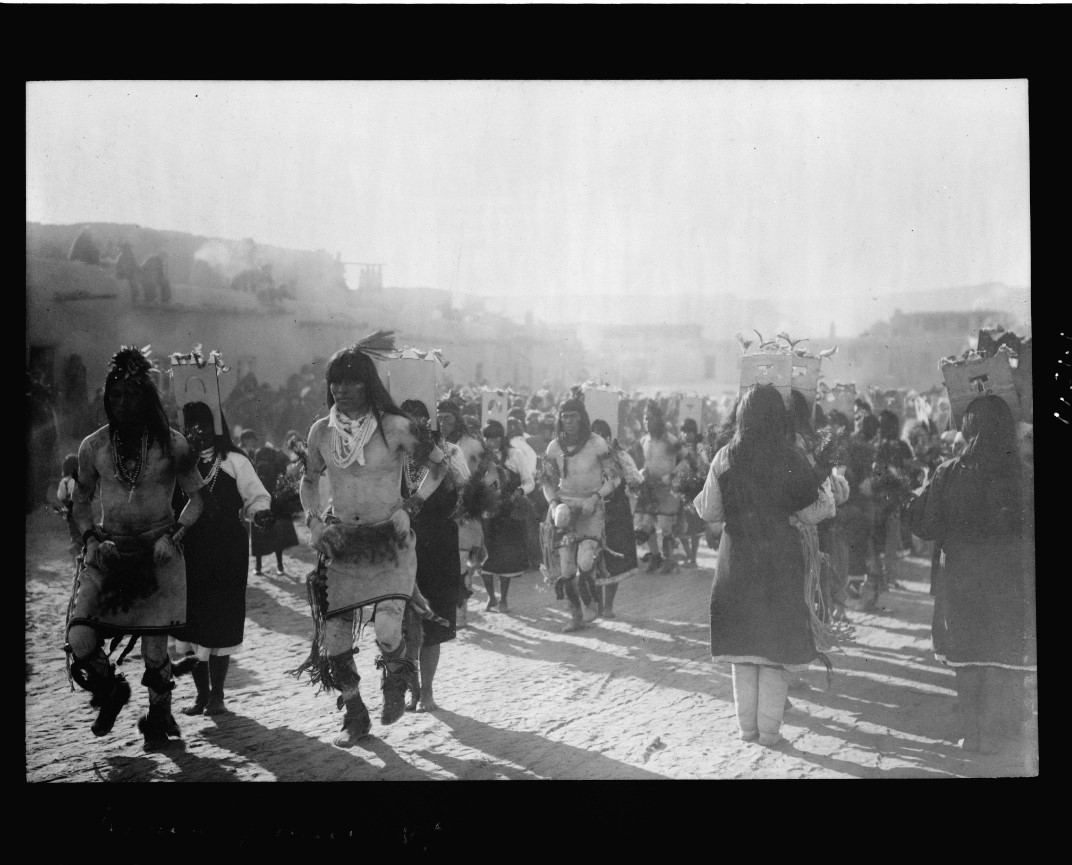
Jemez Pueblo Indians in a ceremonial dance, 1908

Pippa Browde on State Taxation in Indian Country in a Pandemic Economy

Pippa Browde has published “From Zero-Sum to Economic Partners: Reframing State Tax Policies in Indian Country in the Post-COVID Economy” in the New Mexico Law Review.

Here is the abstract:

The disparate impact COVID-19 has had on Indian Country reveals problems centuries in the making from the legacy of colonialism. One of those problems is state encroachment in Indian Country, including attempts to assert taxing authority within Indian Country. The issue of the reaches of state taxing authority in Indian Country has resulted in law that is both uncertain and highly complex, chilling both outside investment and economic development for tribes. As the United States emerges from COVID-19, to focus only on the toll exacted on tribes and their peoples ignores the tremendous opportunities for states to right these historical wrongs. Buoyed by federal COVID-relief funds, state and local governments are in a financial position to reframe their tax policies to promote tribal sovereignty and support economic development in Indian Country. This article argues for states to make diplomatic, responsible state and local tax policies that will create healthier intergovernmental relationships and an environment that in turn creates broader economic growth for tribes and states alike. Through policies requiring state governments to consult with tribes to make joint decisions on tax policy and by refraining from exercising taxing authority in Indian Country, states can move from a zero-sum game. Instead of competing for precious tax revenue, state and local governments can partner with tribes to expand the total amount of available revenue streams. Doing so will not just right the historical wrongs of colonialism—it could also help prevent future crises, such as the COVID-19 pandemic, from having such a disparate impact on tribes again.

Art Wood, LOC, blurry

Ann Tweedy on Tribal Firearms Regs

Ann Tweedy has posted “Tribes, Firearm Regulation, and the Public Square,” forthcoming in the U.C. Davis Law Review, on SSRN.

Professor Tweedy

Here is the abstract:

This paper explores tribal policies towards firearm regulation through four different lenses. First, tribal participation in recent state and federal legislative debates regarding firearm regulation is explored. Second, the essay examines ways that Native Americans continue to be harmed by notions of savagery, including through high rates of victimization of violent crime and high rates of police killings. Third, it explores the historical importance of firearms for many tribal cultures. Finally, tribal firearm regulations are examined, specifically in the context of laws regulating the ability to bring firearms into sensitive spaces and those relating to use of firearms in a threatening manner.

Alia Hoss on Tribal Health Sovereignty

Aila Hoss has posted “Securing Tribal Consultation to Support Tribal Health Sovereignty,” forthcoming in the Northeastern University Law Review, on SSRN.

Professor Hoss

Here is the abstract:

Effective intergovernmental coordination is essential to promoting health and safety. Yet, the current political climate has seen discord between Tribes, states, and the federal government on issues ranging from public health to environmental protection, among countless others. The COVID-19 pandemic has magnified this discord. Many states have challenged Tribal authority to access data, implement quarantine and isolation measures, and establish checkpoints and mask mandates. The federal government has delayed access to COVID-19 data, established burdensome and inconsistent policies for the use of federal response funds, and failed to meet its obligations to provide health care in many American Indian and Alaska Native communities.

As sovereign nations, Tribes have authority and responsibility over their land and people. Modern relationships between Tribes, states, and the federal government are based on the colonization and genocide, legalized by the United States under federal Indian law. Federal Indian law both recognizes Tribal sovereignty but also carves out instances in which a Tribe’s criminal or civil jurisdiction can be infringed. It has allowed federal agencies, Congress, and federal courts to exercise overwhelming authority to determine the scope of Tribal and Indigenous rights. And yet, Native representation in these same branches have been abysmal.

One method for ensuring Tribal and Native perspectives in these decision-making processes has been through Tribal consultation. Consultation is a formal, government-to-government process that requires governments to consult with Tribes before taking actions that would impact them.

Tribal consultation is essential for effective Indian health policy. This article argues for a more robust mechanism for Tribal consultation for health policy issues. Section I briefly describes Tribal governments and their relationship to the federal government. Section II summarizes existing requirements for Tribal consultation under federal and state law. Section III describes the limitations of existing Tribal consultation practices. Finally, section IV describes the impact of inadequate consultation on American Indian and Alaska Native health and offers recommendations for a Tribal consultation framework that fully supports American Indian and Alaska Native health.

American Indian Law Journal Publishes Volume 10, Issue 1

Here:

Volume 10, Issue 1 (2022)

Articles

PDF

Healthcare Self-Governance
Danika Watson

PDF

Analyzing the Implications of the Supreme Court’s Application of the Canons of Construction in Recent Federal Indian Law Cases
Meredith Harris J.D.

PDF

This Land Is Not Our Land, This Land is Their Land: Returning National Park Lands to Their Rightful Protectors
Sierra Kennedy

PDF

John Locke’s Theory of Property, and the Dispossession of Indigenous Peoples in the Settler-Colony
Calum Murray

PDF

How Alaska Native Corporations Can Better Support Alaska Native Villages
E. Barrett Ristroph Esq.

PDF

The Importance of Abolition of the Carceral State for Native Survivors
Christina M. Schnalzer

Nez Perce man named Chief Lawyer, ca. 1861

Bob Miller and Torey Dolan on the Indian Law Bombshell

Robert Miller and Torey Dolan have published “The Indian Law Bombshell: McGirt v. Oklahoma” in the Boston University Law Review.

Check it out — McGirt + . . .

Bombshell = . . .
Law Review GOLD.

“Muskrat Textualism” Now Published in the Northwestern U. Law Review

Here.

The asbtract:

The Supreme Court decision McGirt v. Oklahoma, confirming the boundaries of the Creek Reservation in Oklahoma, was a truly rare case in which the Court turned back arguments by federal and state governments in favor of American Indian and tribal interests. For more than a century, Oklahomans had assumed that the reservation had been terminated and acted accordingly. But only Congress can terminate an Indian reservation, and it simply had never done so in the case of the Creek Reservation. Both the majority and dissenting opinions attempted to claim the mantle of textualism, but their respective analyses led to polar opposite outcomes.

Until McGirt, a “faint-hearted” form of textualism had dominated the Court’s federal Indian law jurisprudence. This methodology enables the Court to seek outcomes consistent with the Justices’ views on how Indian law “ought to be.” This Article labels this thinking Canary Textualism, named after the dominant metaphor used for decades to describe Indian law, the miner’s canary—a caged bird used to warn of toxic gases in a mine. Canary textualists treat Indians and tribes as powerless and passive subjects of federal law and policy dictated by Congress and the Supreme Court. Canary Textualism relies on confusion in the doctrinal landscape and fear of tribal powers to justify departures from settled law. The 1978 decision Oliphant v. Suquamish Indian Tribe, in which the Supreme Court stripped Indian tribes of critical law enforcement powers by judicial fiat, is the prototypical Canary Textualism case. Oliphant’s hallmark is the Court’s legal acknowledgment that Indian tribes are dependent on the federal government in light of centuries of precedents that presumed the racial inferiority of Indian people. This allowed the Court to quietly assume that tribal governments are inferior as well.

Scholars long have decried the Court’s Canary Textualism but have rarely offered a better theory. This Article attempts to fill that gap and to provide more certainty in federal Indian law textualist doctrine that will help preclude Canary textualist activism. A far better metaphor than the miner’s canary is that of the muskrat—the hero of the Anishinaabe origin story of the great flood, a lowly, humble animal that nevertheless took courageous and thoughtful action to save creation. Indians and tribes are no longer caged birds. Tribal governments are active participants in reservation governance. They are innovative and forward-thinking. Luckily, the McGirt decision exemplifies a new form of textualism, Muskrat Textualism, that acknowledges and respects tribal actions and advancement. Muskrat textualists accept tribal governments as full partners in the American polity. Muskrat textualists accept the relevant interpretative rules that govern federal Indian law where texts are ambiguous and where texts are absent or not controlling. As a result, Muskrat Textualism is also a superior form of textualism more generally, illustrating the proper role of the judiciary in constitutional law and statutory interpretation and ensuring more predictable and just Indian law adjudication.

This Article argues that McGirt—and its embrace of Muskrat Textualism—is a sea change in federal Indian law, and rightfully so. If that is the case, then cases like Oliphant should be reconsidered and tossed into the dustbin of history.

Recent American Indian Legal Scholarship

It’s None of Your Business: State Regulation of Tribal Businesses Undermines Sovereignty and Justice

New York University Journal of Law and Business, Vol. 18, No. 1, 2021; Sam Carter and Robin Rotman

Native American Representation: What the Future Holds

Idaho Law Review, Vol. 56, 2020; Emily Rong Zhang

Universal Access to Clean Water for Tribes: Recommendations for Operational, Administrative, Policy, and Regulatory Reform

University of Utah College of Law Research Paper No. 475; Bidtah BeckerAnne CastleHeather TananaAna OlayaJaime Garcia and Chelsea Colwyn


‘We Want Our Land Back’: Returning Land to First Peoples in the Land Return Era Using the Native Land Claims Commission to Reverse Centuries of Land Dispossession

Vol. 24 The Scholar: St. Mary’s Law Review on Race and Social Justice I (Forthcoming); William Y. Chin

Federal Statutes and Environmental Justice in the Navajo Nation: The Case of Fracking in the Greater Chaco Region

American Journal of Public Health; Mario AtencioMA, Hazel James-ToheSamuel SageDavid J. TsosieEdD, Ally BeasleyJD, MPH, Soni GrantPhD, MA, and Teresa SeamsterEdS, MS

Christopher Rossi

Walker Lake and the Public Trust in Nevada’s Waters

Virginia Environmental Law Journal, Vol. 40, No. 1, 2022; Michael C. Blumm and Michael Benjamin Smith

Synching Science and Policy to Address Climate Change in Tribal Communities

Natural Resources & Environment (2021 Forthcoming), University of Utah College of Law Research Paper No. 467; Heather Tanana and John Ruple

Universal Access to Clean Water for Tribes in the Colorado River Basin

University of Utah College of Law Research Paper No. 466; Heather TananaJaime GarciaAna OlayaChelsea ColwynHanna LarsenRyan Williams and Jonathan King