
Here is the flyer in pdf form:
YouTube has all six hours in three parts.
Description of the symposium:
In this day-long symposium sports writers, scholars, authors, and representatives from sports organizations engaged in lively panel discussions on racist stereotypes and cultural appropriation in American sports.
The symposium explores the mythology and psychology of sports stereotypes and mascots, and examines the retirement of “Native American” sports references and collegiate efforts to revive them despite the NCAA’s policy against “hostile and abusive” nicknames and symbols.
Description of each part. Continue reading
Details here:
Conference registration includes two days of information-packed sessions, an evening reception and networking lunches on both days. ($260.00 early bird registration / $350.00 after March 1, 2013 and on-site.)
See Conference Overview and Draft Agenda for more information.
Choose up to two, three-hour training sessions to attend on the day before the full conference. ($75.00 per session / $100.00 for two sessions)
See Pre-Conference Agenda for more information.
For Immediate Release
Media Contact: Evie Holzer, eholzer@ou.edu
NORMAN – The University of Oklahoma American Indian Law Review, Student Bar Association, Native American Law Student Association, and Native American Studies program present the Overcoming Barriers Symposium with registration beginning at 7:45 a.m. Thursday, March 7, at the College of Law, 300 Timberdell Road in Norman.
This daylong symposium blends the richness of Native American culture with the profound legal landscapes facing America’s tribes. Some of the most renowned scholars and practitioners will exchange their wisdom on resolving intra-tribal conflict and defining jurisdictional boundaries. Symposium participants will also have the opportunity to take a Native American Art tour on display at the OU College of Law and experience musical entertainment by Native American musicians.
Symposium presenters include:
• Kevin Washburn, Assistant Secretary of Indian Affairs, U.S. Department of the Interior
• David Mullon, Staff Director and Chief Counsel, Senate Committee on Indian Affairs
• Ed Kneedler, Deputy Solicitor General of the United States
• Leroy Sage Not Afraid, Justice of the Peace, Big Horn County, Montana
• Tracy Toulou, Director of the Office of Tribal Justice, U.S. Department of Justice
• Barbara Smith, Chief Justice, Chickasaw Supreme Court
For additional information and to view the full symposium agenda, go to www.law.ou.edu/ailrsymposium or contact Paige Hoster at paigehoster@ou.edu or Chris Thompson at christhompson@ou.edu.
The Michigan State International Law Review’s upcoming symposium “Battle for the North: Is All Quiet on the Arctic Front?” has received international attention in the Arctic Law Thematic Network Newsletter. What is the Arctic Law Thematic Network?
From the Arctic Law Thematic Network site:
From 2013, Arctic Law Thematic Network (ALTN) publishes a Newsletter with latest news from the Network partners – information on publications, conferences, master and doctoral programmes, new projects, as well as news and analyses of interest for the members of the Network.
To see the newsletter see: http://www.arcticcentre.org/InEnglish/RESEARCH/The_Northern_Institute_for_Environmental_and_Minority_Law/University_of_the_Arctic_Thematic_Network_on_Arctic_Law/Newsletter_-_ALTN.iw3
For information on the symposium or to register see: http://www.law.msu.edu/battle-north/
Here is the notice. The speakers:
Speakers include:
Thanks to Ezra Rosser for completing a newsletter for the AALS Indian Law Section: Indian Law Newsletter Jan 2013
The final agenda is here. The Indian-law related programs are all scheduled for Sunday.
10:30 – 12:15 AM
[6250] Section on Indian Nations and Indigenous Peoples
Cambridge, Second Floor, Hilton New Orleans Riverside
Indian Gaming and the Future of Tribal Sovereignty
Speakers: Matthew L.M. Fletcher, Michigan State University College of Law
Venus McGhee Prince, Attorney General, Poarch Band of Creek Indians, Atmore, AL
Alexander T. Skibine, University of Utah, S. J. Quinney College of Law
George Skibine, Counsel, SNR Denton, Washington, DC
Indian gaming, which came to the forefront of American Indian affairs in the 1980s and 1990s, is now a $27 billion a year business. Indian gaming dramatically restored the relative fortunes of some of the poorest tribes, and helped tribes regain control over their lands and their lives. However, with increased competition, Indian gaming revenues have leveled off and projections for the future of Indian gaming widely vary. How will Indian nations respond? Our panel includes leading legal scholars and practitioners in the Indian gaming field.
Business Meeting at Program Conclusion.
2:00 – 3:45 PM
[6425] Crosscutting Program: (A program selected after a competitive process by the AALS Committee on Special Programs for the Annual Meeting)
Grand Ballroom D, First Floor, Hilton New Orleans Riverside
Climate Change and Indigenous Peoples: The Intersection of Environmental Law, Natural Resources Development, Water Law, Energy Law, International Law, and Indigenous Law
(Papers to be published in the Tulane Environmental Law Journal)
Moderator and Speaker: Elizabeth Kronk, University of Kansas School of Law
Speakers: Randall S. Abate, Florida A&M University College of Law
Sara Bronin, University of Connecticut School of Law
Sarah A. Krakoff, University of Colorado School of Law
Judith V. Royster, The University of Tulsa College of Law
Previous AALS panels related to climate change have addressed the increasing importance of including a discussion of climate change in any law school curriculum. The purpose of the panel is to generally discuss the importance of including indigenous people in any discussion related to climate change. Particularly important is the recognition that legal “answers” to climate change may be different when indigenous people are involved. The panel will then focus on how climate change and its impact on indigenous people may be discussed in several different doctrinal areas. Specifically, each presenter will discuss the importance of this subject matter to his or her doctrinal area and include a discussion of how the topic may specifically be incorporated into lesson plans. The proposed topic is innovative in that program attendees will walk away with not only an understanding of why the topic is important but with actual lesson plans and proposed materials to include in their
4:00 – 5:45 PM
[6480] Section on Law and Anthropology
Cambridge, Second Floor, Hilton New Orleans Riverside
Human Rights, Culture, and Indigenous Development
Moderator: Kathryn Fort, Michigan State University College of Law
Speakers: Kirsten Carlson, Wayne State University Law School
Nicole B. Friederichs, Suffolk University Law School
Mark Goodale, Associate Professor, George Mason Institute for Conflict Analysis and Resolution, Arlington, VA
Kirsty Gover, J.S.D., Programme Director, Comparative Tribal Constitutionalism Research Programme, Melbourne Law School, Carlton, Australia
The theme of this panel will be the exploration of several questions related to indigenous development, such as the following:
1.) How can human rights be used to develop a political and cultural environment in which indigenous peoples can achieve self-determination?
2.) What obstacles must be confronted as indigenous peoples use human rights law to assert their rights to resources, culture and self-governance?
3.) What strategies exist to develop the practice of intercultural education, exchange, respect and diplomacy in the field of human rights?
4.) What is the relationship between international human rights norms and processes and indigenous culture and governance?
Flyer here:
Press release here.
Agenda here:
Friday, December 7, 2012
9:00 a.m. Welcome
Dean Joan W. Howarth, Michigan State University College of Law
9:30 a.m. Teaching to Students with Varying Cultural & Ethnic Backgrounds
Moderator: Nancy Costello, Michigan State University College of Law
Bruce Ching, Michigan State University College of Law
Matthew Fletcher, Michigan State University College of Law
Marilyn Preston, University of Toledo College of Law
Pam Wilkins, University of Detroit Mercy School of Law
10:45 a.m. Break
11:00 a.m. Teaching to Foreign Students
Moderator: Paul Stokstad, Michigan State University College of Law
Chris Evers, Qatar University College of Law
Jeremy Francis, Michigan State University College of Law
Diane Kraft, University of Kentucky College of Law
Stephanie LaRose, Michigan State University College of Law
Karen Shaw, Loyola University Chicago School of Law
12:30 p.m. Lunch
1:45 p.m. Teaching to Lower and Higher Performing Students in the Same Classroom
Moderator: Gary Gulliver, Michigan State University College of Law
Ted Becker, University of Michigan Law School
Jessica Levesque, MacCormac College
Pamela Morgan, MacCormac College
3:15 p.m. Coffee Break
3:30 p.m. Teaching to Students with Emotional Disabilities
Moderator: Deanne Lawrence, Michigan State University College of Law
Jan Collins-Eaglin, Michigan State University
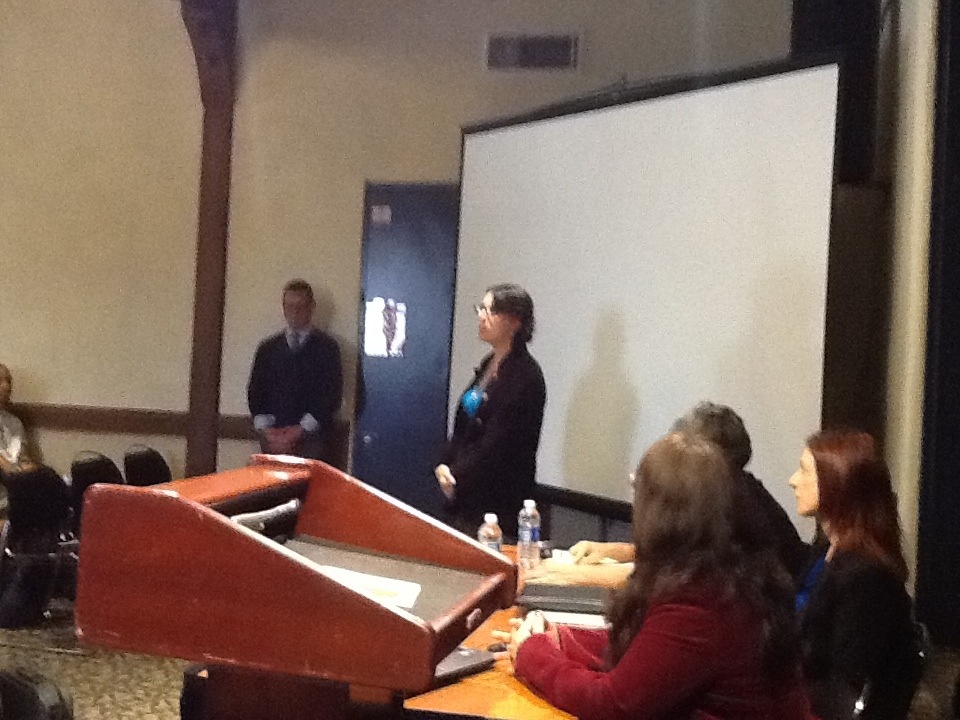
Many thanks to the San Diego State American Indian studies community for hosting today’s panel. Here are some pics.
David Kamper giving last minutes instructions:

Wenona giving her talk, “From Power Politics to Legal Duties: The Anatomy of Tribal-State Relations.”

The honoring of Linda Lockear:
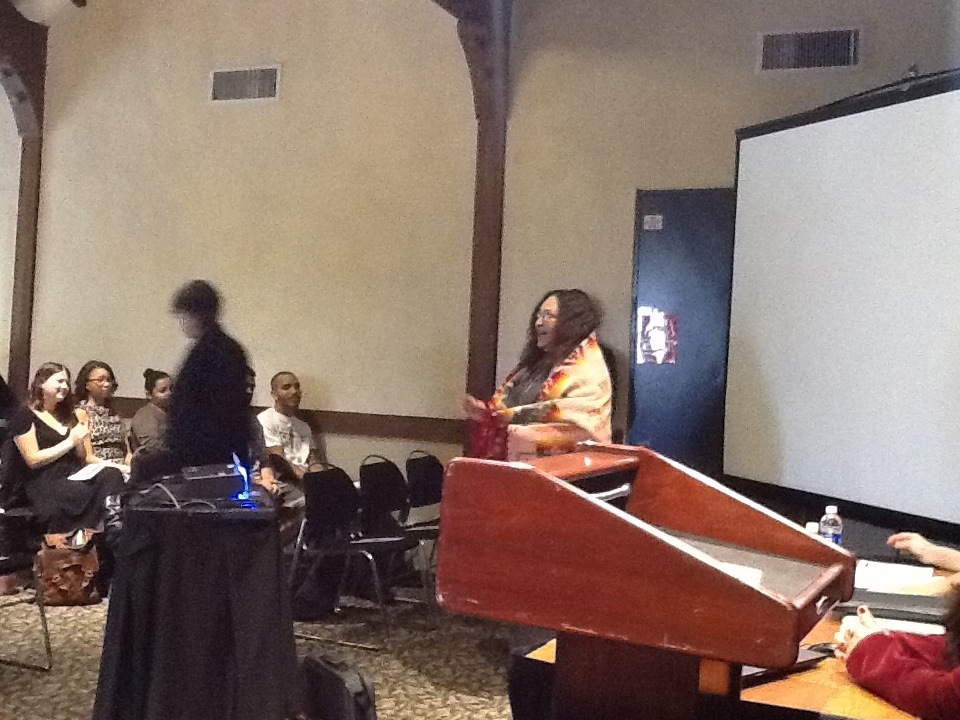
The other panelists, Devon Lomayesva, Michele Fahley, and Linda Parker:
No pics of me, but here are my notes, including my intentionally unfunny joke:

And finally, the bravest audience in the world, the people who sat underneath the scariest medieval chandelier in the Southern California:

 Turtle Talk
You must be logged in to post a comment.