Here is the unpublished order.
Briefs here.
Lower court materials here.
Here.
Here:
The National Indian Law Library added new content to the Indian Law Bulletins on 12/12/18.
Law Review & Bar Journal Bulletin (contact us if you need help finding a copy of an article)
https://www.narf.org/nill/bulletins/lawreviews/2018.html
Federal Courts Bulletin
https://www.narf.org/nill/bulletins/federal/2018.html
Seminole Tribe of Florida v. Biegalski (Doctrine of Claim Preclusion; State Taxation; Utilities)
Guardado v. Nevada (Prisoner Rights)
State Courts Bulletin
https://www.narf.org/nill/bulletins/state/2018.html
Everi Payments, INC. v. Washington State Department of Revenue (Business and Occupational (B&O) Tax Refund – Agency Law)
News Bulletin
https://www.narf.org/nill/bulletins/news/currentnews.html
In the Environment & Energy section, we feature an article about how the United Nations will scale up consideration of the experiences of indigenous peoples with climate change and efforts to respond to it.
Regulatory Bulletin
http://www.narf.org/nill/bulletins/regulatory/2018.html
We feature a notice of the Department of the Interior, Bureau of Indian Affairs, regarding land acquisition for the Dry Creek Rancheria Band of Pomo Indians, California.
Here are the materials in the long-running Cayuga Indian Nation v. Seneca County (W.D. N.Y.):
58 Cayuga Motion for Summary Judgment
Prior posts here.
Pathways to the Legal Profession: Identifying, Advising, and Supporting Native American Pre-Law Students
February 5-6, 2019 at the Isleta Resort and Casino, Pueblo of Isleta, New Mexico
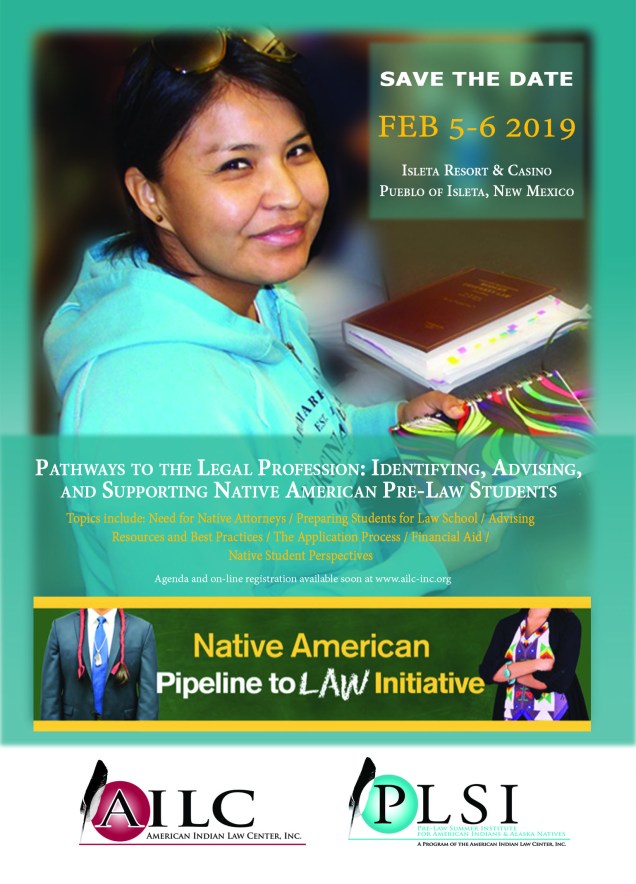
The American Indian Law Center, Inc. and the Native American Pipeline to Law Initiative are pleased to announce that registration is open for our Pre-Law Advisors Training. This training is designed for advisors to Native American pre-law students- this includes Native Studies educators, tribal educators, pre-law advisors, or those who may work with Native students and may direct them to law school.
The registration fee is waived for representatives from Tribal Education Departments, Tribal Colleges and Universities, and schools with Native American student enrollment. A limited number of travel reimbursements are still available. Details on the reimbursement, lodging, and the schedule are provided on the registration webpage.
Topics include:
Please email Rodina Cave Parnall, Pre-Law Summer Institute Director, with questions. caveparnall@law.unm.edu
Here are the materials in Everi Payments Inc. v. Washington State Dept Of Revenue:
D2 50791-9-II Published Opinion
Lower court materials here.
 Turtle Talk
You must be logged in to post a comment.