California
Final Report of the California ICWA Compliance Task Force
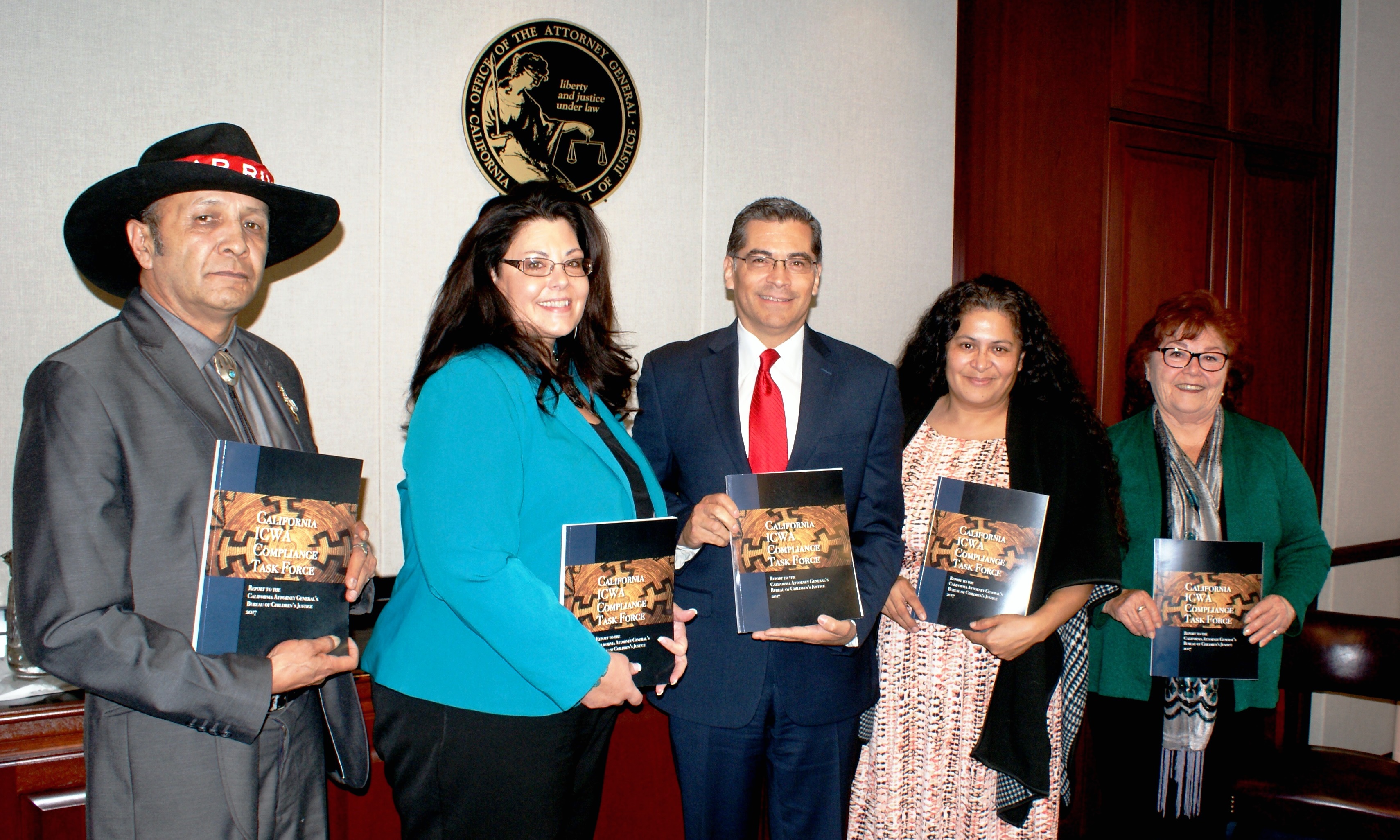
Supreme Court Denies Cert in R.P. v. LA County (Alexandria P. Case)
Order List here.
16-500 R. P., ET UX. V. LA CTY. DEPT. CHILDREN, ET AL. The motion of respondent The Minor, Alexandria P. for leave to proceed in forma pauperis is granted. The motion of respondent Father J.E. for leave to proceed in forma pauperis is granted. The petition for a writ of certiorari is denied.
This means the Supreme Court will not be hearing the case.
There are still a few issues in the California courts being litigated, so we will keep an eye on it, but this should (hopefully) be the end of this case.
Unpublished ICWA Notice Case out of California (First District)
Here.
The First District of California seems to be trying a new way to deal with notice violations in ICWA cases by detailing the mistakes in the notice in the opinion. The first time we saw it was in September (here). In this case, a different division in the same District did a similar analysis.
As to the Chippewa Cree tribe, the notice for G.B.-C. was sent to Chippewa Cree Indians, Brenda Gardiner, ICWA Rep, RR1, P.O. Box 544, Box Elder, Montana 59521. According to the Department’s proof of service, the notice for M.B.-C. was sent to the same address. The address specified for the tribe in the Federal Register was Chippewa Cree Tribe of the Rocky Boy’s Reservation of Montana, Christina Trottier, ICWA Director, 31 Agency Square, Box Elder, MT 59521. (79 Fed.Reg. 3225 (January 17, 2014).) Although the city, state and zip code were the same, the addresses were completely different.The Department asserts the notice was nevertheless adequate because the P.O. Box address it used to provide notice to the Chippewa Cree tribe was the one that was listed on the State Department of Social Services’s (CDSS) website.4The Department relies on In re N.M., supra, 161 Cal.App.4th at page 268, in which the court held the child welfare agency did not err in using the names and addresses provided by CDSS in notifying the relevant tribes, stating: “The Department should not be hamstrung by limitation to only the names and addresses provided for the tribes in the Federal Register if a more current or accurate listing is available and is reasonably calculated to provide prompt and actual notice to the tribes.While requiring the Department to adhere to an address listed in the federal register when other, more accurate information is available elsewhere “would exalt form over substance,” (In re N.M., supra, 161 Cal.App.4th at p. 268), we must still respect the Department of Interior’s primary authority in administering ICWA (In re S.B. (2005) 130 Cal.App.4th 1148, 1157 [the federal regulations implementing ICWA “are binding in all federal and state courts by virtue of the supremacy clause”] ). ICWA notice may depart from the addresses listed in the federal register, but only when the alternative address is “more current or accurate.” (In re N.M., supra, 161 Cal.App.4th at p. 268.)Here, there is nothing in the record indicating the CDSS address the Department used was more current or accurate than the address listed in the Federal Register. Thus, while the return receipt received for the notice sent for G.B.-C. shows that someone at the CDSS address received the notice, there is no basis to conclude the notice was received by someone at the Chippewa Cree tribe who was “trained and authorized to make the necessary ICWA determinations, including whether the minors are members or eligible for membership and whether the tribe will elect to participate in the proceedings.” (In re J.T., supra, 154 Cal.App.4th at p. 994.)”
Article on California’s Report on ICWA (non) Compliance
Report: Compliance with Indian Child Welfare Act Spotty
The report found that state and local agencies still struggle with the law, according to Kimberly Cluff, a task force member and staff member of the Morongo Band of Mission Indians. She said the tribes feel like they’re at “ground zero.”
“The law provides the tribes and, more importantly, tribal children with a bunch of rights, but if the tribe doesn’t know the child is in foster care, or if nobody asks the question of family tribal status, then all those protections are lost,” Cluff said. “If we don’t know that child is an Indian, we can’t protect them as an Indian and it’s just somewhat shocking that 40 years after the passing of this law, we’re still talking about basic implementation.”
A copy of the Report is here.
Preliminary Report on from California’s ICWA Compliance Task Force
Prelim Final – CA ICWA TF Report 6.10.2016
SACRAMENTO – Insufficient services, severe underfunding, barriers preventing tribal participation and inadequate reunification efforts have undermined the effectiveness and promise of the Indian Child Welfare Act (ICWA) in California, according to a preliminary report from a Task Force of tribal leaders from across the state, working independently to apprise the California’s Attorney General’s Bureau of Children’s Justice of these inadequacies.
The ICWA Compliance Task Force’s report recognizes that efforts have been undertaken to overcome cultural, procedural and funding challenges, but these ongoing obstacles continue to severely limit the implementation of ICWA in California, resulting in devastating impacts to Indian children, their families and their tribes.
California ICWA Task Force Information and Survey
Recently the California Department of Justice, Bureau of Children’s Justice, established an ICWA compliance task force with a goal of examining ICWA non-compliance in California. In support of this effort tribal leaders have come together to provide information to assist the California DOJ in looking at ICWA compliance issues, including cases involving non-California tribes. This project is an opportunity for all tribes to provide feedback on these important issues.
Letter to tribal leaders from task force co-chairs.
Letter to tribal leaders from California AG.
There is both a call (details in first letter) and a survey is for any tribe with children in the California system, not just California tribes. Survey is here and is due by January 15.
Questions can be directed to Delia Parr at CILS, CALINDIAN@calindian.org
Three Recent California ICWA Cases
Reported case on notice, where the social service agency attempted to fix the notice issues while the case was on appeal. Fourth District remanded for proper notice.
An unreported case where the trial court refused to apply ICWA because of a lack of written communication from the tribe, though the agency received verbal confirmation of the children’s membership. The case was reversed, also by the Fourth District.
Finally, an unreported case using the “family lore” argument to find there was no notice necessary. Haven’t seen a family lore case in California since 2011. Those cases were all out of the Second District, while this one is out of the First.
Poetry Submissions Sought from Native Americans in or from California
CALL FOR POETRY SUBMISSIONS FOR ANTHOLOGY
Deadline: June 1, 2015
Red Indian Road West:
Native American Poetry from California
To be published by Scarlet Tanager Books:
http://www.ScarletTanager.com
Who should submit? Native American poets from California tribes as well as poets from tribes nationwide who were born or currently live in California. All poems submitted should relate directly or indirectly to Native American experience in California. Please send 3 to 5 poems, tribal affiliation, and a short bio (no longer than 150 words) to Lucille Lang Day: lucyday[AT]scarlettanager[DOT]com. Either a Word .doc attachment or pasted text is okay. Payment is one copy of anthology.
Editors:
Luke Warm Water (Oglala Lakota) has been published in Shedding Skins: Four Sioux Poets (Michigan State University Press, 2008) and in many literary magazines and anthologies. He was a featured poet at the prestigious Geraldine R. Dodge 12th Biennial Poetry Festival. Luke’s poetry collection City Tree of Concrete and Hope received an Artists Embassy International literary/cultural award in 2013.
Lucille Lang Day (Wampanoag) is the author of ten poetry collections and chapbooks, including The Curvature of Blue, Infinities, and Wild One. Her chapbook Dreaming of Sunflowers: Museum Poems won the 2014 Blue Light Poetry Prize and Chapbook Contest and will be published in 2015. Her full-length collection Becoming an Ancestor will appear in 2015 from Červená Barva Press.
__._,_.___
Three Remanded for ICWA Notice Deficiency Cases out of California
Cases from the Second District, the Fourth District and the First District.
From the Second District:
Before the next scheduled hearing on January 31, 2013, DCFS submitted the following documents to the court: signed return receipts for the entities noticed; a letter from the Bureau of Indian Affairs acknowledging receipt of the ICWA notice but indicating it does not determine tribal eligibility; a letter from the United Keetoowah Band of Cherokee Indians in Oklahoma declining to intervene in the case because there was no evidence T.M. was a descendant of anyone on the Keetoowah Roll based on the information supplied; a letter from the Cherokee Boys Club, Inc., on behalf of the Eastern Band of Cherokee Indians, declining to intervene in the case because T.M. was neither registered nor eligible to register as a member of the tribe based on the information supplied; and a letter from the Cherokee Nation seeking further information. The Cherokee Nation letter asked DCFS to “verify correct spelling of maternal great great grandmother Lual Made [D.], also need her date of birth. Relationship of Eleonora [H.] to the above named child. [¶] We need dates of birth for everyone involved, their relationship to the child or children in question, and maiden names of all females listed. It is impossible to validate or invalidate this claim without more complete information.” (Boldface and capitalization removed.)
At the January 31, 2013 hearing, which was presided over by a different hearing officer than Commissioner Lewis, the court stated the tribes were properly noticed and it had received letters back from the tribes indicating T.M. was not an Indian child. The court found the ICWA did not apply. The court did not acknowledge the Cherokee Nation’s request for further information.
Just spit balling here, but maybe the reason Cherokee Nation puts part of its response in BOLDFACE CAPITALIZATION is to help a state court out, so it doesn’t find ICWA doesn’t apply when it might.
 Turtle Talk
You must be logged in to post a comment.