QuaranTICA COVID and Child Welfare Panel

Today:

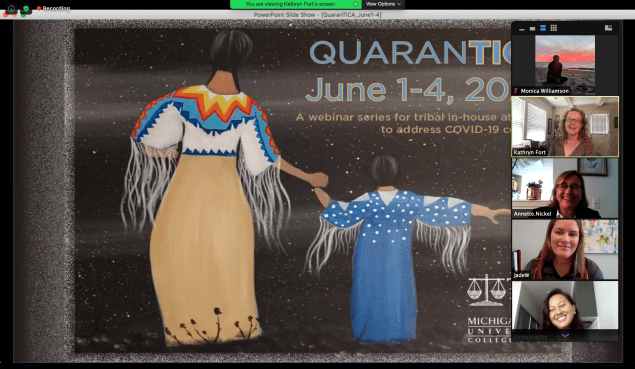
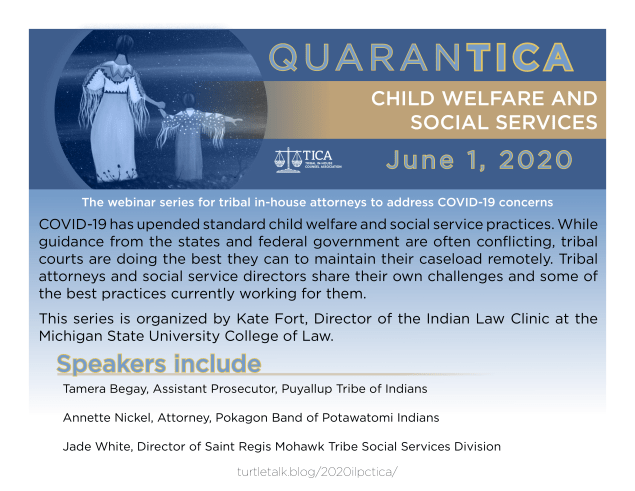
Kate Fort, ILPC; Annette Nickel, Pokagon Band of Potawatomi Indians, Jade White, Saint Regis Mohawk Tribe, Tamera Begay, Puyallup Tribe of Indians.

QuaranTICAChildWelfareSocialServices

I’m awfully biased, but I thought it was a great panel, and a much needed good talk with some really amazing women today.

June 1 QuaranTICA: Child Welfare and Social Services

QuaranTICAPanelDescriptions_ChildWelfare_01


Learn more about QuartanTICA, speakers, and registration here.

CB Letter to State and Tribal Leaders Regarding Families First and Kinship Funding

Child-Welfare-Leader-letter-on-Kinship-Nav-and-Transition-Grant-flexibilities-002

The Family First Transition Act authorized and appropriated $500 million for this new one-time grant to assist with implementation of FFPSA and other child welfare activities. The funding is available to all states, territories and tribes approved to receive grants * * * in light of the current public health emergency and the increased burdens facing child welfare agencies, the Children’s Bureau has determined that we will not require a separate application for this funding. Instead, the Administration for Children and Families (ACF) will proceed to make awards to all eligible grantees as soon as possible. Acceptance of the grant by the agency will indicate its agreement to provide required programmatic and financial reports.

Parenting Time in Michigan during Pandemic

Adding this to the Covid Child Welfare page, but this is very distressing. I’m also not sure how states are allowing co-parenting plans to continue, but denying any in person parenting time. There’s no easy answer, but this is heartbreaking.

Kevin S. Settlement Agreement Involving New Mexico Child Welfare and Includes ICWA

Here

Indian Child Welfare Act
  • A State ICWA law that mirrors and expands upon the federal version and that will be drafted with the Administrative Office of the Courts and with New Mexico Tribes and Pueblos
  • Processes and procedures to promote traditional interventions as first-line interventions and services, developed with the input of New Mexico’s Tribes and Pueblos
  • Federal funding for traditional and culturally responsive treatments, interventions, and supports, including non-medicalized interventions
  • A plan to increase recruitment and retention of Native resource families
  • A policy to provide or ensure provision of direct assistance for traditional ceremonies, including arranging for all preparation and providing payment if needed, if Native Children want to participate

Cool Pro Hac Update from Ho-Chunk Nation

HCN has updated their own tribal rules of civil procedure to allow for a pro hac waiver in tribal court for child welfare cases:

(C) Counsel not admitted to practice before the Ho-Chunk Nation Courts, but seeking to appear on behalf of a federally recognized Indian tribe in a proceeding regarding a petition for guardianship or for child protection over a child who is a member of that tribe, or eligible for membership in that tribe, shall be permitted to appear without paying any fee. Counsel representing an Indian tribe in such a matter shall also be permitted to make their appearance without filing a motion for special appearance, provided that, at that appearance, said counsel states on the record that they are admitted to practice in another state, federal, or tribal jurisdiction; that they have been in actual practice for two or more years, and takes the oath or affirmation for practice. This rule shall not apply to attorneys who appear on behalf of the Ho-Chunk Nation.

HCN Civ. Pro. R. 16(c)

We’ve updated the pro hac page accordingly.  Obviously these are not ICWA pro hac waivers, but are related and can be used to show comity in this area.

Latest on Paul Petersen Adoption Scam from Maricopa Co.

Here

Bill C-92, An Act Respecting First Nations, Inuit and Métis Children, Youth and Families

Government Bill (House of Commons) C-92 (42-1) – Royal Assent – An Act respecting First Nations, Inuit and Métis children, youth and families – Parliament of Canada

Somehow the final passage (“royal assent”) of this bill in Canada slipped our attention back in June. Initially, we saw it referred to as a “Canadian ICWA”, but it seems fair to say that it doesn’t quite achieve that level of protection for Native children and families. If nothing else, it illustrates just how differently the Canadian government engages with the tribal nations within its borders compared to the U.S.. We want to add a large caveat, which is that none of us are experts on Canadian law or child welfare.

However, those that are put together a really helpful publication which is available here, and is well worth your read (it made us think about if ICWA would get passing grades):

does-bill-c-92-make-the-grade_-full-report

From the Jurisdiction section of the report:

Why We Give the Bill a ‘D’ on this:

IN A HISTORIC FIRST FOR CANADA, the Bill purports to recognize Indigenous peoples’ inherent jurisdiction. For example, section 8(a) of the Bill affirms “the rights and jurisdiction of Indigenous peoples in relation to child and family services”. This positively worded language is also noted in the Bill’s introduction and summary. Similarly, section 18(1) states that the “inherent right of self-government recognized and affirmed by section 35 of the Constitution Act, 1982 includes jurisdiction in relation to child and family services, including legislative authority in relation to those services and authority to administer and enforce laws made under that legislative authority.” Section 18(2) affirms that this right includes the right to “provide for dispute resolution mechanisms.”

As there are no section 35 cases that recognize an inherent right of self-government for Indigenous Peoples or that have recognized an Aboriginal or Treaty right over child and family services law-making, this is a significant step forward.

This is not, however, a recognition of jurisdiction that removes all federal or provincial oversight, power or intervention. By recognizing jurisdiction over child and family services as a section 35 right, the federal government immediately re-asserts its power to unilaterally infringe or limit that right, a power upheld by court cases such as Sparrow. The legislation sets legal limits in terms of Indigenous laws being subject to Charter and Canadian Human Rights Act and the BIOC. It also sets practical limits in terms of the virtual necessity of negotiating coordination agreements with the federal and provincial governments, and in the glaring absence of any provisions for funding. At best, this could be interpreted as an acknowledgment of concurrent (or shared) jurisdiction, a matter on which Bill C-92 should be more clear.

***

Further, section 23 states Indigenous laws only authoritative if they can be applied in a way that “is not contrary to the best interests of the child.” As previously stated, Indigenous laws have upheld the best interests of Indigenous children for thousands of years. The concern about this limit is how the BIOC doctrine has been interpreted and applied by courts, non-Indigenous governments and decisions makers to apprehend Indigenous children and separate them from their families, communities and territories for the past 50 plus years.
Dry Creek Child Advocacy Skills Training

October 23-25, 2019

Healdsburg, CA

Dry Creek Child Advocacy Skills Training Save The Date PDF.


Dry Creek Child Advocacy Skills Training Save The Date.png


Tribal Courts and Child Welfare Podcast Series from ACF

Here.

Tribal Courts and Child Welfare Series