This issue has been the subject of repeated investigative journalism articles from Civil Beat in Hawaii. Here is the latest regarding an adoption attorney in Texas:
Original Report (with a number of additional articles and links)
This issue has been the subject of repeated investigative journalism articles from Civil Beat in Hawaii. Here is the latest regarding an adoption attorney in Texas:
Original Report (with a number of additional articles and links)
American Indian Children and the Law by Kathryn “Kate” E. Fort, Director of the Indian Law Clinic at Michigan State University College of Law, is now available. Click here to order.
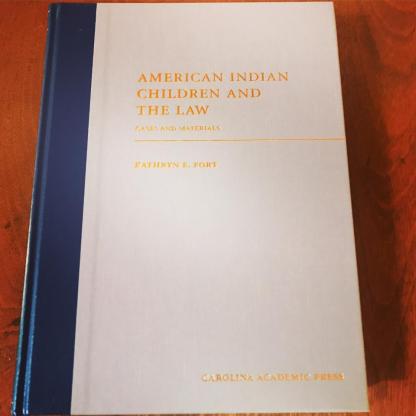
“Introduction: This casebook is the result of years of discussions with Native lawyers, law students, families, tribal leaders, and professors. Because Native children and families continue to be the subject of constant litigation and federal policy changes, this book changed dramatically in the years as it was being written. The actions of federal and state governments against Native children — removing them from their families, culture, language, and communities — has had far ranging implications for generations of families. This casebook discusses the consequences of those actions and the tribal responses to them.”
Not sure what’s in the water today, but here.
Also, not innovative and I’m going to go with illegal:
An investigative report by WDRB in Louisville, Kentucky recently exposed a particularly innovative — although likely illegal — method that the state’s child protective services caseworkers came up with to remove children from their families without court approval.
According to the report, Cabinet for Health and Family Services workers kept stacks of blank emergency removal orders that were pre-signed by local district court judges. This allowed caseworkers to take custody of children without having a judge properly review the allegations or evidence beforehand. Attorneys and judges interviewed for the report compared the practice to a police officer creating their own search warrant without a judge’s approval.
This case is not an ICWA case, but for those who work in this area, it is a familiar fact pattern, and one of the rare times the appellate court overturned the TPR based on lack of evidence. In addition, the press covered both this case, and did a second article on what it means to have “confidential” child welfare cases and provides a fair amount of nuance.
Opinion: 1 CA-JV 18-0322
We hold that a termination based on fifteen-months’ out-of-home placement requires the court to consider the totality of the circumstances throughout the dependency when determining whether the Department of Child Safety (“DCS”) made a diligent effort to provide appropriate reunification services, including whether DCS’s failure to act reasonably and diligently contributed to the circumstances causing the child to remain in out-of-home placement. We further hold that a request through the Interstate Compact on the Placement of Children (“ICPC”) is not required when the evidence does not support a dependency concerning the out-of-state parent.
Dad was not married to mom and did not know the child had gone into DCS care at birth. When he contacted the case worker, he was deemed immediately unfit.
Relating to Father, the primary cause of Melody’s out-of-home care was the court’s dependency finding in May 2015. At that time, no evidence showed that Father was an unfit parent, or that living with Father was contrary to Melody’s welfare. Melody had been in DCS’s custody since birth. Father contacted DCS when Melody was less than one month old. Nevertheless, without any investigation, DCS filed a petition alleging that Melody was dependent due to abuse or neglect as to Father.
***
Despite Mother’s deception in telling Father that he was not Melody’s father, he called Mother’s husband, found out Melody was in DCS’s care, and immediately contacted DCS requesting a paternity test. The case manager told Father to contact the juvenile court, which he did. Father diligently complied with the ordered paternity test, appeared for the hearings, participated in parenting classes, and contested the allegations in the dependency petition.
DCS also required an ICPC (interstate compact on the placement of children) review for the child to be placed with her father in California–though again, there was no actual evidence of unfitness. This is a fact pattern we have dealt with in ICWA cases out of Arizona as well.
An ICPC is not required when evidence does not support a dependency as to the out-of-state parent. See In re Emoni W., 48 A.3d 1, 6 (Conn. 2012) (ICPC does not apply to out-of-state non-custodial parent); accord In re C.B., 116 Cal. Rptr. 3d 294, 302 (Cal. Ct. App. 2010); In re Alexis O., 959 A.2d 176, 182 (N.H. 2008). An ICPC is intended for out-of-state placement of a dependent child. A.R.S. § 8-548, art. II(d) (“’Placement’ means the arrangement for the care of a child in a family free or boarding home or in a child-caring agency . . . .“); A.R.S. § 8-548, art. III(a) (“No sending agency shall send, bring, or cause to be sent or brought into any other party state any child for placement in foster care or as a preliminary to a possible adoption [without complying with the ICPC].” (emphasis added)).
***
Thus, when DCS discovers that a child in its care has an out-of-state parent, the regulation allows it—in addition to the conventional mechanisms it employs to investigate a parent—to request a courtesy check from the parent’s home state. Accord In re Emoni W., 48 A.3d at 11 (an agency can investigate an out-of-state parent without an ICPC). The ability to request a courtesy check, however, does not authorize DCS to hold a child in its care for an indeterminant amount of time simply because it lacks an ICPC approval. Unless DCS has a reasonable basis for believing the out-of-state parent is unfit, it must turn over the child to the parent.
The Court cited to Vivek Sankaran’s article on this very issue, Vivek S. Sankaran, Out of State and Out of Luck: The Treatment of Non-Custodial Parents Under the Interstate Compact on the Placement of Children, 25 Yale L. & Pol’y Rev. 63, 80 (2006).
By all accounts, dad was a good dad to his other children in California. The trial court went on to terminate parental rights regardless.
Reading this opinion should be infuriating. The visitation “plan” alone makes a person’s heart rate climb to unhealthy levels on a plane, as my watch unhelpfully pointed out (“DCS falsely claimed lied and said that “Father ha[d] failed to keep most of the weekly appointments for telephonic contact with the child.” ¶62 The foster mother reported that Father missed only five calls of the fifty days on which Father would have been scheduled to call in that period.”), and is a reminder of the absolute need for very good individual party attorneys in the child welfare system. This is a well written and well reasoned opinion by the Court of Appeals.
Here.
While the Court of Appeals found that the grandmother didn’t have standing and properly dismissed the case, opinion notes the Tribal Court had already been exercising jurisdiction over the child in a concurrent child custody matter.
Here. DUE JULY 22.
This one is arguably a little more complicated than usual, but also not inherently nefarious. Here’s a very quick overview (with thanks to Jack Trope for his recent presentation up at Grand Traverse Band for all the info).
In somewhat of a surprise development, Congress passed an overhaul to Title IV-E a few months ago. Title IV-E is the reimbursement program for foster care funding. Until this change, called Families First, the funding was triggered both by the removal of the child, and by the family’s income qualification.
Families First does two things–it releases funding for children who are “candidates” for foster care and removes the income qualification for services for those children and families. Allowable pre-removal services include “evidence-based”:
1. Mental health prevention and treatment services
2. Substance abuse prevention and treatment
3. In-home parenting-skill based programs
“Evidence based” Services and programs must be “trauma-informed” and “promising”, “supported”, or “well-supported” practices. HHS is to release practice criteria and pre-approved programs. There are long definitions in the quotes above, but basically:
Promising: one study with a control group
Supported: one study with random control or quasi-experimental
Well-supported: is at least two studies that used a random control or quasi-experimental trial
Finally, HHS must allow programs and services adapted to culture and context of a tribal community. No one really knows how this provision will interact with the evidence based provision above. This call for comments “solicits comments by July 22, 2018 on initial criteria and potential candidate programs and services for review in a Clearinghouse of evidence-based practices in accordance with the Family First Prevention Services Act of 2018.”
The HHS approved list of programs (“Clearinghouse”) will be automatically eligible for the funding. So! If you are provider who knows about such evidence-based practices for tribal youth and families, TELL HHS! Alternatively, if you work for a tribe, you might ask about how tribal consultation will fit into this process.
This may also be a partial game changer for tribes on the fence about doing direct IV-E funding with the federal government. The planning grant for that process should pop up again in the spring.
The United Nations Expert Mechanism on the Rights of Indigenous Peoples joins the concern expressed by the United Nations High Commissioner for Human Rights and others regarding the situation of families, children, and individuals being detained in the United States of America at its southern border with Mexico. We call on the United States immediately to reunite children, parents, and caregivers that have been separated to date, and to ensure their basic human rights to family, safety, and security.
In addition, the Expert Mechanism calls attention to the particular impact of the United States’ practices regarding international border detentions and prosecutions on indigenous peoples. Many of the individuals now being stopped at the border are of indigenous origin, including Kekchi, Tzutujil, Kacqchikel, and Mam-speakers and other Maya from Guatemala, as well as indigenous peoples from Honduras, El Salvador, Mexico, and other countries. In many instances, they are fleeing situations of economic, social, and political unrest in their homelands where they have been denied rights to self-determination and territory, and have faced discrimination and violence.
The Expert Mechanism expresses particular concern regarding the vulnerability of indigenous children. Many countries, including the United States, have a long history of forced removal of indigenous children from their families, a practice that is now universally condemned by the human rights communities and by federal law in the U.S. because of the trauma it causes to children, their families, and their communities.
More broadly, indigenous peoples, whether migrants or not, have rights under international
instruments including the UN Declaration on the Rights of Indigenous Peoples, supported by 148 nations across the world, including the United States. These include the right to maintain indigenous cultural identity, to be free from forced family separation, to speak their languages (and have translation services), to be free from discrimination and violence, and indeed to migrate. In some instances current international borders cross indigenous peoples’ homelands, including in the case of the Yaqui and Tohono O’odham people who have territory and family members on both side of the Mexico border. We call on the United States to recognize the particular situation of indigenous peoples in its border practices and policies and to uphold the rights and responsibilities set forth in the Declaration on the Rights of Indigenous Peoples.
Also, here is Mark Trahant’s piece, our previous post with NAICJA’s statement, and NCJFCJ’s statement (which went out on our Twitter feed but not here).
At the Michigan Supreme Court:
Appellee (Macomb County/State)’s Brief
Sault Tribe Amicus Brief (MSU Indian Law Clinic, ICWA Appellate Project co-wrote this brief)
Coverage of some of the tremendous problems with Canada’s foster care system.
According to a report from B.C.’s representative for children and youth, although Indigenous children are less than 10 per cent of the population, they account for 62 per cent of children in government care.

 Turtle Talk
You must be logged in to post a comment.