POSTPONED: CLE on Native American Tribal Claims and Federal Jurisdiction on Oct. 9

Register here

October 9, 2023 | 12:00 p.m. – 2:00 p.m.
Castle Board Room
Live Stream also available

Minnesota Credits Pending Approval: 2 hours

Course Description
Native American Tribes and Nations are self-governing sovereigns that exist simultaneously within the United States, yet separate and apart from many Federal and State laws and institutions. This panel explores the unique claims of American Indians and Alaska Natives and the Tribes, Nations, Pueblos, and Rancherias to which many belong. Specifically, it will analyze the Indian Tucker Act and its implications on Native American tribal claims within the United States. Participants will gain a thorough understanding of the jurisdictional scope and the substantive legal principles underlying tribal claims against the federal government within the United States Court of Federal Claims.

Attendees will delve into the complexities of tribal claims and fiduciary duties, while examining the historical context and legal frameworks that underpin these disputes.

Kathryn Fort, Clinic Director, will provide introduction and welcome. This panel of participants will include Judge David A. Tapp of the United States Court of Federal Claims; Joel West Williams, Deputy Solicitor for Indian Affairs in the Department of Interior; Frank Singer, senior litigation counsel with the Environment and Natural Resources Division of the U.S. Department of Justice, representing the Defendant’s perspective; and Thomas Peckham of Nordhaus Law Firm, LLC representing the Tribal Plaintiffs’ perspective.
UNLV Law CLE on Brackeen, Sept. 20

Here

After Brackeen: Outcomes and Implications of the Supreme Court’s Decision Upholding the Indian Child Welfare Act

Approved for 2 Nevada MCLE Credit

September 20, 2023

Virtual
10:00 a.m. – 12:00 p.m (Pacific Time)

Registration is required

Click Here To Register for The Virtual Webinar

~~~~~~~~~

In Person UNLV Student Viewing and Discussion (Lunch Provided)

10:00 a.m. – 12:00 p.m (Webinar Viewing) / 12:00 p.m. – 1:00 pm (Discussion)

Boyd School of Law Room 203

In Person Registration is required

Click Here To Register For the Student Only In Person Discussion


In June, the Supreme Court issued its long-awaited decision in Brackeen v. Haaland upholding the federal Indian Child Welfare Act. Enacted in 1978, the ICWA affirms tribal jurisdiction over state child welfare matters and sets uniform standards for child welfare cases involving Indian children. As the Court recognized, the law was a necessary and largely successful action by Congress to reverse decades of federal and state campaigns to remove Native children from their homes and sever ties between tribes and their children. The Court rejected several challenges to the law that, if accepted, would have had devastating consequences for children, families, and tribal sovereignty. 

Brackeen was a major victory for tribes and Native children. The majority opinion by Justice Barrett, and concurring arguments by Justice Gorsuch, addressed questions about Congressional power over Indian affairs, tribal sovereignty, and equal protection. As a follow up to our November 2022 webinar, which explored the various arguments and the impact of a potential decision on tribal courts and jurisdiction, this webinar will bring together experts in the field to explain the decision, its practical and jurisprudential significance, and what it portends for future cases involving the ICWA and tribal sovereignty. 

Featured Panelists:

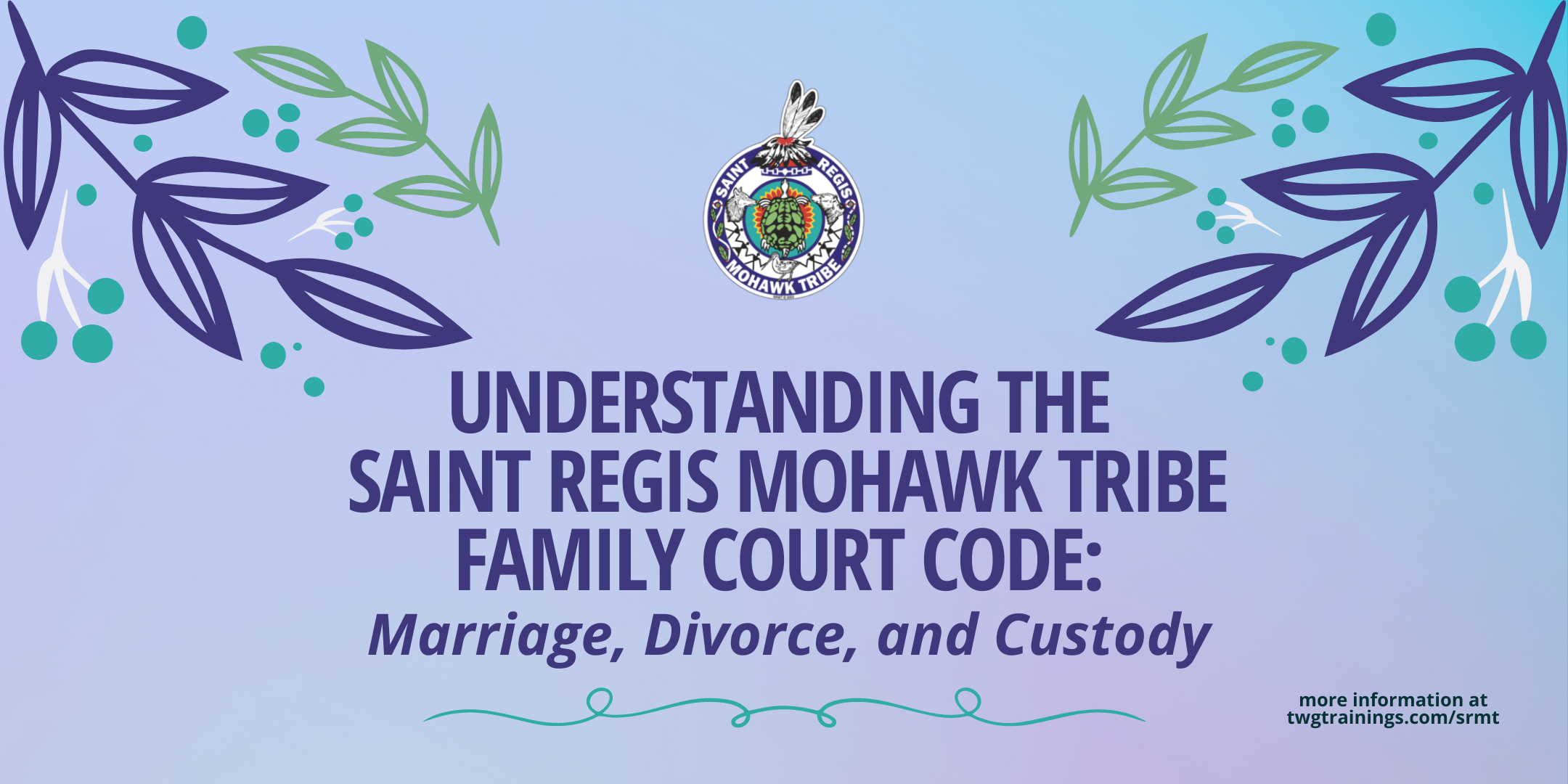
Free CLE on Saint Regis Mohawk Custody and Marriage Code on Aug. 30

Understanding the SRMT Family Court Code CLE (2160 × 1080 px))updated

Training is August 30 at 12pm. Kate Fort and Ron Whitener are presenting. Registration is here:

Event Registration

Information at Training Link

The CLE is hosted by the Saint Regis Mohawk Tribe and sponsored by the New York State Child Welfare Court Improvement Project. This program is pending approval by the NYS Unified Court System, Office for Justice Initiatives, Division of Policy and Planning in accordance with the requirements of the NYS Continuing Legal Education Board. This training is free of charge and is appropriate for both newly admitted and experienced attorneys.

WSBA Indian Law Section CLE, June 16-17

Registration here.

Thursday, June 16 | 8am – 1pm PT

  • Judicial Updates
  • Makah Whaling Rights and MMPA Waiver
  • Ecology Department’s Refusal to Consider Unadjudicated Reserved Treaty Water Rights for Instream Flow
  • State and Federal Consultation with Tribes: The Climate Change Commitment Bill and National Archives Case Studies
  • Treasury Department Funding Distributions and Relations with Tribes
  • Tribal Sovereign Immunity and Individual Liability of Tribal Officials

Friday, June 17 | 8am – 1pm PT

  • Tribal Laws and Accommodating Employee Vaccine Objections; Learning from the Pandemic
  • Growing Food Sovereignty Through Tribal Agricultural Enterprise
  • Brackeen in the Supreme Court
  • Hemp and Other Economic Development Models
  • Shopbell v. WDFW Seizure Claims
  • Ethics issues and Conflicts of Interest Analyses in a Small Legal Community

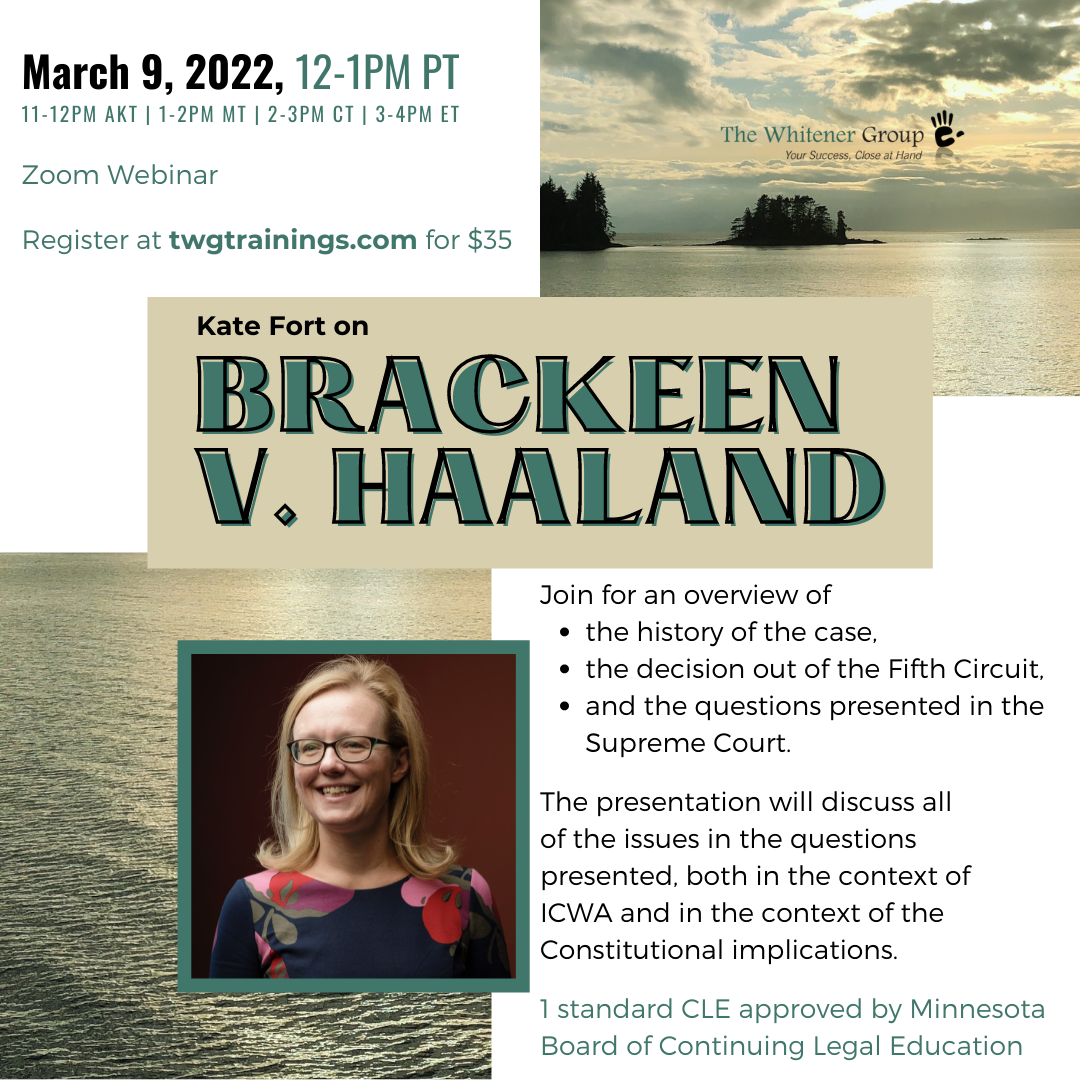
Brackeen/ICWA CLE from Fort

Since we all now have to deal with it, might as well deal with it together:

022822_BrackeenWebinar_Flyer

Indian Law CLE: “Cutting Edge Indian Law Issues: McGirt v. United States Ramifications and Indian Child Welfare Act Constitutional Challenges”

This Indian law CLE is hosted by Thomas Reuters West LegalEdcenter and is available for on-demand viewing. See more information here.

Program Description:

“Under an 1833 treaty, the United States and the Muscogee (Creek) Nation agreed to set aside land for the latter’s occupation in the Indian Territory, now encompassed within the eastern half of the State of Oklahoma. An 1866 treaty reduced the reservation’s size.  Following the influx of non-Indian settlers in the latter half of the century and passage of various federal statutes to establish a uniform set of laws for both Oklahoma Territory and Indian Territory residents, Congress in 1907 admitted Oklahoma to statehood whose boundaries combined the Territories. Thereafter, the State and its courts treated the Creek Reservation as disestablished and all residents, regardless of Indian status, as subject to state law. In a 5-4 decision, however, the Supreme Court held that the Reservation remained intact and overturned state-law felony convictions of Jimcy McGirt, an Indian, for conduct within the Reservation. The majority reasoned that that the Reservation was not disestablished by Congress and therefore remains Indian country subject the Major Crimes Act, 18 U.S.C. § 1153, and not state criminal law with respect to offenses committed by Indians of the type for which McGirt was convicted. McGirt v. United States, 140 S. Ct. 2452 (2020).  

The McGirt decision raises substantial Indian-law doctrinal issues beyond the immediate question of reservation disestablishment. Ann E. Tweedy, Associate Professor, University of South Dakota Knudson School of Law, will explore those issues, particularly in light of other recent Supreme Court decisions and the Court’s changing composition. Anthony J. “A.J.” Ferate, Of Counsel, SpencerFane, is an Oklahoma practitioner with broad legal and governmental experience and will discuss McGirt’s on-the-ground impact. 

The United States, four Tribes, the State of Texas, and private parties filed petitions for writ of certiorari in September 2021 seeking review of the Fifth Circuit’s closely-divided en banc opinion in Brackeen v. Haaland, 994 F.3d 249 (2021). In complex and multi-pronged constitutional challenges to various provisions of the Indian Child Welfare Act and Administrative Procedure Act-based challenges to regulations issued by the Secretary of the Interior to implement ICWA, the court of appeals affirmed in part, reversed in part, and affirmed in part by an equally divided court without a precedential opinion a district court judgment that had accepted most of the challenges. Brackeen v. Zinke, 338 F. Supp. 3d 514 (N.D. Tex. 2018). It appears likely that the Supreme Court will grant review. Christina M. Riehl, Deputy Attorney General, California Department of Justice, Bureau of Children’s Justice, has been involved in the litigation from its outset through amicus filings on behalf of California and will discuss the constitutional issues raised by the certiorari petitions. 

The program will be moderated by Tania Maestas, Deputy Executive Director, Attorney General Alliance.”

Two In-Person CLEs: Friday, October 15th

2021 Indian Law Seminar: Reconnecting Our Sovereign Nations

Friday, October 15, 2021 from
8:00 AM to 6:30 PM CDT

Where:
Mystic Lake Casino Hotel
2400 Mystic Lake Blvd.
Prior Lake, MN 55372

In previous years, the tribal leaders, scholars, and practitioners of our Indian law community gathered at the Federal Bar Association’s annual Indian Law Conference to share our knowledge, triumphs, and trials in the pursuit to protect the sovereignty of our tribal nations. As we return to congregating safely, our members now have the opportunity revive these important gatherings. In the spirit of perpetuating community, connection, and education in the Indian Law community, the Minnesota chapter of the Federal Bar Association along with the Minnesota American Indian Bar Association, the national FBA’s Indian Law Section, the New Mexico Chapter of the FBA, presents the 2021 Indian Law Seminar: Reconnecting Our Sovereign Nations. This seminar will run simultaneously with a seminar in New Mexico, and attendees will hear from two live panels and two simulcast panels in each state for CLE credit.

PDF version here.

Agenda available here.

New Mexico Chapter: Indian Law Seminar

October 15 @ 8:00 am – 3:45 pm MST

Where:

Sandia Resort & Casino, 30 Rainbow Rd
Albuquerque, NM 87113

This event is the first of its kind within New Mexico and Minnesota. We will be hosting live sessions in both states while providing live simulcast to our partner state. Our aim is to provide participants in both states and surrounding jurisdictions with content relevant to attorneys who practice in the field of Federal Indian law.

Topics include:
U.S. Supreme Court’s decision in United States v. Cooley
ICWA, State ICWA laws, and possible implications of Brackeen v. Haaland
Native Americans and the Criminal Justice System
Yellen v. Confederated Tribes of the Chehalis Reservation

Note: We have added a virtual participation option also! The cost is the same, so please register using the link below, and then email Roshanna Toya at roshannak.toya@gmail.com to request a link to the presentations.

Brackeen 1 Hour CLE Next Week

Registration Link: https://www.twgtrainings.com/brackeen-decision

Kansas Indian Law CLE January 29

Here is the announcement.

Not to be too promotional, but they got three pretty solid presenters (no manel here!) for this CLE: 

Working for Tribal Clients – Ethics
An overview of ethical responsibilities and obligations of legal practitioners who represent tribal clients, including tribal nations, tribal organizations and tribal members. (1.0 Ethics CLE)
Presented by: Vivien Olsen, Managing Attorney for the Legal Assistance to Victims program of the Kansas Coalition Against Sexual and Domestic Violence.
 
Indian Child Welfare Act: Litigation and Legislation
Are you familiar with ICWA (1978)? Any attorney practicing in family law or child-related cases will benefit from this session where Professor Kate Fort will review ICWA and key cases from 2019 and 2020, including recent state legislation and court rules adopted to protect ICWA. (1.0 General CLE)
Presenter: Professor Kate Fort, Michigan State University, Indian Law Clinic
 
The Violence Against Women Act & the Missing and Murdered Indigenous Persons Crisis
4 in 5 Indigenous women will experience violence in their lifetimes. – National Institute of Justice Report
 
This session will discuss the re-authorization of VAWA efforts over the past two years and will discuss the most recent efforts to pass legislation that will address the crisis of missing and murdered Indigenous Persons in the United States. (1.0 General CLE)
Presented by: Mary Kathryn Nagle, member of Cherokee Nation, partner at Pipestem Law PC

Southwest Indian Law CLEs

The first one has passed, but the rest are still available and free!