Alex Fay on Elk v. Wilkins

Alexandra Fay has posted “”Subject to the Jurisdiction Thereof”?: Citizenship and Empire in Elk v. Wilkins,” forthcoming in the Washington & Lee Law Review, on SSRN.

Here is the abstract:

In 1884, the Supreme Court held that the Fourteenth Amendment’s guarantee of birthright citizenship did not apply to Native Americans. In Elk v. Wilkins, the Court denied John Elk the right to vote on the grounds that he was born a tribal member, not subject to the jurisdiction of the United States, and thus ineligible for citizenship. This Article explores that decision, its context, and its consequences. It considers the radical promise of the Fourteenth Amendment’s text alongside the intentions of its Framers and the expectations of minority litigants. It situates Elk in a transformative period for both federal Indian policy and American federalism. The Article offers several readings of the Elk decision. It explores both the racist paternalism and the respect for tribal sovereignty evident in the Court’s reasoning, as well as the rapid shifts in Indian policy coinciding with Reconstruction. It ultimately argues that Elk v. Wilkins is emblematic of a distinct inflection point in federal Indian law, in which the Court’s formal adherence to longstanding principles of tribal sovereignty could simultaneously service federal assimilationist policy goals and a larger turn to American empire.

Ablavsky and Berger on Birthright Citizenship and Elk v. Wilkins

Gregory Ablavsky and Bethany Berger have posted “Subject to the Jurisdiction Thereof: The Indian Law Context,” forthcoming in the NYU Law Review Online, on SSRN.

Here is the abstract:

Section 1 of the Fourteenth Amendment provides that “All persons born or naturalized in the United States, and subject to the jurisdiction thereof, are citizens of the United States and of the State wherein they reside.”  Much of the debate over the meaning of this provision in the nineteenth century, especially what it meant to be “subject to the jurisdiction” of the United States, concerned the distinctive status of Native peoples—who were largely not birthright citizens even though born within the borders of United States.  

It is unsurprising, then, that the Trump Administration and others have seized on these precedents in their attempt to unsettle black-letter law on birthright citizenship. But their arguments that this history demonstrates that jurisdiction meant something other than its ordinary meaning at the time—roughly, the power to make, decide, and enforce law—are anachronistic and wrong. They ignore the history of federal Indian law.

For most of the first century of the United States, the unique status of Native nations as quasi-foreign entities was understood to place these nations’ internal affairs beyond Congress’s legislative jurisdiction. By the 1860s, this understanding endured within federal law, but it confronted increasingly vocal challenges. The arguments over the Fourteenth Amendment, then, recapitulated this near century of debate over Native status. In crafting the citizenship clause, members of Congress largely agreed that jurisdiction meant the power to impose laws; where they heatedly disagreed was whether Native nations were, in fact, subject to that authority. Most concluded they were not, and in 1884, in Elk v. Wilkins, the Supreme Court affirmed the conclusion that Native nations’ quasi-foreign status excluded tribal citizens from birthright citizenship. 

But the “anomalous” and “peculiar” status of Native nations, in the words of the nineteenth-century Supreme Court, means that the law governing tribal citizens cannot and should not be analogized to the position of other communities—or at least any communities who lack a quasi-foreign sovereignty and territory outside most federal and state law but within the borders of the United States. Indeed, the Court in Wong Kim Ark expressly rejected the attempt to invoke Elk v. Wilkins to deny birthright citizenship to a Chinese man born in the U.S. to non-citizen parents, ruling that the decision “concerned only members of the Indian tribes within the United States.” The analogy has no more validity today than it did then, and the current Court should continue to reject it.

D.C. Circuit Panel Holds American Samoans Not Entitled to American Birthright Citizenship

Here is the opinion in Leneuoti Tuaua v. United States.

An excerpt:

As even the dissent to Elk recognized, “it would be obviously inconsistent with the semi-independent character of such a tribe, and with the obedience they are expected to render to their tribal head, that they should be vested with the complete rights—or, on the other, subjected to the full responsibilities—of American citizens. It would not for a moment be contended that such was the effect of this amendment.” Id. at 119–20 (Harlan, J., dissenting). Even assuming a background context grounded in principles of jus soli, we are skeptical the framers plainly intended to extend birthright citizenship to distinct, significantly self-governing political territories within the United States’s sphere of sovereignty—even where, as is the case with American Samoa, ultimate governance remains statutorily vested with the United States Government. See Downes, 182 U.S. at 305 (White, J., concurring) (doubting citizenship naturally and inevitably extends to an acquired territory regardless of context).

I would have thought (hoped) that the rule of Elk v. Wilkins had faded into meaninglessness, but here it is again.

Another excerpt:

At base Appellants ask that we forcibly impose a compact of citizenship—with its concomitant rights, obligations, and implications for cultural identity12—on a distinct and unincorporated territory of people, in the absence of evidence that a majority of the territory’s inhabitants endorse such a tie and where the territory’s democratically elected representatives actively oppose such a compact.

That footnote 12 in bold? Here:

See also, e.g., Robert B. Porter, The Demise of the Ongwehoweh and the Rise of the Native Americans: Redressing the Genocidal Act of Forcing American Citizenship Upon Indigenous Peoples, 15 HARV. BLACKLETTER L.J. 107, 169 (1999) (arguing that statutorily “[f]orcing American citizenship upon Indigenous [Native American] people [destructively] transformed [their] political identity”).


Justice Harlan’s Multicultural Theory of the Commerce Clause?

Law scholars have recently published the text of Justice John Marshall Harlan’s lectures on constitutional law.

An excerpt, of course related to Indians:

Our relations with the Indians in this country are of a peculiar character. Here is the power given to Congress to regulate commerce with the Indian tribes. The Indian tribes are a peculiar people, and our relations with them are peculiar. We sometimes have made treaties with the Indians, but our making treaties with them does not stand exactly upon the footing of our treaties with foreign nations. We have been in the habit, since the foundation of the government, of making treaties with the Indians, and then when we wanted another treaty, compelled them to make another. If we want a treaty modified, why the chiefs are brought here, and broadcloth clothes put on them, and they are shown all the sights around Washington, and we get out of them such a treaty as we want. They are the wards of the nation, not citizens of the United States. They are dependent upon us. They are mere wards, but the men who framed the Constitution knew what infinite trouble there would be if the subject of our relations with the Indians were not put in Congress, but left with the states.

Therefore, the Congress of the United States may say exactly what may go to the Indians, and what may not. Congress may say that no spirituous liquors may be carried into the Indian nations. Congress may prescribe the rule by which you are to be governed in your trading with them. Congress may say, you shall not trade with this tribe at all, or if you do trade with it, it shall be under certain circumstances, and it was necessary to put it there because no state had exclusive interests or control over the Indians. They were scattered throughout the country, and it would never have done at all, as bad as has been the conduct of the United States towards that dying race, to have left it to the states. The states would have dealt with them in a way that might have shocked humanity, as some of them did, and although they have been fairly well treated in their general control by the United States, it is a race that is disappearing, and probably within the lifetime of some that are now hearing me there will be very few in this country. In a hundred years, you will probably not find one anywhere, so that clause of the Constitution about regulating commerce with the Indian tribes will amount to nothing.

A very robust defense of Congressional plenary power over Indian affairs, along the lines the Court was going in United States v. Kagama. But the next paragraph is interesting:

That is not the only race that is disappearing. I may digress this far, and I only do so for the purpose of indicating the immense reach of this commerce power after awhile. To my mind, to my apprehension, it is as certain as fate that in the course of time there will be nobody on this North American continent but Anglo-Saxons. All other races are steadily going to the wall. They are diminishing every year, and when this country comes to have, as it will before a great many years, two or three hundred million of people, when states that are now sparsely populated become thickly populated, we will then appreciate, or the country will then appreciate more than it does now, the immense importance of the common government of the whole country having power to protect trade between the states and with foreign nations, beyond the power of any state for its selfish purposes to harass it.

Pages 132-33.

Hmmm. So if the non-whites will all die off, then the 300 million people of the United States (virtually all white) will really need the commerce clause and the national power that comes with it. Ok, so what does that say about a nation of 300 million where whites are soon going to be in the minority? Would Justice Harlan say national power is more or less necessary to govern in that circumstance? It seems to me that the national power to regulate Indian affairs remains viable and important so long as there are Indian nations. It turned out that Justice Harlan was wrong, as so many were in the 19th and early 20th centuries, that the vanishing race would vanish.

Interestingly, Justice Harlan appears to regret his dissent in Elk v. Wilkins (or maybe just saying that as a dissenter, he was inherently wrong by virtue of the vote):

Judge, does that include Indians?
No. The case of Elk against Wilkins—I wish I knew the volume—they were considered an exception.488 You will find a very learned opinion there by the majority of the Court. It was the case of an Indian who had left his tribe and came into the state of Nebraska, intending to become a part of that people, and the majority of the Court thought that he could not become a citizen of the United States. That case was apart from this Amendment. They were wards of the nation, and they thought he could not become a citizen of the United States. I had the misfortune to differ from the Court upon that question, and of course I was wrong.

Pages 266-67.
Judge Richard G. Kopf – Deconstructing the Mythology of the Standing Bear Case

Here.

I agree with Judge Kopf that there is a mythology surrounding  Standing Bear v. Crook case and believe it was perpetuated by those who were “bent on publicizing the Indian cause.” I am particularly interested in how this mythology played into Elk v. Wilkins. While there is little written or known about John Elk, there was sentiment that the legal team involved in Standing Bear sought out Elk to continue the pursuit of this cause. A couple years ago, I found an article written in  “Seen & Heard” (1904) and think about it whenever I hear about either of these cases. The whole piece on both cases starts at page 4753, but the excerpt starts on page 4762 and describes what happened after Standing Bear.

After Judge Dundy’s decision, Bishop Clarkson, of Nebraska, and James Cook urged Mr. Tibbles to continue the fight. He did so with vigor, and for the next five years lectured on Indian reforms all over the United States. To push the matter still further, one Presidential election day Mr. Tibbles went to Omaha and induced John Elk, a full blooded Indian, to go to the polls and vote.

Atlantic.com: The Most Important Supreme Court Cases You’ve Never Heard Of

Here.

Thanks to Gerald Torres, Elk v. Wilkins makes the list:

Gerald Torres, professor, University of Texas School of Law

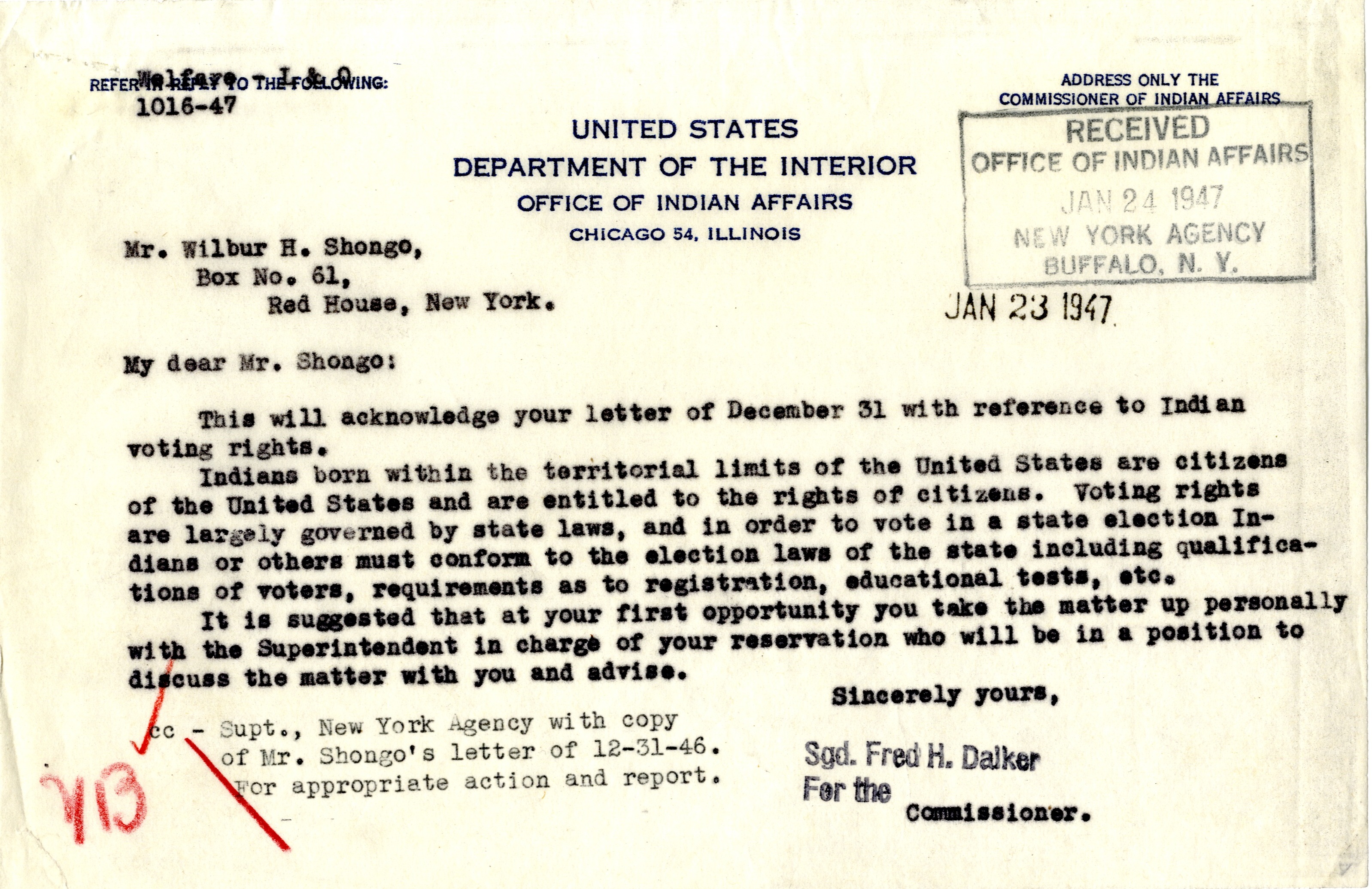
In 1879, John Elk renounced his allegiance to his American Indian tribe to go live among the citizens of Omaha. But when he tried to register to vote, the registrar claimed that he was not a citizen. No one disputed that Elk was born within the territorial limits of the United States, but in 1884’s Elk v. Wilkins, the Court ruled that the citizenship clause of the Fourteenth Amendment did not apply to Elk or others like him. The Indian Citizenship Act of 1924 changed this, but the case remains relevant to today’s birthright debate. Some suggest that the children of undocumented immigrants have no more claim to citizenship than Elk did. They are wrong.