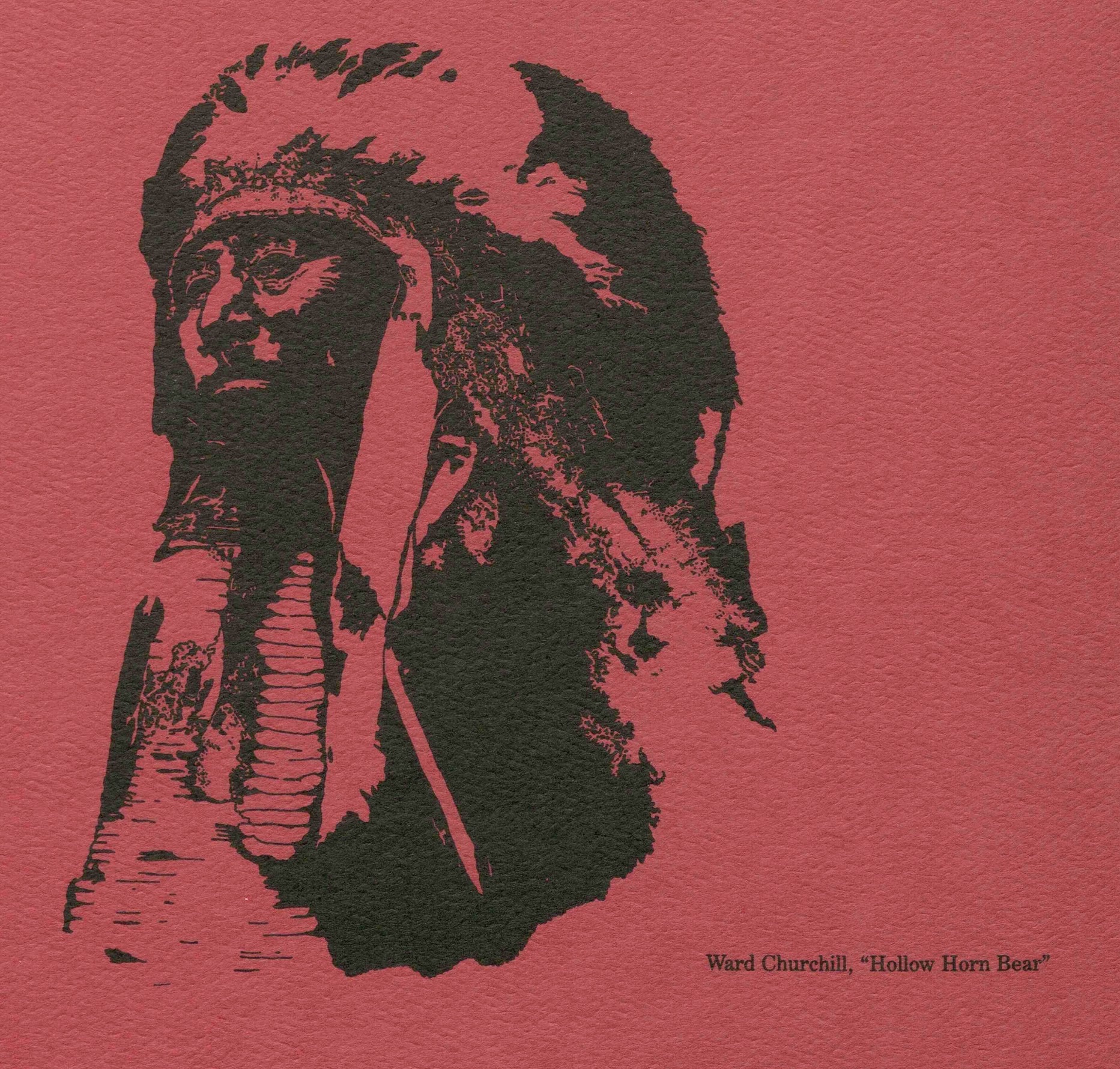
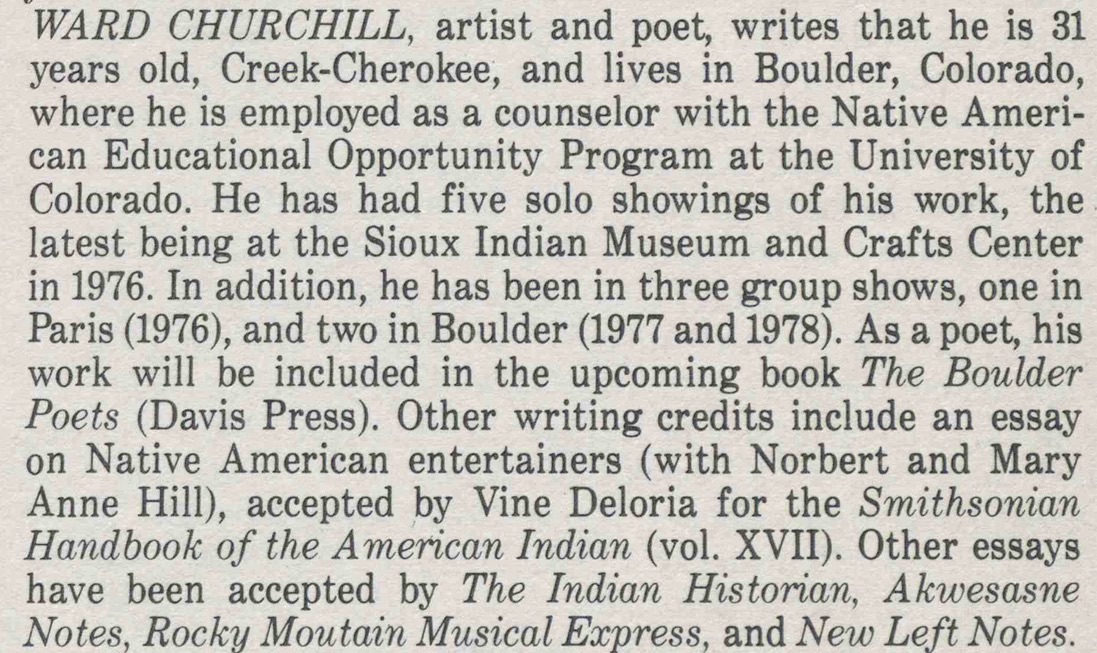
Ward Churchill Dies

NYTs

I never had the chance to meet Ward Churchill. I first read him in the early 90s at Michigan in a Native Studies class taught by Estevan Rael-Galvez. Estevan assigned this book, one the featured Ward heavily:
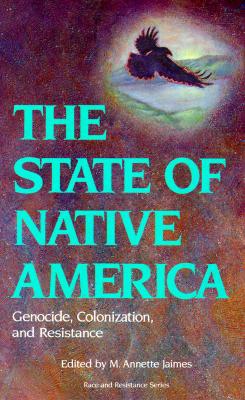
I liked it enough to keep buying books by the leading authors in this collection, including Ward. I was reading Howard Zinn, Noam Chomsky, Vine Deloria, John Trudell, Edward Said, Winona LaDuke, Paula Gunn Allen, Emma Goldman, etc. back in those days. They were mainstays of a radical publishing industry.

Eventually, I would hear negative comments about Prof. Churchill, that he threatened people, that he wasn’t really Indigenous, that he was a plagiarist. Hearing those things doesn’t necessarily make it so, especially when some of the people saying those things to me were themselves a bit unreliable. Other people I trust advised me that Ward was a true champion of academic freedom.

In the mid to late 2000s, D.C. Fed Bar asked me to join Ward and Sam Deloria on a panel about Indian citizenship and identity in their fall event one year. I even put together some materials in a packet I facetiously called “Who is an Indian? Ask the Government.” Being a baby law prof, I had no interest in arguing with either Sam or Ward, which I imagine could be quite bruising, but I did want to meet the man I had read for so long. Sadly, I did not get to see Sam and Ward interact on the same stage because Ward cancelled (or so I was told) and was replaced by a Congressional staffer. I can only imagine, given the controversies over Ward’s ancestry, that the panel might have been enlightening — or a debacle.

In Native circles in the public record, Ward first appears as an artist in the 1970s. That was news to me. He even showed in Paris in the mid-1970s.
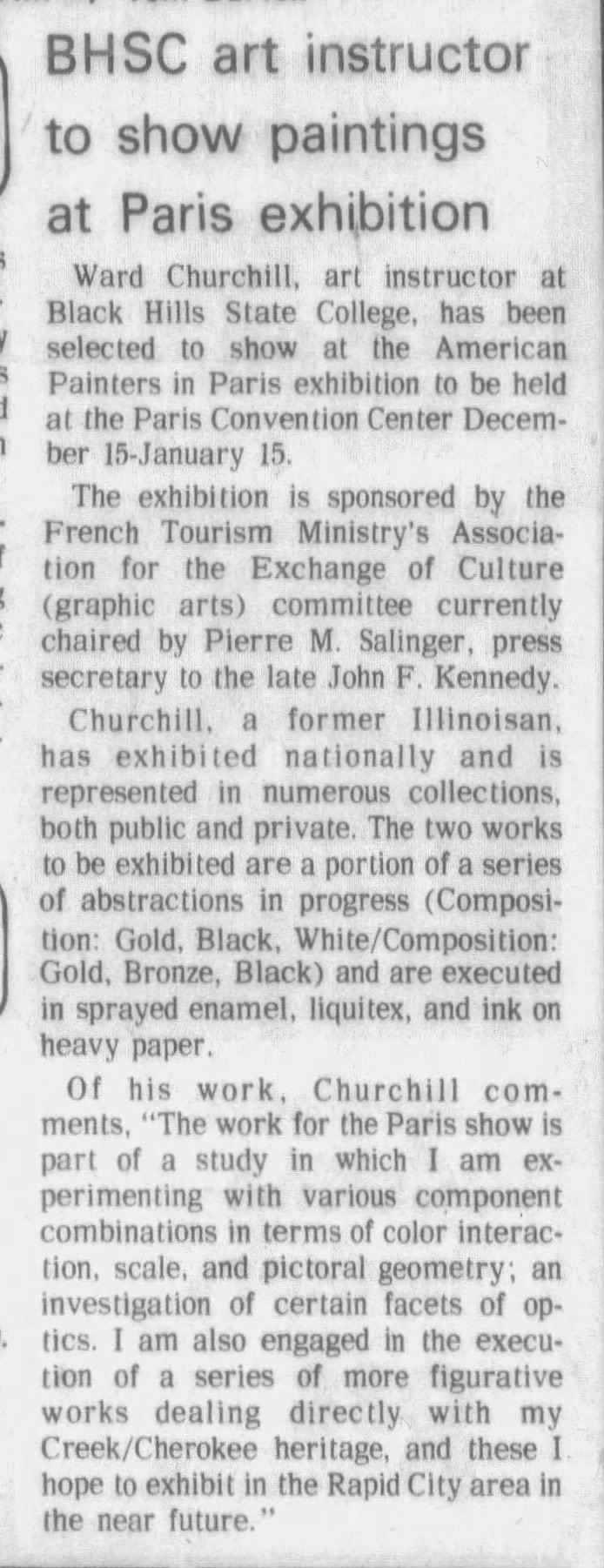
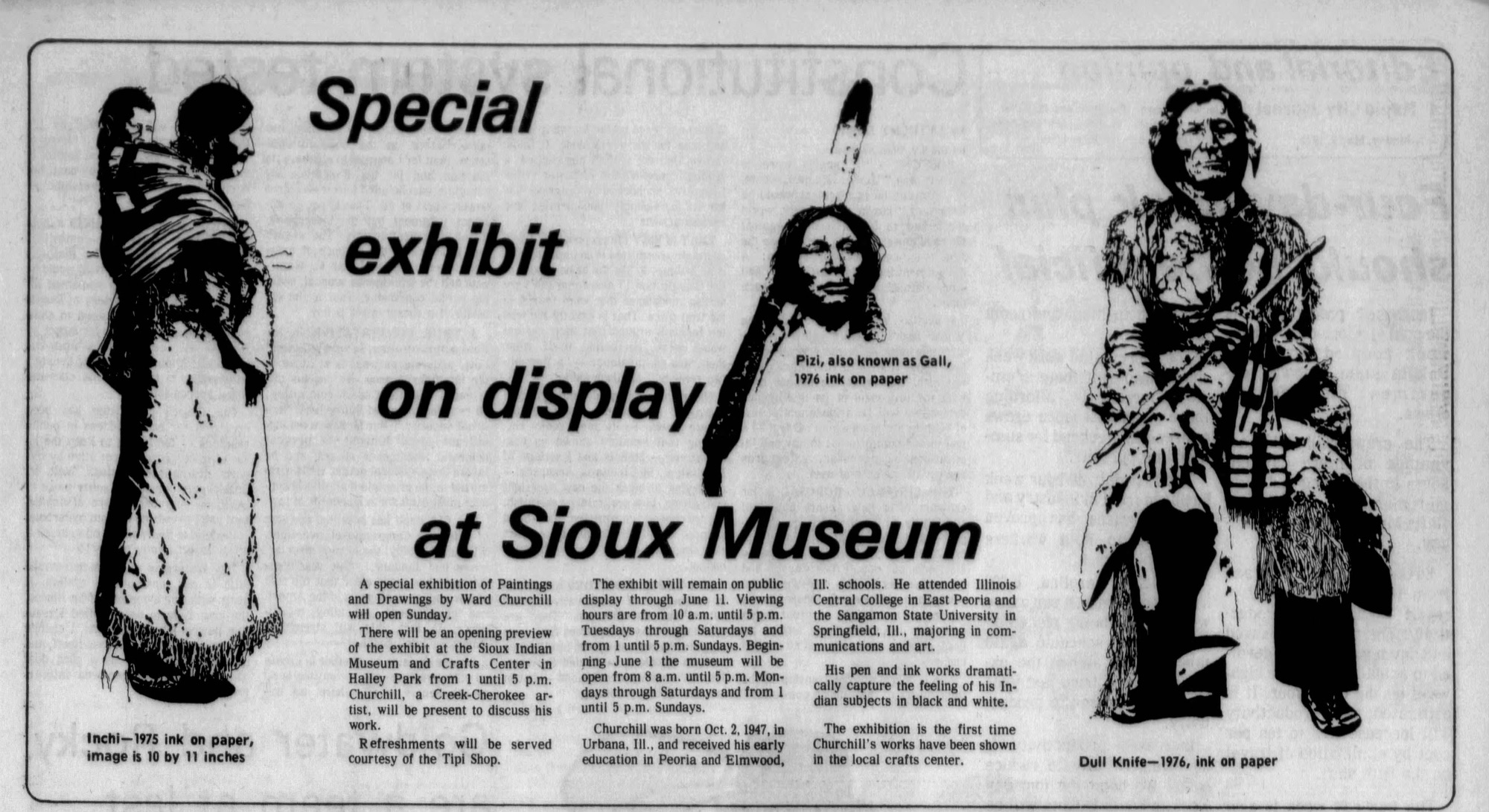
Rapid City Journal, 1975
Rapid City Journal, 1976
Back inside cover of Shantiih, Summer-Fall 1979
An early bio from the same issue of Shantiih.

I confess that I found myself annoyed/jealous that Ward came up in a field that had so many gaps that one person could be so many things, artist, poet, activist, academic, institutional leader, etc. It’s very impressive that he was all these things without a PhD, JD, MFA, MBA, etc., academic credentials that Native people now struggle to attain — and usually must — just to be one of the things that Ward was known for. It was certainly a different time, with the few Native people that were able to make it through the higher education system that any person who did it was instantly a unicorn.

It was also a time of violence (Wounded Knee, treaty fishing, etc.), which seems to me to have contributed to the ugly academic discourse of that generation, in which Ward definitely partook. Whatever one’s views about Ward, his writings identified so many issues I had never heard about as a young man utterly uneducated about Native issues in the 1990s. For that, I say thanks to Ward and that entire generation of activist-academics.

Like I said, I never met him, but a few years back I did meet his delightful spouse, Natsu Saito, who is truly lovely. In my brief interaction with Prof. Saito, I noticed that her characterization of Ward was much different than what I had heard and read about him. My thoughts go out to her.

More News Coverage of Ward Churchill Case

Here.

Colorado Supreme Court Rules against Ward Churchill

Here is the opinion.

The briefs are here.

From the court’s syllabus:

The supreme court affirms the court of appeals and the trial court, both of which held that Professor Ward Churchill was not entitled to any of the remedies that he sought. Churchill brought a claim under 42 U.S.C. § 1983 claiming that the University of Colorado at Boulder opened an investigation into his academic integrity in retaliation for the publication of a controversial essay, and that both the investigation and resulting termination of his employment violated his free speech rights. The proceedings against Churchill took more than two years and included five separate opportunities for Churchill to present witnesses, cross-examine adverse witnesses, and argue his positions. It possessed the characteristics of an adversary proceeding and was functionally comparable to a judicial proceeding. Hence, the supreme court holds that the Regents’ termination proceeding was a quasi-judicial proceeding, and the Regents are entitled to absolute immunity.
The supreme court also affirms the trial court’s ruling denying Churchill request to be reinstated and to receive front pay. The trial court accepted as fact that the University’s investigation found that Churchill had plagiarized his academic writings, fabricated evidence, and violated the University’s academic standards. The trial court ruled that reinstating Churchill would not be appropriate because the relationship between Churchill and the University has been irreparably damaged. Reinstating Churchill, the trial court ruled, would harm the University’s ability to enforce its standards of academic integrity and could impair the University’s ability to attract good students and faculty. The trial court’s rulings and findings did not constitute an abuse of its discretion and these rulings are affirmed.

Thanks for D.L. on the DL for the head’s up. Actually, it’s not on the DL. I just couldn’t resist.

Briefs in Ward Churchill Case at Colo. SCT

Here:

Churchill Opening Brief

Colorado Answer Brief

Churchill Reply Brief

ACLU Amicus Brief

National Lawyers Guild Amicus Brief

Case argued yesterday. News coverage here.

Colorado Supreme Court Grants Review in Ward Churchill Case

Here is the article, from the Chronicle.

Colorado Court of Appeals Briefing in Ward Churchill Appeal

Many of the briefs have been filed in Churchill v. University of Colorado (Colo. App.). More are forthcoming:

Churchill Opening Brief

National Lawyers Guild Amicus Brief

ACLU Amicus Brief

University of Colorado Brief

State of Colorado Amicus Brief–updated (3:05PM)

Extensive lower court materials are at the Race to the Bottom here (a more direct link to lower court documents is here).

Ruling in Churchill Reinstatement Motion — Denied

Here is the opinion — Churchill reinstatement ruling

Denver Post article

Of note, even the $1 jury verdict has been vacated.

Churchill’s Reply Brief to CU’s Opposition to Reinstatement

If the inability of Ward Churchill’s attorneys to spell anyone’s name is any indicator, Churchill doesn’t stand a chance.

2009 06-01 CHURCHILL Plaintiffs Reply in Support of his Motion

Ward Churchill Reinstatement Materials — Updated

Now that Ward Churchill has won exactly $1 from the University of Colorado via jury, the real fight begins — over reinstatement. The University of Colorado’s brief opposing reinstatement is here.

The brief itself runs from pages 1-32 of the pdf file linked here.

The attachments are of especial importance. Here are a few of the affidavits from (mostly) American Indian academics opposing Churchill’s reinstatement:

Thomas Brown (pdf pages 70-72) (Thomas Brown affidavit)

Elizabeth Cook Lynn (pdf pages 77-80) (Cook-Lynn affidavit content)

Suzan Shown Harjo (pdf pages 81-84) (Harjo affidavit content)

Tom Holm (pdf pages 85-87) (Tom Holm affidavit, sorry the pages aren’t in the right order, but there’s only three)

John LaVelle (pdf pages 88-92) (LaVelle affidavit content)

Patricia Jo King (pdf pages 93-96) (Patricia Jo King affidavit)

David Bradley (pdf pages 97-100) (David Bradley affidavit)

Robert Trepp (pdf pages 101-105) (Robert Trepp affidavit)

Chadwick Smith (pdf pages 106-109) (Chief Smith affidavit content)

Rhonda Lynne Kelly (pdf pages 128-131) (Rhonda Kelly Affidavit content)

Other materials from this case are posted on Denver University’s website, here.

And here are links to a few news stories on this latest filing in the Churchill litigation: The Chronicle, the Colorado Daily, and the Denver Post.

Stanley Fish on Ward Churchill Case

Missed this the first time around….

from the NYTs:

Last Thursday, a jury in Denver ruled that the termination of activist-teacher Ward Churchill by the University of Colorado had been wrongful (a term of art) even though a committee of his faculty peers had found him guilty of a variety of sins.

The verdict did not surprise me because I had read the committee’s report and found it less an indictment of Churchill than an example of a perfectly ordinary squabble about research methods and the handling of evidence. The accusations that fill its pages are the kind scholars regularly hurl at their polemical opponents. It’s part of the game. But in most cases, after you’ve trashed the guy’s work in a book or a review, you don’t get to fire him. Which is good, because if the standards for dismissal adopted by the Churchill committee were generally in force, hardly any of us professors would have jobs.

Continue reading