Child Welfare and the Courts, COVID-19 Edition

HERE.

I’m starting to get a lot of calls and emails about how child welfare cases are being handled during shut downs. As you might imagine, it’s going about as well as you might imagine (not well). I don’t have any answers, but I do have a lot of notices and orders from the states. It appears that the variance in practice between counties is going to be even larger than usual (the communication from California is confusing, but that’s the upshot). I’ve created a page where I posted documents I’ve received from the states about this issue. I’m also still in communication with people on how to handle the legal aftermath.

I will also try to remember to do a post whenever I add to the page.

Also, NAICJA is having a tribal court webinar TODAY about tribal court work

ETA: We’ve also been asked to host general tribal governance and tribal court documents, which will be on a different linked page.
Inquiry and Notice Case out of California (Published!)[ICWA]

B300468

At the detention hearing, Father said he had Native American Indian heritage, but he was unable to identify the correct tribe. Father believed his heritage was through his paternal grandmother. He provided CWS and the juvenile court with the names of his father and grandmother.

***

Father argues CWS failed to comply with ICWA requirements and the juvenile court did not make findings on whether ICWA applied. He contends the court was “not authorized to proceed with foster care placement until ICWA notice has been sent and received.” He is correct.

***

Here, CWS had reason to know the children might be Indian children. Accordingly, CWS was required to comply with ICWA notification requirements at least 10 days before the disposition hearing, because the hearing was an involuntary proceeding in which CWS “was seeking to have the temporary placement continue[d].” (Jennifer A., supra, 103 Cal.App.4th at pp. 700-701; 25 U.S.C. § 1912(a).)

This is very different from the reasoning applied by the Washington Court of Appeals here.

Call for Presentations for NAICJA Annual Conference!

Call for Presentations_NAICJA-NationalConf_02-28-20_final

CALL FOR PRESENTATION PROPOSALS 2020

National Tribal Judicial and Court Personnel Conference Deadline:

Friday, April 10, 2020, 5:00 pm MST

Submission form: https://naicja.wufoo.com/forms/m10hpejn06xrvqf/

The National American Indian Court Judges Association (NAICJA) invites presentation proposals for the 51st Annual National Tribal Judicial and Court Personnel Conference to be held October 20-23, 2020, at the Radisson Hotel and Conference Center in Green Bay, Wisconsin. NAICJA’s Annual Conference offers innovative and timely tribal justice information through high quality presentations by national experts. This is your opportunity to share your expertise and display your creativity by developing an original program for presentation. Proposals specifically tailored to meet the needs of the 300-person NAICJA audience are strongly preferred.

Prosecutor/Attorney Position Open at LCO, Closing date 3/20/20

Tribal Attorney Job PostingKGRevised20200228

Indian Child Case out of the Colorado Court of Appeals [ICWA]

18CA2258-PD

An example of what a mess happens when an agency proceeds on termination of parental rights before establishing tribal membership. And an answer to the question what happens to all those cases remanded for notice.

California Misinformation in an ICWA Case

Opinion

There are too many unpublished cases to post here, but this one including the following quote, which I think is important for understanding how few people in the child welfare system have a handle on ICWA’s protections, even today. I’m sure all the tribal attorneys are surprised to find out they might have to appoint a parent an attorney:

The social worker informed Mother that if she was “found to have affiliation with the tribes, she could be appointed an attorney from the tribes and placement of the children could change.”

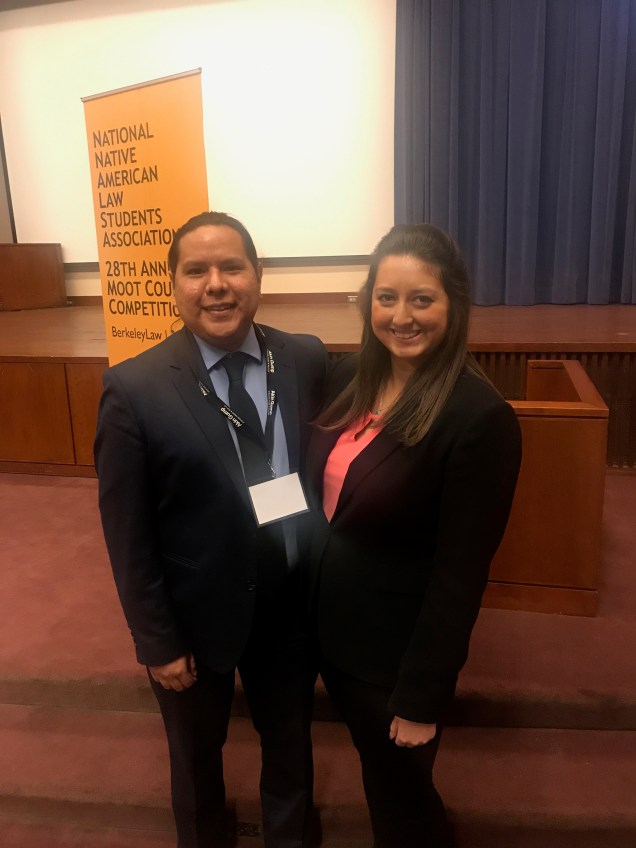
MSU NALSA Team Advances to the NNALSA Moot Court Final

We are very pleased to announce that Judge Matthew Fletcher has been conflicted out of the final of the NNALSA Moot Court Competition due to the fact that our team has made it to the FINAL ARGUMENT for the first time in our Center’s history. Look at these rock stars!

IMG_0465
Kacey Chopito (Zuni Pueblo) and Kaitlin Gant (Oneida Nation of the Thames) 

Guardianship Case out of Nebraska [ICWA]

Here.

You have to love a court that starts the opinion so clearly:

The federal Indian Child Welfare Act (ICWA) and the Nebraska Indian Child Welfare Act (NICWA) provide specific procedures and requirements that apply in certain proceedings involving the custody and adoption of and termination of parental rights to Native American children. This case requires us to decide whether those procedures and requirements apply in a case in which a maternal grandmother sought to establish a guardianship for an Indian child over the objection of her daughter, the child’s mother. After interpreting the relevant statutory language, we conclude that the guardianship proceeding at issue was governed by ICWA and NICWA. In addition, we find that the grandmother did not make the showing required by ICWA and NICWA. We therefore reverse the order of the county court establishing the guardianship and remand the cause with directions to vacate the guardianship, dismiss the petition, and return custody to the child’s mother.

Cool Pro Hac Update from Ho-Chunk Nation

HCN has updated their own tribal rules of civil procedure to allow for a pro hac waiver in tribal court for child welfare cases:

(C) Counsel not admitted to practice before the Ho-Chunk Nation Courts, but seeking to appear on behalf of a federally recognized Indian tribe in a proceeding regarding a petition for guardianship or for child protection over a child who is a member of that tribe, or eligible for membership in that tribe, shall be permitted to appear without paying any fee. Counsel representing an Indian tribe in such a matter shall also be permitted to make their appearance without filing a motion for special appearance, provided that, at that appearance, said counsel states on the record that they are admitted to practice in another state, federal, or tribal jurisdiction; that they have been in actual practice for two or more years, and takes the oath or affirmation for practice. This rule shall not apply to attorneys who appear on behalf of the Ho-Chunk Nation.

HCN Civ. Pro. R. 16(c)

We’ve updated the pro hac page accordingly.  Obviously these are not ICWA pro hac waivers, but are related and can be used to show comity in this area.