Supreme Court Decides Allen v. Milligan (Voting Rights)

On June 8, 2023, the Supreme Court of the United States in Allen v Milligan upheld the lower court’s determination that the newly adopted Alabama congressional maps likely violate Section 2 of the Voting Rights Act. After lower courts found that Alabama’s most recent redistricting likely violated the Voting Rights Act, the state chose to appeal the case rather than draw non-discriminatory electoral districts. The state argued that, contrary to the protections embodied in the Voting Rights Act, race should not be taken into consideration in redistricting efforts. The Supreme Court disagreed.

Last July, the National Congress of American Indians, represented by NARF, filed an amicus brief in the case arguing against the proposal to eliminate race from redistricting considerations. Participating in American democracy provides Native Americans the opportunity to remedy past injustices by electing representatives who understand and honor Native Nations’ political status within American federalism, who will advance treaty rights, advocate for basic resources, and respect and value Native Americans’ contributions to this country.

The brief explained that there is an ongoing and critical need for Section 2 of the Voting Rights Act to address racial discrimination and contemporary voter suppression that dilutes Native American votes and political power. In fact, the only Section 2 enforcement action brought by the Department of Justice during President Trump’s tenure was a challenge to an at-large district that prevented the election of Native American candidates of choice to a school board.

Motion to Dismiss briefing in Bears Ears Litigation

Lena’ Black v. Broken Arrow Public Schools

High school graduate Lena’ Black, an enrolled member of the Otoe-Missouria Tribe and of Osage descent, filed a lawsuit on May 15, 2023, against the Broken Arrow School District for violating her rights to free exercise of religion and freedom of speech. Black seeks restitution for emotional distress caused when school officials singled her out and attempted to take her sacred eagle plume by force, damaging the plume that she received in ceremony when she was three years old.

“My eagle plume has been part of my cultural and spiritual practices since I was three years old. I wore this plume on graduation day in recognition of my academic achievement and to carry the prayers of my Otoe-Missouria community with me,” said Lena’ Black. “The law protects my right to wear this eagle plume at my graduation, and school officials had no authority to forcibly remove it from my cap.”

Governor J. Kevin Stitt recently vetoed Oklahoma Senate Bill 429, passed by the state legislature with near unanimous bipartisan support to prohibit discriminatory graduation dress codes. The bill would have reaffirmed the rights of Native American students like Black to wear tribal regalia at graduations, a critical protection in the state with the second highest concentration of American Indians. Following his veto, Governor Stitt suggested this issue should instead be resolved at the district level.

Black is represented by the Native American Rights Fund (NARF) and Pipestem Law, P.C. “We will hold the Broken Arrow School District accountable for its discriminatory actions,” said NARF Staff Attorney Morgan Saunders. “The Broken Arrow School District violated Ms. Black’s rights despite existing laws that should have ensured she was able to wear her eagle plume without incident.”

“This lawsuit demonstrates why these decisions cannot be left up to individual school districts,” said Pipestem Law Partner Wilson Pipestem. “Without clarity from the State, Native students will continue to be forced to seek justice in the courts after their rights have been violated and their graduation ceremonies are long since over.”

“I filed this lawsuit to ensure everyone understands the importance of items like my eagle plume, and to prevent schools from targeting Native students like me in the future. No student should face ignorance and discrimination in their school or their community,” said Black.

While traditions vary, members of many tribal nations wear specific clothing or objects, like eagle plumes, at graduation ceremonies to signify their academic achievement and in recognition of their spiritual and religious beliefs. Schools, school district leaders, educators, parents, students, and allies can learn more about creating inclusive graduation ceremonies and positive change at: https://narf.org/cases/graduation/.
Webinar: How to Transform Voter Registration in Indian Country Through NVRA Designation

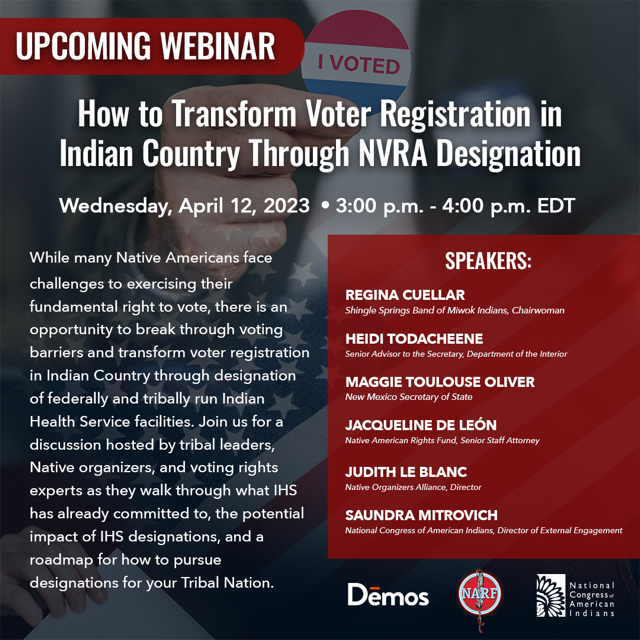
While many Native Americans face challenges to exercising their fundamental right to vote, there is an opportunity to break through voting barriers and transform voter registration in Indian Country through designation of federally and tribally run Indian Health Service facilities. Join us for a discussion hosted by tribal leaders, Native organizers, and voting rights experts as they walk through what IHS has already committed to, the potential impact of IHS designations, and a roadmap for how to pursue designations for your Tribal Nation. Register here.

When: Wednesday, April 12, 2023 at 3:00 p.m. – 4:00 p.m. EDT

Speakers:
Regina Cuellar – Shingle Springs Band of Miwok Indians, Chairwoman
Heidi Todacheene – Senior Advisory to the Secretary, Department of Interior
Maggie Toulouse Oliver – New Mexico Secretary of State
Jacqueline De León (Moderator) – Native American Rights Fund, Senior Staff Attorney
Saundra Mitrovich – National Congress of American Indians, Director of External Engagement

Briefs on PI and TRO in Glacier County Regional Port Authority v. Esau, et al.

Port Authority’s Motion for a Preliminary Injunction and TRO:

On February 10, the Blackfeet Nation filed a Response in Support of the Plaintiff’s Motion for Preliminary Injunction and Temporary Restraining Order:

Brief in Response:

The Blackfeet Nation intervened in the case, arguing that the State of Montana does not have the authority to enforce state law on the Reservation.

Tribal Nations Granted Intervention in Bears Ears Litigation

On November 18, 2022, the Hopi Tribe, Navajo Nation, Ute Mountain Ute Tribe, and the Pueblo of Zuni moved to intervene in two lawsuits in the U.S. District Court for the District of Utah regarding the Bears Ears National Monument. The Court granted the motions to intervene.

Order granting intervention here:

Motions can be seen here and here.

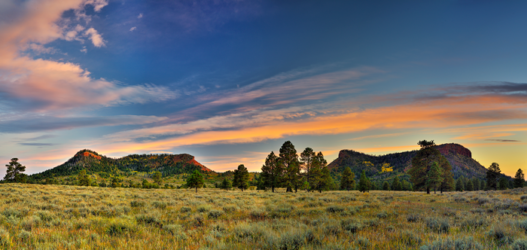
Bears Ears at Sunset. Photo credit: Tim Peterson.

Blackfeet Nation granted intervention in Glacier County Regional Port Authority v. Laurie Esau

This case is about whether the Montana Human Rights Bureau can enforce state law on Blackfeet Nation land. Here is the brief in support of the motion to intervene.

And here is the order granting intervention.

More on the case here.

Tohono O’odham Nation and Gila River Indian Community v. Mark Brnovich et al.

Here is the Complaint.

Spirit Lake Nation sues Benson County North Dakota over its redistricting plan

The Spirit Lake Nation and two tribal members sued Benson County North Dakota, alleging that the county’s at-large redistricting plan: (1) discriminates against Native American voters by unlawfully diluting their voting strength in violation of Section 2 of the Voting Rights Act; and (2) violates a 2000 consent decree in which the county was prohibited from ever implementing an at-large method of election.  Here is the Complaint:

More information on the case here.

Decision in Western Native Voice et al. v. Jacobsen (voting rights)

After a two week trial, on September 30, 2022, a Montana court struck down as unconstitutional two state laws that hinder Native participation in the state’s electoral process. HB 176 eliminated Election Day registration, which reservation voters disproportionately rely upon to cast votes in Montana. HB 530 prohibited paid third-party ballot assistance, a service that aids Native voters living on reservations. The court ruled that the laws violate provisions of the Montana Constitution, including the right to vote, equal protection, free speech, and due process.

The 199 page order is here:

More background and information on the case can be seen here.