Written Comments on BIA Proposed ICWA Regulations Due May 19

Written comments on the proposed ICWA federal rule are due by May 19. In order for this process to be effective, Tribes need to speak up as do individuals who have strong feelings about ICWA or have been impacted by ICWA compliance or lack of compliance. It matters how many written comments are received.

In order to assist, NICWA has put together several resources such as sample talking points and a sample comment letter. The NICWA resource page is available here.

Comments can be submitted via email, mail, or hand delivery.

Email: comments@bia.gov.
Include ‘‘ICWA’’ in the subject line of the message.

Mail or hand-delivery:
Ms. Elizabeth Appel, Office of Regulatory Affairs & Collaborative Action—Indian Affairs,
U.S. Department of the Interior, 1849 C Street NW., MS 364, Washington, DC 20240

(202) 273–4680

Previous coverage here.


How Lack of Tribal Access to Databases Contributed to Tragic School Shooting

Full article here.

Excerpts from the article:

A flawed reporting system between tribes and outside authorities allowed a man to buy a handgun later used by his son to kill four classmates and himself in Washington state — a problem state and federal agencies have long known about but haven’t fixed.

A domestic violence protection order issued by the Tulalip Tribal Court should have prevented Raymond Lee Fryberg Jr. from buying firearms. But the order was never entered into any state or federal criminal databases, as it would be if it came from a Washington county court.

Critics say that’s because state and federal officials have failed to establish a system that allows tribal courts to enter those orders directly, or create a process that ensures it happens easily.

Fryberg passed a background check when he bought one of the guns his son, Jaylen, used in an October shooting at his high school north of Seattle. Had the protection order been in a database, Fryberg would have failed the check and been denied the gun.

. . . .

A key problem is logistics. There’s no uniform way to enter information on tribal protection orders into state databases or the National Instant Criminal Background Check System, and such reporting is not required by law.

“I can’t think of a single tribe that wants abusers to have access to firearms, but despite our efforts, we keep hitting roadblocks,” said Sarah Deer, a professor at William Mitchell College of Law in Saint Paul, Minnesota.

Stephen Fischer Jr., with the FBI’s Criminal Justice Information Services, said some tribes enter protection orders into a national database themselves, while others have agreements for state or local agencies to do it for them. Some tribes have no involvement with federal and state databases.

Tulalip Tribes attorney Michelle Demmert has said in testimony to the U.S. Justice Department that tribal courts should not have to go through the states to enter data.

“As sovereign nations, we should not be treated as subservient partners to the state,” she said.

. . .

The National Congress of American Indians said entry of tribal court cases often is done through agreements with state or county agencies, but that data entry “is frequently denied or delayed, thus jeopardizing victim safety.”

The organization called on the U.S. attorney general to review how criminal databases are accessed, consult with tribal governments and develop a remedy.

In another article posted on Indianz.com, full article here, Judge Richard Blake, current president of the NAICJA board said,

“This problem is not a local problem or unique to the Tulalip Tribes. The issue of lack of entry of tribal protection orders in state and federal databases is a national crisis,” said Richard Blake, a member of the Hoopa Valley Tribe of California who serves as the president of the board of directors for NAICJA.

At the state level, Blake noted that tribes are barred from submitting data by the Washington State Police. So some tribes, including Tulalip, have entered into agreements in which local courts submit the information to the state database.

But Blake, who served as chief judge for his tribe, said the process is not flawless. Without direct tribal access, cases could fall through the cracks.

“We had hoped that with the passage of the Tribal Law and Order Act of 2010 which mandated the federal government to provide access to federal databases that this critical gap in public safety would be closed,” Blake said. “But here we are five years later and the U.S. Department of Justice and the FBI are still in violation of the statutory requirement that tribes be given direct access to the NCIC system.”

Previous coverage here.

Eastern Band Cherokee Hosts First Ever CVB Court in Indian Country

Full article here.

Excerpts from the article:

The Cherokee Tribal Court did something on Thursday, April 2 that no other court in Indian Country has ever done before – open a CVB (Central Violation Bureau) session.  In a special event at the EBCI Justice Center, the Tribal Court celebrated the momentous occasion with various state and federal judicial officials.

CVB Court handles small, petty misdemeanor offenses that occur on federal lands.

“In the big scheme of things, where a District Court or a Magistrate’s Court is held, might not seem that important,” said Cherokee Supreme Court Chief Justice Bill Boyum.  “And, unless you know what’s going on in Indian Country, it’s really not that important, but given what is going on in Indian Country, it is of the ultimate importance.”

Boyum added, “Given the fact that the Violence Against Women Act (VAWA) now allows Tribes the right to prosecute non-Indians and has opened the door for full sovereign independence for tribal courts, it means that we would be able to prosecute all folks on our reservation at some point in time.  VAWA has opened that door, and that means that we’re really going to have to work with federal courts.”

On the importance of the Cherokee Tribal Court hosting the CVB Court, Boyum stated, “There are no rules.  There are no laws.  There are no regulations.  There is no case law.  There are not even any policies or thought processes on how this kind of thing could happen because it’s never happened before.  On the bright side, there are no rules, policies or regulations to say it can’t happen.”

Last month, Principal Chief Michell Hicks and Chief U.S. District Court Judge Frank Whitney signed a Memorandum of Understanding outlining the details of the agreement whereby the Tribal Court would host CVB Court.

Boyum said the relationships the Eastern Band of Cherokee Indians has with the State of North Carolina and the federal government helped make this a reality.  “In the rest of Indian Country, there is often an antagonist relationship between the state and the Tribe and the federal government.  The system that is in place requires the exact opposite of that.  It requires all three of them to work together.”

“In the future, we hope to hold some U.S. District Courts here; at least the motions and sentencing and maybe some jury trials,” said Boyum who added the Tribal Court has been in discussions with state court officials and may share space with the state courts in the future as well.

Louise Erdrich to be awarded Library of Congress Prize for American Fiction

Congratulations to Louise Erdrich. Her work is getting a great deal of attention around the country. Finally.

Here is a great quote from Librarian of Congress James Billington about why Erdrich was chosen for this award:

Librarian of Congress James Billington said in a statement that Erdrich’s novels have uniquely explored the cultural challenges faced by Native Americans and mixed-race Americans.

“[H]er prose manages to be at once lyrical and gritty, magical yet unsentimental, connecting a dreamworld of Ojibwe legend to stark realities of the modern-day,” Billington said. “And yet, for all the bracing originality of her work, her fiction is deeply rooted in the American literary tradition.”

Link to news articles here and here.

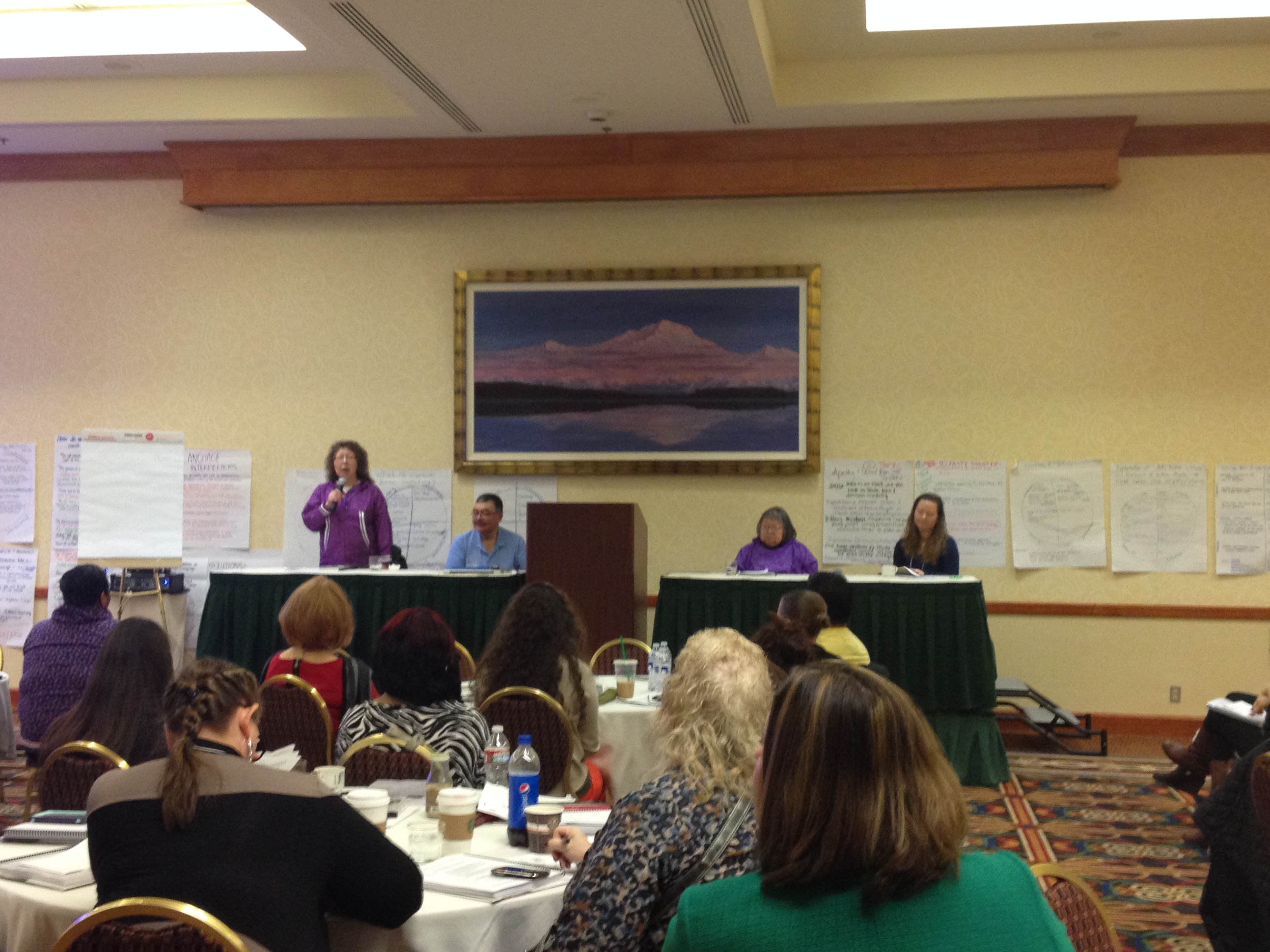
Yup’ik Translation/Access to Justice Panel, Rural and Safety Justice Conference

This panel explained the difficulties in finding accurate words in the Yup’ik language for court terminology, particularly in cases of sexual assault and domestic violence.

IMG_2277

Pictured above: Sophie Alexie, Instructor of Yup’ik Eskimo, University of Fairbanks, Kuskokwim Campus; Oscar Alexie, Assistant Professor Yup’ik Eskimo, University of Fairbanks, Kuskokwim Campus; Mary Beaver, Elder Advocate, Irniamta Ikayurviat-Children’s Advocacy Center at Tundra Women’s Coalition in Bethel; Kari Robinson, Language Access & Rural Domestic Violence Attorney with the Alaska Institute for Justice

Previous coverage here.

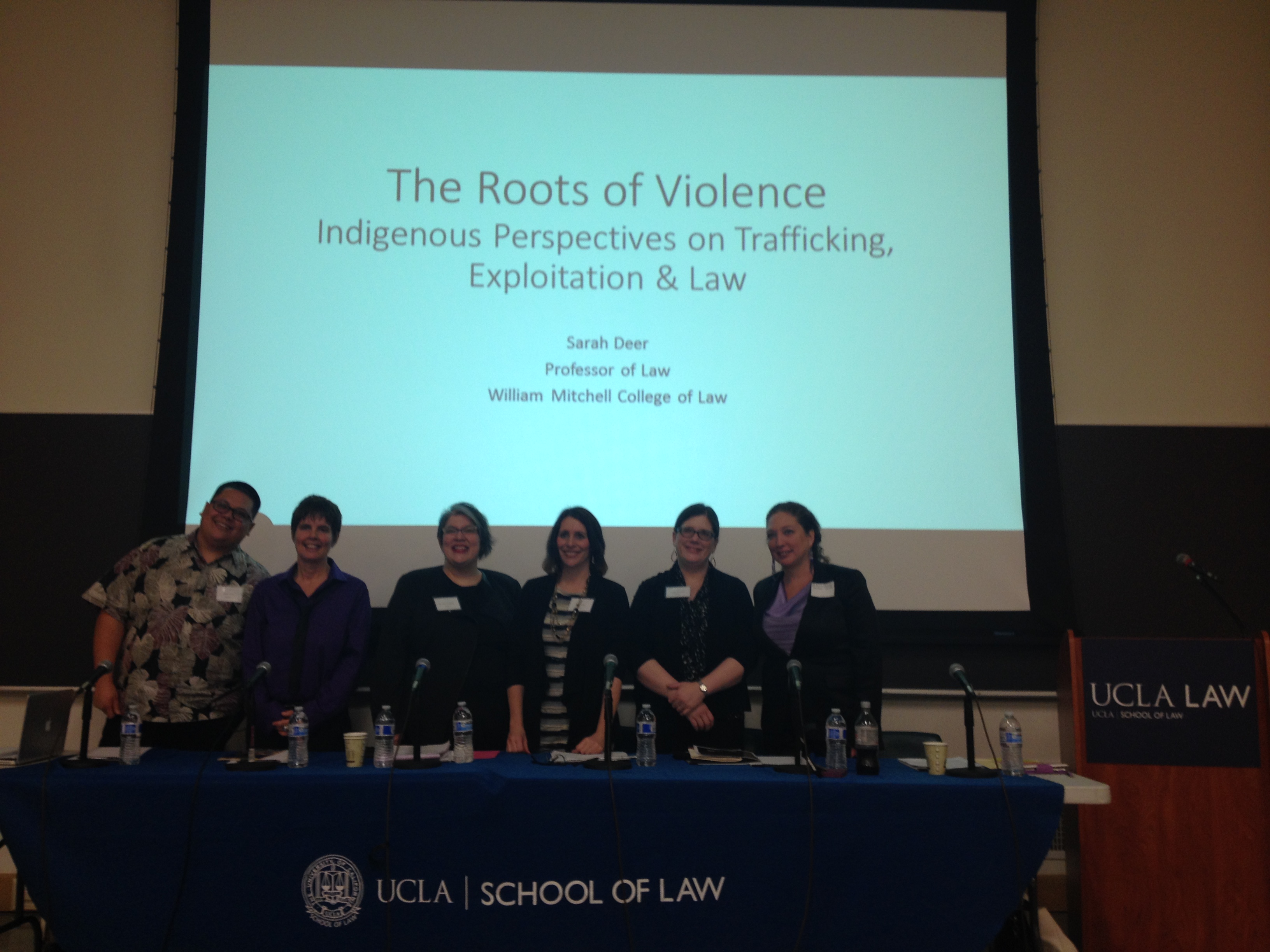
Opening Session of the UCLA Law Review Symposium, Examining the Roots of Human Trafficking and Exploitation

For the first time at a conference that doesn’t focus only on Indigenous issues, the Indigenous panel went first.

The opening session was titled The Roots of Violence: Indigenous Perspectives on Trafficking, Exploitation & Law

2015-01-29 10.32.50

Pictured: Julian Aguon, Christine Stark, Robyn Bourgeois, Victoria Sweet, Sarah Deer, Mishuana Goeman

Funding Opportunity: Tribal Court Improvement Program

Application Deadline: April 20, 2015

Full details available here

Description

The Administration for Children and Families, Children’s Bureau announces the availability of awards to provide tribes and tribal consortia the opportunity to compete for grants to enable tribal courts to:

(1) Conduct assessments of how tribal courts handle child welfare proceedings and to make improvements to court processes;

(2) Implement improvements to provide for the safety, permanency and well-being of children as set forth in the Adoption and Safe Families Act of 1997 (Pub. L. 105-89) and increase and improve engagement of the entire family in court processes relating to child welfare, family preservation, family reunification and adoption;

(3) Ensure children’s safety, permanence, and well-being needs are met in a timely and complete manner (through better collection and analysis of data); and

(4) Provide for training of judges, attorneys, and other legal personnel in child welfare cases.

Grant funds may not be used to hire attorneys or judges, fill vacant court personnel positions, or otherwise supplant funding for tribal government positions.

News Article: Collaboration between Counties and Tribes Benefit Dual Status Native Youth

This article highlights a promising program being implemented in northern Minnesota. The counties and tribes are working collaboratively to meet the needs of dual status youth (juveniles who come into contact with both child welfare and juvenile justice systems). This model is being applied in a few other places around the country and may be a model for other counties and tribes to consider.

The entire article is available here.

Excerpts from the article:

Way up in northwestern Minnesota, progress is being made within the Ojibwe tribes.

 “It’s been a long process,” said Trisha Hansen, Bemidji District supervisor for the Minnesota Department of Corrections. “… It was a tough two years, let me tell you. Probation and social services have really worked together in the last two years.”
 Since September, the traditional divisions between the systems of juvenile justice and child welfare have begun to be erased.
With a tribal nation contained within the county, the separations are doubled. . . .

The ultimate goal is to integrate tribal, federal, state and local services for culturally appropriate services and to run juvenile delinquency prevention programs within the community rather than off-reservation.

“I anticipate great results,” said national consultant John Tuell. The goal is to “overcome this mess we’ve created with this separation between child welfare and juvenile justice.” He is executive director of the Robert F. Kennedy National Resource Center for Juvenile Justice and RFK Children’s Action Corps, based in Boston.

One of the challenges, Hansen said, was figuring out the confidentiality parameters among the various agencies. She said the White Earth Nation in central Minnesota, which already uses the dual status youth strategies successfully, is helping them. White Earth Nation, also Ojibwe, is in Mahnomen County. It also uses county and tribal services and courts.

About 40 youths ages 10-17 are in the Beltrami County juvenile justice system locally and about 80 are under supervision on any given day, Hansen said.

White Earth Court Administrator Lori Thompson said the tribe adopted the dually involved youth program about 18 months ago. She has worked with the White Earth court system since 2000.

Currently, she said, about 15 young people are in the program.
The strategies, she explained, increase interagency information-sharing and give families and youngsters more of a voice in dealing with the agencies. Benefits include early identification, connecting families and youth with services, “diverting youth from adjudication and court when feasible” and “promoting culturally valid intervention.”

Such interventions include beading and drumming, Thompson said. Young people are assigned to four hours of community involvement every two weeks, such as setting up chairs, serving food and cleaning up at meetings.

The youngsters also carry wood for and take part in weekly sweat lodges, often with some of the officials, such as probation officers, who serve them. . . .

If a child commits an offense, Lind said, the process starts with the county attorney, who makes the initial decision of whether to charge the youngster. The county attorney also contacts county and tribal social services. Parents also meet with a social services worker and a probation officer, he said. Under the new program, these meetings would be conducted jointly, requiring less travel and saving time and money.

In the past, families often had to meet with several agencies. Such confrontations can be confusing to both parents and children, Hansen said. “They aren’t hearing a thing because there’s so much swirling around them,” she said.

“White Earth has made a lot of progress,” Hansen said, citing the Circle Back Center in Ogema, Minn., on the White Earth Reservation. Circle Back Center clients can be referred through Indian Health Services, law enforcement, tribal court, county social services, tribal, county and state corrections, substance abuse programs and private entities or families.

Eligible clients are boys and girls ages 10-18 who have successfully completed alcohol or substance abuse treatment, those who lack a sober or safe home and those with behavior problems such as truancy, runaway and curfew violations. The center primarily accepts American Indian youth, but extends services to non-native youngsters if staff members consider them able to benefit from the program.

Upcoming Symposium: Examining the Roots of Human Trafficking and Exploitation

January 29-30, 2015  UCLA School of Law

There will be a panel devoted specifically to Indigenous communities.

See flyer for registration details:

UCLA Symposium Flyer

NAICJA Webinar on Tribal Public Defense, January 8, 2015

Join the National American Indian Court Judges Association and the American Indian Law Center for the first in a series of four upcoming webinars on Emerging Practices in Civil Legal Assistance and Criminal Indigent Defense. The goal of these webinars is to share four emerging practices that incorporate the philosophy, values, and characteristics of successful and effective legal assistance practices. These webinars will also share and highlight multiply programs that are currently implementing these practices.

Webinar 1 – “Tribal Initiatives: Tribal Public Defense and How to Use Existing Resources to Provide Holistic Defense in Tribal Communities”

Thursday, January 8, 2015 from 2:00 – 3:30 p.m. (MST)

Register now for this free webinar at

https://naicja.webex.com/naicja/onstage/g.php?d=662539071&t=a

As tribal governments consider expanding their jurisdiction through the Tribal Law and Order Act, providing effective assistance of counsel to the accused is at the forefront. This webinar discusses one model of public defense and how it can be adapted to fit any community. With technical assistance from the Center for Holistic Defense at the Bronx Defenders in New York, the Tribal Defenders for the Confederated Salish and Kootenai Tribes in Montana use holistic defense to work toward solutions for their clients who struggle with the criminal justice system. Learn how in-house psychological and social work services as well as existing resources in your community can improve client outcomes.

Presenters:

Ann Sherwood, Attorney, Defenders Office of the Confederated Salish and Kootenai Tribes

Alex Sierck, Project Director of the Center for Holistic Defense, Bronx Defenders

Desiree Fox, Case Manager and Program Manager, Tribal Defenders Office Holistic Defense Program.


Moderators:

A. Nikki Borchardt Campbell, Program Administrator, NAICJA

Francine Jaramillo, Staff Attorney, American Indian Law Center, Inc.

This webinar series is supported by Grant No. 2011-AL-BX-K002 awarded by the U.S. Department of Justice, Bureau of Justice Assistance. The Bureau of Justice Assistance is a component of the Office of Justice Programs, which also includes the Bureau of Justice Statistics, the National Institute of Justice, the Office of Juvenile Justice and Delinquency Prevention, the Office for Victims of Crime, and the Office of Sex Offender Sentencing, Monitoring, Apprehending, Registering, and Tracking. Points of view or opinions in this document are those of the author and do not necessarily represent the official position or policies of the U.S. Department of Justice.


Questions? Contact Francine Jaramillo at jaramillo@law.unm.edu or call (505) 277-5462