Here are the materials:
Announcements
UNM Montana Symposium Agenda — March 24-25, 2011
Here: UNM Montana Symposium agenda
Registration info: UNM Symposium registration info
The conference website is here.
“American Indian Tribal Law” Now Available from Aspen
 Here is Turtle Talk’s page on the book, and here is the Aspen webpage for the book (where it can be purchased). Update — Also, the companion website.
And here is where you can download the introduction, table of contents, table of cases, and index.
FBA Indian Law Section — Call for Award Nominations
At the 36th Annual Indian Law Conference, we will award the Lawrence Baca Lifetime Achievement Award and Indian Law Section Outstanding Service Award on April 8, 2011. Prior recipients of the Lawrence Baca Lifetime award include: Lawrence Baca, Professor Phillip Frickey, and John EchoHawk. Prior recipients of the Indian Law Section Outstanding Service Award include: Jack Lockridge, Hon. D. Michael McBride and Professor Elizabeth Kronk. The Award and Nomination Committee which is responsible for selecting the recipients of these awards is chaired by past FBA President and Indian Law Section Chair Lawrence Baca. The deadline for nominations is Friday, February 25, 2011. Please submit nominations to the Chairman of the Awards Committee, Lawrence Baca, at lawrence.baca@yahoo.com. Nominations should specifically address why the nominee meets the criteria for each award outlined below.
Qualifications for Lawrence Baca Lifetime Achievement Award:
1. Must have worked in the field of Indian law for at least twenty years as a practitioner, judge, legislator, leader, scholar or educator;
2. Be of good standing and held in high esteem in his or her professional arena;
3. And have made significant contributions to the field of Indian law through litigation, development of legislation, scholarship or the development of Indian law students or through tribal leadership.
Qualifications for Indian Law Section Outstanding Service Award:
Only FBA members and FBA staff can qualify for this Award, and only service rendered over the previous year is considered.
Award recipients must demonstrate their commitment to the Section through at least one of the following:
1. Significantly contributed to the strong continuance and development of the Indian Law Section.
2. Worked to improve the strength of the Indian Law Section by recruiting new members and working with other FBA sections.
3. Helped develop a positive outlook and rapport between the FBA and other Native American organizations.
4. Promotes the mission of the Indian Law Section or the FBA or
5. Develops significant outside relationships beneficial to the Section.
2011 FBA Indian Law Conference Agenda
Here: brochure11.
NALSA Art Auction Online Now
Auction is here.
NALSA Auction Poster
“American Indian Tribal Law” on SSRN
My book — “American Indian Tribal Law” — soon will be published by Aspen as part of the Aspen Elective Series. This is the first law student-oriented casebook on tribal law.
I have posted the introduction, table of contents, table of cases, and the index on SSRN. Please take a look. You can download the pdf here.
Here is a description of the book:
“American Indian Tribal Law” is the first casebook for law students to survey the field of laws and cases generated by American Indian tribes. There are 565 federally recognized Indian tribes in the United States as of this writing. Each Indian nation has the authority, often expressed in an organic document such as a tribal constitution or a treaty with the United States, to legislate for the general welfare of the tribe, its people, and its land. Tribal ordinances and resolutions often are codified into tribal codes and published in book form and on the Internet.
American Indian tribal courts decide thousands of cases daily, with misdemeanor criminal cases, child welfare, and tribal administrative law cases constituting the large portion of tribal court dockets. Some tribal courts, such as those of the Navajo Nation, handle more than 100,000 cases each year, while other tribal courts handle only a very few cases. Many tribal courts span the full panoply of subject areas, from criminal to civil to probate to divorce to environmental law; others handle only a select few subject areas, such as tribal conservation courts, which adjudicate disputes involving tribal treaty fishing and hunting rights. The variety of tribal court disputes is endless.
Indian country is ready for a comprehensive set of materials on what some academics and practitioners have called the ‘‘real Indian law’’—the law of Indian nations and tribal courts. It is a new field, and scholarship on the subject has taken off only in the past few years. These materials are intended to assist students in navigating tribal courts and other indigenous dispute resolution forums, and how to otherwise practice law in Indian country. Students need to learn that nearly all tribal jurisdictions can and do apply their own laws, not the laws of the United States or state law.
[The materials that form this submission are the introduction and acknowledgments, the table of contents, the table of cases, and the index.]
National NALSA Moot Court Call for Judges!!!! [UPDATED]
Volunteer to judge the Competition! Sign up here!
The National NALSA Moot Court Competition is an annual event held by the Native American Law Students Association. On February 25 & 26, 2011, the Competition will be held at Columbia Law School. Teams from law schools across the country will head to New York City to compete against each other. The Competition also provides an opportunity for law students interested in Federal Indian and Tribal law to meet each other and practitioners, and to enjoy New York City.
The Competition begins with the release of the Problem, written each year by a leading scholar in Federal Indian and Tribal Law, in the fall. Team registrations were due Dec. 6, with the late registration deadline Dec. 18. Based off of the Problem, teams of two write an appellate-level brief on behalf of one of the parties in the suit. The Briefs are due in mid-January. At Competition, teams compete against each other in oral argument rounds, arguing for both parties over several rounds. Awards are given out for Best Briefs, Best Oral Advocates, and Best Advocates. For more information, please see the Moot Court Rules.
For more information about Columbia Law School’s NALSA Chapter, please visit our website. For information about how Columbia runs their Moot Court program, please read this pdf.
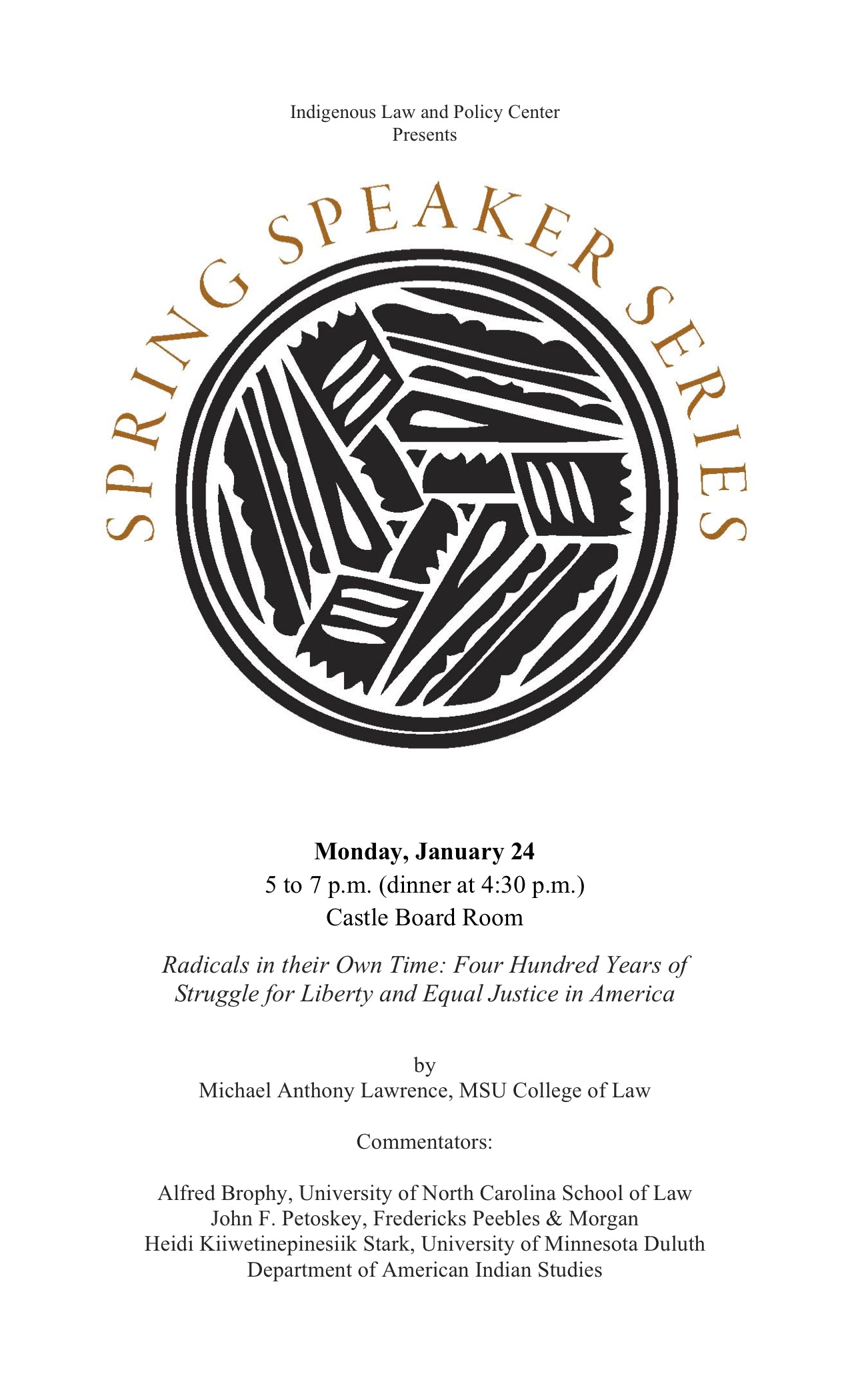
January 24th Spring Speakers Event
Great Lakes History Conference 2011 CFP
Call for Papers: Great Lakes History Conference:
“Education and Society”
October 7 & 8, 2011
The 37th annual Great Lakes History Conference, sponsored by Grand Valley State University, will be held in Grand Rapids, Michigan, on October 7-8, 2011. Professor William Reese, Carl F. Kaestle WARF Professor of Educational Policy Studies and History at the University of Wisconsin, will deliver the keynote address.
We seek panels and papers on the history of education broadly considered, from national and transnational perspectives, with particular focus on providing a historical context to current “crises” in education, whether at the elementary and secondary level or in higher education. Papers may consider a range of topics, including the history of schooling, educational policy, educational reform, the history of colleges and universities, the “crisis in the humanities,” the costs and financing of education, questions of academic freedom, non-academic educational institutions, transnational educational projects, educational philosophy and pedagogy, the role of ethnic and racial difference in education, education and gender, or the intersection of religion and education.
 Turtle Talk
You must be logged in to post a comment.