It appears likely that the WSBA will enact an outright ban. The Indian Law Section’s comment letter is here.
Announcements
Judge Richard Blake Honored as Justice Innovator of the Year
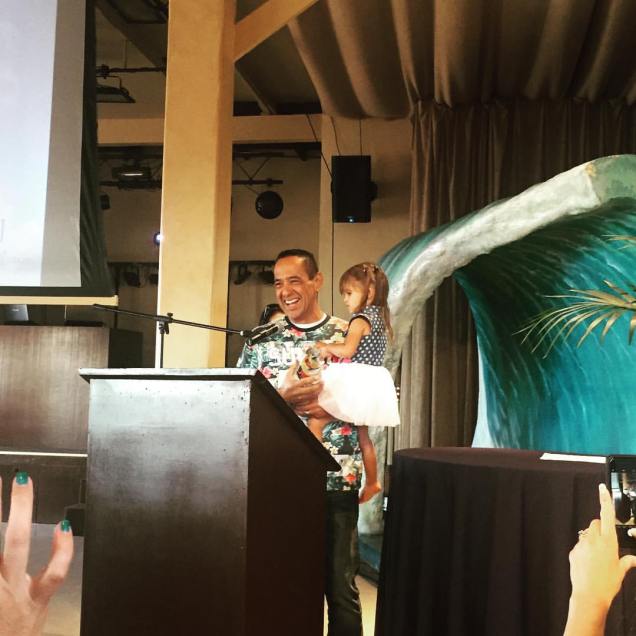
Judge Richard Blake, Chief Judge of Hoopa Valley Tribal Court and Board of Directors President of the National American Indian Court Judges Association, was honored at the NCJFCJ Annual Conference as Justice Innovator of the Year.
The Innovator of the Year Award honors someone who has inspired, sponsored, promoted, or led an innovation or accomplishment of national significance in juvenile justice, child abuse and neglect, family law, and/or domestic violence.
Judge Blake has been a tireless advocate for tribal court judges and has been involved in amazing work in his own Tribe, leading the way in innovative practices in all areas of the law. The work he has done and the sacrifices he has made have been inspirational to many. It is great to see him being recognized on a national level for his efforts.
Congratulations Judge Blake (and his gorgeous daughter who stole the show).
H/T to Nikki Campbell for the picture.
Save the Dates: Tribal Judicial Institute Conference and Training
Harvard Researchers to Lead New Council of Economic Advisors for the Navajo Nation
Link to press release from Office of President and Vice President here.
Kellogg Foundation Funds Tribal Model Food Code Project
Here is the link to the article published by the University of Arkansas School of Law link
From the article:
The Kellogg grant will allow the project to establish a model legal framework that tribal governments may adopt to regulate and support food and agricultural systems. Code sections may include provisions for food safety, land use, water, sustainability principles, organic production, seed protections and protection of traditional foods among other subjects. . . .
Tribal governments possess the inherent authority to enact laws affecting the lands, natural resources, communities and people within their jurisdiction. By helping to secure food and agricultural policy within the actions of tribal self-governance, the project hopes to ensure that tribes can reclaim the health of their people and long term food security in their communities.
Tribal Consultation Session Call In for Probate Regulation Revisions
Tomorrow is the second of two Tribal consultation sessions to provide a forum to share insights and make recommendations related to the probate of Indian estates. Specifically, three areas have been identified for modification which would have an immediate impact in streamlining the probate process. Additional information on these potential areas is provided in the following PowerPoint: Draft Probation Revisions Presentation.
The consultation information:
- Wednesday, July 13th, 2016: 2:00pm-4:00pm, EST Call-in Number: 1-800-857-7479, Passcode: 6543434
The Department will also be hosting a listening session on Monday, June 27th, 2016 in Spokane, Washington, in conjunction with the National Congress of American Indians mid-year conference.
Written comments must be received by August 1, 2016. Methods for submitting comments include via email: consultation@bia.gov; or via hard copy to:
Ms. Elizabeth Appel, Office of Regulatory Affairs and Collaborative Action, U.S. Department of the Interior, 1849 C Street, NW, MS-3071-MIB, Washington, DC 20240.
Black Hills CLE Coming Up July 22 in Rapid City
Don’t miss the Black Hills settlement CLE Course July 22 in Rapid City, S.D.
Register today for ILTF’s Continuing Legal Education (CLE) course on the Black Hills settlement. The course, which is open to the public, will cover the Black Hills Claim (Docket 148-78) and the 1851 Treaty Title Claim (Docket 74).
The course will be held at the Comfort Suites Hotel and Convention Center in Rapid City, S.D., on Friday, July 22, 2016 from 10 a.m. to noon.
The fee to attend is $200 for attorneys receiving CLE credits. Admission is free for law students and the Governor of South Dakota. Others may attend for a nominal contribution of $30 to ILTF to help offset costs of the event. Refreshments will be provided.
Instructor: Mario Gonzalez, Esq. of the Gonzalez Law Firm in Rapid City. Mr. Gonzalez has worked as an attorney for the Oglala Sioux Tribe and other tribal entities for more than 30 years. He is an expert on the Black Hills settlement.
Please direct questions about the Black Hills CLE to Nichlas Emmons at nemmons@iltf.org
Draft ROW Bill Requests Tribal Comments By July 13th
Download proposed rule here.
NCAI has been asked to share this draft of the Rights-of-Way bill with Tribes for feedback before it is introduced next Friday by Congressman Luján (D-NM). Turnaround time to provide comments is by middle of next week.
Please review and if you have any feedback, thoughts, or questions, please contact Graham Mason, Legislative Director, Office of Congressman Luján at Graham.Mason@mail.house.gov.
Registration Extended for 2-Day Admissions Workshop at MSU Law
Link to original post here.
New Application Deadline: July 20, 2016
Questions? Contact Kate Rosier, Executive Director, Indian Legal Program
Apply Today!
Native American Law School Admissions Workshops
August 5-6 at Michigan State University College of Law (2-day)
White Earth Descendant Selected for Minnesota Supreme Court
Congratulations Judge Anne McKeig
Link to full article here
From the article:
Gov. Mark Dayton has selected Fourth Judicial District Judge Anne McKeig as the next Supreme Court justice, giving the state’s highest court its first American Indian jurist, as well as the first female majority since 1991.
McKeig, 49, a descendant of White Earth Nation, has specialized in child protection and Indian welfare issues. She was first appointed to the bench in 2008 by GOP Gov. Tim Pawlenty. She will replace retiring Justice Christopher Dietzen, also a Pawlenty appointee.
The selection means that Dayton has made a majority of appointments on the 7-member court, likely ensuring his legacy on the bench long after he leaves office. He has now appointed five justices, though former Justice Wilhelmina Wright joined the federal bench earlier this year.
In his two terms, Dayton has made diversifying the state’s courts a priority. He praised McKeig’s legal experience, and he also emphasized her biography, reading a passage from her application as he announced his pick.
“I grew up in rural Minnesota in challenging circumstances surrounded by poverty,” McKeig wrote. “The lessons I learned as a young woman from Federal Dam, Minn. planted in me a strong desire to make a difference for my community. My passion for public service comes from seeing the enormous need matched against the limited resources on the reservation.”
McKeig delivered an emotional speech Tuesday to reporters, members of her family and other Minnesota dignitaries, including the state Supreme Court. She called her appointment a “historic day” for American Indians. She thanked trailblazing Judge Robert A. Blaeser for paving the way for other American Indians pursuing legal careers.
“I didn’t know him, but he was a White Earth member,” McKeig said, recalling the impression his 1995 swearing-in ceremony left on her. “And, I, a proud descendant of the White Earth nation, knew that if he could do it, than maybe I could.”
She added: “It is people like him and his wife who have led the way that have allowed for others like me to dare to dream. So today is a historic day, not only for myself and for my family, but for all native people.”
 Turtle Talk
You must be logged in to post a comment.