NCJFCJ Toolkit for Monitoring ICWA Compliance

Here.

The NCJFCJ is committed to helping state courts achieve full ICWA compliance. A new resource is now available to the courts (or Court Improvement Programs) to help achieve this goal. Measuring Compliance with the Indian Child Welfare Act: An Assessment Toolkit, provides concrete tools and recommendations for the state courts to assess their current compliance with ICWA. The Toolkit identifies strengths and weaknesses of different data collection approaches, provides sample tools or questions for the sites, and identifies resources and examples of putting this into practice. If you have any questions or would like additional information about measuring ICWA compliance in your jurisdiction, you can e-mail the research team at research@ncjfcj.org.

NARF Peacemaking Initiative

New website here. There are numerous upcoming events listed there as well. One that we have not yet announced is here (pdf), an event in Oklahoma on April 23-24.

(on a side note, NARF does a great job with its website addresses for these projects, making them very easy to pass on at events or when speaking: narf [dot] org [slash] icwa ; narf [dot] org [slash] peacemaking. It’s a little thing, but much appreciated.)

Indigenous Peacemaking Initiative
The mission of the Indigenous Peacemaking Initiative (IPI) is to support Native peoples in restoring sustainable peacemaking practices by:

* Promoting Traditional Peacemaking Practices
* Raising awareness about peacemaking practice
* Spotlighting existing programs that have had success with model programs
* Coordinating a Traditional Peacemaking Practices Clearinghouse
* Creating a peacemaking clearinghouse by cataloging codes, manuals, curricula and best practices
* Digitizing all records for easy dissemination
* Creating an anthology of successful programs and individuals within peacemaking
* Convening Traditional Peacemaking Meetings
* Coordinating meetings for a variety of audiences interested in peacemaking
* Tribal Leaders, Tribal Peacemakers, Tribal Judges, Policymakers, Non Native Peacemakers
* Training and Teaching Opportunities
* Documenting and disseminating best practices
* Development of curriculum, case studies, and tools
* Provide training on various components and techniques of peacemaking
* Mentoring and Nurturing
* Supporting relationships and mentoring between and among individual peacemakers, programs, and communities

MSU Extension Webinars for Tribal Leaders

Here.

RSVP here.

Department of Human Services, Native American Affairs &
Tribal Services: How We Work Together to Improve Lives
March 12th
– Stacey Tadgerson, Director of the Office of Native
American Affairs, Michigan Department of Human Services (DHS)
Congress enacted the Indian Child Welfare Act (ICWA) to eliminate the
wholesale state removal of abused/neglected Indian children from their tribes
and culture. Participants in this session will learn about the history of ICWA,
Native American Affairs, and resources available to youth in care, tribal
governments, and urban Indian organizations from the DHS that will assist
tribal youth in becoming self-sufficient while reaching for their dreams.

Baby Veronica & Inside the Michigan Indian Family
Preservation Act – April 2nd
– Kate Fort, Staff Attorney and Adjunct
Professor – MSU Indigenous Law & Policy Center
The United States Supreme Court decided only the second case on the
Indian Child Welfare Act since its passage. This presentation will give the
basic facts and holding of the case, as well as its potential implications for
ICWA cases in the future. It will also address the way the Michigan Indian
Family Preservation Act helps to limit the application of the Baby Girl case.

Making Smart Choices for Health Insurance – April 16th

Brenda Long, Educator – MSU Extension
To help people navigate the complex and confusing health insurance
landscape, MSU Extension is teaching people how to take control of their
health insurance situation through webinars and in-person presentations.
Those who participate will be able to analyze their insurance needs, learn
important terms and concepts, compare health insurance plans, and figure
out what fits in their budget. People will also become more confident
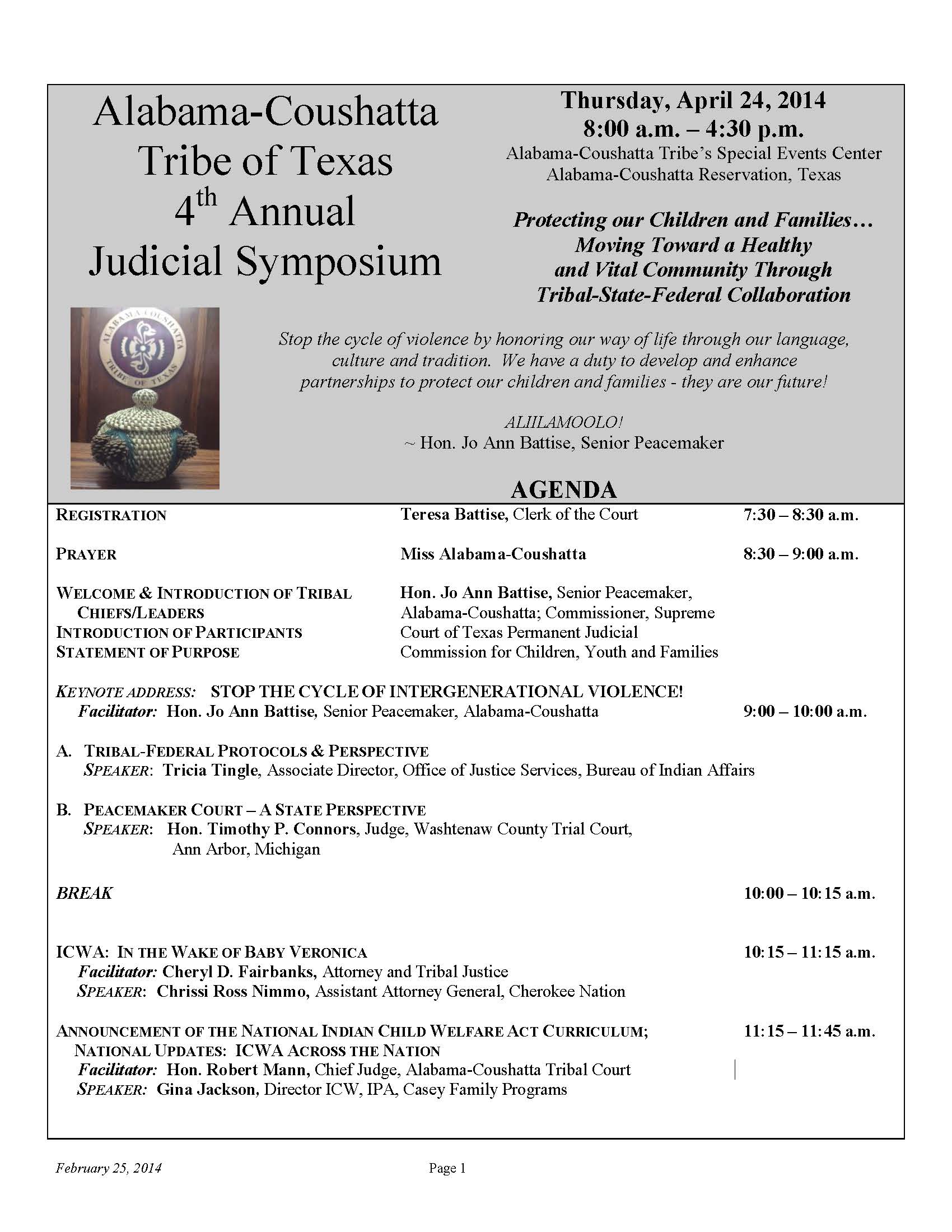
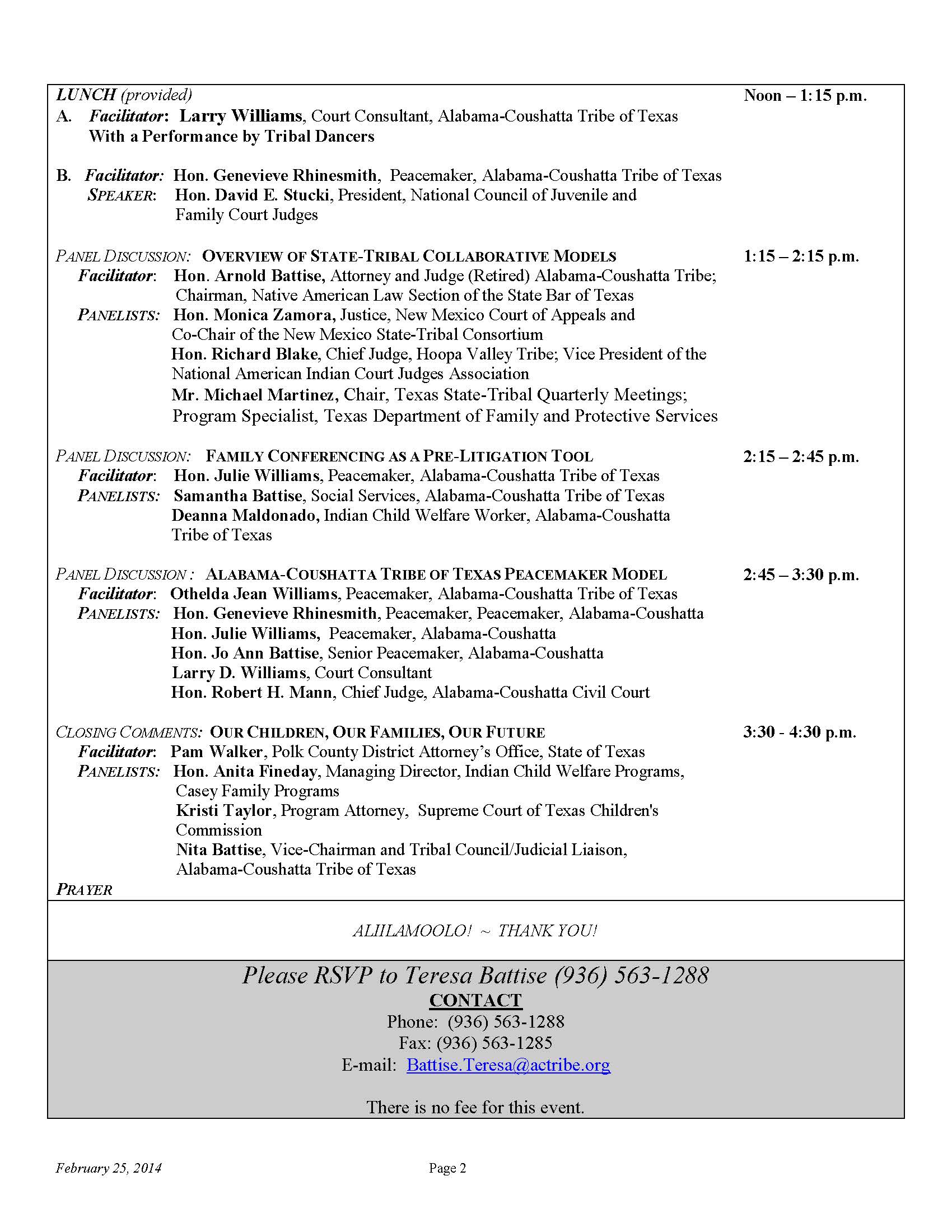
Agenda for Alabama-Coushatta Judicial Symposium April 24, 2014

Here (PDF):

Agenda 25FEB2014_Page_1 Agenda 25FEB2014_Page_2

New Mexico Appleseed Job Posting

New Mexico Appleseed

STAFF ATTORNEY

Albuquerque, New Mexico or Santa Fe, New Mexico

Practice Areas:  Hunger, homelessness, community development, poverty law, Native American

Job Description

Reporting to Executive Director, the Staff Attorney is responsible for research, analysis, and writing for the organization on a wide variety of poverty-related issues such hunger, homelessness, and foster care.  Primary responsibilities include legal research and writing, policy analysis and advocacy, legislative drafting, negotiation, community education, and collaboration with non-profit, community-based, and governmental organizations.  This position does not involve litigation.  Diverse candidates are encouraged to apply.

Continue reading

UCLA Race, Labor & the Law Conference February 28-March 1, 2014

Here. Agenda here. Fletcher/Fort/Singel paper here.

Fletcher’s panel:

Saturday, March 1

Labor and Employment Issues Facing Indigenous Peoples in the U.S.
Matthew L.M. Fletcher, J.D. | Professor of Law & Director of the Indigenous Law & Policy Center, Michigan State University
James Kawahara, J.D. | Adjunct Professor in Practice, UCLA School of Law, UC Los Angeles; Attorney, Kawahara Law P.C.
  • “Judicial Application of Federal Labor and Employment Laws to Indian Tribes When Congress is Silent: What Fills the Vacuum?”
Lynn Stephen, Ph.D. | Professor of Anthropology and Director of the Center for Latino/a and Latin American Studies, University of Oregon
  • “Indigenous Mexican Workers in the U.S.: Labor Conditions, Health, and Identity”
David Kamper, Ph.D. | Associate Professor and Chair of American Indian Studies, San Diego State University
  • “The Work around Tribal Sovereignty: Negotiating Notions of Labor, Jobs, & Class in Tribal Governmental Gaming and Economic Development”
Moderated by: Pamela A. Izvănariu, J.D., LL.M. | Director of Research & Development, UCLA Institute for Research on Labor and Employment, UC Los Angeles

NAICJA Training RFP

Here:

NAICJA RFP 2014

University of Oklahoma Indian Law Conference

Norman — The University of Oklahoma College of Law, American Indian Law Review and OU Native American Studies Department is hosting its third annual symposium.  This year’s “Tribal Sovereignty: A Global Perspective” symposium will highlight the issues indigenous peoples face at the international and regional levels.  This includes the ability of indigenous peoples to assert their rights at the United Nations and the Organization of American States, in addition to the ability of tribes to engage economically on an international level.

“Woven into the fabric of the College, Native American Law is central to our strategic vision and an integral part of our curriculum.  It is truly our privilege to host extraordinary world leaders to highlight significant issues facing indigenous peoples,” said Dean Joe Harroz.

Continue reading

AUSA Vacancy Announcement in District of New Mexico

The District of New Mexico has posted vacancy announcements  for Assistant United States Attorneys on the DOJ Internet and DOJ Intranet web sites.  These positions are located in the Albuquerque and/or the Las Cruces, NM Office.  If you know of anyone who might be interested in applying, please make sure to direct them to the appropriate link below and advise them to review the complete announcement for full information.

http://www.justice.gov/careers/legal/jobs/14-ausa-nm-1.htm (CRIMINAL)

http://www.justice.gov/careers/legal/jobs/14-ausa-nm-2.htm  (CIVIL)

American Indian Law Journal CFP

The American Indian Law Journal, published by the Seattle University School of Law, is currently accepting submissions for potential publication in the fall and spring issues.  The American Indian Law Journal serves as a vital online resource providing high quality articles on issues relevant to Indian law practitioners and scholars across the country. The deadline for submissions for the fall issue is August 31, 2014.  Our staff begins the editing process in mid-September, with publication occurring in November. Articles considered for publication in the spring issue must be submitted no later than December 15, 2014.

The American Indian Law Journal accepts articles and abstracts for consideration from students, practitioners, and law school faculty members.  For more information or to submit an article, please contact Jillian Held, Content Editor, at heldj@seattleu.edu.