The U.S. District Court for the District of New Mexico is accepting applications for a part-time Magistrate Judge to serve a four-year term in Gallup, New Mexico. The advertisement can be found here or here.
Announcements
Columbia NALSA Announces National NALSA Writing Competition
The Columbia Law Native American Law Students Association is proud to present the 12th Annual
Indian Law Writing Competition
The purpose of the competition is to recognize excellence in legal research and writing related to Indian law, actively encourage the development of writing skills of NNALSA members, and enhance substantive knowledge in the fields of Federal Indian Law, Tribal Law and traditional forms of governance. The competition is open to matriculated law students at any point in their law school career and regardless of race or tribal membership status. Eligible topics are Federal Indian law and policy, Tribal law and policy, International law and policy concerning indigenous peoples, and Comparative Law (i.e intertribal or government-to-government studies). Existing work is welcomed.
• First Prize – $1000.00 – Sponsored by Sonosky, Chambers, Sachse, Endreson & Perry, LLP
& Publication in the Columbia Journal of Race and Law.
• Second Prize – $500.00 – Sponsored by SNR Denton US LLP
• Third Prize – $250.00 – Sponsored by Shanker & Kewenvoyouma, PLLC
• The Federal Bar Association has donated registrations for each awardee to the 38th Annual Indian Law Conference. (Awardees are responsible for their own travel and lodging costs.)
All awardees will be recognized at the National NALSA yearly conference.
Submission Deadline: 5:00 pm EST, Friday January 18, 2013.
All submissions must be electronically submitted to NNALSAWritingCompetition@gmail.com.
Visit the NNALSA Web Site at http://nationalnalsa.org/events/writingcomp/ for official rules and submission form.
President Obama Announces 2012 White House Tribal Nations Conference
From the press release:
THE WHITE HOUSE
Office of the Press Secretary
FOR IMMEDIATE RELEASE
November 15, 2012
President Obama Announces 2012 White House Tribal Nations Conference
WASHINGTON – On Wednesday, December 5, President Obama will host the White House Tribal Nations Conference at the Department of the Interior. The conference will provide leaders from the 566 federally recognized tribes the opportunity to interact directly with the President and representatives from the highest levels of his Administration. Each federally recognized tribe will be invited to send one representative to the conference. This will be the fourth White House Tribal Nations Conference for the Obama Administration, and continues to build upon the President’s commitment to strengthen the government to government relationship with Indian Country. Additional details about the conference will be released at a later date.
###
NMAI Program on the Nixon Administration and Indian Self-Determination — Thursday 11/15/12
In light of the Nixon Administration papers we posted, see here:
Nixon and the American Indian: The Movement to Self-Determination Thursday, November 15, 2012, 10:30 AM – 12 PM
| Categories | Lectures & Discussions, Webcasts & Webinars |
| Venue | American Indian Museum |
| Event Location | Rasmuson Theater, First Level |
| Webcast | nmai.si.edu… |
| Cost | Free |
Early in his administration, President Richard Nixon dramatically changed the federal government’s Native American policy to support self-determination for Native American tribes and restoration of their culture. Fortifying the fiduciary relationship of the federal government for the tribes was central to ensuring that the new policy succeeded. White House and administration officials who worked with President Nixon discuss the leadership, legislation, and litigation necessary to implement the policy and what it means to the American Indian. The Archivist of the United States, David Ferriero, will deliver opening remarks. Cosponsored with the Richard Nixon Foundation and the National Archives.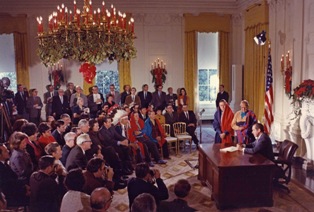
For further information, please contact NMAI-SSP@si.edu.
Photo President Richard Nixon signing landmark legislation on Native American sovereignty at the White House, December 15, 1970 by Oliver F. Atkins
Kansas Law Announces 17th Annual Tribal Law and Government Center Conference
The University of Kansas Tribal Law and Government Center announces the 17th Annual Tribal Law and Government Conference.
The conference will take place Friday, March 1, 2013 at the Burge Union on the University of Kansas campus in Lawrence, Kansas. This year’s theme is climate change and its impact on indigenous peoples. CLE credit will be available to attendees. Lunch will be provided.
Confirmed speakers include:
- Professor Randall Abate, Florida A&M University College of Law
- Professor Robin Craig, S.J. Quinney College of Law, University of Utah
- Leonardo Crippa, Indian Law Resource Center
- Heather Kendall Miller, Native American Rights Fund
- Professor Rebecca Tsosie, Sandra Day O’Connor College of Law, Arizona State University
- Dr. Daniel Wildcat, Haskell Indian Nations University
- Professor Elizabeth A. Kronk, University of Kansas School of Law
The conference will also mark the domestic launch of the book “Climate Change and Indigenous Peoples: The Search for Legal Remedies” (Randall Abate & Elizabeth Ann Kronk eds., Edward Elgar Publishing, 2013).
The annual University of Kansas School of Law Diversity Banquet will follow the conference. This year’s Diversity Banquet is hosted by the KU Native American Law Students Association. Conference attendees are invited to attend the banquet.
More detailed information and registration will be available in early 2013. For additional information, please contact Professor Elizabeth Ann Kronk at (785) 864-1139 or elizabeth.kronk@ku.edu.
Agenda for Harvard Law School Tribal Courts Symposium — This Thursday and Friday
Tribal Courts and the Federal System
Cambridge, MA
November 8th and 9th, 2012
Tribal Courts and Criminal Law: Assessing the Work of the Tribal Law and Order Commission
November 8, 2012
8:30–8:45 am Introductions and Overview of Conference
Robert Anderson, Oneida Nation Visiting Professor of Law, Harvard Law
School, and Professor of Law, University of Washington School of Law
Seth Davis, Climenko Fellow and Lecturer on Law, Harvard Law School
8:45–9:30 am Introducing the Work of the Tribal Law and Order Commission (TLOC)
Commission Chairman Troy Eid
9:30–11:30 am Improving Criminal Law Enforcement in Indian Country
Professor Carole Goldberg, Professor of Law and Vice-Provost, UCLA; Honorable Theresa Pouley, Tulalip Tribal Court and TLOC Commissioner; Kristen Carpenter, Professor, University of Colorado School of Law
What are the major issues that arise in adjudication of crimes covered by the Major Crimes Act and Indian Country Crimes Act? What is the relationship between tribal and state authorities in jurisdictions where Congress has authorized state criminal jurisdiction within Indian country? Who is an Indian for federal criminal jurisdiction purposes?
11:30 am–12:15 pm Break
12:15–1:45 pm Lunch and Keynote Address
Honorable Kevin Washburn, Assistant Secretary for Indian Affairs, U.S. Department of the Interior
2:00–3:30 pm Tribal Criminal Jurisdiction: Theory and Practice
Angela Riley, Professor of Law, UCLA; Professor Ron Whitener, University of Washington Public Defense Clinic; Anita Fineday, Annie E. Casey Foundation (former White Earth Tribal Judge)
What are the major jurisdictional issues that tribal courts confront? How do tribal courts approach sentencing alternatives? What should be the long-term plan for strengthening tribal courts? What is being done to provide defense for indigent defendants?
3:30–3:45 pm Break
3:45–5:00 pm Intergovernmental Cooperation Among Tribes, States, and the United States
Robert Anderson, Oneida Nation Visiting Professor of Law, Harvard Law School and Professor of Law, University of Washington School of Law; Carole Goldberg, Professor of Law and Vice-Provost, UCLA; Wenona Singel, Associate Professor of Law, Michigan State University
What are the legal and practical relationships between federal, state, and tribal courts and law enforcement officials in the area of criminal law? What are the opportunities for retrocession at the state level to return criminal jurisdiction to Indian tribes and the federal government? How can cooperative public safety agreements be a solution to jurisdictional complications in Indian Country?
Tribal Civil Jurisdiction and Sources of Tribal Law
November 9
8:30–8:45 am Introductions and Overview of Day 2
Robert Anderson, Oneida Nation Visiting Professor of Law, Harvard Law
School, and Professor of Law, University of Washington School of Law
Seth Davis, Climenko Fellow and Lecturer on Law, Harvard Law School
8:45–9:45 am Tribal Civil Jurisdiction
Judge William C. Canby, Jr., Ninth Circuit Court of Appeals
9:45–10:15 am Break
10:15–11:45 am Tribal Civil Law Development
Judge Michael Petoskey, Pokagon Band of Potawatomi Indians; Professor Matthew Fletcher, Michigan State School of Law; Julie Kane, General Counsel, Nez Perce Tribe; Seth Davis, Climenko Fellow and Lecturer on Law, Harvard Law School
How do tribal courts approach the task of developing common law? To what extent do they focus on tribal norms and to what extent do they borrow from state or federal law? How do tribal courts understand their relationship to tribal councils or other legislative bodies? How do tribal courts relate to tribal executives?
11:45 am–12:00 pm Break
12:00–1:30 pm Lunch and Closing Address
Honorable Hilary Tompkins, Solicitor, U.S. Department of the Interior, Washington, D.C., The Importance of Tribal Courts in the Federal System
Congrats to Georgene Louis!
Among the victories last night, Georgene, Pueblo of Acoma, won her election contest and will be a representative in the New Mexico House of Representatives!
You can view her information here.
NARF Seeks Alaska Staff Attorney
Here.
Wisconsin Judicare Indian Law Attorney Job Posting
DESCRIPTION — Wisconsin Judicare’s Indian Law Office has an opening in Wausau for an additional attorney to represent Native American individuals and groups on a variety of Indian Law issues including litigation in tribal and state courts. Wisconsin Judicare is a non-profit legal services program serving northern Wisconsin where there are 11 Indian reservations.
DUTIES — (1) Maintain caseload on behalf of Indian individuals and groups; (2) Participate in tribal court development and community education projects; and (3) Carry out training and back-up assistance to private attorneys.
QUALIFICATIONS — (1) Admission to practice law in Wisconsin at earliest opportunity; (2) Good communications skills; and (3) Knowledge of Native American issues preferred.
SALARY — DOE. There are excellent fringe benefits plus all the advantages of living in the four full seasons of northern Wisconsin.
APPLICATION PROCEDURE — Please submit resume, writing sample and 3 references to James Botsford, Director, Indian Law Office, Wisconsin Judicare, P.O. Box 6100, Wausau, WI 54402 or at jbotsford@judicare.org. For inquiries call James at 1-800-472-1638. The position will remain open until filled.
NATIVE AMERICANS, MINORITIES, WOMEN, OLDER PERSONS AND
HANDICAPPED PERSONS ARE ENCOURAGED TO APPLY.
Update from Lewis & Clark NALSA re: National NALSA Moot Court — CALL FOR JUDGES
NNALSA Moot Court
Lewis & Clark is excited to announce that the 2013 Moot Court Competition Problem has been released. The competition problem can be found here. You can also register for the competition on our website.
The competition rounds will be held on February 22-23, 2013 and will require close to 200 judges to execute. There are three rounds of competitions to determine which teams will advance to the final rounds on Saturday. If you are interested in judging during the competition, please just click here and fill out this form.
If you have any questions, feel free to contact nalsa@lclark.edu. Good luck and we look forward to seeing you in February!
 Turtle Talk
You must be logged in to post a comment.