Final AFCARS Rule with ICWA Elements

Here is the final Adoption and Foster Care Analysis and Reporting System Rule incorporating a number of new data elements states will have to report to the feds. These elements include important information on ICWA cases and placements. Many people in our field worked very hard to get these elements included, which required a supplemental notice and comment period.

This is the first time these ICWA data elements will be required by the federal government. The first anticipated annual AFCARS report that will include the information is anticipated by 2020 (thanks, Heather, for this information!).
2016 BIA ICWA Guidelines Released

Here are the 2016 Guidelines. For those keeping track at home:

February 2015, Updated Guidelines replacing the 1979 Guidelines (No Longer in Effect)

June 2016, Federal Regulations released (Became Binding on December 12)

December 2016, Updated Guidelines replacing the February 2015 Guidelines

What this means:

25 USC 1901 et seq (ICWA) has not changed in 1978, and provides the minimum federal standards for Indian families. State ICWA laws (and corresponding court rules) that provide higher standards still apply. The federal Regulations are now binding and are like the federal law. The December 2016 Guidelines are now in effect and are non-binding interpretation of the Regulations (given the way they are drafted).


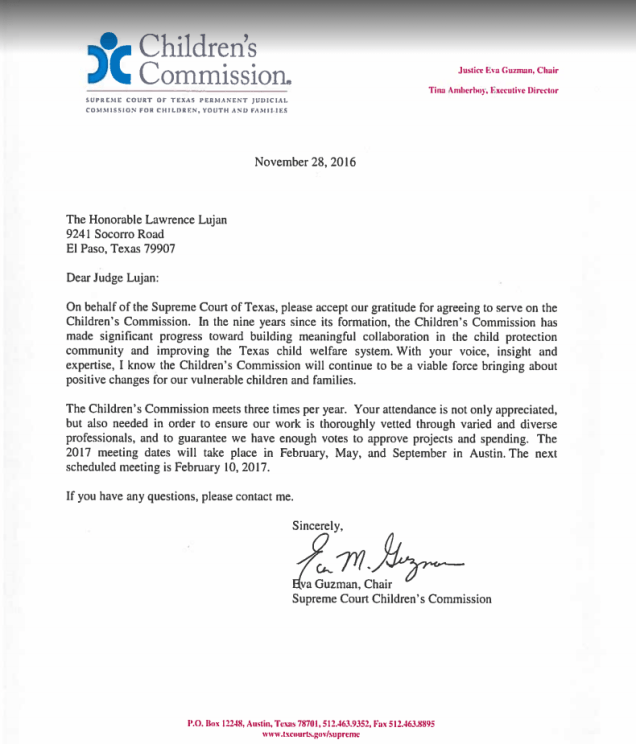
Ysleta del Sur Chief Judge Lawrence Lujan Appointed Commissioner to Texas Supreme Court’s Permanent Judicial Commission for Children, Youth and Families

From the National American Indian Court Judges Association (NAICJA) Facebook Page:

NAICJA Vice President Appointed Commissioner to the Texas Supreme Court’s Permanent Judicial Commission for Children, Youth and Families

Our Tribal Courts not only serve our sovereign communities but also seek partnerships at the state and federal level. These partnerships enhance Indian Country legal services and most importantly put our tribal nations in key leadership positions that promote the welfare of our community members and the sovereignty of all Tribal Courts.

Congratulations on your new appointment Chief Judge Lawrence Lujan of the Ysleta del Sur Pubelo!


image-1image

Nebraska Supreme Court ICWA/NICWA Decision

Here.

This is a tough case of intergenerational removal. The Nebraska Supreme Court finds that both ICWA and NICWA apply to non-Indian parents of Indian children as defined by the statutes. The Court also found that NICWA’s different language in its active efforts provision, which requires active efforts not just to prevent the break up of the family, but to unite the parent with the Indian child, means the Baby Girl holding does not apply to that provision of state law. However, where NICWA’s language is the same as ICWA’s regarding “continued custody” in the termination of parental rights section, the Baby Girl holding does apply, and there is no need to find the continued custody of the child will result in serious physical or emotional damage, where the parent hasn’t had custody of the child.

While the new federal Regulations, which go into effect next week, are useful for tribes and Native families, state ICWA laws continue to hold the most promise for enforcement of the law in the courts. If your state is contemplating drafting one (either through a tribal-state workgroup, Court Improvement Program, or other mechanism), there are resources and people available to provide research and assistance.

Oklahoma Court of Appeals Case Granting Transfer to Tribal Court

Here. And the OK Supreme Court agreed to publish the decision. 

This case involved a guardianship:

ICWA defines “foster care placement” as “‘any action removing an Indian child from its parent or Indian custodian for temporary placement in a foster home or institution or the home of a guardian or conservator where the parent or Indian custodian cannot have the child returned upon demand, but where parental rights have not been terminated.'”25 U.S.C. 1903(1)(i). This guardianship case is governed by this definition of foster care placement because Mother cannot have her children returned on demand as shown by the fact that she requested that the guardianship be terminated and her request was denied.

The case also discusses the requirement of clear and convincing evidence to deny transfer. The trial court denied transfer stating it was the advanced stage of the proceedings–which it was because Cherokee Nation didn’t receive notice, and the delay was beyond the Nation’s control.

This is only the 16th time an appellate court reversed the lower court and ordered transfer. This is one of two from this year.

BIA Publishes Updated Model Tribal Juvenile Code

Press Release here.

Model code here.

One of the things that is particularly useful in this model code is how it is annotated with information on why the drafters made certain choices, and links to other resources with additional information.

Unpublished ICWA Notice Case out of California (First District)

Here.

The First District of California seems to be trying a new way to deal with notice violations in ICWA cases by detailing the mistakes in the notice in the opinion. The first time we saw it was in September (here). In this case, a different division in the same District did a similar analysis.

As to the Chippewa Cree tribe, the notice for G.B.-C. was sent to Chippewa Cree Indians, Brenda Gardiner, ICWA Rep, RR1, P.O. Box 544, Box Elder, Montana 59521. According to the Department’s proof of service, the notice for M.B.-C. was sent to the same address. The address specified for the tribe in the Federal Register was Chippewa Cree Tribe of the Rocky Boy’s Reservation of Montana, Christina Trottier, ICWA Director, 31 Agency Square, Box Elder, MT 59521. (79 Fed.Reg. 3225 (January 17, 2014).) Although the city, state and zip code were the same, the addresses were completely different.
The Department asserts the notice was nevertheless adequate because the P.O. Box address it used to provide notice to the Chippewa Cree tribe was the one that was listed on the State Department of Social Services’s (CDSS) website.4The Department relies on In re N.M., supra, 161 Cal.App.4th at page 268, in which the court held the child welfare agency did not err in using the names and addresses provided by CDSS in notifying the relevant tribes, stating: “The Department should not be hamstrung by limitation to only the names and addresses provided for the tribes in the Federal Register if a more current or accurate listing is available and is reasonably calculated to provide prompt and actual notice to the tribes.
While requiring the Department to adhere to an address listed in the federal register when other, more accurate information is available elsewhere “would exalt form over substance,” (In re N.M., supra, 161 Cal.App.4th at p. 268), we must still respect the Department of Interior’s primary authority in administering ICWA (In re S.B. (2005) 130 Cal.App.4th 1148, 1157 [the federal regulations implementing ICWA “are binding in all federal and state courts by virtue of the supremacy clause”] ). ICWA notice may depart from the addresses listed in the federal register, but only when the alternative address is “more current or accurate.” (In re N.M., supra, 161 Cal.App.4th at p. 268.)
Here, there is nothing in the record indicating the CDSS address the Department used was more current or accurate than the address listed in the Federal Register. Thus, while the return receipt received for the notice sent for G.B.-C. shows that someone at the CDSS address received the notice, there is no basis to conclude the notice was received by someone at the Chippewa Cree tribe who was “trained and authorized to make the necessary ICWA determinations, including whether the minors are members or eligible for membership and whether the tribe will elect to participate in the proceedings.” (In re J.T., supra, 154 Cal.App.4th at p. 994.)”

Preliminary 2015 AFCARS Data Released by DHHS

Just a reminder that this is the Adoption and Foster Care Analysis and Reporting System data, which is information sent from the state to the federal government about kids in foster care. There is still a pending rule change that would add ICWA-specific data elements to these reports, but it has not yet been promulgated. How Native children are identified by state actors for this report varies dramatically by state (and county), but it is the best data we have at this time.

Here.

Proposed Court Rule in Michigan to Waive Pro Hac Fees and Other Limits for Out of State Tribal ICWA Attorneys

Here.

In ICWA cases, the tribe has a right of intervention in whatever state court is hearing the case of the tribal child. While it is true that the “tribal representative” does not have to be attorneys, when they are attorneys, there may be concerns about practicing without finding local counsel or using the local “pro hac” rule. Michigan has proposed a court rule that would waive those requirements for tribal attorneys representing the tribe in a state court where the attorney is not barred. This proposed rule is in direct response a number of requests from tribal ICWA attorneys nationwide. We are hopeful other states will consider a similar rule (though in Nebraska this is right is guaranteed by statute, which is another great fix). This rule was proposed by the Michigan Tribal-State Judicial Forum.

Also, if you are an out of state attorney who would benefit from this proposed Rule (or in state) please send in comments by March 1.

Washington Supreme Court Explicitly Rejects Existing Indian Family Exception

Here

In only the third Washington Supreme Court case to directly interpret ICWA and the first to interpret WICWA, the Court holds In re Crews (the case that established EIF in Washington) is overturned.

Under our above interpretation of ICWA and WICWA, if a case (1) meets the definition of a “child custody proceeding” and (2) involves an Indian child, both acts shall apply. ICWA and WICWA recognize only two exceptions to coverage–delinquency
proceedings and custody disputes following divorce where one parent retains custody of the Indian child. Our interpretation therefore overrules Crews to the extent that it embraced the existing Indian family exception because it recognizes no additional exceptions to coverage outside of the two expressly stated in ICWA and WICWA.

ICWA and WICWA also apply based on the child’s membership, not the parent’s:

For these reasons, we hold that whether the parent whose rights are being terminated is non-Indian is immaterial to a finding that ICWA and WICWA apply. If the child at issue is an Indian child and that child is involved in a child custody proceeding, ICWA and WICWA shall apply.

Craig Dorsay represented the tribal amicus brief (including oral arguments), and NARF and Indian Law Clinic at MSU Law provided strategy and research support in this case. Previous coverage here.