West Virginia Supreme Court Repudiates Existing Indian Family; Orders Transfer to Tribal Court

Ex re Delaware Tribe v. Hon. Nowicki-Eldridge

This is, as you might imagine, a description of a mess where the West Virginia agency never contacted the Tribe, and then didn’t respond to attempts by the Tribe to get in contact with the agency.  Then foster parents were granted intervenor status as well. The decision doesn’t state who made the EIF argument, but the Indian Law Clinic has been hearing the argument more and more from foster parents seeking to deny transfer to tribal court. While the Clinic was not involved in this case, it is reminiscent current appeals the Clinic is working on. My sense from the opinion is that the tribal briefing was likely excellent. The West Virginia Supreme Court didn’t buy it:

This unequivocal statement plainly dispels any notion that the EIF exception is compatible with the ICWA. Accordingly, we join the “swelling chorus of [jurisdictions] affirmatively reject[ing] the EIF exception[,]” ICWA Proc., 81 Fed. Reg. 38778, 38802 (June 14, 2016), and hold that West Virginia does not recognize the Existing Indian Family exception to the Indian Child Welfare Act, 25 U.S.C. §§ 1901 to -1963 (2021). Accordingly, the circuit court erred in adopting the EIF exception and subsequently relying on that exception to determine that the ICWA was inapplicable to this case.

Another fun thing that has been happening a lot is parties arguing the 1979 Guidelines rather than the 7 year old 2016 Regulations and Guidelines:

Before this Court several of the parties cited this guidance as a basis for arguing that the Tribe is not entitled to transfer because it knew of these proceedings in December 2021 but did not move to transfer until eight months later in August 2022. What the circuit court and the parties fail to recognize is that the 1979 Guidelines were explicitly abrogated and replaced by the BIA when it promulgated the 2016 Guidelines. See Guidelines for Implementing the Indian Child Welfare Act, 81 Fed. Reg. 96476 (Dec. 30, 2016) (“The [2016] guidelines replace the 1979 and 2015 versions[.]”). Therefore, we do not find the 1979 Guidelines persuasive, nor do we rely upon any guidance contained therein.

***

The proceeding regarding termination of the parental rights of Respondent Father was not at all advanced at the time the Tribe filed its motion to transfer the proceeding. Respondent Father had not been adjudicated; indeed, neither a preliminary nor adjudicatory hearing had even been scheduled. While five months passed between March 2022 and the Tribe’s motion to transfer in August 2022, the record reveals that those months were devoted to ascertaining whether the ICWA applied to this case, and not to any consideration of the merits of the amended petition. In short, there was nothing “advanced” about this proceeding when the Tribe moved to transfer.

Finally, this Court did not just send the case back for reconsideration, but rather ordered the lower court to transfer jurisdiction to the Delaware Tribe.

Here is the press coverage on the case: https://www.courthousenews.com/delaware-tribe-of-indians-applauds-west-virginia-supreme-court-decision-affirming-its-jurisdiction-in-child-welfare-case/

No Brackeen Decision Today

Next opinion day is June 15.

Remember, no matter what someone tells you, the Court does not suddenly or randomly release opinions. If the Court’s website doesn’t say they are releasing opinions, they are not releasing opinions that day. The website also says what time (10am) they are convening to release opinions. We absolutely do not know which opinions they will release, or how many, just that they will release some.

This alert is definitely not based on phone calls I got last Sunday.

No Brackeen Today/Observations on Foster Parent Intervention

Next opinion day is June 8.

While we wait for Brackeen, I wanted to highlight this story from Colorado, where the Office of Respondent Parents’ Counsel has been doing great work on ICWA cases. In this case, they have collected incredibly useful data on what happens to a child protection case when foster parents intervene. This article is not ICWA specific, but the last two cases the MSU Indian Law Clinic has had on appeal are a direct result of the attempt at foster parents to intervene. In both cases, the court and agency agreed with the tribes and followed ICWA. In both cases, the foster parents sought to intervene and appealed the case. As we look past Brackeen, addressing this issue of foster parent intervention generally is vital.

Article

According to data provided by the ORPC foster parent intervention has increased in Colorado in the past decade. In 2020, 10% of Dependency and Neglect cases had Intervenors. When foster parents intervene, the chance of reunification decreases from 62% to 22% for the birth parents.

emphasis added

According to the ORPC, the average Dependency and Neglect Case costs $3,500 to litigate, but when foster parents intervene the average court cost goes up to $7,500.

Montana Legislature Sends State ICWA Bill to Governor’s Desk

Here is the bill: HB0317

There has been a lot of wrangling on this one, but in the end this bill has the protections of ICWA as well as incorporating language from the federal regulations.

And just for the record, the Montana Legislature is currently run by a Republican super majority, as is Wyoming and North Dakota, all of which have now passed state ICWA bills. ICWA is a bipartisan law.

North Dakota Passes State ICWA Law, Needs Governor’s Signature

Here is a link to the legislative page. The downloaded bill is on the Turtle Talk State ICWA Law Page.

Press coverage here:

Lawmakers voted nearly unanimously this week to pass House Bill 1536, which would weld the crux of the federal Indian Child Welfare Act (ICWA) onto North Dakota’s law books. The bipartisan legislation now goes to Gov. Doug Burgum, whose spokesman did not immediately respond to a request for comment.

ICWA Jurisdiction Case out of the Oklahoma Supreme Court

Here is the opinion

IN THE MATTER OF S.J.W.

This is a truly unfortunate opinion with absurdly weak analysis that extends the reasoning in Castro-Huerta to reservations in Oklahoma for ICWA cases involving non-member Indian children residing on reservation.

So we are all on the same page, 1911(a) of ICWA states:

An Indian tribe shall have jurisdiction exclusive as to any State over any child custody proceeding involving an Indian child who resides or is domiciled within the reservation of such tribe, except where such jurisdiction is otherwise vested in the State by existing Federal law.

(emphasis added)

This case involves the jurisdiction of the Chickasaw Nation tribal court over a Muskogee child. The parents appealed a state child protection case claiming the state did not have jurisdiction over the child after McGirt and the Chickasaw Nation had exclusive jurisdiction. There is, of course, an easy answer to this, which is the Tribes after McGirt all signed 1919 agreements with the State of Oklahoma to ensure continued concurrent jurisdiction post-McGirt when it involves an ICWA case. The Oklahoma Supreme Court would like you to know that this is a “misunderstanding of the construction of 1911(a)” which, frankly, came as a surprise to me and seems to be lacking any legal support, but here we are. 

Instead, the Oklahoma Supreme Court took it upon itself to, for the first time I’ve ever seen, claim that 1911(a) only refers to territorial jurisdiction but not subject matter jurisdiction. In fact, the Court  wrote “Whether § 1911’s ‘jurisdiction’ means ‘subject matter jurisdiction’ has received little attention, but requires our review.” I mean, I really don’t think it did, but here we are. Again. 

In doing so, the  Court decided that Castro-Huerta, involving the prosecution of non-Indians on reservation, is broad enough to hold that the state courts have subject matter jurisdiction over tribal reservations for . . . all the things?

When federal Indian law issues arise, we must take special care to determine if federal law preempts or ousts the state of its general adjudicative authority. Id. When determining jurisdictional disputes for cases arising within the external boundaries of a reservation, we must remember that Oklahoma’s sovereignty does not stop at reservation borders. Castro-Huerta, 597 U.S. at ___, 142 S. Ct. at 2488. The U.S. Constitution authorizes Oklahoma district courts to exercise jurisdiction in Indian country–Oklahoma’s territory includes “Indian country.” Id. at 2493.

Indian country is part of the State, not separate from the State. To be sure, under [the United States Supreme Court’s] precedents, federal law may preempt that state jurisdiction in certain circumstances. But otherwise, as a matter of state sovereignty, a State has jurisdiction over all of its territory, including Indian country. See U.S. CONST., Amdt. 10.

Id. The general rule is that Oklahoma is “‘entitled to the sovereignty and jurisdiction over all the territory within her limits.'” Id. (citing Lessee of Pollard v. Hagan, 44 U.S. (3 How.) 212, 228, 11 L. Ed 565 (1845)).

The State of Oklahoma by its Constitution has broadly authorized its district courts to exercise subject matter jurisdiction over “all justiciable matters” unless otherwise noted in the Constitution. Okla. Const. art. VII, § 7(a). Adjudicating children deprived surely is a “justiciable matter.” Ibid. While the parties refer to ICWA’s general reference to “jurisdiction” as “subject matter jurisdiction,” we decline to accept this characterization. This is especially so given the presumption of a district court’s general adjudicatory jurisdiction

Therefore, the Court holds that the state has concurrent jurisdiction on reservation over non-member Indian children, because 1911(a) only means tribes have territorial jurisdiction exclusive concurrent as to its members. To be fair, the opinion is fairly confusing, but ultimately states:

When a child appears before a district court judge and is subsequently determined to be a member Indian, the district court maintains subject matter jurisdiction. But the sovereign status of a tribe and its territorial jurisdiction over its members and territory necessitates disposition of the matter in that tribe’s tribal courts because self-governance is implicated. See Holyfield, 34. (Abusive state practices with respect to Indian Children “seriously undercut the tribes’ ability to continue as self-governing communities. Probably in no area is it more important that tribal sovereignty be respected than in an area as socially and culturally determinative as family relationships.” (citations omitted) (quotations omitted). Section 1911’s “jurisdiction” does not concern a district court’s subject matter jurisdiction; it concerns the connection to the forum and to the group of people (tribe). 

I mean, ICWA seems pretty clear that the exclusive jurisdiction is over any child custody proceeding, which feels like subject matter jurisdiction to me, and every court I’ve ever been in front of, but the Oklahoma Supreme Court seems to believes the state maintains subject matter jurisdiction over all child protection proceedings whether on or off reservation. It’s truly fascinating to see the Oklahoma Supreme Court claim that territorial jurisdiction “as a concept of international law, is important for our state . . .”

The Court then holds, without citation, that 1911(a) requires the Indian child to be residing on their own reservation rather than any reservation for exclusive (?) jurisdiction–though it is certainly not clear from the language of the law that is the intent. The Court notes again this question hasn’t been subject to “judicial scrutiny,” which is probably because the language is pretty straightforward and tribal jurisdiction over non-member Indians is noncontroversial. It appears from the last sentence of the opinion that the Chickasaw Court doesn’t have jurisdiction over the non-member Indian child at all.  I guess, here we are. 


ICWA Application Case out of Nebraska Supreme Court

Opinion here: N00009406PUB

At Fed Bar this year, I spoke about concerns regarding the definition of an Indian child for the purposes of ICWA when the child is eligible and the parent is a tribal member. This is the third case I’ve seen where there is an argument that a parent’s eligibility should be enough. Unfortunately, this isn’t the definition, and it has been an unsuccessful argument.

We hold that evidence that the tribe “considered” Amber a member for purposes of ICWA is insufficient. The plain language of § 43-1503(8) provides as relevant that an “Indian child” must have a biological parent who is a member of a tribe. The evidence adduced in the juvenile court shows that Amber is not currently a member of the tribe; the children, in turn, do not have a biological parent that is a member of the tribe.

One practice tip may be for tribes to apply for permissive intervention under the state court rules rather than the mandatory intervention under ICWA. This may be compelling for a judge when a parent is in the process of becoming a tribal member–at which point, ICWA would apply moving forward.

Montana SCT Briefs in Monroe v. Boggs [Blackfeet Tribal Court Child Custody Matter]

Here:

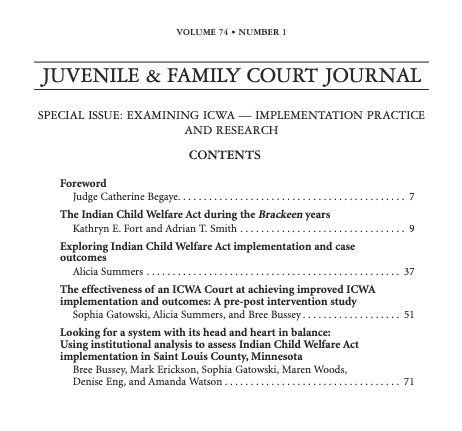
Juvenile and Family Court Journal: Examining ICWA

Screenshot 2023-03-28 at 2.17.17 PM

Here