In support of S. 246, The Alyce Spotted Bear and Walter Soboleff Commission on Native Children Act, Senator Heidi Heitkamp is highlighting Native youth from North Dakota on her Instagram account starting yesterday. It will continue over the next few days. There are a lot of challenges that Native kids face, but these profiles are meant to highlight kids who have overcome them using the hashtag #AgainstTheOdds.
Child Welfare
NAICJA Board of Directors Unanimously Support AG and ILOC Reports
Resolution No. 2015-01
Resolution No. 2015-02
The National American Indian Court Judges Association are supporting the Indian Law and Order Commission’s November 2013 report entitled “A Roadmap for Making Native America Safer,” which “advocates for tribal justice systems to have the ability to fully express their sovereignty by opting out of the current jurisdictional maze, and exercise criminal jurisdiction over all persons without any sentencing limitations, including juveniles.” However, NAICJA prefers that all individuals charged with crimes under this enhanced tribal jurisdiction be provided with civil rights protections equivalent to those guaranteed by the Indian Civil Rights Act, instead of the U.S. Constitution.
NAICJA is also supporting the November 2014 report from the Attorney General’s advisory committee on American Indian/Alaska Native Children Exposed to Violence entitled “Ending Violence So Children Can Thrive” which “calls for the restoration of the inherent sovereignty of tribes to assert full criminal jurisdiction over all persons who commit crimes against AI/AN children in Indian country.”
Briefing Completed in Nat’l Council for Adoption v. Jewell (Guidelines Litigation) on Motion to Dismiss
Hearing on the matter is set for 11/13. Government’s Reply Brief here.
Even if BAF’s claims were not precluded by the Memorandum Opinion, however, they would fail in their own right. BAF does not have standing, either for itself or to assert the interests of unspecified birth parents, nor has it alleged any basis for this Court to conclude that its claims are ripe. If adoption proceedings are underway, then the Court should abstain from hearing the present suit or dismiss the declaratory relief as contrary to the Anti-Injunction Act. BAF cannot demonstrate that “legal consequences flow” from the Guidelines so as to render them reviewable because it concedes that Defendants do not enforce the Guidelines, and makes no argument that Defendants otherwise treat them as controlling. Nor does BAF cite any binding authority for the propositions that the Guidelines are race-based, that birth parents have a fundamental right to dictate the adoptive placement of their child, that ICWA exceeds the Indian Commerce Clause, or that non-binding Guidelines may commandeer state entities. For these reasons, and because they have not alleged a basis for relief under Bivens, Plaintiffs’ claims fail for lack of subject-matter jurisdiction and as a matter of law and must be dismissed.
Previous filings here. (documents 52, 56, 64, 67)
DOJ Motion to Dismiss and Supporting Amicus Briefs in Goldwater (ICWA) Litigation
Motion to Dismiss here.
Footnote 8:
Plaintiffs do not seek the type of relief – increased funding or systemic changes in the quality of child-welfare services provided by state agencies – that the Ninth Circuit found unworthy of Younger abstention in Jamieson, 643 F.2d at 1354; instead, they demand that this Court enjoin state courts and agencies from applying long-standing state and federal laws to their ongoing child-custody proceedings, which clearly warrants equitable restraint under Younger.
(emphasis added)
Also:
Membership in a federally recognized Indian tribe, or being born the child of a member of such a sovereign entity, is not a forced association. ICWA does not require association, but rather protects associations that already exist.
In addition, Casey Family Programs plus twelve other national child welfare organizations filed this amicus brief (gold standard brief).
Finally, it is a key best practice to require courts to follow pre-established, objective rules that operate above the charged emotions of individual cases and that presume that preservation of a child’s ties to her parents is in her best interests. See National Council of Juvenile and Family Court Judges, supra, at 14. Application of the best-interests-of-the-child standard should be guided by substantive rules and presumptions because “judges too may find it difficult, in utilizing vague standards like ‘the best interests of the child,’ to avoid decisions resting on subjective values.” Smith v. Organization of Foster Families for Equal. & Reform, 431 U.S. 816, 835 n.36 (1977). Courts should not terminate a child’s relationship to a parent based on “imprecise substantive standards that leave determinations unusually open to the subjective values of the judge.” Santosky v. Kramer, 455 U.S. 745, 762-763 (1982).
Finally, the national Native organizations (NCAI, NICWA, AAIA) also filed this amicus brief (historical brief).
The Indian Child Welfare Act must be viewed in light of the historical abuses that it was intended to stop. For most of American history prior to ICWA’s enactment, federal Indian policy favored the removal of Indian children from their homes as a means of eroding Indian culture and tribes. State and private child welfare agencies later took on the implementation of these policies, carrying them out with little concern for the families or communities they affected. By the 1970’s, the widespread and wholesale removal of Indian children from their parents and communities resulted in a crisis recognized as “the most tragic and destructive aspect of American Indian life today.” H.R. REP. No. 95- 1386, at 9 (1978), reprinted in 1978 U.S.C.C.A.N. 7530, 7532.
Grand Traverse Band Defeats Preliminary Injunction in Fifth Federal ICWA-Related Case Challenging Michigan’s ICWA Law
After initially granting a TRO based on an ex parte motion, the Western District of Michigan denied the requested preliminary injunction. The underlying complaint arguing the transfer provisions of the Michigan Indian Family Preservation Act (Michigan’s ICWA law) are unconstitutional. We are collecting documents in this case here.
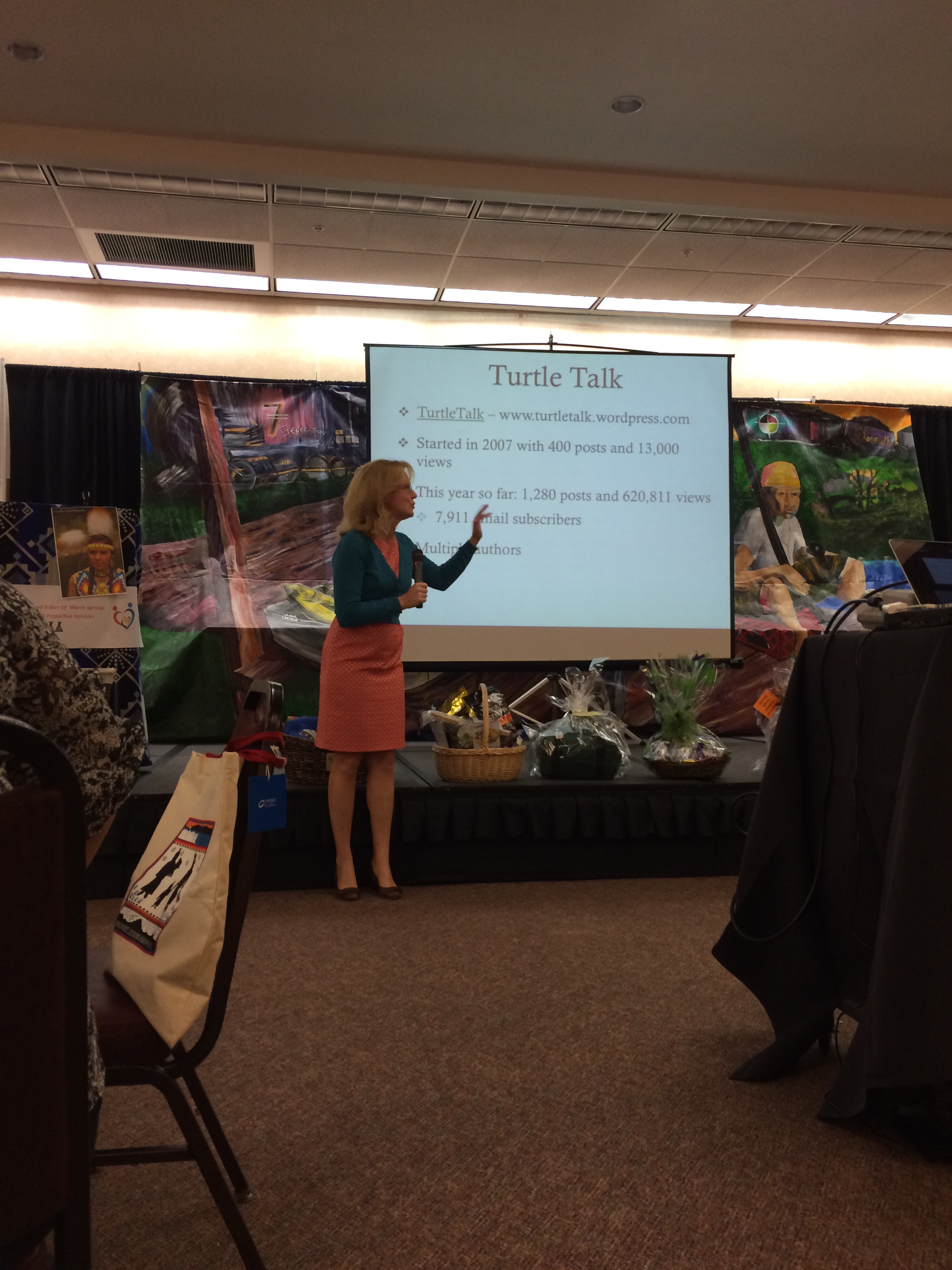
Kate Fort at the 2015 Oregon Tribal/State ICWA Conference
Here’s a picture on Turtle Talk of Kate Fort speaking about Turtle Talk at the 2015 Oregon Tribal/State ICWA Conference. Kate is a regular presenter at ICWA conferences around the country, but this may be the first time she’s presented about the blog specifically at one of these conferences.
Thanks Addie S for sending along the picture!
Alaskan Tribal Consortium Seeks Family Services Director
Link to job announcement here.
The Association of Village Council Presidents includes 56 Alaska Native Villages in the Yukon-Kuskokwim Delta. The position is out of Bethel, AK.
Michigan Tribal ICWA Attorneys Meeting
The second annual! A great opportunity for all of the attorneys who represent tribes in ICWA cases to get together and share information and develop relationships.

DOJ Prevails in Partial Motion for Summary Judgment in NCFA v. Jewell (Guidelines Litigation)
Order was issued on September 29th, but the Memorandum Opinion was issued today.
This Court DENIES Plaintiffs’ for Partial Summary Judgment because (1) Plaintiffs lack standing to challenge the 2015 Guidelines, (2) the 2015 Guidelines are not “final agency action” within the meaning of the APA because they do not create legal rights and obligations, and (3) the 2015 Guidelines are non-binding interpretive rules not subject to APA notice-and-comment procedures.
Previous filings are here.
Federal ICWA Cases Update Memo
We originally posted this when the first three lawsuits were filed. There have been two additional ones since then. Here is the memo with the most recent updates.
The National Indian Child Welfare Association (NICWA), the Native American Rights Fund (NARF), the National Congress of American Indians (NCAI), and the ICWA Appellate Project at Michigan State University College of Law—collectively known as the ICWA Defense Project—are working collaboratively to defend ICWA and the long overdue reforms to it introduced this year. This memo will summarize the pending litigation and describe some of the legal and communications strategies these partner organizations have developed to inform, advance, and unify a coordinated effort across Indian Country to respond to these attacks.
Here is a link to the page where we are keeping all of the PACER documents.
 Turtle Talk
You must be logged in to post a comment.