Published California ICWA Opinion on QEW and Active Efforts

Here.

Among other things, this case demonstrates some of the confusion going on in the courts about WHEN certain provisions of ICWA are required. Must there be a qualified expert witness at disposition hearings? What if the court makes a finding about returning a child to a parent at a disposition hearing? And finally, who is responsible for getting QEW testimony?

(The answer to the last one is the State. Not the tribe, not the parent, and it’s not waive-able [though that happens] since it’s the evidentiary burden of the State to have a QEW who agrees with termination or foster care.)

Federal Grants Available for Tribal-State ICWA Programs

Here.

The purpose of this funding opportunity announcement is to support the creation of effective practice model partnerships between state courts and/or Court Improvement Program, state public child welfare agency and a tribe, group of tribes, or tribal consortia, including both the tribal child welfare agency and tribal court for effective implementation of the Indian Child Welfare Act (ICWA) of 1978 (Pub.L. 95-608).

Demonstration sites will be required to jointly develop protocols and practices to promote effective and timely:

– Identification of Indian children;
– Notice to tribes;
– Tribal participation as parties in hearings involving Indian children;
– Tribal intervention in dependency cases;
– Transfer of ICWA cases to tribal courts; and
– Placement of Indian children according to tribal preferences.

Partnership models must be co-created by states and tribes, jointly implemented, and designed to generate and capture clear, measurable outcomes such as:

– Compliance with identification methods;
– The number of Indian children identified;
– Length of time from removal or petition filed until identification is made;
– Number of notices sent;
– Length of time from identification until notice sent (state measure)
– Number of notices received (tribal measure)
– Length of time for tribal intervention or participation; (tribal measure)
– Number of cases in which a tribe intervenes; (joint measure)
– Number of transfers; (joint measure); and
– Number of Indian children placed according to tribal placement preferences (joint measure).

Assistant Secretary Washburn Announces a New Program to Assist Tribal Social Services Agencies in Placing Children in Safe Homes

Press release (copy here):

Assistant Secretary Washburn Announces a New Program to Assist Tribal Social Services Agencies in Placing Children in Safe Homes

WASHINGTON – Assistant Secretary – Indian Affairs Kevin K. Washburn today announced a new Bureau of Indian Affairs’ Office of Justice Services (BIA-OJS) program to assist federally recognized tribal social services agencies seeking to place children in safe homes.

“The BIA-OJS Purpose Code X Program will provide tribal social service agencies with the information they need to protect the children they place into care in emergency situations when parents are unable to provide for their welfare,” Washburn said. “This program provides BIA law enforcement personnel with the ability to provide our social service agency partners with muchneeded information to help to make sure children requiring emergency placements will be placed in safe homes.”

The BIA-OJS Purpose Code X Program arose out of a 2014 working group formed by the Departments of Justice (DOJ) and the Interior (DOI) to identify sustainable solutions that provide tribes access to national crime information that addresses criminal and civil needs of tribes. The outcome of this collaboration was the BIA-OJS Purpose Code X Program and DOJ Tribal Access Program for National Crime Information (TAP) TAP will allow tribes to more effectively serve and protect their communities by ensuring the exchange of critical data.

Under the BIA-OJS Purpose Code X Program, BIA-OJS dispatch centers will be available to provide 24-hour access to criminal history records, so name-based checks can be done immediately. Protocols for operating under the new program are being developed by BIA-OJS and will be tested by a select number of tribes prior to a nationwide implementation of the program.

BIA-OJS obtained authorization to perform these name-based checks from the National Crime Prevention and Privacy Compact Council, an organization which has the legal authority to promulgate rules and procedures governing the exchange of criminal records for non-criminal justice purposes.

“The BIA Office of Justice Services and DOJ’s Office of Tribal Justice have made collaboration on improving tribal access to information a high priority over the last year, and I am grateful to the Compact Council for approving our request so quickly,” said BIA OJS Deputy Director Darren A. Cruzan.

OJS has also worked to improve tribal reporting to the Uniform Crime Report system and encouraged tribal participation in the National Data Exchange (NDEx) system.

All of these efforts underscore the importance of the exchange of information between law enforcement agencies to achieving public safety in all jurisdictions, including Indian Country.

The BIA-OJS’s mission is to address public safety concerns in Indian Country by funding law enforcement, correctional departments and tribal court services to the nation’s federally recognized tribes. It also coordinates emergency preparedness support on federal Indian lands by working cooperatively with other federal, state, local and tribal law enforcement agencies throughout Indian Country. The BIA-OJS operates the Indian Police Academy in Artesia, N.M., which provides training and professional development to BIA and tribal law enforcement personnel.

Visit http://www.indianaffairs.gov/WhoWeAre/BIA/OJS/index.htm for more information about OJS and its work.

For more information on TAP, visit http://www.justice.gov/tribal/tribal-access-program-tap.

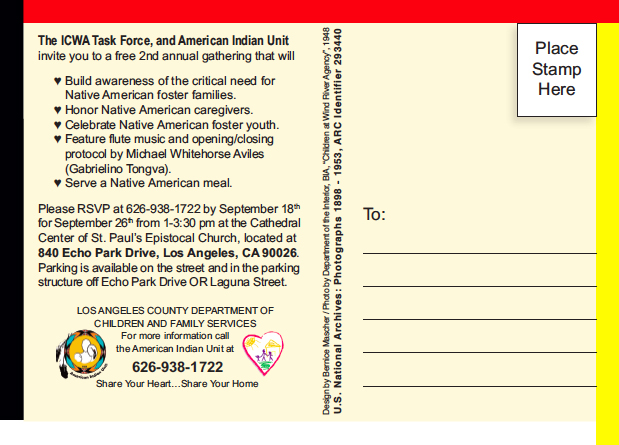
Los Angeles “Tiospaye” Native Foster Family Recruitment Event

The Los Angeles County Department of Children and Family Services American Indian Unit is sponsoring its 2nd Annual Native foster family/parent recruitment event. This event is an attempt to be proactive in searching to find native homes in an urban environment for those native children in foster/adoptive care.

***SAVE THE DATE: September 26,2015***
“TIOSPAYE”: Los Angeles Foster Family Recruitment Event
Sponsored by: The Los Angeles County Department of Children and Family Services American Indian Unit
RSVP by September 18, 2015 at 626-938-1722
Place: Cathedral Center of St. Paul’s Episcopal Church (ECHO PARK)
Address: 840 Echo Park Ave, Los Angeles, CA 90026

Sept_26_2015 LA foster recruitment Back Program

Sept_26_2015 LA foster recruitment Front

ICWA Burden of Proof Case Out of Texas

Here. The case cites to the In re K.S. case here.

The court found a way to splice the burden of proof issue, finding that the beyond a reasonable doubt standard only applies to the finding that continued custody of the child by the parent is likely to result in serious emotional or physical damage to the child, not to the termination of parental rights.


Unpublished Michigan ICWA Notice Case

Here. From Kalamazoo County.

Of note: There are six tribes in Michigan alone that should be noticed if a parent family in a “Chippewa tribe,” and DHHS noticed one of them. MIFPA requires the notice of the tribe in the county where the case arises, though the Pokagon Band service area does not include Kzoo county, while the other two (unnoticed) Potawatomi tribes do cover the county. Finally, it’s not clear from the opinion why Cherokee was noticed at all.

There is no question that the ICWA and MIFPA notice requirements were triggered early in these proceedings when father indicated at an April 2013 preliminary hearing that he might have some family membership—specifically, through his brother—in the “Chippewa tribe.” There is some indication in the record that respondent-mother also claimed potential Indian heritage, although it is unclear what tribes, if any, she identified. Because “sufficiently reliable information” of possible Indian heritage was provided, the trial court had “reason to know” that an Indian child could be involved, thus triggering the ICWA and MIFPA notice requirements. 25 USC 1912(a); MCL 712B.9(1); In re Morris, 491 Mich at 109.

The record indicates that DHS sent notifications to several different tribes, including the Eastern Band of Cherokee Indians, the United Keetoowah Band of Cherokee, the Cherokee Nation, the Sault Ste. Marie Tribe of Chippewa Indians, and the Pokagon Band of Potawatomi Indians. DHS also sent a notification to the Midwest Bureau of Indian Affairs. On June 18, 2013, both the Eastern Band of Cherokee Indians and the Sault Ste. Marie Tribe of Chippewa Indians responded and indicated that the child was not eligible for membership. The Cherokee Nation also responded with a request for more family information, although there is no indication that further information was thereafter provided. There is also no indication that the remaining tribes or the Bureau of Indian Affairs responded. Based on the responses that had been received, the trial court indicated at a November 2013 review hearing that the ICWA/MIFPA inquiry was “at an end.”

We conclude that the record sufficiently evidences DHS’s compliance with the ICWA and MIFPA notice requirements. DHS sent notifications to several tribes, as well as the Bureau of Indian Affairs. On appeal, father does not identify any other tribes that should have been notified. Moreover, while father takes issue with the fact that DHS apparently never provided further information to the Cherokee Nation, he does not identify what further information could have been provided, nor does he argue that he provided the information requested to DHS but that DHS failed to forward it to the Cherokee Nation. Moreover, we note that DHS does not have an affirmative responsibility “to conduct independent research to obtain a parent’s detailed genealogical information.” In re Morris (On Remand), 300 Mich App 95, 105; 832 NW2d 419 (2013). Finally, despite father’s argument to the contrary, the trial court did in fact make a conclusive determination that the child was not an Indian child by noting that the issue was “at an end” and by leaving unchecked, in its subsequent orders, the box indicating that the proceedings involved an Indian child. There was no plain error affecting substantial rights.

Here is DHHS’s map of tribal service areas in Michigan.

Published California Court of Appeals ICWA Notice Case

Here. Out of the Second Appellate Division, L.A. County. The State has the ongoing duty to send updated notices when they receive additional information.

The issue presented in this case is whether there is a duty under the ICWA to send updated notices to the relevant tribes when additional information regarding the child‟s ancestors (such as previously omitted birthdates, aliases, and/or alternate spellings) is obtained after the original ICWA notices were sent. We conclude there is such a duty. Because the Los Angeles County Department of Children and Family Services (the Department) in this case failed to send updated notices after it obtained additional information, we reverse the order terminating the parental rights of appellant W. H. (mother) with regard to her daughter, I.B.,2 for the limited purpose of compliance with the ICWA.

The Judges’ Page Devotes Issue to the Topic of Tribal Issues in Dependency Court

The Judges’ Page, a newsletter published by the National CASA Association and the National Council of Juvenile and Family Court Judges, has just released the summer 2015 issue.  The entire issue is devoted to the theme Tribal Issues in Dependency Court.

The newsletter is available here.

From Judge Dean Lewis (ret):

The National Council of Juvenile and Family Court Judges (NCJFCJ) and the National CASA Association are partners in publishing The Judges’ Page. Both organizations are deeply committed to effective court advocacy for American Indian and Alaska Native children and families involved in dependency court proceedings. This issue of The Judges’ Page addresses the importance of compliance with the Indian Child Welfare Act of 1978 (ICWA) from the legal as well as the cultural perspective. The issue provides effective educational tools for ICWA implementation and offers examples of collaborations between state and tribal courts.

Readers should be aware that the Bureau of Indian Affairs (BIA) issued updated Guidelines for State Courts and Agencies in Indian Child Custody Proceeding effective February 25, 2015. The updated Guidelines are intended to promote compliance with ICWA’s stated goals and to provide best practices for ICWA compliance by state courts and child welfare agencies. In addition, on March 20, 2015, the Bureau of Indian Affairs proposed Regulations for State Courts and Agencies in Indian Child Custody Proceedings. Recently, Congress passed two bills to help protect Native American Children: The Native American Children’s Safety Act and the Alyce Spotted Bear and Walter Soboleff Commission on Native Children Act. The Executive branch and the Congress are to be commended for their efforts to clarify the original intent of the ICWA, and to promote the health, safety, and well-being of Native Children.

The NCJFCJ Tribal Caucus identified key topics of concern to be addressed in this issue of The Judges’ Page. Our thanks to Victoria Sweet, Program Attorney at NCJFCJ, for seeking input from the Caucus and securing numerous articles for this issue. Donna Goldsmith was tasked with developing a primer for judges and advocates on key issues for implementation of the ICWA, and we appreciate her undertaking that project. Our thanks also to Judge Len Edwards and Jennifer Walter of the Center for Families, Children & the Courts of the Judicial Council of California for securing and writing articles that exhibit the remarkable best practices instituted throughout that state. And, to all of the authors who volunteered their time to contribute to this issue, thank you.

Articles in This Issue

Judge William A. Thorne, Jr. (ret), describes the background that led to the adoption of the Indian Child Welfare Act and its relevance to treatment of all children impacted by the child welfare process.

Donna Goldsmith, JD, informs readers of the ICWA legal requirements and provides a primer of how to proceed in ICWA cases utilizing the provisions of the BIA updated Guidelines for State Courts and Agencies in Indian Child Custody.

Victoria Sweet, JD, gives an overview of the updated BIA Guidelines for State Courts and Agencies in Indian Child Custody Proceedings and proposed Regulations for State Courts and Agencies in Indian Child Custody Proceedings.

Mary Beth Jager, MSW, Rachel Rose Starks, MA, Adrian T. Smith, JD, MSW, and Miriam Jorgensen, PhD, collaborated to share the history of tribal child welfare systems and lawmaking which have been recognized by the ICWA as the governance
mechanism by which a tribe establishes and implements jurisdiction for the wellbeing of Indian children.

Judge Leonard Edwards (ret.) discusses the ICWA active efforts requirement and distinguishes active efforts from reasonable efforts.

Victoria Sweet, JD, describes the commitment of NCJFCJ to implementation of the ICWA. She introduces readers to NCJFCJ publications and includes the recommendation of NCJFCJ that state court judges apply the recently revised Bureau of Indian Affairs ICWA Guidelines.

Paige Beard, Director of Program Development at the National CASA Association, provides background on the National CASA Association’s commitment to training and supporting CASA volunteers who serve Indian
children through Tribal Courts and Dual State Court/Tribal Court Programs.

Judge Korey Wahwassuck reports on how the joint tribal-state jurisdiction in Itasca County, MN, has proven effective in promoting lifetime healing while protecting public safety, and how this model can be used as a tool for reducing the number of children in out-of-home placement, as well as speeding reunification.

The California Judicial Council established a Tribal/State Projects Unit in 2009 as part of the Center for Families, Children & the Courts. This unit staffs the California Tribal Court-State Court Forum (forum), which was formed in 2010. Judges and staff share their perspectives on their collaborative work locally and statewide through the forum.

Judge Leonard Edwards (ret.) discusses the ICWA active efforts requirement and distinguishes active efforts from reasonable efforts.

Justice Jill Elizabeth Tompkins reviews the provisions of the ICWA and the updated Guidelines for State Courts and Agencies in Indian Child Custody Proceedings provisions regarding transfer of an Indian child’s case from a state court to a tribal court from the perspective of the tribal court.

Jack Trope, JD, and Sarah L. Kastelic, PhD, set out the ICWA placement preferences. They explain the limitation on the “good cause” exception as established in the updated Guidelines for State Courts and Agencies in Indian Child Custody Proceedings.

Claire Chiamulera of the ABA Center on Children and the Law shares her recommendations in “Best Practice for Native American and All Families” reprinted from Child Law Practice.

Kathryn E. Fort, JD, offers insight and best practices on ICWA cases involving military families.

Jessica Jorgensen, JD, offers her perspective on the issue of “good cause” to deviate from ICWA placement preferences.
Web Resources is an article that provides readers with the websites of organizations that produce educational materials on the ICWA as well as resources and assistance in implementation of the ICWA.
TLPI Code Resource: Drafting or Revising Tribal Juvenile Justice Codes

The Tribal Law and Policy Institute (TLPI) is pleased to announce a new Tribal Legal Code Resource publication – A Guide for Drafting or Revising Tribal Juvenile Delinquency and Status Offense Laws – which is the most recent addition to TLPI’s Tribal Legal Code Resource series. This resource was developed with support from both the U.S. Department of Justice Bureau of Justice Assistance (BJA) and the Office of Juvenile Justice and Delinquency Prevention (OJJDP) Tribal Youth Program Training and Technical Assistance Center. Please note that the June 2015 version – available through TLPI’s Tribal Court Clearinghouse www.TLPI.org – includes an interactive version with extensive internal and external links and downloadable PDF format.

TLPI 4th Annual Healing to Wellness Court Enhancement Training, Sept. 8-10

Here.

Among many other presenters, Fort & Vicaire will be talking about tribal veterans courts, family law, and (you guessed it) ICWA.