For the first time ever the National Indian Child Welfare Association’s Annual Protecting Our Children Conference will be offering CLE’s to participants. We have applied for CLEs in Minnesota and Oregon and many state offer reciprocal CLEs. Also, we will have information about how to apply to CLEs in all states. The 32nd Annual Conference is being held in Fort Lauderdale, Florida April 13–16. For more information about our conference visit http://www.nicwa.org/conference.
Child Welfare
Third KU ICWA Panel on the Future of ICWA
Viven Olsen, attorney at Prairie Band Potawatomi, with Colette Routel, Russ Brien, and moderator Julia Goodfox

Chrissi Nimmo Speaking at KU ICWA Conference
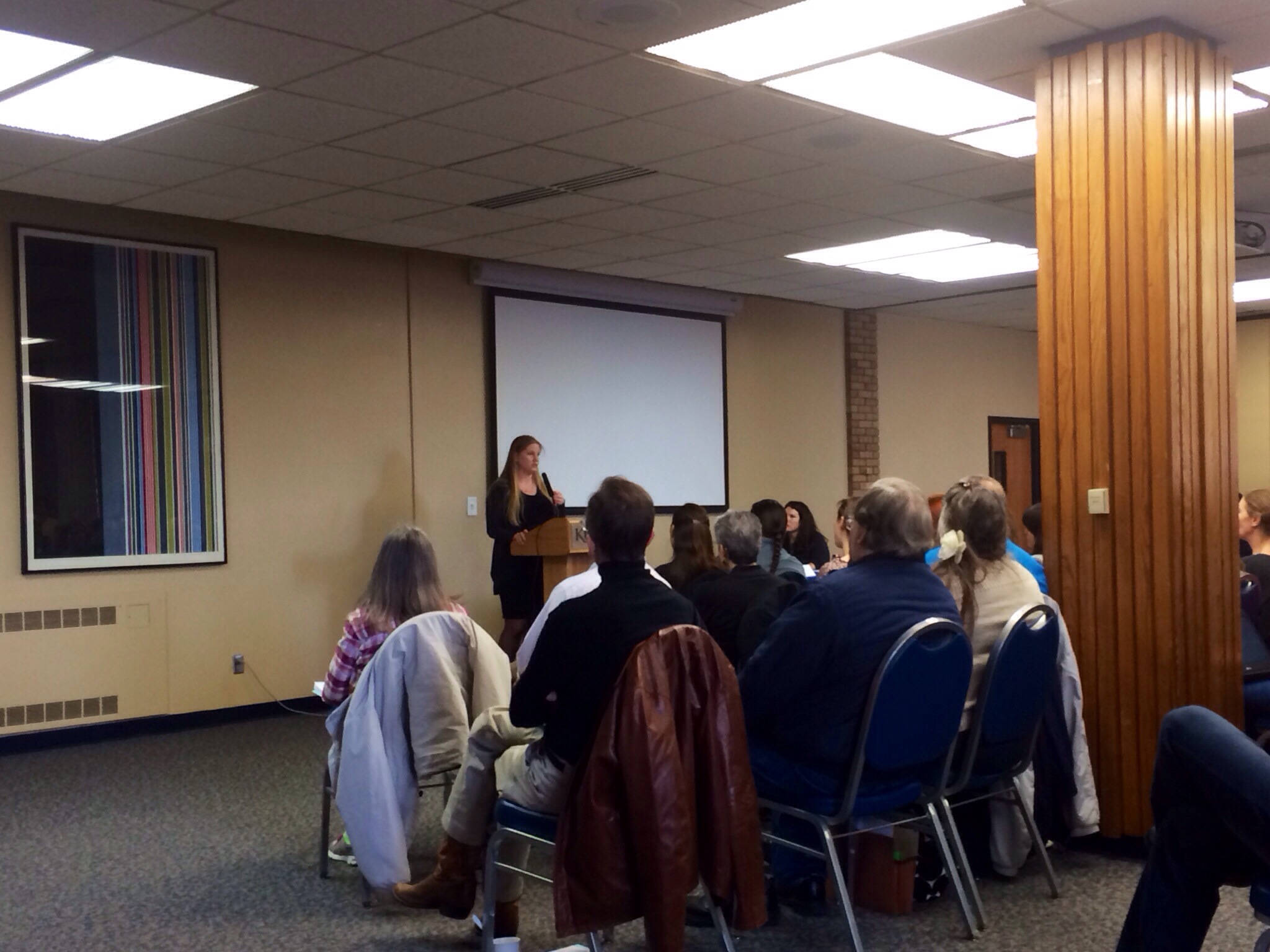
With moderator Elizabeth Kronk Warner and co-panelist Mark Fiddler.
Lakota People’s Law Project Meeting on Federal Foster Care Funds
Court Conditionally Reverses TPR to Comply with ICWA Notice Provisions, Unpublished Case, California
Link to PDF: b247833.pdf .
It is also available at 2014 WL 848098 and online at the California courts website.
Dean Leeds Teaching ICWA at KU ICWA Conference
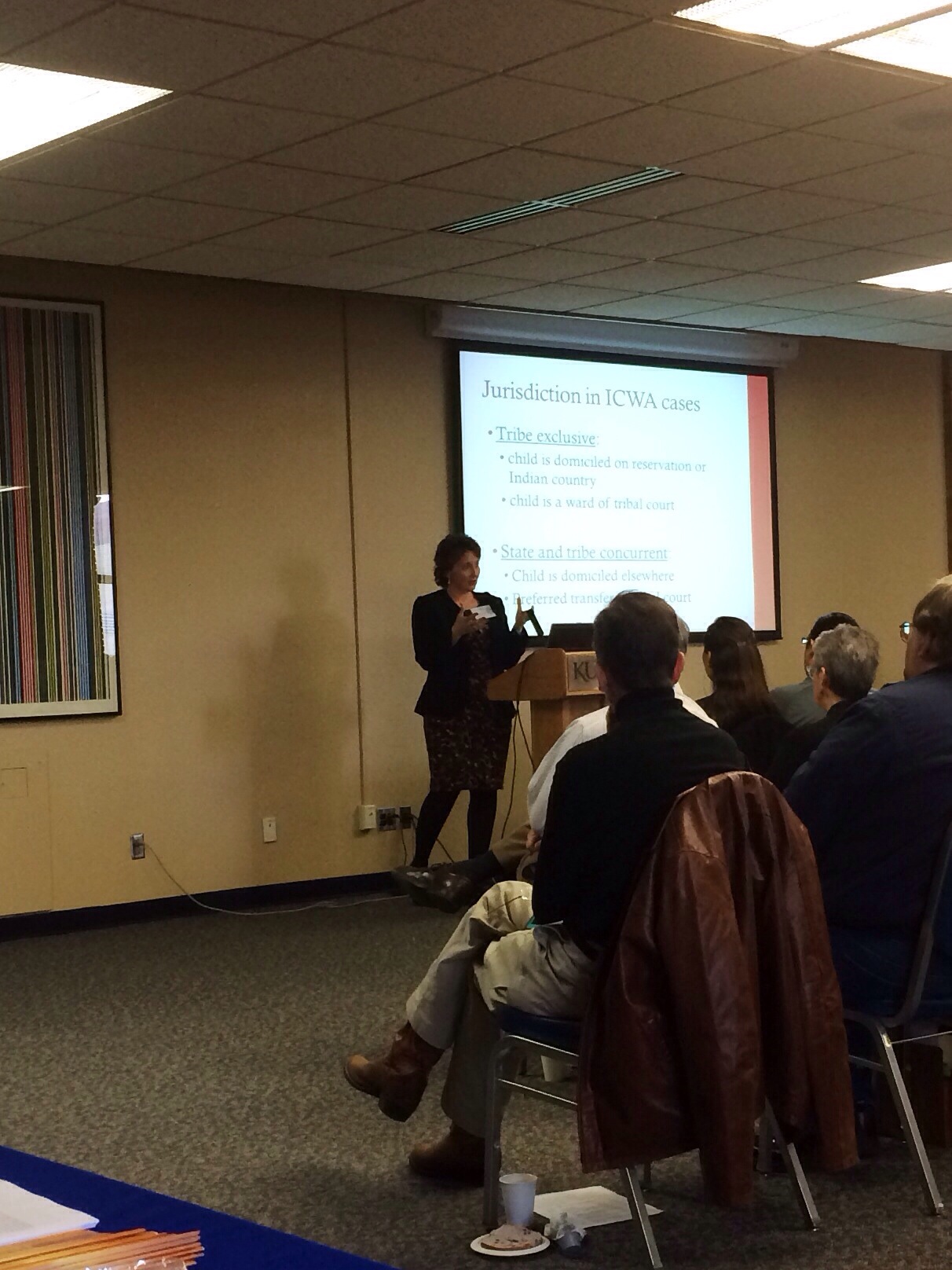
Kansas Law Conference on ICWA
18th Annual Tribal Law & Government Conference today.
| 9:00-9:15 | Welcome Remarks Dean Stephen Mazza, KU Law Professor Elizabeth Kronk Warner, Director, KU Tribal Law & Government Center |
| 9:15-10:15 | Indian Child Welfare Act: Its Origins and Application (PDF) Dean Stacy Leeds, University of Arkansas School of Law Moderator: Burton Warrington, President and CEO of Prairie Band LLC |
| 10:15-10:30 | Break |
| 10:30-12:00 | Adoptive Couple v. Baby Girl: The Arguments, The Decision and Potential Implications Mark Fiddler, Mark Fiddler Law Office (PDF) Chrissi Nimmo, Assistant Attorney General of the Cherokee Nation (PDF) Moderator: Professor Elizabeth Kronk Warner, Director, KU Tribal Law & Government Center |
| 12:15-1:15 | Lunch, Gridiron Room, Burge Union |
| 1:30-3:00 | The Future of ICWA Russ Brien, Brien Law LLC (PDF) Vivien Olsen, Attorney with the Prairie Band Potawatomi Nation (PDF) Professor Colette Routel, William Mitchell College of Law |
| 3:00-3:15 | Break |
| 3:15-4:15 | Ethical Considerations Related to ICWA Professor Kate Fort, Michigan State University College of Law (PDF) Moderator: Rebecca Howlett, KU Law Student and KU NALSA Member |
| 4:15 | Closing Remarks |
Placement Preferences, Guardianship, and Identifying Tribe Unpublished ICWA Case from California
Unpublished opinion here.
MSU Extension Webinars for Tribal Leaders
Here.
RSVP here.
Department of Human Services, Native American Affairs &
Tribal Services: How We Work Together to Improve Lives
March 12th
– Stacey Tadgerson, Director of the Office of Native
American Affairs, Michigan Department of Human Services (DHS)
Congress enacted the Indian Child Welfare Act (ICWA) to eliminate the
wholesale state removal of abused/neglected Indian children from their tribes
and culture. Participants in this session will learn about the history of ICWA,
Native American Affairs, and resources available to youth in care, tribal
governments, and urban Indian organizations from the DHS that will assist
tribal youth in becoming self-sufficient while reaching for their dreams.
Baby Veronica & Inside the Michigan Indian Family
Preservation Act – April 2nd
– Kate Fort, Staff Attorney and Adjunct
Professor – MSU Indigenous Law & Policy Center
The United States Supreme Court decided only the second case on the
Indian Child Welfare Act since its passage. This presentation will give the
basic facts and holding of the case, as well as its potential implications for
ICWA cases in the future. It will also address the way the Michigan Indian
Family Preservation Act helps to limit the application of the Baby Girl case.
Making Smart Choices for Health Insurance – April 16th
–
Brenda Long, Educator – MSU Extension
To help people navigate the complex and confusing health insurance
landscape, MSU Extension is teaching people how to take control of their
health insurance situation through webinars and in-person presentations.
Those who participate will be able to analyze their insurance needs, learn
important terms and concepts, compare health insurance plans, and figure
out what fits in their budget. People will also become more confident
Kristen Carpenter and Lorie Graham on Human Rights and Adoptive Couple v. Baby Girl
Kristen Carpenter and Lorie Graham have posted a very compelling and powerful paper about the Supreme Court’s decision in Adoptive Couple v. Baby Girl. It is required reading for anyone interested in the case, and is destined to be the definitive paper on the international human rights aspects of the case.
The article is titled Human Rights to Culture, Family, and Self-Determination: The Case of Adoptive Couple v. Baby Girl. Here is the abstract:
The well-being of indigenous children is a subject of major concern for indigenous peoples and human rights advocates alike. In 2013, the U.S. Supreme Court decided in Adoptive Couple v. Baby Girl that the Indian Child Welfare Act did not prevent the adoption of a Cherokee child by a non-Indian couple. This occurred over the objections of her Cherokee biological father, extended family, and Tribal Nation. After the decision, Baby Girl’s father and the adoptive couple contested the matter in a number of proceedings, none of which considered the child’s best interests as an Indian child. The tribally-appointed attorney for Baby Girl, as well as the National Indian Child Welfare Association and National Congress for American Indians, began examining additional venues for advocacy. Believing that the human rights of Baby Girl, much like those of other similarly situated indigenous children, were being violated in contravention of the United Nations Declaration on Indigenous Peoples Rights, and other instruments of international law, they asked us to bring the matter to the attention of the United Nations Special Rapporteur for Indigenous Peoples Rights (“UNSR”). We prepared a “statement of information” to alert the UNSR of the human rights violations occurring in the case. With the permission of the attorneys and organizations involved, this chapter introduces the Baby Girl case, contextualizes the claims in international human rights law, and then reproduces the statement of information, and portions of the UNSR’s subsequent public statement. It concludes with an update on the Baby Girl case and broader discussion about the potential for using international law and legal forums to protect the human rights of indigenous children.
 Turtle Talk
You must be logged in to post a comment.