Four Intervening Tribes in Texas v. Zinke ICWA Case File Notice to Appeal and Motion to Stay in Fifth Circuit

New Fifth Circuit page here.

Tribal Motion for Stay Pending Appeal

Finally, the district court’s ruling will cause significant inconsistency throughout the country. As this Court noted in Bryant, when issuing a stay, “[t]he inevitable disruption that would arise from a lack of continuity and stability in this important area of the law” will harm the parties and “the public interest at large.” Id.

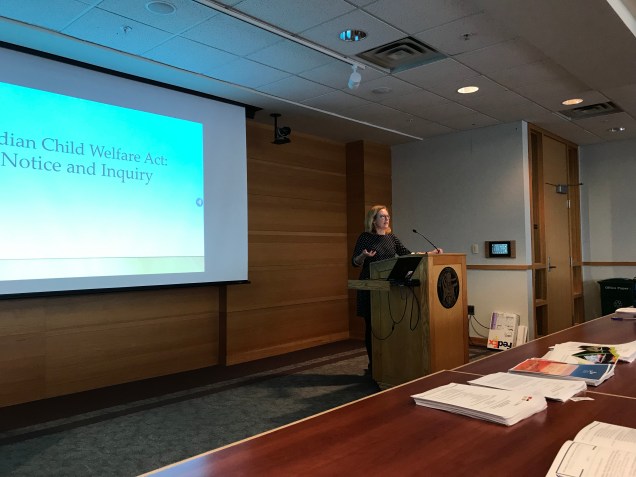
2018 TICA/MSU ILPC Conference Panel #7: Litigating Difficult ICWA Cases

Annette Nickel, Tom Murphy, and April Olson
Kate Fort

Colorado Court of Appeals ICWA Case on Burden of Proof and Application

Opinion here.

ICWA requires two things to apply–an “Indian child” and a “child custody proceeding”. Once both of those things are met, then the court has to apply the heightened standards required by the law. This decision out of Colorado wrestles with when to apply the heightened burdens. There are four “child custody proceedings” under ICWA: a foster care proceeding, a termination of parental rights proceeding, a pre-adoptive placement, and an adoptive placement. In a standard state child custody case, there is an emergency/shelter care/preliminary/24-72 hour hearing, then an adjudicatory/jurisdictional hearing, followed by dispositional/review hearings, and finally permanency hearings. They don’t neatly map on to the ICWA defined proceedings, so the question of when to apply the heightened burden of proof can be up for debate. Because the adjudicatory hearing is the time when the court decides whether the state has met its burden to intrude on the family’s life and whether the court therefore has jurisdiction to do so, ICWA advocates often argue that the court should apply heightened standards at that very important hearing. However, it’s also often true that state has already removed a child, so it is technically not a “foster care proceeding” because the child is already in foster care. The Colorado Court of Appeals here decided the heightened burden has to apply to the dispositional hearing, where the Court determines the placement of a child (any proceeding that may result in a foster care placement, even if the child is placed back with a parent is subject to ICWA standards).

The Court also holds that a lack of notice does not deprive the state court of subject matter jurisdiction, and that ICWA applies until it is determined the child is not an Indian child.

The Indian Child Welfare Act at 40

On this date in 1978, President Carter signed the Indian Child Welfare Act into law.

Senator Abourezk introduced the bill to the Senate on April 1, 1977, and the Senate voted on it on November 4, 1977. Interestingly, while Sen. Goldwater supported the purpose of the bill, he did not vote on the Senate’s version of ICWA. He was traveling back to Arizona the night of the vote.

The House Resolution (H.Res. 1374) to consider the bill was introduced by Rep. Shirley Chisholm, the first Black woman elected to Congress, on September 22, 1978. The House voted on the bill on October 14, 1978.

The Act was obviously the work of more people than can be named in a post, but here are the names of just some of the Native women activists identified in the book A Generation Removed: Mrs. Fournier and the mothers’ delegation of Fort Totten, Margaret Townsend (Fallon, Nevada) Evelyn Blanchard (Laguna and Yaqui), Eloise Doan (Blackfeet), Goldie Denny (Quinault), the women of the Wisconsin American Indian Child Placement and Development Program, the North American Indian Women’s Association, Janet McCloud (Tulalip and Nisqually), Maxine Robbins (Yakama), Betty Jack (Ojibwe), and Ramona Bennett, Chairwoman of the Puyallup Tribe who was denied a seat at the National Tribal Chairmen’s Association because she was a woman, and when finally allowed in, told the chairmen that while they were talking about fishing and housing and natural resources, they needed to do something about the children who were being taken away too.

As always, NARF has all of the legislative history online and searchable, which is full of important work like the letter from Eric Eberhard on behalf of the Navajo Nation, or the original statistical report from AAIA or the letter from Don Milligan at the “Indian Desk” State of Washington Department of Social and Health services detailing in 14 pages the way PL-280 was destroying tribal families.

Spending time in the legislative history of ICWA is both humbling and inspiring and a good way to spend some time on this fortieth anniversary.

Texas v. Zinke Update: Stay Denied; Navajo Nation Files Motion to Intervene

In Texas v. Zinke, the ICWA case in the northern district of Texas, the district court judge denied the four intervening defendant tribes’ motion to stay the decision. There has been no stay request filed in the Fifth Circuit nor a notice of appeal.

Navajo Nation filed a motion to intervene for the purpose of appeal.

Statement from Partnership for Native Children explaining the stay is here.

Case page is here, media page is here.

Comments Needed for Pro Hac Vice Rule Change in Wisconsin (ICWA)

Rule here.

Letter regarding the rule: 18-04-Ltr to Interested Persons.

Comments due by November 29.

Any comment to the rule petition should be filed by November 29, 2018, with the Clerk of Supreme Court, Attention: Deputy Clerk-Rules, P.O. Box 1688, Madison, WI 53701-1688. If possible, email a Microsoft Word version of your response to clerk@wicourts.gov. See comment guidelines at the court’s website at https://www.wicourts.gov/scrules/petitioncomment.htm.

Nebraska Supreme Court ICWA Decision: Active Efforts

In re Micah H.

This case discusses how private parties (grandparents) can provide active efforts in a guardianship situation. This further develops this state case law in this area, most recently addressed in In re Micah H. (Neb. 2016), In re T.A.W. (Wash. 2016) and In re S.S. (Ariz. Ct. App. 2017):

In this case, Tyler was counseled by Linda concerning his drug and alcohol problems. The record shows that Linda suggested
multiple treatment programs in which Tyler could seek rehabilitation for his addiction. However, Linda and Daniel had no control with regard to forcing Tyler to seek treatment.

The record demonstrates that Linda and Daniel discussed proper parenting techniques and interactions with small children. Further, Linda and Daniel assisted with scheduling visitation
and the implementation of a parenting plan. Tyler demonstrated no need for housing, financial support, or transportation
to unite with Micah. Despite Tyler’s numerous criminal convictions involving drugs and alcohol, Tyler maintained that he
does not suffer from drug or alcohol addiction.

With the exception of completing parenting classes while in prison, Tyler has not sought to actively participate in drug and alcohol treatment or support programs. In fact, Tyler has attended only one Alcoholics Anonymous meeting while in prison, at the invitation of another, and suggested to the court
below that his presence at the meeting was for the purpose of supporting others in the program.

Based on the specific facts and circumstances of this case, we find that Linda and Daniel undertook active efforts to provide
remedial services and rehabilitative programs designed to unite Tyler and Micah.

Eighth Circuit Asks Defendants for Response to En Banc Petition

Here is the order:

JUDGE ORDER:A petition for rehearing has been filed by the appellees in the above cases. The court requests a response to the petition. The response is limited to 3900 words and must contain a word count certificate. The response should be filed electronically. Response due on 11/08/2018 by Appellants Mark Vargo, Craig Pfeifle and Lisa Fleming. Hrg Feb 2018 [4720385] [17-1135, 17-1136, 17-1137] (JPP)

The petition is here.


NCJFCJ Statement Supporting ICWA

The National Council of Juvenile and Family Court Judges, one of the oldest and largest judicial membership organizations in the country serving an estimated 30,000 professionals in the juvenile and family justice system has released a statement supporting ICWA.

The full statement is available here 

The Honorable John J. Romero, Jr.  President, National Council of Juvenile and Family Court Judges  (bold added by me):

It’s imperative to preserve the rights, culture, connections, and traditions of Indian children and their families. The disproportionate numbers of American Indian and Alaska Native children in our child welfare system persist almost 40 years after ICWA became law. Consequently, the new ICWA rules and regulations enacted in 2016 promote the uniform application of ICWA and to advance and protect Indian children’s best interests.

Our American Indian and Alaska Native children are essential to the security and stability of each tribe. In each ICWA proceeding, the judicial officer and other court professionals should be mindful that children are the heart of the law. Committed uniform application of ICWA and the Regulations will advance and protect the best interests of each child and enhance tribal security and stability.