Professor (and Tribal Judge) Mary Jo Hunter and I will be speaking on practicing in tribal courts at the Minnesota Lavender Bar Association Conference this Saturday. Here’s the full agenda. CLE credit is available.
Lecture
Seneca President Robert Odawi Porter to be 5th Canby Lecturer
|
“Tribal National Security Strategy
for the 21st Century”
NOTE: NEW DATE
Tuesday, January 24, 2012 – 4:30 pm – 6:00 pm
(PREVIOUSLY SCHEDULED ON JANUARY 26)
Robert Odawi Porter
President,
Seneca Nation of Indians
(Public Reception to follow) The upcoming Indian Legal Program event is free and open to the public, however for planning purposes online RSVP or registration is requested and appreciated. For more information, please contact Darlene Lester at 480.965.7715 ormailto:darlene.lester@asu.edu Reserved parking will be available in ASU Visitor’s Rural Road Parking Structure, accessed from Terrace Avenue, west of Rural Rd. Terrace Avenue has a “Road Closed” sign but it is open to traffic to enter the Visitor’s Parking Entrance. Parking is $2.00 /hour, maximum $8.00. This is an attended parking lot where guests pull a ticket upon entrance to the gate controlled facilities and pay (cash only) upon exiting. Mention “Canby Lecture” to be guaranteed a reserved spot in lot.
Web Streaming Live at http://online.law.asu.edu/events/2012/Canby
(4:30 pm MST)
|

Announcing the 2012 ILPC Spring Speaker Series
Each spring, we host a series of events to celebrate and discuss selected new books involving American Indian law and policy. Here is our Spring 2012 schedule:
January 23rd, 2012, 2:00 pm
This event will be held in Room 474 of the Law School as part of a first year class in Property
Author:
Kali Murray
Integrating Spaces: Property Law and Race
Commentator:
Prof. Kristi Bowman (MSU Law)
February 21, 2012, 2:00 pm (Castle Board Room)
Authors:
Kaighn Smith Jr.
Labor and Employment Law in Indian Country
David Kamper
The Work of Sovereignty: Tribal-Labor Relations and Self-Determination at the Navajo Nation
Commentators:
Prof. Wenona T. Singel (MSU Law)
Gun Lake Gaming CEO John Shagonaby to Speak at WMU
Here are the details.
Ryan Dreveskracht on Policing on Indian Reservations (U-Dub, Dec. 6)
Here.
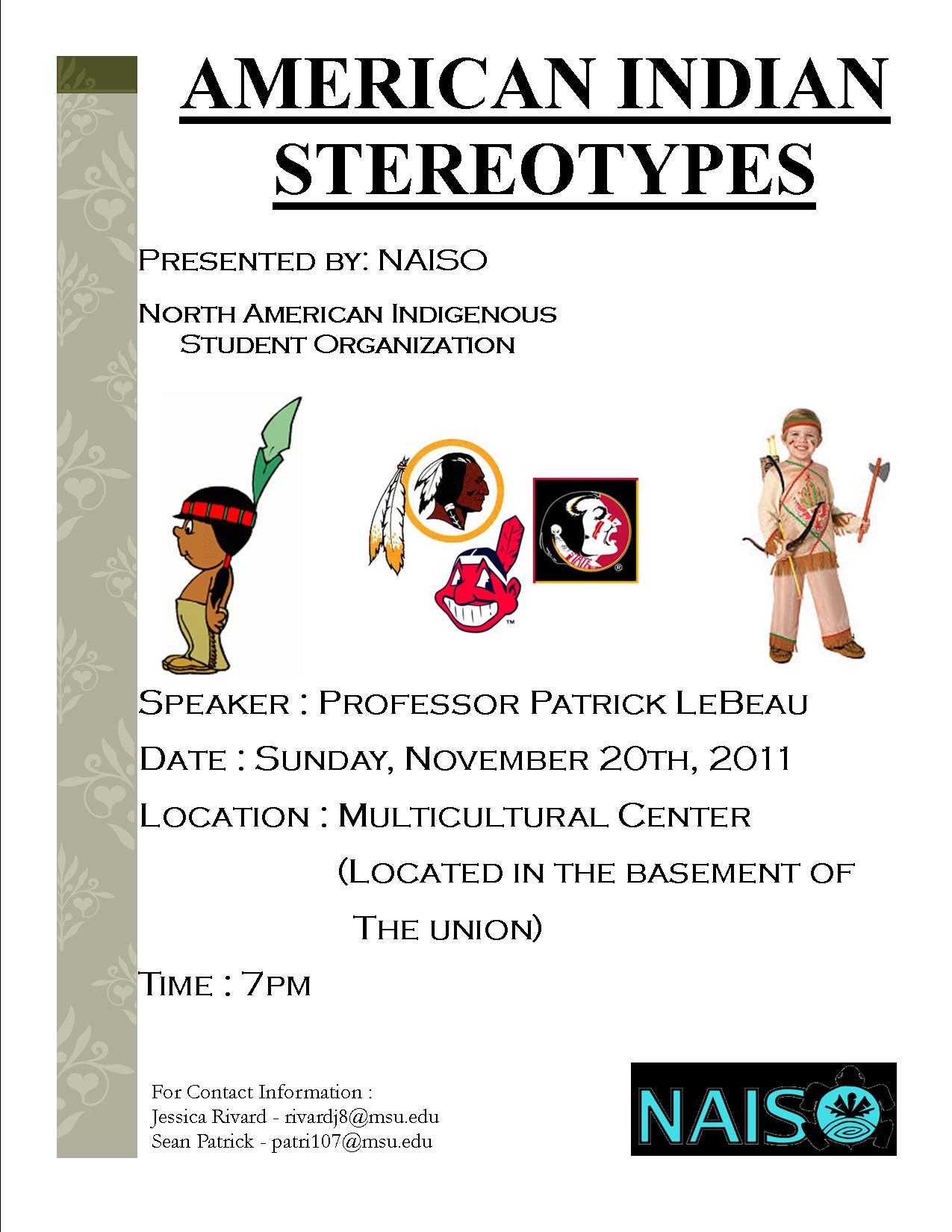
MSU Prof. Patrick LeBeau Talk on American Indian Stereotypes on Nov. 20, 2011
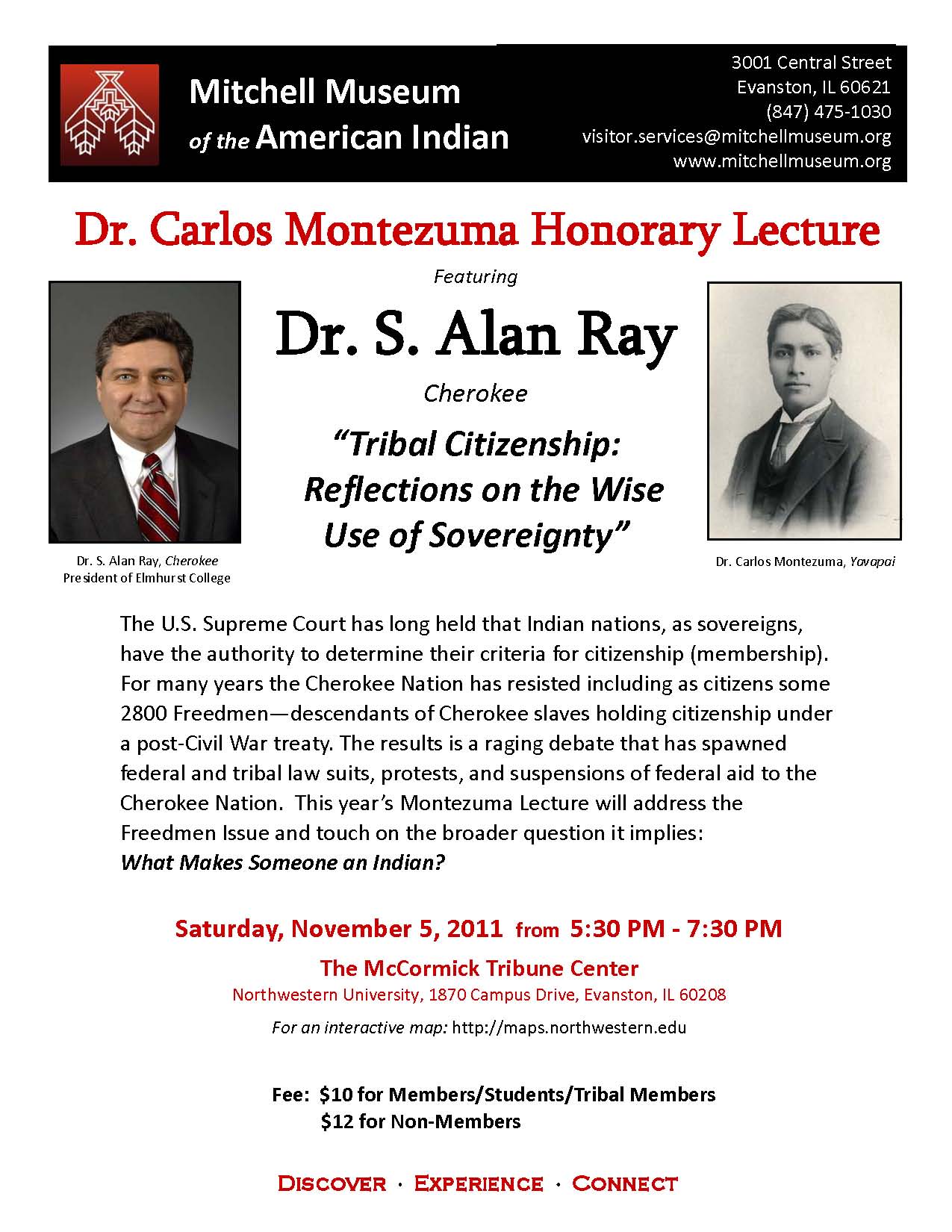
Dr. Carlos Montezuma Honorary Lecture: Dr. S. Alan Ray
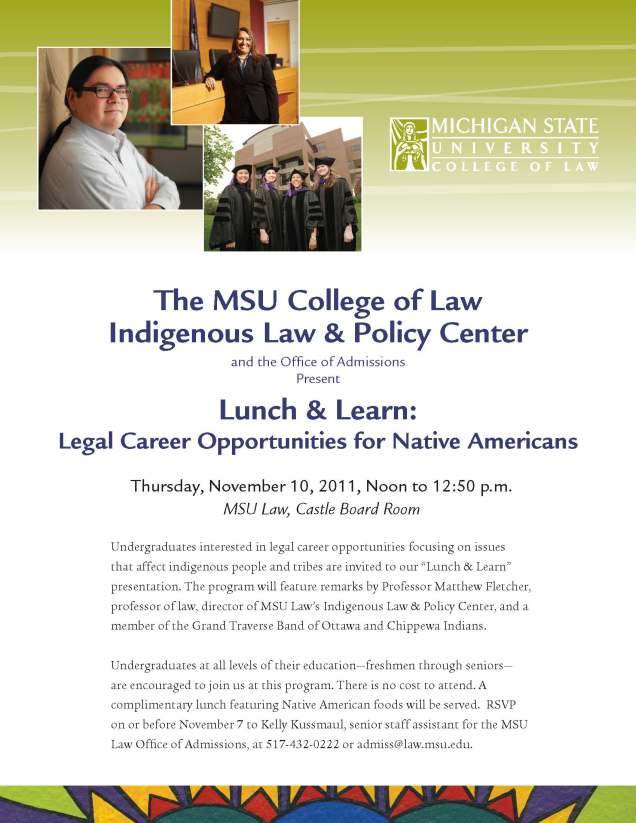
Lunch & Learn: Legal Career Opportunities for Native Americans: November 10, 2011
If you are interested in this event, and we hope you are, please RSVP here:
Fletcher to Speak at Penn State Law School Today
From PSU College of Education website:
UNIVERSITY PARK, Pa. – American Indian law and policy expertMatthew Fletcher will visit Penn State Law on September 19 to present “American Indian Education: Counternarratives in Racism, Struggle, and the Law.” Fletcher is the chief editor of Turtle Talk, the leading law blog on American Indian law and policy.
“Professor Fletcher’s talk will help people understand the challenges inherent in Indian education and will appeal especially to those with an interest in educational leadership and issues related to the education of American Indian and Alaska Native students,” said Susan Faircloth, associate professor of education at Penn State.
Faircloth is the director of Penn State’s American Indian Leadership Program, the nation’s oldest continuously operating education leadership program for American Indians and Alaska Natives. Her research focuses on the overrepresentation of American Indian and Alaska Native students in special education programs and services.
“This event will challenge participants to think about the importance of tribal sovereignty to American Indian education,” said Penn State Law Professor Carla Pratt, who studies both Indian law and the experience of minorities in law school and the legal profession.
Matthew L.M. Fletcher is professor of law at Michigan State University College of Law and director of the Indigenous Law and Policy Center. He is the chief justice of the Poarch Band of Creek Indians Supreme Court and also sits as an appellate judge for the Pokagon Band of Potawatomi Indians, the Hoopa Valley Tribe, and the Nottawaseppi Huron Band of Potawatomi Indians. He is a member of the Grand Traverse Band of Ottawa and Chippewa Indians, located in Peshawbestown, Mich. In 2010, Fletcher was elected to the American Law Institute.
Fletcher recently published the sixth edition of Cases and Materials on Federal Indian Law with David Getches, Charles Wilkinson, and Robert Williams, and American Indian Tribal Law, the first casebook for law students on tribal law. His book, The Return of the Eagle: The Legal History of the Grand Traverse Band of Ottawa and Chippewa Indians, will be published later this year by Michigan State University Press. He is also the author of American Indian Education: Counternarratives in Racism, Struggle, and the Law (Routledge, 2008).
Fletcher’s talk is sponsored by the American Indian Leadership Program, the College of Education, and Penn State Law. His presentation begins at noon on September 19 in the auditorium of the Lewis Katz Building. The public is welcome.
MSU Lecture on Cobell Settlement (Edward Valandra)
In These Times, In this Land: Objections to the Settlement in Cobell v. Salazar
Lecture/Discussion
With
Lakota Scholar
Edward Valandra
Friday August 19th 213 Morrill Hall
12 Noon
In December 2009 the U.S. departments of the Interior and Justice reached a settlement on the long-running Cobell class-action lawsuit regarding the federal government’s mismanagement of more than 300,000 individual American Indian and Alaska Native trust accounts.
Edward Valandra, a Lakota scholar and the founder and research Fellow of the Community for the advancement of Native Studies (CANS), will be giving a luncheon talk in the English Department Conference Room, 213 Morrill Hall at 12:00 noon on Friday August 19. He will be critiquing recent developments in Cobell v. Salazar and how they affect the rights of Native peoples in this long standing case.
Sponsored by the Native American Institute and Michigan State University
 Turtle Talk
You must be logged in to post a comment.