News
News Coverage of LVD Mexico Investment Case
We’ve posted on this before here. Here is an oddly written article on this case in the Miami Herald via McClatchy News Service. An excerpt:
By Tim Johnson
McClatchy NewspapersWATERSMEET, Mich. — If any Indian tribe could ill afford to lose money in a Mexico casino scam, it is the disadvantaged Lac Vieux Desert Band of Lake Superior Chippewa.
Anchored in rolling woodlands of Michigan’s Upper Peninsula, the tribe’s 600 members have faced constant hardship for more than a century.
As recently as the mid-1970s, the median income per household for the tribe was only $2,300, and fully half of its working age members were unemployed.
When the tribe opened a bingo hall with a few slot machines in 1988, the year it was recognized as a separate nation, the new income allowed some members to move from overcrowded, rundown houses into better dwellings.
Over the past two decades, the tribe built the Lac Vieux Desert Casino Resort, the 76-room Dancing Eagles Hotel and a nine-hole golf course, earning enough to finance 30 new homes, a cultural-recreation center, a clinic, childcare facilities, a police force and water and wastewater treatment facilities.
But there were still too few jobs, and the loss of a $6.5 million casino investment in Mexico and ensuing legal fees have kept the tribe in crisis, unable to upgrade the casino’s aging slot machines or build new attractions.
Keith Harper Nominated for President’s Commission on White House Fellowships
Here. An excerpt:
Keith Harper, a Washington-based partner and chair of Kilpatrick Townsend & Stockton’s Native American practice group, was nominated to become a member of the President’s Commission on White House Fellowships. Harper, who is a member of the Cherokee Nation of Oklahoma, focuses his practice on litigation, green economy and Native American affairs.
Tribal Justice News from DOJ, Nov. 14-18
TRIBAL JUSTICE NEWS
Nov. 14 – 18, 2011
Contact: Wyn Hornbuckle, Office of Public Affairs (202) 514-2007
***
INDIAN COUNTRY PUBLIC SAFETY INITIATIVES
U.S. Attorney’s Office for the District Of Montana Announces The Creation Of The “Native Shield Initiative”
U.S. Attorney Michael W. Cotter announced today the creation of a new initiative, the Native Shield Initiative, in partnership with county and tribal authorities in Montana. The initiative is designed to help protect Indian women from physical and sexual violence. The new Initiative encourages the U.S. Attorney’s Office to focus on existing federal statutes that give the federal government jurisdiction to prosecute misdemeanor domestic assaults committed by a non-Indian perpetrator against an Indian victim. The Initiative also promotes prosecutions of habitual domestic violent offenders under 18 U.S.C. § 117. In support of the Native Shield Initiative, the U.S. Attorney’s Office has committed to providing the following to its tribal and county law enforcement partners: training on how to submit misdemeanor domestic violence cases directly to the U.S. Attorney’s Office; training in the investigation and prosecution of crimes against women; and training on the resources available for those entities, including potentially entering into collaborative agreements with tribal and county law enforcement.
For more information: www.justice.gov/usao/mt/
New Bay Mills Chair Supports Off Reservation Gaming Efforts
Here.
News Coverage of the 8th Annual Haudenosaunee Conference
From the Democrat and Chronicle:
SYRACUSE — Three federal court decisions regarding Native American land claims in upstate have created legal doctrine that lawscholars meeting in Syracuse described as unsupportable.
About 50 Indian law professors and students discussed the issue Friday at Syracuse University during the eighth annual Haudenosaunee Conference, which continues today. The conference, hosted by the SU Law School’s Center for Indigenous Law, Governance & Citizenship, looks at contemporary legal issues that affect New York’s native peoples.
Referring to a new legal theory espoused in a 2005 decision regarding a tax dispute between the Oneida Nation of New York and the city of Sherrill in Oneida County, Syracuse attorney Joseph Heath said, “It’s racist. It only applies to Indians.”
* * *
Kathryn Fort, staff attorney at the Indigenous Law and Policy Center at Michigan State University, described what she called “new laches” doctrine established by the recent cases. The doctrine departs from the 800-year-old laches theory that says legal complaints can be denied if the plaintiff waits too long and the defendant would be harmed by that delay.
However, even when laches applies, she said, there can still be an equitable remedy — paying for the land taken by illegal treaties, for instance.
In the New York tax and land claim cases, though, no remedy was offered.
***
Bill Castanier on “Laughing Whitefish” in the Lansing City Pulse
From Lansing City Pulse:
By any measure the career of John D. Voelker was a phenomenal success. He was a successful author, having written the bestseller “Anatomy of a Murder” (later made into a movie directed by Otto Preminger and starring James Stewart, Lee Remick and George C. Scott) and he was a member of the Michigan Supreme Court. But something was gnawing at him.
As a younger man, he had heard a story about an Indian woman who had, against all odds, taken on the white power structure of the Upper Peninsula’s mining industry while seeking what she thought was compensation owed to her family.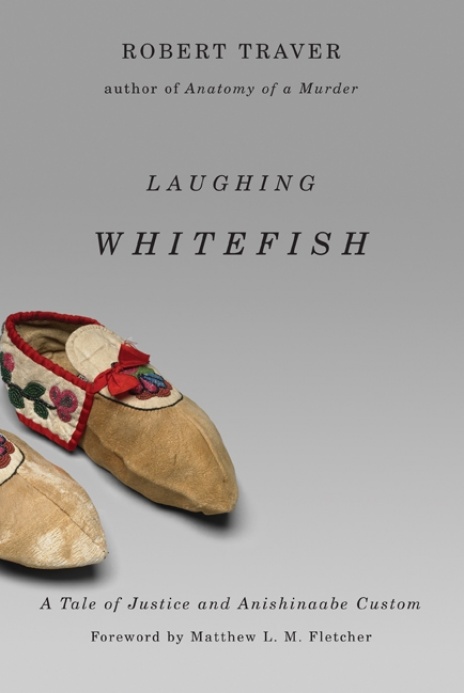
Voelker had always wanted to do a fictional treatment of this real-life case, but the success of “Anatomy” and his job as a justice had kept him too busy.
In an address to the Michigan Historical Society in 1970 he said his “neglected Indian story receded even further into the background.”
In a brash move, Voelker decided he was fed up and had enough of the “baying dogs of success” — he quit his job.
In his letter of resignation to Gov. G. Mennen Williams he wrote, “While other men can write my legal opinions (although I would debate that) they can scarcely write my books. I am sorry.”
Voelker, who wrote under the pen name Robert Traver, retreated to the Upper Peninsula, where he would spend two winters writing his Indian story. “Laughing Whitefish” was published in 1965, but soon went out of print.
Now, Michigan State University, working with the Voelker family, has reprinted the book with an introduction written by MSU College of Law Professor Matthew Fletcher, who heads the Indigenous Law and Policy Center.
In describing his book, Voelker always said it was “a basic story … rather simple” and “it was about iron ore, Indians and the infidelity to one’s own promises.”
The book tells the story of a young Indian woman, Charlotte Kawbawgam (her real name was Kobogum), who seeks compensation for her father. He had been promised a “wee fractional interest” after leading a group of mining executives to the world’s largest deposit of iron ore. Kawbawgam hires lawyer Willy Post, a newcomer to Marquette.
Samuel Winder Judicial Investiture Tomorrow in Albuquerque
CONGRATS!!!!
Here is a copy of the program (wish I could find a news item online):
West Virginia Court Rules Martin Webb’s “Lakota Cash” Must Comply with State AG Subpoenas
Here is the news coverage, via Pechanga. We’ll post the court opinion when the W.Va. posts the press release online (hopefully soon).
Our previous posting on Illinois’ suit against “Lakota Cash” is here.
On Tribal Courts and the Navajo Bond Offering
Here is news analysis of the Navajo bond offering (AK previously posted about this last week). An excerpt:
S&P’s Jacob says the Navajo offering is unusual because tribes traditionally have borrowed directly from banks or sold bonds backed by gaming revenue. There are $5.3 billion of Native American bonds outstanding, according to a Bloomberg analysis.
The Navajo bonds will be sold to institutional investors in a private placement as soon as year-end and will include both taxable and tax-exempt debt, says Goe, the bond counsel.
The Navajos intend to seek investors willing to settle disputes in tribal courts, a first for a bond issue, Goe says. Clarkson says the requirement “would be a reaffirmation of the legitimacy of tribal courts – this time from the financial market.”
Yet it may also make the issue harder to sell. Lyle Fitterer, who helps oversee $26 billion of municipal bonds at Wells Capital Management in Menomonee Falls, Wis., says the tribal-court stipulation “is one more hurdle in terms of investing in a deal like this” and could lead to the Navajos paying higher rates.
Mike Lettig, executive vice president for Native American financial services and agriculture at Cleveland’s KeyBank, hopes the Navajo issue will be “a start for tribal governments to enter the public finance markets routinely.”
KeyBank’s KeyBanc Capital Markets unit will handle the placement.
Would love to be a fly on the wall in those discussions about tribal courts. Lenders routinely demand a higher rate from tribes in these deals when the deal involves tribal court jurisdiction. Why? Especially at Navajo, where tribal law is published online, the Navajo Reporter, and in West’s Navajo Nation Code (also online). I am sure the lenders’ discussions about tribal courts will be double-coded; that is, they’ll do everything they can not to offensive, while perhaps being insulting all along.
 Turtle Talk
You must be logged in to post a comment.