On October 9, national and regional Tribal organizations, including NCAI, NARF, and the National Association of Tribal Historic Preservation Officers, urged Senate leaders to withdraw provisions related to the Section 106 review process of the National Historic Preservation Act in Title III of Division B of S. 5653, the Bipartisan American Affordability and Jobs Act of 2026 (BAAJA). The concerns raised by the coalition are detailed in the attached letter.
BAAJA arrives amid three administrative tracks affecting Section 106.
First, following President Trump’s 2025 energy emergency order, the Advisory Council on Historic Preservation advised agencies that projects they determine fall within the order may use an emergency procedure that gives notified Tribes and other parties seven days to comment. ACHP extended the procedure for the duration of the presidential emergency declaration. Seventeen states now challenge the order and the federal government’s use of emergency authorities in Washington v. Trump. The pending lawsuit brought by the states challenges the emergency track established by EO 14156 and federal actions taken under it, including use of emergency procedures for Section 106 review. It doesn’t challenge the Interior Secretary’s Order 3452 or ACHP’s later draft rewrite of the Section 106 regulations.
Second, Interior Secretary’s Order 3452 directs Interior bureaus to accelerate Section 106 reviews.
Third, ACHP voted in July 2026 to send a draft rewrite of the Part 800 regulations implementing Section 106 to OMB’s Office of Information and Regulatory Affairs for interagency review before publication of the Notice of Proposed Rulemaking in the Federal Register. As of October 13, ACHP had not published the proposed rule in the Federal Register, and no public comment period had opened.
Taken together, these three administrative tracks push Section 106 toward faster reviews and greater agency control over what gets reviewed and on what consultation timetable. BAAJA would add a legislative track. Title III would put some related changes into NHPA, rewrite statutory procedures and protections, restrict judicial remedies, and expand new federal oversight of THPO programs, including possible Secretarial assumption of THPO functions under specified conditions. Sen. Shelley Moore Capito (R-W.Va.) introduced S. 5653 on September 30, 2026, with cosponsors Sens. Mike Lee (R-Utah), Sheldon Whitehouse (D-R.I.), and Martin Heinrich (D-N.M.).
Across each of these tracks, federal agencies have gained or would gain more control over the scope, pace, and consequences of Section 106 review, while Tribal governments would face tighter windows and fewer ways to influence or challenge agency decisions. If enacted in its current form, BAAJA would put that shift into statute.
The Oglala Lakota College has assembled an archive of oral history recordings called “A Song From Sacred Mountain Collection.” This is an excellent resource that includes digitized interviews with Cheyenne and Lakota leaders from the 1980s that were collected by the Oglala Lakota Legal Rights Fund in connection with sacred site litigation related to Bear Butte in Crow v. Gullet, 706 F.2d 856 (8th Cir. 1983). The collection provides a rare body of extensive online recorded interviews that relate to the intersection of land, sacred sites, history, and litigation.
Federal agency leaders and tribal representatives on the Bears Ears Commission stand in front of the newly installed Bears Ears National Monument sign on June 18, 2022. Pictured from left, former Agriculture Department Under Secretary Homer L. Wilkes, Ute Indian Tribe Business Committee Member Christopher Tabbee, Ute Mountain Ute Councilman Malcolm Lehi, Zuni Tribe Lt. Gov. Carleton R. Bowekaty, Hopi Chair Timothy Nuvangyaoma, Navajo Nation Executive Assistant Davis Filfred and BLM Director Tracy Stone-Manning. Photo courtesy of the BLM
The Bureau of Land Management began removing the seals of five tribes from the Bears Ears National Monument signs on Wednesday, July 22. President Donald Trump shrank the monument for a second time on July 13 and disbanded the Bears Ears Commission, which consisted of representatives from five tribes. Photo courtesy of the Bears Ears Inter-Tribal Coalition
On August 14, Earthjustice reported that Kimmerle Mining staked seven mining claims on lands stripped of protection when President Trump issued a proclamation reducing Bears Ears National Monument. Kimmerle Mining recorded the claims on July 14, one day after Trump signed the proclamation. The claims reportedly target uranium, vanadium, copper, and precious metals. The lands aren’t scheduled to reopen to mineral entry until September 11, so these filings show how quickly mining interests are moving to position themselves to benefit. Earthjustice has the details and a map of the claims.
Trump’s proclamation reduced the monument from approximately 1.36 million acres to 121,100 acres, a reduction of more than 90 percent. The proclamation also terminated the Bears Ears Commission, eliminating the formal management role of the Hopi Tribe, Navajo Nation, Ute Indian Tribe, Ute Mountain Ute Tribe, and Pueblo of Zuni. Federal officials immediately removed the five Tribal Nations’ seals from monument signs.
The five Tribes of the Bears Ears Commission understand Bears Ears as an interconnected living cultural landscape. Trump’s proclamation instead describes the region as a collection of uranium, vanadium, copper, and other minerals “critical to national security.” The Department of the Interior had promised to meet with the Bears Ears Commission before changing the monument’s boundaries or management, but the Commission reports that no meaningful government-to-government consultation occurred. The Commission had finalized the Bears Ears Resource Management Plan in January 2025, a milestone described as “a historic achievement for the management of Bears Ears National Monument that underscores the power of unity, trust, and shared responsibility in land stewardship.”
Trump’s invocation of national security should be understood within the historical context of uranium extraction in Indian Country. Uranium mining began on the Navajo Nation during WWII to secure fuel for nuclear weapons, and production continued in strength until the 1980s. The mining resulted in Native miners and families experiencing deadly illnesses, contaminated homes and water, and hundreds of abandoned mines. More than 500 abandoned uranium mines remain on or near Navajo lands, and the federal government still has no comprehensive estimate of what completing the cleanup will cost. Members of the Ute Mountain Ute Tribe’s White Mesa community also continue to raise concerns about the uranium mill operating only five miles from their homes and Bears Ears.
The President’s Bears Ears Proclamation invokes national security to promote more uranium mining, despite the fact that the past human and environmental costs of historic uranium mining have never been fully remedied.
I’m adding two valuable memos by Monte Mills and Martin Nie to the Roadless Rule resources posted yesterday. Mills is the Charles I. Stone Professor of Law and Director of the Native American Law Center at the University of Washington, where his work focuses on Federal Indian law, Tribal sovereignty, and natural resources. Nie is Professor of Natural Resources Policy and Director of the Bolle Center for People & Forests at the University of Montana, with particular expertise in federal public lands governance.
Their September 2025 memo provides historical and legal background on Tribal interests in the original Roadless Rule and later Idaho, Colorado, and Tongass rulemakings. Their new August 28, 2026 memo focuses on USDA’s proposed rule and Draft EIS, including what they describe as a “shell game” of shifting protection from a national rule to forest- and project-level processes while some of those protections are themselves being weakened. They also report that 108 of 126 current forest plans, about 86%, provide no substantive recognition or meaningful protection of Tribal rights or interests.
These pair well with the ILPC papers that I created and posted yesterday, which approach the rulemaking from a different direction. One analyzes what Tribes actually placed in the 2025 administrative record and USDA’s response to those concerns, while the other addresses strategic considerations for Tribal Nations before the September 21 comment deadline, including relevant legal doctrines and other hooks for building and preserving the administrative record.
On August 20, 2026, USDA published a proposed rule to rescind the 2001 Roadless Area Conservation Rule, which has restricted road construction, road reconstruction, and timber harvesting across approximately 44.7 million acres of National Forest System lands for the past quarter century. The proposal would replace the existing rule’s nationwide layer of protection and return more decisions about roadless areas to individual forest plans and project-level review.
Alongside the proposed rule, USDA released a 333-page Draft Environmental Impact Statement, a cost-benefit and regulatory-flexibility analysis, and a Tribal Summary Impact Statement. (Links to these documents are below.)
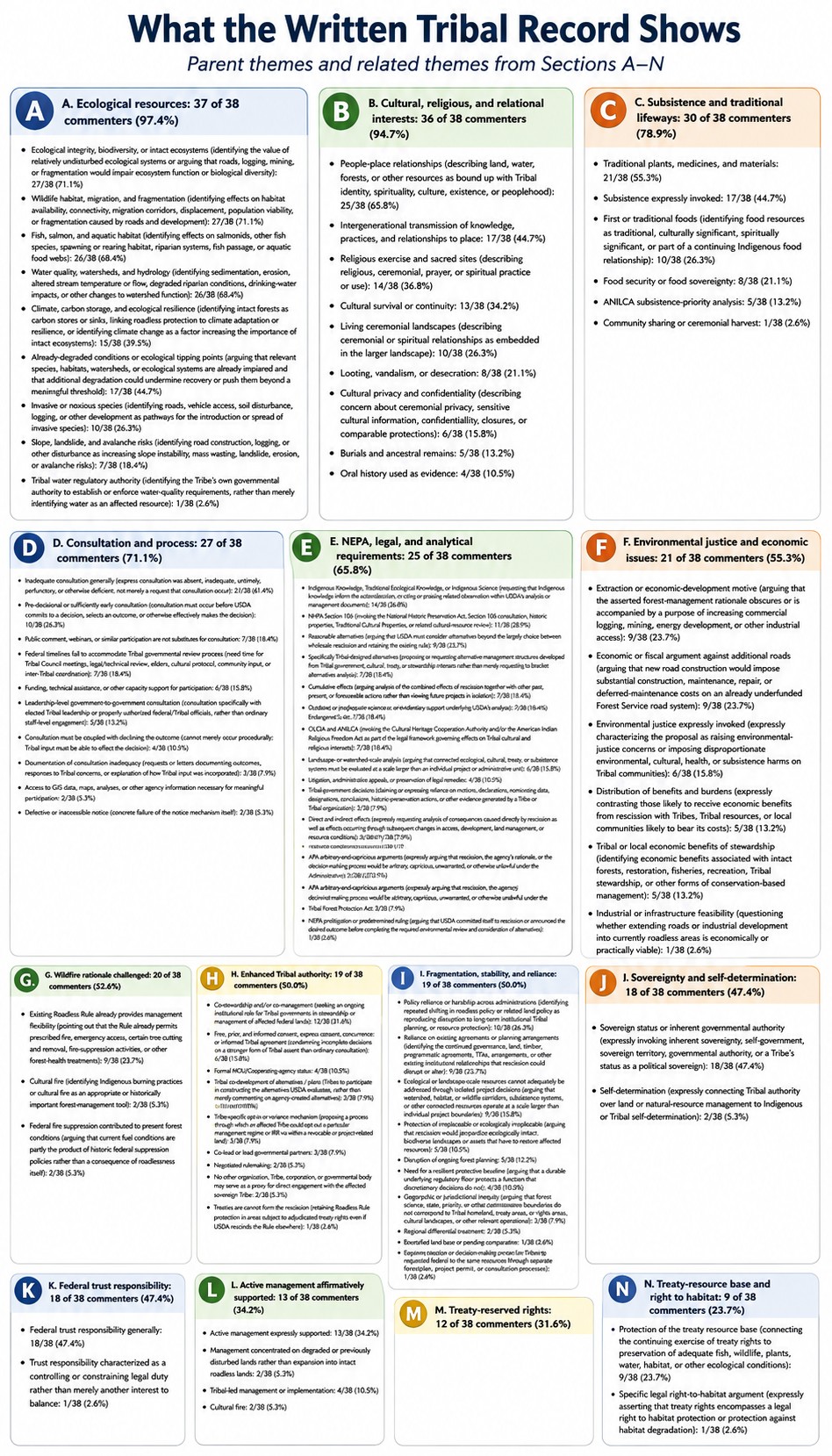
This isn’t the first time Tribes have weighed in. USDA’s August 2025 Notice of Intent opened a scoping comment period that drew more than 220,000 comments, with about 99% opposed to the rescission. Based on the ILPC’s analysis, the comments included 42 written submissions from 38 distinct Tribal governments and organizations. Scoping comments, however, only shape what an agency studies, and a court asked to review the eventual final rule will look at the record as it stands when the agency acts. As a result, the current 30-day comment period is fundamentally different from the one in 2025, since it’s the last opportunity to place Tribe-specific evidence, legal argument, and disagreement with USDA’s reasoning into the administrative record before the rule is finalized.
The ILPC is sharing four documents to help Tribes and their staff and counsel use that opportunity
a. The first document is a list of tribal comments submitted during the fall 2025 window and found by the ILPC in response to the Notice of Intent. The document includes links to each tribe or tribal organization’s comments.
b. The second document,The Tribal Administrative Record on the Roadless Rule, is an ILPC independent empirical review of the 38 distinct Tribal comments filed in 2025. Rather than starting from USDA’s own categories, the ILPC coded the submissions and measured how often fourteen recurring themes appear, from near-universal concerns about ecological resources (94.7%), and cultural and religious interests (94.7%), to concerns raised by roughly half of commenters about consultation adequacy and enhanced Tribal governmental authority beyond ordinary consultation. It then compares that record against USDA’s 2026 Draft EIS line by line. Our finding: USDA’s Draft EIS rhetorically recognizes Tribal sovereignty, treaty rights, and trust obligations. It also concludes that full rescission, the alternative it proposes, would create the greatest potential for adverse effects on Tribal rights and interests of any alternative it studied. The gap this record exposes isn’t whether USDA heard Tribes. It’s what the agency did about what it heard.
b. The third document, Strategic Considerations for Tribal Nations in the 2001 Roadless Rule Rescission Comment Period, moves to strategy. It walks through the administrative law tools a comment filed now can use, including arbitrary and capricious review, record preservation and issue exhaustion doctrine, NEPA’s alternatives requirement, NHPA Section 106, and treaty rights claims where they apply, and explains why the strongest comments this round will do more than restate 2025 positions. The most impactful comments submitted now will name an impact, identify USDA’s specific response in the documents it published in the docket on August 20, and explain concretely why that response does or doesn’t hold up. The memo also addresses the administration’s simultaneous move to weaken the protections of NHPA Section 106 through a proposed rule that is expected to be published soon. If NHPA 106 protections are administratively weakened, Tribes will face a multiplication of interventions as decision-making is returned to the land management planning process at the individual national forest level, on top of diminished leverage under a weakened 106 regime.
The strategic considerations memo also flags a separate problem ILPC ran into directly. USDA’s Tribal Summary Impact Statement rests heavily on 29 completed (and 34 scheduled) government-to-government consultations (out of 64 Tribal requests for consultation), but the underlying consultation records aren’t in the public docket, and ILPC couldn’t locate any posted log of them. After an August 28 letter to the Forest Service’s Office of Tribal Relations went unanswered, ILPC filed a formal FOIA request the same day. Because of FOIA’s ordinary processing timeline, that request may not be resolved before the comment period closes. As it stands, Tribes and the public are being asked to evaluate USDA’s account of what it heard in consultation without being able to see the records that account is based on. That timing problem is itself worth putting directly into a comment.
Below is a full set of links to the docket, including the proposed rule, the complete Draft EIS, the Tribal Summary Impact Statement, the economic analysis, and the ILPC-generated documents referred to above.
The Draft EIS (Vol. I – III) (Vol. II includes maps of all roadless rule affected areas organized by state; Vol. III includes copies of all Tribal comments submitted in response to the NOI in fall 2025)
The Tribal Summary Impact Statement for Proposed Rule to Rescind the 2001 Roadless Area Conservation Rule
The Economic Analysis for the 2004 Roadless Rule Rescission
NCAI Resolution Opposing the Legislative Repeal of the 2001 Roadless Area Conservation Rule and Supporting its Retention
Roadless Rule Tribal Hub : “The Tribal Hub is an informational platform created to support Tribal leaders, staff, and community members in responding to the proposed rescission of the 2001 Roadless Rule. Our goal is to ensure that Tribes have timely access to resources, information, and tools to protect sovereignty, treaty and reserved rights, and cultural lifeways throughout this federal rulemaking process.”


You must be logged in to post a comment.