
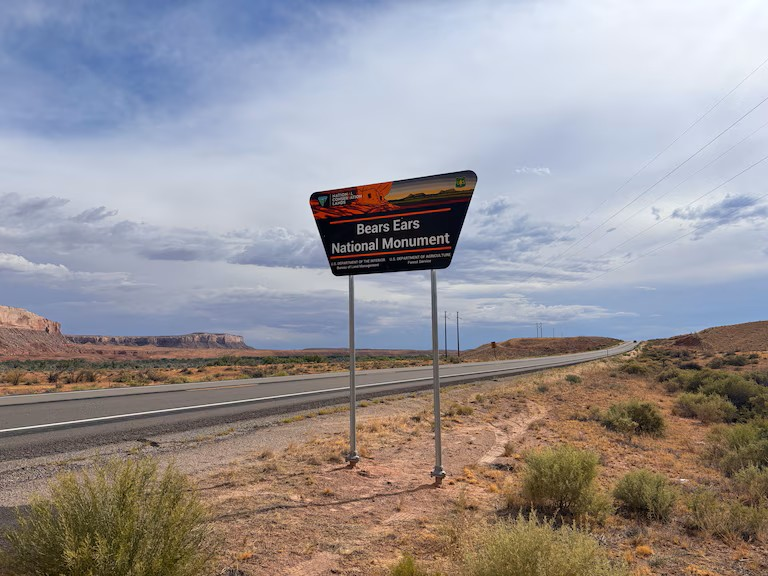
Federal agency leaders and tribal representatives on the Bears Ears Commission stand in front of the newly installed Bears Ears National Monument sign on June 18, 2022. Pictured from left, former Agriculture Department Under Secretary Homer L. Wilkes, Ute Indian Tribe Business Committee Member Christopher Tabbee, Ute Mountain Ute Councilman Malcolm Lehi, Zuni Tribe Lt. Gov. Carleton R. Bowekaty, Hopi Chair Timothy Nuvangyaoma, Navajo Nation Executive Assistant Davis Filfred and BLM Director Tracy Stone-Manning. Photo courtesy of the BLM
On August 14, Earthjustice reported that Kimmerle Mining staked seven mining claims on lands stripped of protection when President Trump issued a proclamation reducing Bears Ears National Monument. Kimmerle Mining recorded the claims on July 14, one day after Trump signed the proclamation. The claims reportedly target uranium, vanadium, copper, and precious metals. The lands aren’t scheduled to reopen to mineral entry until September 11, so these filings show how quickly mining interests are moving to position themselves to benefit. Earthjustice has the details and a map of the claims.
Trump’s proclamation reduced the monument from approximately 1.36 million acres to 121,100 acres, a reduction of more than 90 percent. The proclamation also terminated the Bears Ears Commission, eliminating the formal management role of the Hopi Tribe, Navajo Nation, Ute Indian Tribe, Ute Mountain Ute Tribe, and Pueblo of Zuni. Federal officials immediately removed the five Tribal Nations’ seals from monument signs.
The five Tribes of the Bears Ears Commission understand Bears Ears as an interconnected living cultural landscape. Trump’s proclamation instead describes the region as a collection of uranium, vanadium, copper, and other minerals “critical to national security.” The Department of the Interior had promised to meet with the Bears Ears Commission before changing the monument’s boundaries or management, but the Commission reports that no meaningful government-to-government consultation occurred. The Commission had finalized the Bears Ears Resource Management Plan in January 2025, a milestone described as “a historic achievement for the management of Bears Ears National Monument that underscores the power of unity, trust, and shared responsibility in land stewardship.”
Trump’s invocation of national security should be understood within the historical context of uranium extraction in Indian Country. Uranium mining began on the Navajo Nation during WWII to secure fuel for nuclear weapons, and production continued in strength until the 1980s. The mining resulted in Native miners and families experiencing deadly illnesses, contaminated homes and water, and hundreds of abandoned mines. More than 500 abandoned uranium mines remain on or near Navajo lands, and the federal government still has no comprehensive estimate of what completing the cleanup will cost. Members of the Ute Mountain Ute Tribe’s White Mesa community also continue to raise concerns about the uranium mill operating only five miles from their homes and Bears Ears.
The President’s Bears Ears Proclamation invokes national security to promote more uranium mining, despite the fact that the past human and environmental costs of historic uranium mining have never been fully remedied.
Additional Resources
What the Mines Left Behind by Elise Wild for Native News Online (August 21, 2026)
The History of Uranium Mining and the Navajo People, Doug Bruggest, PhD, MS, and Rob Goble, PhD, American Journal of Public Health (Sept. 2022, Vol. 92, No. 9)
 Turtle Talk
You must be logged in to post a comment.