
ILPC Annual Conference: Call for Presentation and Panel Proposals
NCAI is accepting late resolutions only if they are emergency in nature and national in scope, and they must be received by Tuesday, October 20, at 12 p.m. Pacific (3 p.m. Eastern). Only NCAI individual Indian members in good standing may submit, using NCAI’s 2026 template through its online portal. Could an NCAI member, working with their Tribe, ask NCAI to urge Interior and NARA to protect these records?
A preliminary draft ILPC comparison of the proposed schedule and the available 2005 schedule reviews 164 record types. It finds 101 proposed for temporary treatment. Of those, 23 are expressly permanent under the available 2005 schedule, 59 appear permanent based on “P” file codes, 17 have current policies the guide could not verify, and two have code or title conflicts. These are counts of record types, not files or volumes. The proposal would assign permanent treatment to 63 types.
The proposed temporary categories include:
These records can document what the federal government held, knew, decided, and did. Trust accounting records may support account reconstruction, audits, and claims. Adoption, child welfare, contract, education, law enforcement, and investigation records can preserve evidence about government actions affecting Tribal governments and Native people. If no complete copy survives, a record may be unavailable when a Tribe later needs it.
Federal law imposes specific trust accounting and audit duties, but no general retention period for every record series. A series-by-series analysis is needed to explain how the proposed periods account for the duties and evidence those records serve.
A resolution could ask NCAI to urge Interior not to implement the proposed schedule or destroy records under it, and NARA to defer approval until Tribes receive and can review the missing crosswalk and inventories. It could also call for retention periods tied to specific legal and accounting duties, with safeguards for records subject to legal holds or connected to unresolved trust accounts, audits, administrative matters, or pending claims.
To submit an emergency resolution, download the NCAI 2026 template and submit through the emergency resolutions portal. Membership questions go to membership@ncai.org; resolution submission problems go to resolutions@ncai.org.
Indian Affairs consultation and comments
Online consultations are scheduled for October 26–29. Register here. Written comments are due November 30, 2026, at consultation@bia.gov.
This consultation is separate from NARA’s planned closure of its Chicago and San Francisco facilities. The Indian Affairs schedule would determine whether records are kept or destroyed. The NARA closures concern where archival records are relocated and how researchers can access them. NARA held Tribal listening sessions on the closures on October 13 and 15.
Resources
Yesterday, the Indigenous Law & Policy Center at MSU Law marked Orange Shirt Day with a lunch book talk by Sierra Biidaabaan Nadeau on What the Ancestors Say, her investigation into Michigan Indian boarding schools.
Sierra talked about the process of tracing boarding school histories through family, archives, and community, and about what it means to tell these stories in ways that remain accountable to the people whose lives they record.
A photo from the event is below.


Odawa author Sierra Biidaaban Nadeau’s new book, What the Ancestors Say: One Journalist’s Intimate Investigation into Indian Boarding Schools, is officially released on September 29. The very next day, on Orange Shirt Day, September 30, she’ll join us at MSU Law for a book talk hosted by the Indigenous Law & Policy Center.
Please register at the QR code in the poster above to rsvp.
Here.
On August 20, 2026, USDA published a proposed rule to rescind the 2001 Roadless Area Conservation Rule, which has restricted road construction, road reconstruction, and timber harvesting across approximately 44.7 million acres of National Forest System lands for the past quarter century. The proposal would replace the existing rule’s nationwide layer of protection and return more decisions about roadless areas to individual forest plans and project-level review.
Alongside the proposed rule, USDA released a 333-page Draft Environmental Impact Statement, a cost-benefit and regulatory-flexibility analysis, and a Tribal Summary Impact Statement. (Links to these documents are below.)
Comments on the proposed rule are due September 21, 2026. The docket is FS-2025-0001.
This isn’t the first time Tribes have weighed in. USDA’s August 2025 Notice of Intent opened a scoping comment period that drew more than 220,000 comments, with about 99% opposed to the rescission. Based on the ILPC’s analysis, the comments included 42 written submissions from 38 distinct Tribal governments and organizations. Scoping comments, however, only shape what an agency studies, and a court asked to review the eventual final rule will look at the record as it stands when the agency acts. As a result, the current 30-day comment period is fundamentally different from the one in 2025, since it’s the last opportunity to place Tribe-specific evidence, legal argument, and disagreement with USDA’s reasoning into the administrative record before the rule is finalized.
The ILPC is sharing four documents to help Tribes and their staff and counsel use that opportunity
a. The first document is a list of tribal comments submitted during the fall 2025 window and found by the ILPC in response to the Notice of Intent. The document includes links to each tribe or tribal organization’s comments.
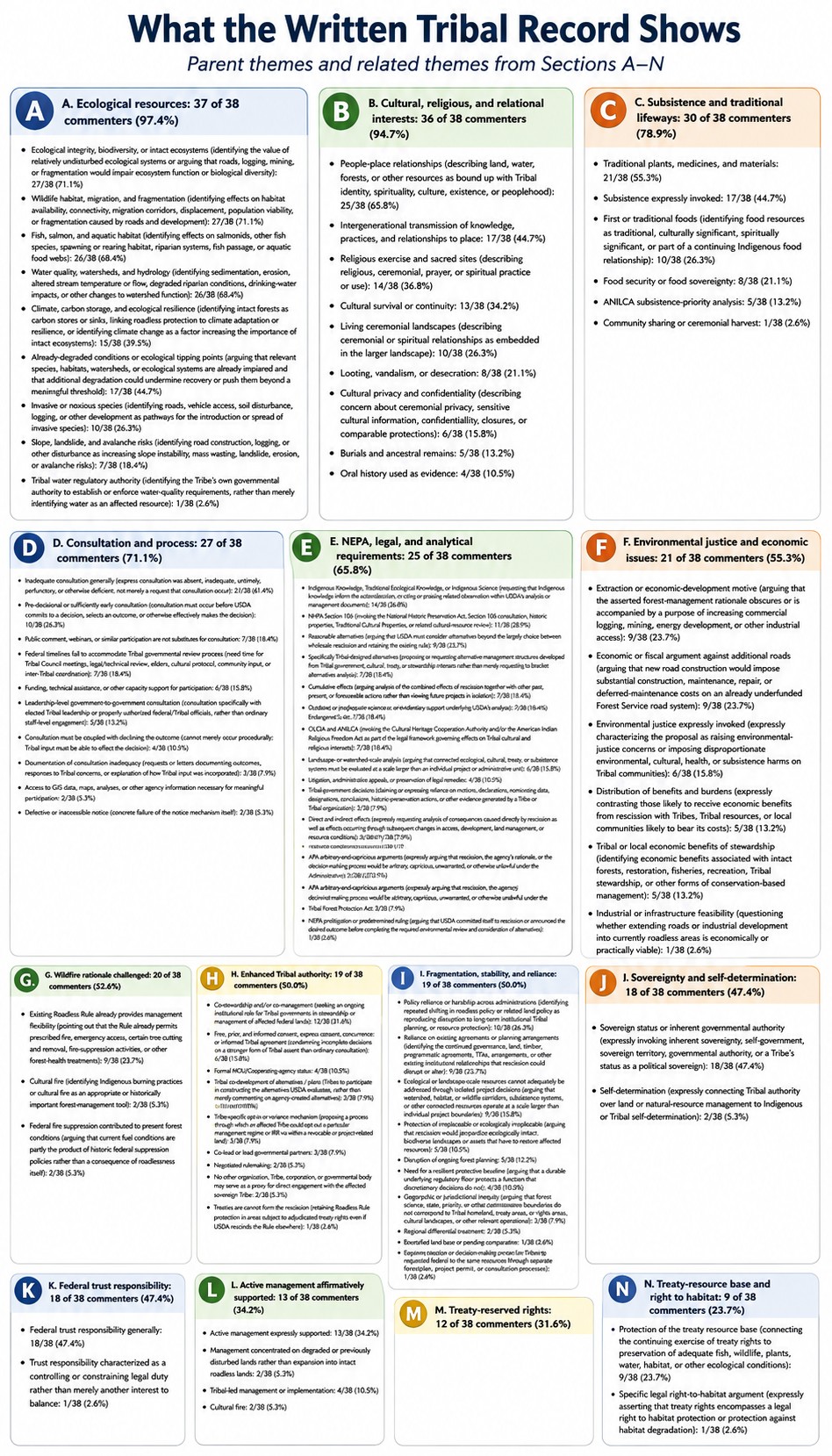
b. The second document, The Tribal Administrative Record on the Roadless Rule, is an ILPC independent empirical review of the 38 distinct Tribal comments filed in 2025. Rather than starting from USDA’s own categories, the ILPC coded the submissions and measured how often fourteen recurring themes appear, from near-universal concerns about ecological resources (94.7%), and cultural and religious interests (94.7%), to concerns raised by roughly half of commenters about consultation adequacy and enhanced Tribal governmental authority beyond ordinary consultation. It then compares that record against USDA’s 2026 Draft EIS line by line. Our finding: USDA’s Draft EIS rhetorically recognizes Tribal sovereignty, treaty rights, and trust obligations. It also concludes that full rescission, the alternative it proposes, would create the greatest potential for adverse effects on Tribal rights and interests of any alternative it studied. The gap this record exposes isn’t whether USDA heard Tribes. It’s what the agency did about what it heard.
b. The third document, Strategic Considerations for Tribal Nations in the 2001 Roadless Rule Rescission Comment Period, moves to strategy. It walks through the administrative law tools a comment filed now can use, including arbitrary and capricious review, record preservation and issue exhaustion doctrine, NEPA’s alternatives requirement, NHPA Section 106, and treaty rights claims where they apply, and explains why the strongest comments this round will do more than restate 2025 positions. The most impactful comments submitted now will name an impact, identify USDA’s specific response in the documents it published in the docket on August 20, and explain concretely why that response does or doesn’t hold up. The memo also addresses the administration’s simultaneous move to weaken the protections of NHPA Section 106 through a proposed rule that is expected to be published soon. If NHPA 106 protections are administratively weakened, Tribes will face a multiplication of interventions as decision-making is returned to the land management planning process at the individual national forest level, on top of diminished leverage under a weakened 106 regime.
The strategic considerations memo also flags a separate problem ILPC ran into directly. USDA’s Tribal Summary Impact Statement rests heavily on 29 completed (and 34 scheduled) government-to-government consultations (out of 64 Tribal requests for consultation), but the underlying consultation records aren’t in the public docket, and ILPC couldn’t locate any posted log of them. After an August 28 letter to the Forest Service’s Office of Tribal Relations went unanswered, ILPC filed a formal FOIA request the same day. Because of FOIA’s ordinary processing timeline, that request may not be resolved before the comment period closes. As it stands, Tribes and the public are being asked to evaluate USDA’s account of what it heard in consultation without being able to see the records that account is based on. That timing problem is itself worth putting directly into a comment.
Below is a full set of links to the docket, including the proposed rule, the complete Draft EIS, the Tribal Summary Impact Statement, the economic analysis, and the ILPC-generated documents referred to above.
Additional Resources
Link to the Docket for the 2001 Roadless Rule Rescission
List of Tribes with Comments Submitted Fall 2025 (with links) UPDATE: pdfs of all Tribal comments are included in Vol. III of the EIS.
ILPC Memo: The Tribal Administrative Record on the Roadless Rule
ILPC Graphic: Chart of Tribal Comments Grouped by Theme
ILPC Memo: Strategic Considerations for Tribal Nations in the 2001 Roadless Rule Rescission Comment Period
ILPC Email to FS OTR for Consultation Records
ILPC FOIA Request to FS OTR for Consultation Records
NCAI Resolution Opposing the Legislative Repeal of the 2001 Roadless Area Conservation Rule and Supporting its Retention
Roadless Rule Tribal Hub : “The Tribal Hub is an informational platform created to support Tribal leaders, staff, and community members in responding to the proposed rescission of the 2001 Roadless Rule. Our goal is to ensure that Tribes have timely access to resources, information, and tools to protect sovereignty, treaty and reserved rights, and cultural lifeways throughout this federal rulemaking process.”


Join us at MSU Law for Treaty Waters at Risk: Tribal Sovereignty and the Line 5 Challenge in the Great Lakes, a one-day conference on Friday, April 17, 2026, examining the legal and environmental stakes of energy infrastructure in treaty-protected waters.
Featuring a keynote by Whitney Gravelle, MSU Law and ILPC alumna and President of the Bay Mills Indian Community, the program brings together leading voices to discuss treaty rights, co-management, and the ongoing Line 5 conflicts at Bad River and the Straits of Mackinac.

From MSU Today, here is “Faculty voice: Intergenerational trauma to indigenous families is real.”

Wenona Singel
Professor of Law and Director of Indigenous Law and Policy Center Wenona Singel is currently researching and writing a book on her family’s multi-generational experience with forcible removal of Indian children in U.S. history. Below is an excerpt.
Five generations of my family experienced and responded to U.S. policies of forced displacement and assimilation. In 1840, my third-great-grandfather lost his Native family around the time of the U.S. military’s forcible mass detention and removal of Native people in southern Michigan.
He was raised by a Native family that moved from southern Michigan to the northern part of the Lower Peninsula. My ancestors lived in northern Michigan settled in a Native village at Burt Lake, where they purchased multiple lots of land. Later, they transferred title to that land to the Governor of Michigan to be held in trust for their benefit.
On October 15, 1900, Sheriff Fred Ming of Cheboygan County and a lumber speculator named John McGinn poured kerosene on the entire Native village at Burt Lake, destroying everything but the church and one small shack. Following that event, which is now referred to as the Burt Lake Burnout by Michigan Native communities, children of Burt Lake village, including my great-grandfather’s generation, were sent to the federally operated Mount Pleasant Indian Industrial School.
Indian boarding schools throughout the U.S. were well-documented sites of forcible assimilation, abuse, and neglect. Native children, who were frequently removed from their homes against their parents’ wishes, arrived at the schools, where they were stripped of their traditional clothing. Their hair was cut short, they were forbidden from speaking their Indigenous languages, they were taught menial skills, and they suffered from numerous forms of physical and sexual abuse as well as malnutrition, rampant spread of disease, and other forms of neglect.
Many Native children died during their institutionalization at Indian boarding schools, and the U.S. has only identified a portion of the grave sites of these children. Those who survived Indian boarding schools speak of persistent feelings of unworthiness and shame for being Indian.
My grandfather was among the children born to the generation that attended the Mount Pleasant Indian Industrial School. He attended Holy Childhood School of Jesus, an Indian boarding school operated by the Catholic Church in Harbor Springs, Michigan.
At Holy Childhood, my grandfather met my grandmother, who also lived at the school. They later married and had five children, all of whom were taken from them by social services.
One of the lasting legacies of Indian boarding schools is that children who attended these schools grew up without exposure to their own families’ parenting skills. Instead, survivors grew up learning cooking and cleaning over academics and were subjected to institutional abuse.
These experiences deeply traumatized many survivors of the schools and left them unprepared for gainful employment and economic prosperity in adulthood. Furthermore, social services agencies in the twentieth century treated Native families as incapable of raising their own children.
By 1978, 25% to 35% of all Native children in the U.S. were removed from their homes and placed in foster care, adoptive homes, or institutions. In nearly all cases, Native children were placed with families who were not Native, leading to the widespread loss of children’s cultural identity and connection with their tribal communities.
Like so many of the Native children born in the 1950s, my mother was removed from her family as an infant and lived in multiple foster care homes until she was adopted by a white Catholic family with one of her biological sisters at the age of five.
My mother and aunt experienced loss of their Anishinaabe cultural identity. They also confronted cruel negative stereotypes about Native Americans in their schools, church, and family.
As an 18-year-old girl, my mother became pregnant with me and left her adoptive family. For three years, my mother and I “couch-surfed” in temporary housing until my sister was born and we found an income-pooling commune founded by a church in Detroit. The following year, when I was four, my baby sister was taken from us and adopted by a white family.
Today, I am a parent to two children. I am committed to documenting the impact of federal and state Indian law and policy on Native families and the intergenerational trauma it produces. I want my own children to be the first generation in my family since at least 1840 not to experience separation from their parents. (However, my sister lost custody of her son following life in the adoptive home that she fled during adolescence.)
I became extremely self-reliant as a child to compensate for the challenges my family had as a result of abuse and neglect. However, many negative impacts of the toxic stress of my early years continue to affect me today, such as constant hyper-vigilance and the sensation of being in survival mode, even though I’ve long established the security I lacked in my youth.
My story is not exceptional; rather, it’s representative of and part of a pattern common to Native families throughout the country. Themes of substance abuse, thoughts of suicide, domestic violence, lack of secure housing, and financial issues plagued the adults in my family, contributing to toxic stress.
On the Adverse Childhood Experiences scale, which measures children’s exposure to various forms of abuse, neglect, dysfunction, and chaos, I score an 8 out of 10. Scores of 8 through 10 are shared by an estimated 1% to 3% of the U.S. population.
I know many Native community members who score a 10 out of 10. Studies have shown that people with an ACE score of 4 or more have a greater likelihood of developing chronic health conditions, they are four times more likely to experience depression, anxiety, and substance use disorders than the general population, and they have a lower life expectancy.
They are also 12 times more likely to attempt suicide.
My work is intended to help other Native families understand how federal and state Indian policies have contributed to multiple generations of profound harm that continue to cause reverberating impacts in the present.
I am exploring how evidence-based strategies for surviving and thriving despite high ACE scores can be scaled and tailored to address historic trauma using culture, traditional teachings, and education.
I am also examining how our justice and political system might respond and provide remedies for the intergenerational harm.
I am an advocate of a multi-pronged approach that includes components such as an acknowledgement of the full effect of the harms experienced by Native families; formal and meaningful apologies; accountability for individuals, organizations, and governments; restitution; rehabilitation; and healing as defined and prescribed by Indigenous communities.
Try as they did, the federal and state governments did not succeed at whitewashing our people. It came close. And now they must take action on each of these prongs to help Indigenous people heal.

Michigan State University College of Law is hiring in Indigenous law. Entry-level and lateral tenure-system faculty members are invited to apply. Our announcement is below:
MICHIGAN STATE UNIVERSITY COLLEGE OF LAW
Michigan State University College of Law seeks to fill several tenure-system and fixed-term faculty positions for the 2024-2025 academic year. We welcome applications from candidates across all areas of law, but are particularly interested in hiring: (1) a tenured faculty member with exceptional teaching and scholarship credentials to fill our John F. Schaefer Chair in Matrimonial Law; (2) an entry-level or lateral tenure-system faculty member to join the Indigenous Law and Policy Center; (3) an entry-level or lateral tenure-system faculty member to fill the Inaugural 1855 Professorship in the Law of Democracy, which will focus on legal inequities in the democratic process and election law; (4) several entry-level or lateral tenure system faculty members to teach in one or more of the following subject areas: Trusts and Estates, Civil Procedure, Family Law, Commercial Law, Criminal Law and Criminal Procedure, Torts, International Law, Constitutional Law, and Professional Responsibility; (5) an entry-level or lateral tenure-system or fixed-term faculty member to direct the Low-Income Taxpayer Clinic; and (6) a fixed-term faculty member to teach in our Legal Research, Writing, and Advocacy program. Michigan State University is the nation’s premier land grant university, established in 1855. MSU Law’s history dates to 1891. More information about the Law College can be found at www.law.msu.edu. MSU is committed to achieving excellence through diversity. The University actively encourages applications from and nominations of people from diverse backgrounds including women, persons of color, people with diverse gender identities and sexual orientations, veterans, and persons with disabilities. Please submit application materials to MSU College of Law Faculty Appointments Committee Co-Chairs, Professor David Blankfein-Tabachnick dbt@law.msu.edu and Professor Brian Kalt kalt@law.msu.edu.
You must be logged in to post a comment.