Andrea Smith reviews both Frank Pommersheim’s Broken Landscape and Kevin Bruyneel’s The Third Space of Sovereignty: The Postcolonial Politics of U.S. – Indigenous Relations.
Scholarship
Ojibwe Treaty Rights Article in American Indian Quarterly
“After the Storm: Ojibwe Treaty Rights Twenty Five Years after the Voigt Decision” by Patty Loew and James Thannum was published in the American Indian Quarterly, vol. 25, no. 2 (Spring, 2011). Here’s an excerpt/abstract:
This article examines the socioeconomic, political, and cultural fac- tors that contributed to the spearfishing crisis twenty-five years ago and the state of relations between Native and non-Native residents in the ceded territory today. It focuses on Wisconsin, where the most virulent protests occurred. Because most residents learned about the controversy through newspaper and television news accounts, the article pays special attention to media coverage of the boat landing struggles. It argues that the relative calm that exists today is attributable to increased public awareness about treaty rights and sovereignty, largely due to education efforts and better reporting by the media. It also argues that the contributions of the Ojibwe bands themselves over the past twenty-five years to maintain and improve the natural resources within the ceded territory has also had a positive effect.
Student Comment in Colorado Law Review re: Tribal Law and Land Use
John C. Hoelle has published “Re-Evaluating Tribal Customs of Land Use Rights” in the University of Colorado Law Review.
Here is the abstract:
Indigenous peoples developed sustainable land tenure systems over countless generations, but these customary systems of rights are barely used by American Indian tribes today. Would increasing formal recognition of these traditional customs be desirable for tribes in a modern context? This Comment examines one traditional form of indigenous land tenure—the use right—and argues that those tribes that historically recognized use rights in land might benefit from increased reliance on these traditional customs. The Comment argues that in the tribal context, use rights can potentially be just as economically efficient, if not more so, than the Anglo-American system of unqualified, absolute ownership in land. The Comment also argues that tribal customs of land use rights may help preserve Indian cultural identity by cultivating core, non-economic values of tribal peoples. The Comment concludes by addressing some of the challenges tribes will likely face in attempting to more broadly rely on their customs of land use rights in the new millennium, while also remarking on some current and important opportunities for the re-integration of tribal customs in tribal land law.
If we get a pdf, we’ll post the paper too.
New Scholarship on Solar Power in Indian Country
Ryan Dreveskracht has posted his paper, “Solar as an Economic Development Tool in American Indian Country,” on SSRN.
Here is the abstract:
This paper discusses the use of solar as an economic development tool in American Indian country, and offers a few suggestions on how to make these projects successful.
New Scholarship on Tribal Campaign Financing Disclosures and Sovereign Immunity
Mary-Beth Moylan has posted her paper, “Sovereign Rules of the Game: Requiring Campaign Finance Disclosure in the Face of Tribal Sovereign Immunity,” on SSRN. It is forthcoming in the B.U. Public Interest Law Journal.
Here is the abstract:
This paper examines the history and current state of affairs concerning tribal political participation. Additionally, this paper suggests legislative action to create a sensible structure in which Indian tribes can responsibly participate in the political process at both a federal and state level.
Student Note on Oklahoma “Indian Country” Cases
Philip Tinker has posted his paper, “Is Oklahoma Still Indian Country? “Justifiable Expectations” and Reservation Disestablishment in Murphy v. Sirmons and Osage Nation v. Irby.
Here is the abstract:
The Tenth Circuit Court of Appeals and the United States District Court for the Eastern District of Oklahoma recently held that Allotment-Era statutes disestablished Indian tribal reservations in the former Indian Territory. However, these decisions were not based on any express statutory provisions. Rather, the courts focused on the state’s history of exercising jurisdiction over the allotted reservations as conclusive evidence that Congress must have intended this result.
This paper argues that these courts relied on the “justifiable expectations” approach adopted by the Supreme Court in the unrelated case of City of Sherrill v. Oneida Indian Nation in order to validate the state’s longstanding but erroneous assumption that Congress authorized the state to assume jurisdiction over the allotted Indian reservations. In so doing, these courts have revitalized the heretofore repudiated assumption that “Oklahoma is different” and not subject to the limitations on state action in the Indian Country.
NYT’s review of The Bitter Waters of Medicine Creek
A surprisingly insightful review from the paper of record:
Kluger’s recitation of these events can be seen as an upbeat refusal to treat a historical tragedy as irredeemable. Usually, Indians tend to disappear from histories about them — even when the blame for their suffering is placed on others. The Nisqually, as Kluger shows, have not disappeared, and “The Bitter Waters of Medicine Creek” is an eloquent account of a massacre’s legacies as well as its history.
Staudenmaier and Khalsa have published an article on Carcieri and taking land into trust in UNLV Gaming Law Journal
The title is A post-Carcieri vocabulary exercise: what if “now” really means “then”? The cite is 1 UNLV Gaming L.J. 39 (2010).
UPDATE: The article is available here.
ILPC Event: Prof. Atwood on ICWA, March 24th
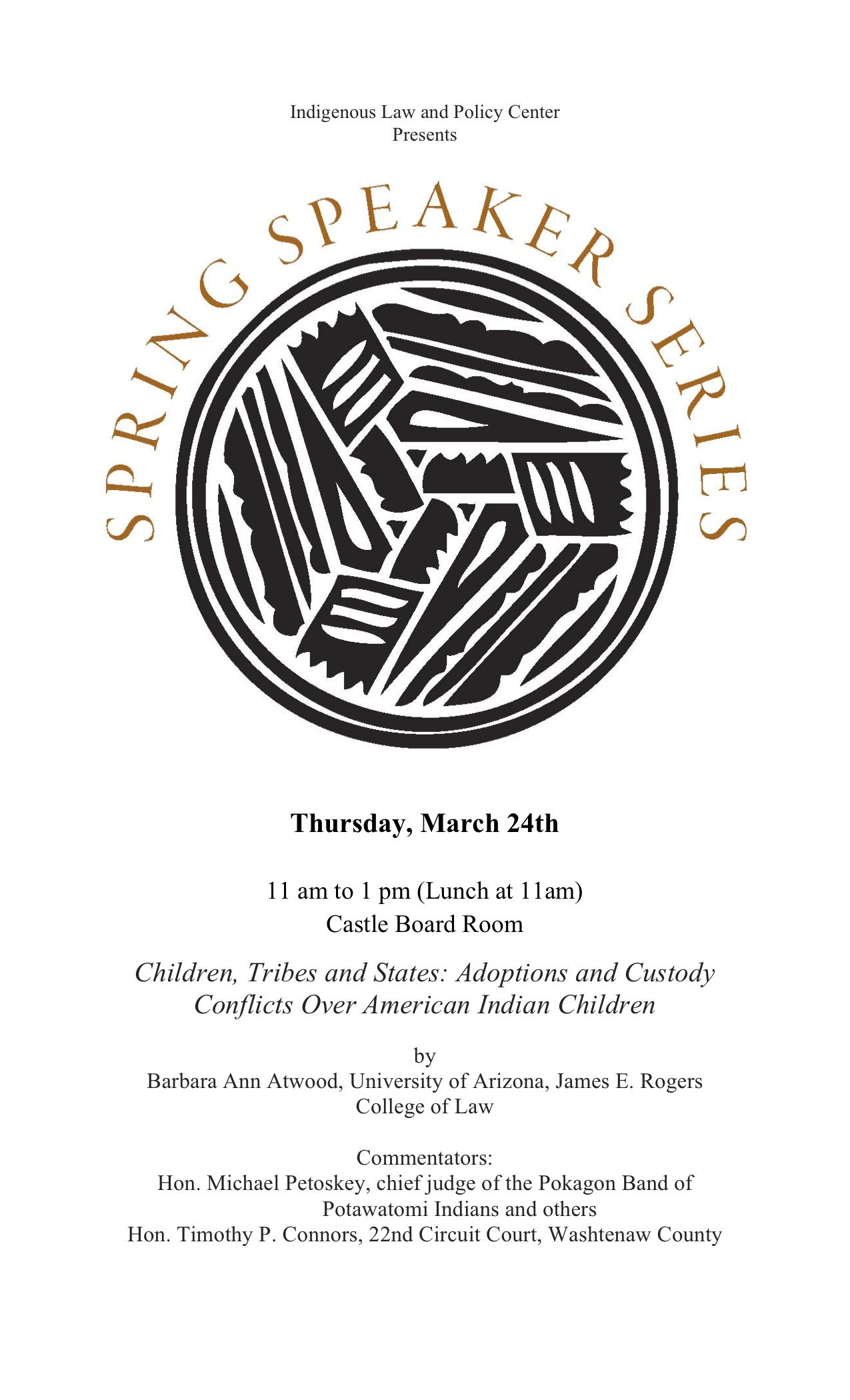
Please join us for our third event in our Spring Speakers Series, a discussion with Prof. Barbara Atwood, author of Children, Tribes and States: Adoptions and Custody Conflicts Over American Indian Children. The Honorable Michael Petoskey and the Honorable Timothy Connors will be commenting on the book. The event will start at 11am with lunch in the Castle Board Room, and end by 1pm. No registration is necessary.
Problems with “Uses of History”
The History News Network posted an essay by Herbert Gans today on Uses of History. He was making a distinction between Present-oriented history and Past-oriented history. His point was that the former is looking to history for insights into the present, while the latter is concerned only with the past. Specifically he writes,
Present-oriented history recounts historical events, processes and other social situations that are useful for understanding what is happening now, even if such comparisons are risky when incompletely done or decontextualized. This kind of history also reports and analyzes the origin of present organizations, institutions, social processes etc. with special attention to how their pasts continue into or shape the present.
and,
Another kind of present-oriented history originates with currently topical events and explores their past in order to better understand the present. Americanists can search the past for roots to our current economic troubles, just as historians of the Mideast trace today’s upheavals to the region’s past.
He compares this history with Past-oriented history, which might be considered history for history’s sake. Past history is not written to give us insight into the present. He argues that, for example, a study of tools of 19th century sharecroppers would not give us insights into the plight of urban African-American poor today. And while it is true that scholars engage in that type of history writing, his main example is particularly unfortunate:
Past-oriented history is about events and people that are not relevant in any way to the present, for example a history of Lake Michigan area Native American settlements during the 15th century. I suppose one could even write a history of Reconstruction that makes no connection to the present, although given the continuing interest in the subject, not to mention the role it played in the arrival of Jim Crow, that would be a difficult task.
While his point about the existence of past-oriented history scholarship might be well taken, stating that the history of Native settlements in 15th century Lake Michigan area are “not relevant in anyway to the present” is simply wrong. In fact, those settlement patterns were vital to the 2007 consent decree negotiations and the final decree. See, Matthew L.M. Fletcher, ‘Occupancy’ and ‘Settlement’: Anishinaabemowin and the Interpretation of Michigan Indian Treaty Language. Those settlement patterns are relevant to people today for many cultural and legal reasons.
The other problem with this paragraph is the assumption past-oriented work about an important part of United States history (Reconstruction) would be more difficult than past-oriented work about an important part of Anishinaabe history (tribal settlements before and during contact). He seems to claim this is true because Reconstruction is part of a longer history from slavery to Jim Crow and beyond. The statement unfortunately assumes tribal settlement patterns are a discrete and obscure part of history, not tied to a longer history of tribal peoples both before and after contact. It seems to me Gans took the most obscure thing he could think of someone studying and used it as a (bad) example.
 Turtle Talk
You must be logged in to post a comment.