Student Note on U.S. v. Bryant

University of Nebraska law student Sara Rips has posted “Mind the Gap: The Unique Disadvantage Faced by Indigent Indians” on SSRN.

Here is the abstract:

In 2014, the Ninth Circuit created a federal circuit split over the use of tribal court convictions in federal prosecutions that the Supreme Court will soon resolve. In United States v. Bryant, the Ninth Circuit held that tribal court convictions cannot be used as predicate offenses in subsequent federal prosecutions unless the tribal court guarantees a right to counsel commensurate with the Sixth Amendment right. The Court accordingly dismissed a federal domestic assault charge under 18 U.S.C. § 117(a) because the predicate offense upon which the prosecution relied would have violated the Sixth Amendment right to counsel had the case arisen in federal or state court. The Court rooted its decision in the principle commonly espoused in criminal procedure jurisprudence that uncounseled convictions are unreliable. Extending this reliability principle to tribal proceedings is, perhaps predictably, problematic since indigent defendants are rarely guaranteed the right to appointed counsel, and the Constitution itself is without force in tribal courts. The Eighth and Tenth Circuits have thus upheld the use of uncounseled tribal court convictions on comity grounds. This Note analyzes the Eighth, Ninth, and Tenth Circuit cases to highlight the unique disadvantage indigent Indian defendants with prior uncounseled tribal court convictions confront when prosecuted under § 117(a). With an eye toward the Supreme Court, this Note proposes an alternative interpretation of the statute that avoids the constitutional quandary created by the Eighth and Tenth Circuits’ holdings. This Note concludes by urging the Court seize the opportunity United States v. Bryant presents to reassess Congress’ immense plenary power under the Indian Commerce Clause.

Patty Ferguson-Bohnee on Indian Voting Rights in Arizona

Patty Ferguson-Bohnee has posted “The History of Indian Voting Rights in Arizona: Overcoming Decades of Voter Suppression,” which she published in the Arizona State Law Journal. Here is the abstract:

Native Americans “have experienced a long history of disenfranchisement as a matter of law and of practice.” This comes from a complicated and contradictory history of laws and policy that has recognized tribes as separate sovereigns, reduced tribal status to that of domestic dependent nations, sought to remove, relocate, or assimilate tribal citizens, terminated numerous indigenous nations, and has now moved to a policy of tribal self-government. Unfortunately, the right to vote for Arizona’s first people has only recently been achieved, and there are continuing threats to the electoral franchise.

Voter suppression has been used to discourage or prevent Indian people from voting in Arizona. Voter qualifications such as literacy tests were used to prevent Indians from participating in elections for approximately fifty years. Once Native Americans started voting, redistricting and vote dilution were used to reduce the effectiveness of the Native vote.

This article will review the history of Indian voting rights in Arizona. The author begins by reviewing the history of Native American voting rights and the history of voting discrimination against Native Americans in Arizona. The Voting Rights Act turned the corner for Native people to participate in the state and federal election processes. The article then discusses the current challenges faced by Native American voters and specifically discuss the voter ID law passed in 2004. The voter ID law is a roadblock that impedes full participation by all Arizona Indians. The last part of the article focuses on strategies to protect Indian voting rights. Notwithstanding the Supreme Court’s invalidation of the Section 5 coverage formula in Shelby County, tribes should consider proactive measures to ensure that tribal citizens can participate in elections.

Highly recommended.

Michalyn Steele on Plenary Power, Political Questions, and Sovereignty in Indian Affairs

Michaelyn Steele has published “Plenary Power, Political Questions, and Sovereignty in Indian Affairs” in the UCLA Law Review.

Here is the abstract:

A generation of Indian law scholars has roundly, and rightly, criticized the Supreme Court’s invocation of the political question and plenary power doctrines to deprive tribes of meaningful judicial review when Congress has acted to the tribes’ detriment. Courts have applied these doctrines in tandem so as to frequently leave tribes without meaningful judicial recourse against breaches of the federal trust responsibility or intrusions upon tribal interests and sovereignty. For example, courts consider congressional abrogation of a treaty a political question beyond the reach of the judiciary. At the same time, challenges to the inherent, or aboriginal, authority of tribes are deemed justiciable. The Court’s inconsistent approach represents a kind of “heads I win; tails you lose” application of the political question and plenary power doctrines in Indian affairs.

This Article proposes that, rather than facing a rigged coin toss in the courts, tribes should be able to avail themselves of the political question and plenary power doctrines to have Congress, rather than the courts, decide questions of inherent tribal authority. Under current precedent, the Court has aggrandized its own power in Indian affairs through the theory of implicit divestiture, which holds that the judiciary may find tribes divested of inherent powers even without congressional action. This Article argues that the questions of whether inherent tribal authority endures, and which sovereign powers tribes can exercise, should be political rather than judicial. This Article challenges long-held assumptions about these fundamental doctrines of federal Indian law and poses important questions about the role of the courts and Congress and about the future of inherent tribal sovereignty.

HIGHLY RECOMMENDED.

Matthew Fletcher is First Native Plenary Speaker at National Conference

ncjfcj1
Click to enlarge

Here is Matthew with Robert Listenbee, Jr., at the National Council of Juvenile and Family Court Judges’ National Conference on Juvenile Justice in Las Vegas.  Listenbee, Administrator of the DOJ’s Office of Juvenile Justice and Delinquency Prevention, introduced Matthew and encouraged the group to work harder to bring justice for Native children and youth.  Matthew is the first Native plenary speaker that NCJFCJ has had at one of its national conference!  His presentation was “The Crisis in American Indian Juvenile Justice.”

Kevin Washburn on Recurring Issues in Indian Gaming Compact Approval

Kevin Washburn has posted “Recurring Issues in Indian Gaming Compact Approval” on SSRN. The paper is forthcoming in Gaming Law and Economics.

The abstract:

As tribal-state gaming compact negotiations under IGRA have become more complex and ratification in state and tribal legislative bodies has become more political, state and tribal negotiators sometimes lose sight of important interests protected by IGRA through the Secretary of the Interior’s review authority. IGRA is fairly clear about the terms parties may and may not negotiate in compacts and Interior has begun to enforce IGRA more and more rigorously in the review process. To minimize the risk of disapproval, state and tribal negotiators are wise to consider several issues that are likely to raise concerns among federal reviewers. This essay surveys some of the more common issues that continue to arise in compact negotiations.

On another, unrelated note, Professor Washburn’s photography skills were in fine form this last weekend.

American Indian Law Review, Vol. 39, No. 2

Here:

Vol. 39, No. 2 (2014-2015)

Articles

Tribal Criminal Jurisdiction Beyond Citizenship and Blood – Addie C. Rolnick

When a Tribal Entity Becomes a Nation: The Role of Politics in the Shifting Federal Recognition Regulations – Lorinda Riley

Comments

Native Americans and the Legalization of Marijuana: Can the Tribes Turn Another Addiction into Affluence? – Melinda Smith

Coalbed Methane Development in Wyoming and Montana: The Potential Impacts of Montana v. Wyoming, Coalbed Methane Development, and Water Quality on the Tribes of the Powder River and Wind River Basins – Mallory Irwinsky

The Bureau of Land Management’s Finalized Hydraulic Fracturing Rule on Tribal Lands: A Responsibility or Intrusion? – Kerstie Moran

Note

Analysis of a Bias-Based Exception to the Doctrine of Exhaustion in Wilson v. Bull – Mitch McGrew

Sarah Krakoff on American Indian Tribes, Race, and the Constitutional Minimum

Sarah Krakoff has posted “They Were Here First: American Indian Tribes, Race, and the Constitutional Minimum” on SSRN.

Here is the abstract:

In American law, Native nations (denominated in the Constitution and elsewhere as “tribes”) are sovereigns with a direct relationship with the federal government. Tribes’ governmental status situates them differently from other minority groups for many legal purposes, including equal protection analysis. Under current equal protection doctrine, classifications that further the federal government’s unique relationship with tribes and their members are not subject to heightened scrutiny. Yet this deferential approach has been subject to recent criticism and is currently being challenged in pending cases. Swept up in the larger drift toward colorblind or race-neutral understandings of the Constitution, courts and commentators question the distinction between tribes’ political and racial status, and urge courts to strike down child welfare and gaming laws that benefit tribes. Yet tribes (as collectives) must trace their heritage to peoples who preceded European/American settlement in order to establish the political relationship with the federal government. Tribes, in order to be recognized as such under the Constitution, therefore must, as an initial definitional matter, consist of people tied together by something akin to lineage. Descent and ancestry (often conflated with the socio-legal category of “race,”) are the difference between legitimate federal recognition of tribal status and unauthorized and unconstitutional acts by Congress. Congress, in other words, cannot establish a government-to-government relationship with just any group of people. Tribes are treated differently from other groups due to their ties to the indigenous peoples of North America, and federal courts should not use that constitutional distinction against tribes in a misguided effort to eradicate all traces of things currently sounding in “race.”

The argument advanced here might be seen as a form of American Indian law exceptionalism. Yet it is consistent with racial formation theory’s project of understanding race as a construction that serves, creates, and perpetuates legalized subordination, and that also shapes daily social conceptions and interactions. Racial formation theory calls for multiple accounts of racialization depending on the social and economic purposes served by each groups’ subordination. On the remedial side, racial formation theory therefore necessarily anticipates what we might think of as multiple exceptionalisms. Reversing policies that aimed to eliminate Native people from the continent, and the racialized understanding of Indians that drove them, requires maintaining the political status of tribes as separate sovereigns, not destroying it in the name of an ahistorical conception of “race” neutrality.

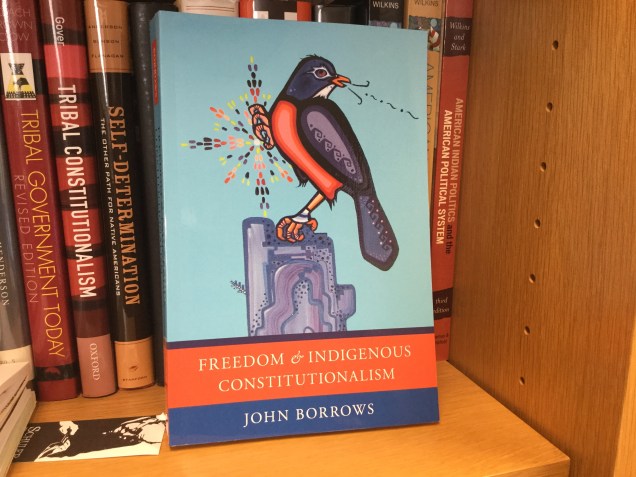
Robert Miller on Tribal Constitutions and Their Influence on the American Constitution

Robert Miller has posted “American Indian Constitutions and Their Influence on the United States Constitution” on SSRN. 

Here is the abstract:

This paper analyzes modern-day American Indian constitutionalism. It describes the development of written constitutions by Indian nations and primarily focuses on constitutions developed since 1934 under the auspices of the federal Indian Reorganization Act. This paper also briefly examines the evidence that American Indian political philosophies, and traditional tribal governmental structures and ideas, influenced many of the Founding Fathers and the drafting of the United States Constitution.

Native American Scholarship Available for Elk River Writers Workshop

Chickasaw poet Linda Hogan is among the faculty.  Deadline is May 1.  More information is available here.

Minn. American Indian Bar Assoc.’s 2016 Indian Law Conference

Download the agenda and registration form here.

The MAIBA CLE Committee announces the 2016 Indian Law Conference will be held on Friday May 6th at the Mystic Lake Casino Hotel.  An excellent program has been scheduled with several national speakers and cutting edge topics.  Please note that Professor Sarah Deer will be honored at the reception Friday afternoon.

Their co-sponsor, Minnesota CLE, is again handling registration.  Please find the attached brochure, which includes the agenda.  You can view the same material and register by using the following link:

http://www.minncle.org/E-PromosHTML/indian2016.htm