Department of Justice Announces Program to Enhance Tribal Access to National Crime Information Databases

DEPARTMENT OF JUSTICE ANNOUNCES PROGRAM TO ENHANCE TRIBAL ACCESS TO NATIONAL CRIME INFORMATION DATABASES

 Department of Justice Tribal Access Program (TAP) Will Improve the Exchange of Critical Data 

Department of the Interior Companion Program to Provide Name-Based Emergency Background Checks for Child Placement

WASHINGTON – The Department of Justice is launching an initial phase of the Tribal Access Program for National Crime Information (TAP) to provide federally-recognized tribes access to national crime information databases for both civil and criminal purposes.  TAP will allow tribes to more effectively serve and protect their communities by ensuring the exchange of critical data.

This initial phase of TAP was announced today in a meeting with tribes held during the 2015 Department of Justice/FBI Criminal Justice Information Services (CJIS) Division Tribal Conference in Tulsa, Oklahoma.

“Federal criminal databases hold critical information that can solve crimes, and keep police officers and communities safe,” said Deputy Attorney General Sally Quillian Yates.  “The Tribal Access Program is a step forward to providing tribes the access they need to protect their communities, keep guns from falling into the wrong hands, assist victims and prevent domestic and sexual violence.  Empowering tribal law enforcement with information strengthens public safety and is a key element in our ongoing strategy to build safe and healthy communities in Indian country. ”

“The FBI is pleased to participate in this initiative,” said Executive Assistant Director Amy Hess of the FBI’s Science and Technology Branch.  “This will be a positive step for the tribal agencies to receive valuable criminal information and also for those same tribal agencies to submit criminal information at the national level.  Through this partnership, information becomes richer and communities can become safer.”

TAP will support tribes in analyzing their needs for national crime information and help provide appropriate solutions, including a-state-of-the-art biometric/biographic computer workstation with capabilities to process finger and palm prints, take mugshots and submit records to national databases, as well as the ability to access CJIS systems for criminal and civil purposes through the Department of Justice.  TAP will also provide specialized training and assistance for participating tribes.

While in the Tribal Law and Order Act of 2010 Congress required the Attorney General to ensure that tribal officials that meet applicable requirements be permitted access to national crime information databases, the ability of tribes to fully participate in national criminal justice information sharing via state networks has been dependent upon various regulations, statutes and policies of the states in which a tribe’s land is located.  Therefore, improving access for tribal law enforcement to federal criminal information databases has been a departmental focus for several years.  In 2010, the department instituted two pilot projects, one biometric and one biographic, to improve informational access for tribes.  The biographic pilot continues to serve more than 20 tribal law enforcement agencies.

Departments of Justice and Interior Working Group

In 2014, the Departments of Justice and the Interior (DOI) formed a working group to assess the impact of the pilots and identify long-term sustainable solutions that address both criminal and civil needs of tribes.  The outcome of this collaboration was the TAP, as well as an additional program announced today by the DOI’s Bureau of Indian Affairs (BIA) that provides tribes with national crime information prior to making child placement decisions in emergency circumstances.  Under the BIA program, social service agencies of federally recognized tribes will be able to view criminal history information  accessed through BIA’s Office of Justice Services who will conduct name-based checks in situations where parents are unable to care for their children.

“Giving tribal government programs access to national crime databases through DOJ’s Tribal Access Program for National Crime Information is a tremendous step forward towards increasing public safety in Indian Country,” said Assistant Secretary Kevin K. Washburn for Indian Affairs at the Department of the Interior.  “The Bureau of Indian Affairs Office of Justice Services’ Purpose Code X program provides a much-needed tool for tribal social service agencies when they must find safe homes to place children during temporary emergency situations.”

In the initial phase of the TAP program, the biometric/biographic workstations will be deployed to up to 10 federally-recognized tribes who will provide user feedback.  This phase will focus on assisting tribes that have law enforcement agencies, while in the future the department will seek to address needs of the remaining tribes and find a long-term solution.  The department will continue to work with Congress for additional funding to more broadly deploy the program.

The Department of Justice’s Chief Information Officer manages TAP.

“It is our hope that TAP can minimize the national crime information gap and drive a deeper and more meaningful collaboration between the federal, state, local and tribal criminal justice communities,” said Chief Information Officer Joseph F. Klimavicz for the department.

For more information on TAP, visit www.justice.gov/tribal/tribal-access-program-tap.

For more information about the Justice Department’s work on tribal justice and public safety issues, visit: www.justice.gov/tribal.

For more information about the Department of the Interior Bureau of Indian Affairs, visit www.indianaffairs.gov/

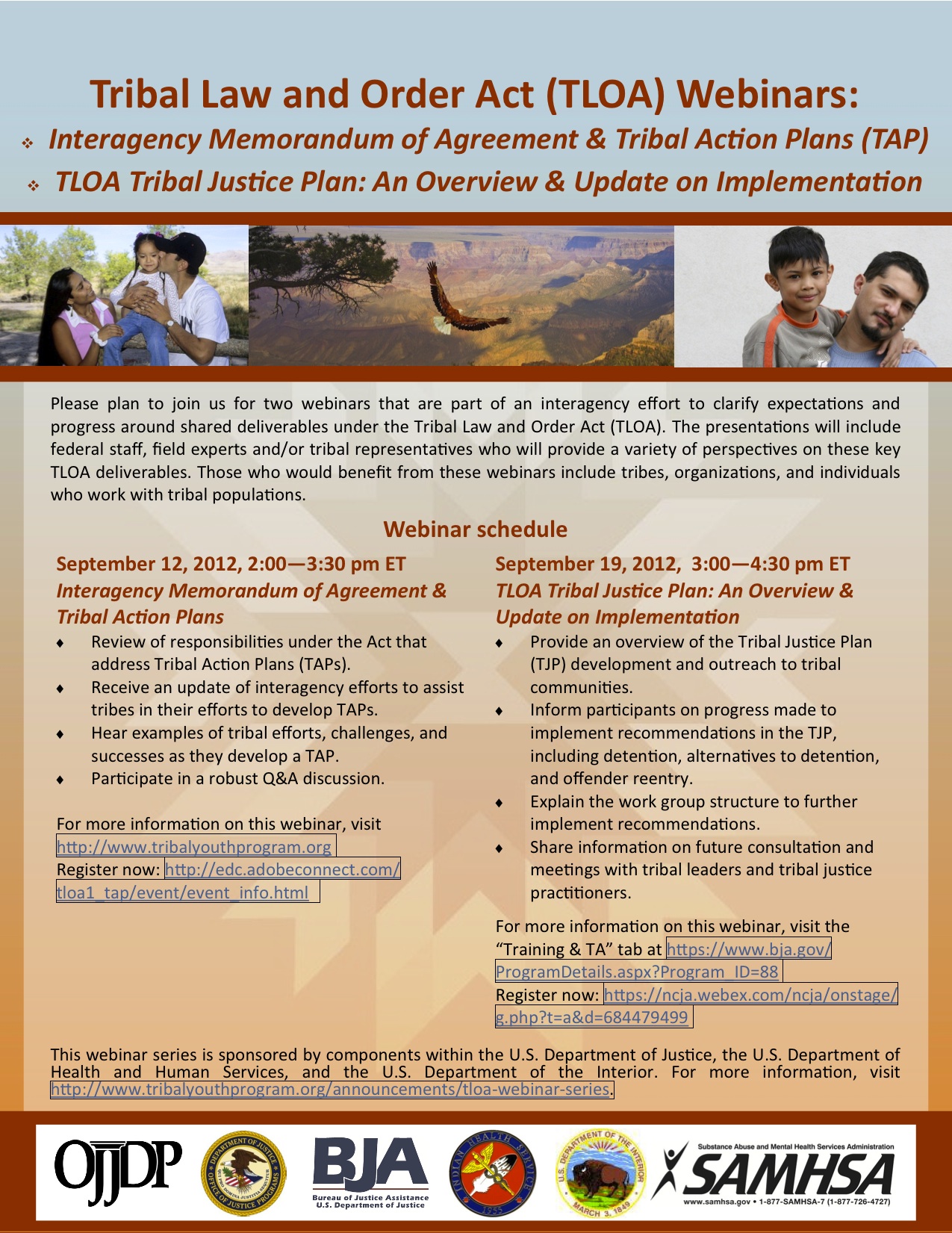
TLOA Implementation Event, July 13-14

Dialogue on Implementing TLOA’s Enhanced Sentencing Authority

On July 13–14, 2015, the Bureau of Justice Assistance, U.S. Department of Justice and the American Probation and Parole Association will conduct A Dialogue on the Tribal Law & Order Act (TLOA) Implementation of Enhanced Sentencing Authority in Tucson, AZ. At this no-cost event, tribal governments will share their experiences in implementing new TLOA authority. Discussion will also explore how to better implement enhanced sentencing authority among interested tribes. For more information visit: www.appa-net.org/eweb/Dynamicpage.aspx?webcode=IV_ProjectDetail&wps_key=49d0989a-0f8a-4644-ba62-2cedacc704bc.

Hello My Name Is: Alaska Native Voices Calling Out for Safety of Native Women

Synergy, the Resource Center on Domestic Violence: Child Protection and Custody’s (RCDV: CPC) twice a year newsletter, is now available! SynergyFVPSA, 30th & VAWA 20th Anniversary Issue, No. 2 of 2 is dedicated to increasing awareness of violence against women in tribal communities generally, and Alaska Natives specifically. This issue includes an article titled Hello My Name is: Alaska Native Voices Calling Out for Safety of Native Women; an overview of the Tribal Law and order Act; and a playwrights view on the idea for and development of, Sliver of a Full Moon, a play highlighting the collective success of Native women’s voices to change laws so that their children and grandchildren will have a better future.

The newsletter is available for download here.

OVW Training on Federal Criminal Databases & DOJ Consultation on Violence Against Women

The Office on Violence Against Women (OVW) is hosting a training session on federal criminal databases and information sharing, October 14, 2014 from 1:30-4:30 p.m in Rapid City, SD. The training is free and will provide information about the various federal criminal databases, requirements for accessing and submitting information to the databases, considerations for tribal leaders working to implement TLOA and VAWA 2013, current DOJ efforts to increase Tribal access to federal criminal databases, and updates on the implementation of Section 905(b) of VAWA 2005.

October 15, 2014 from 8:00 a.m. – 5:00 p.m. in Rapid City, SD is the U.S. Department of Justice’s 9th Annual Government-to-Government Violence Against Women Tribal Consultation. From the site:

The purpose of the consultation is to solicit recommendations on enhancing safety for American Indian and Alaska Native women, strengthening the Federal response to the crimes of domestic violence, dating violence, sexual assault, and stalking, and administering grants funds.

More information and registration is available here.

Washington Post Op Ed on VAWA and TLOA

Here.

Even with the laws now passed, legal loopholes remain and the wait for justice for Native women continues, in part because VAWA, the newer of the two laws, won’t take effect until next year on most reservations, including the Standing Rock Sioux Reservation. Even then, tribes must have implemented a series of steps that many might not already have in place and could pose large legal costs.

One of these steps, for example, includes ensuring tribal judges have appropriate credentials they might not already have, said Troy Eid, a former U.S. Attorney for Colorado who this past year chaired the Justice Department’s Tribal Law and Order Commission.

“It’s going to be a while before these changes take place on many reservations,” he said. “And there is going to be a lot of waiting while these issues unfold.”

Indian Law Resource Center Report on Tribal Capacity for Enhanced Sentencing

Report here.

The Indian Law Resource Center recently released, Restoring Safety to Native Women and Girls and Strengthening Native Nations ─ A Report on Tribal Capacity for Enhanced Sentencing and Restored Criminal Jurisdiction. The report examines existing literature on the readiness among Indian nations to exercise enhanced sentencing authority under TLOA and fuller criminal jurisdiction over all perpetrators of violent crimes under VAWA 2013 or other future legislation. It also identifies challenges facing Indian nations in exercising such authority and how some Indian nations are moving forward to increase their capacity to safeguard Native women in their communities. The report, available at http://indianlaw.org/content/restoring-safety-native-women-and-girls-and-strengthening-native-nations, concludes with ten recommendations aimed at ending violence against Native women and girls and strengthening the ability of Indian nations to address this crisis. We hope that the report will guide the Center, and perhaps others, in better assisting Indian and Alaska Native nations to make their communities safe places.

Eastern Band of Cherokee Indians Issues Four Year Sentence in DV Case

Here

Russell McKinley Wolfe, 35, was convicted on Nov. 16, 2012, in the Cherokee Court for Domestic Violence Assault on a Female, Violation of a Domestic Violence Protective Order, Driving While Impaired, and Injuring Public Property. He was sentenced to four years imprisonment. The sentence, issued by the Honorable Kirk G. Saunooke, Cherokee Court Judge, was one of the longest sentences ever issued by the Cherokee Court and comes after the enactment of the Tribal Law and Order Act which authorized criminal sentences of greater than one year in tribal courts.

Since the sentence was handed down in Wolfe’s case, the Office of the Tribal Prosecutor, in conjunction with the Cherokee Court and Cherokee Police Department, worked together with the Federal Bureau of Prisons to authorize Wolfe’s sentence to be served in a Federal Detention Facility with the Bureau of Prisons.

Louise Erdrich and TLOA in Poets & Writers Magazine


Unfortunately the article isn’t available online, but it includes snippets of an interview with Louise Erdrich, a discussion of The Round House, and some comments by both Erdrich and Professor Bruce Duthu on the problems with the current criminal jurisdiction framework on reservations. Here’s further information about where to find it.

Hopi to Become First Tribe to Implement Higher Sentences Available Under the Tribal Law & Order Act

Here.

TLOA On Line Presentations Held by DOJ, DHS & DOI

Here is the information: