Here are the materials in Federal Trade Commission v. CWB Services LLC (W.D. Mo.):
Uncategorized
National Indian Law Library Bulletin (9/29/2016)
Here:
The National Indian Law Library added new content to the Indian Law Bulletins on 9/29/16.
U.S. Supreme Court Bulletin
http://www.narf.org/nill/bulletins/sct/2016-2017update.html
Petition for certiorari was granted in Lewis v. Clarke (Tribal Sovereign Immunity)
News Bulletin
http://www.narf.org/nill/bulletins/news/currentnews.html
We feature articles about the recent White House Tribal Leaders Conference as well as a settlement of mismanaged monetary assets and natural resources held in trust by the United States for the benefit of tribes.
U.S. Federal Trial Courts Bulletin
http://www.narf.org/nill/bulletins/dct/2016dct.html
Littlefield v. U.S. Dept. of the Interior (Land into Trust)
Navajo Nation v. Urban Outfitters, Inc. (Trademarks)
Law Review & Bar Journal Bulletin
http://www.narf.org/nill/bulletins/lawreviews/2016lr.html
These articles were added:
Reconciling patent law and traditional knowledge: Strategies for countries with traditional knowledge to successfully protect their knowledge from abuse.
Spreading justice to rural Montana: Expanding local legal services in underserved rural communities.
Let the jury fit the crime: Increasing Native American jury pool representation in Federal judicial districts with Indian Country criminal jurisdiction.
Sacred in the city: the Huron Indian Cemetery and the preservation laws.
Challenge-flag thrown: the trademark trial and appeal board’s cancellation of the Redskins’ trademarks and pro-football’s chances on appeal.
U.S. Regulatory Bulletin
http://www.narf.org/nill/bulletins/regulatory/2016fr.html
We feature an adopted rule from the Environmental Protection Agency regarding treating tribes as states under provisions of the Clean Water Act.
U.S. Legislation Bulletin
http://www.narf.org/nill/bulletins/legislation/114_uslegislation.html
The following bill and resolution were added:
S.1579: Native American Tourism and Improving Visitor Experience Act (NATIVE Act).
S.Res.577: A resolution commemorating the 50th anniversary of the Alaska Federation of Natives.
Atlantic Monthly Mini-Doc on Forced Assimilation @ White Earth Nation
Here is “How the Legacy of Native Americans’ Forced Assimilation Lingers Today,” featuring the documentary “Little Dream Catchers.”
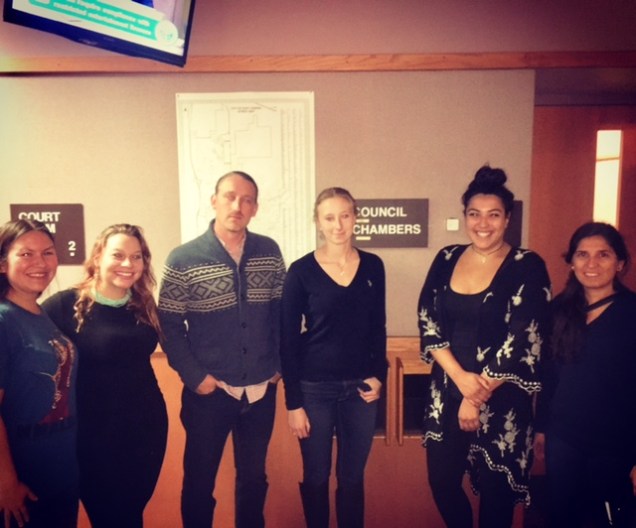
MSU Students and Faculty Testified in Favor of East Lansing’s Indigenous Peoples Day Resolution
Passed last night! Here:
Commentary on Schaefer Riley’s Column on the DAPL Case
Naomi Schaefer Riley offered commentary on the Dakota Access Pipeline matter in her regular column in the New York Post, “How the Standing Rock Sioux should have been able to stop that pipeline.” This column continues NSR’s mockery of Indian peoples’ economic and cultural interests expressed in The New Trail of Tears.
The lede says it all:
Quick quiz: What’s the best way to stop a company from building an oil pipeline on a piece of land you find valuable? Answer: Buy the land.
Assuming that the Standing Rock Sioux Tribe and other affected tribes had the resources to do so, it probably wouldn’t have mattered — energy companies usually just confiscate the land under their delegated power of eminent domain, as Dakota Access has. Sure, property ownership helps, but in the end, the law is tipped in the pipeline companies’ favor.
NSR cites to the Mormons (huh?) in a strange fictional scenario, and the friends of Langston Hughes in a more realistic scenario, who could purchase cultural property that might otherwise be destroyed through development:
But the results haven’t been satisfactory to the tribe. So let’s imagine a different scenario — in which any group of people in the United States wanted to block development on a certain site. Perhaps it’s the Mormons who hear a skyscraper will be going up in the place where Joseph Smith saw the golden tablets.
Or take a real-life example: The home where the poet Langston Hughes once lived is up for sale. A group of people want to turn it into a museum. In order to do so they’re raising money to buy the building from its current owner.
A pipeline developer’s power of eminent domain would wipe all that out. Really, the only thing that could stop the exercise of that power by an energy or utility company is tribal trust property, the very thing NSR criticizes as “dead capital,” to borrow Hernando de Soto’s phrase. Inspired by de Soto, NSR recommends (in a massive non sequitur) confiscating tribal trust property (never mind the Fifth Amendment’s takings clause) and awarding that property to individual Indians (much like she does in TNToT). The US tried that when it was called allotment and then again when it was called termination — both failed miserably. Peru tried it, too, following de Soto’s recommendations. Was it successful? Not so much. Other countries too (quoting from a Slate article that described the failures):
Reports from Turkey, Mexico, South Africa, and Colombia suggest similar trends. “In Bogota’s self-help settlements,” writes Alan Gilbert, a London professor of geography who has done extensive research on land issues in Colombia and other parts of Latin America, “property titles seem to have brought neither a healthy housing market nor a regular supply of formal credit.”
Indian country is the subject of a lot of predatory lending and redlining — NSR’s ideas very likely would mean massive windfalls for businesses exploiting poor people (kinda like Donald Trump’s claim that profiting from poor people in the housing crisis is “good business” in last night’s debate). Something tells me NSR doesn’t have the best interests of Indian people in mind.
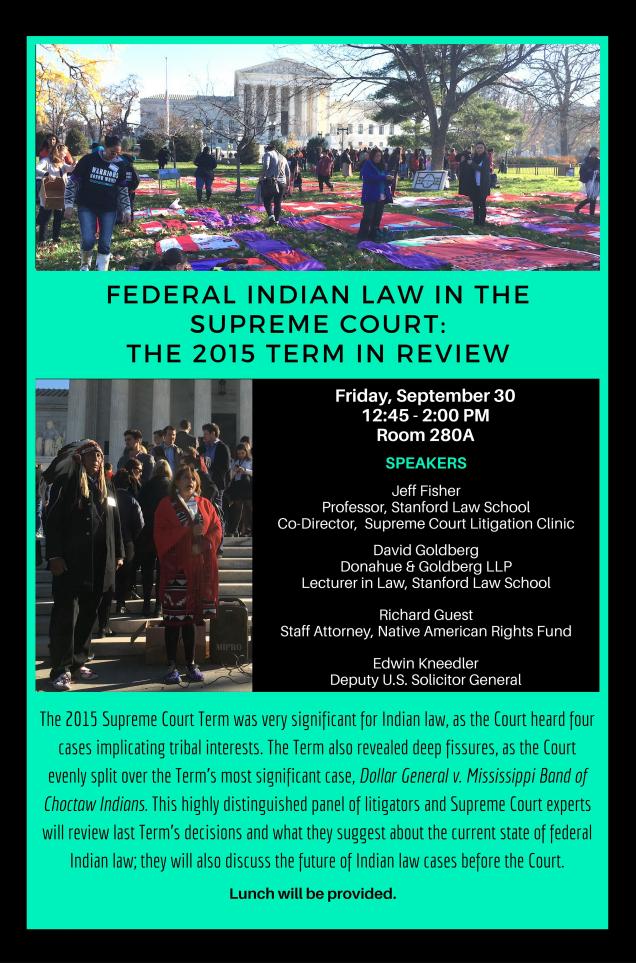
Stanford Law School Panel on Indian Law at the Supreme Court (9/30/2016)
Here:
Colorado Indian Bar Assn. 5K Event — Oct. 2, 2016
Here:
Interior Releases Rule on Government-to-Government Relationship with Native Hawaiians
The DOI issued a news release regarding its rule for Native Hawaiians. Here’s the rule, “Procedures for Reestablishing a Formal Government-to-Government Relationship with the Native Hawaiian Community.”
Friday Job Announcements
Job vacancies are posted on Friday. Some announcements might still appear throughout the week. If you would like your Indian law job posted on Turtle Talk, please email indigenous@law.msu.edu.
Department of the Interior
Attorney-Advisor, Office of the Solicitor, Division of Indian Affairs, Branch of Tribal Government Services, Washington D.C. (Closes 10/3/2016)
Attorney-Adviser, Office of the Solicitor, Intermountain Region, Salt Lake City, UT. (Closes 10/3/2016)
National Indian Gaming Commission
Attorney, Office of General Counsel, Washington D.C. (Closes 10/3/2016)
Quileute Tribe
Chief Court Clerk/Administrator, Quileute Tribal Court, Closes August 7th 2013 until filled.
ASU ICWA CLE

 Turtle Talk
You must be logged in to post a comment.