Here:
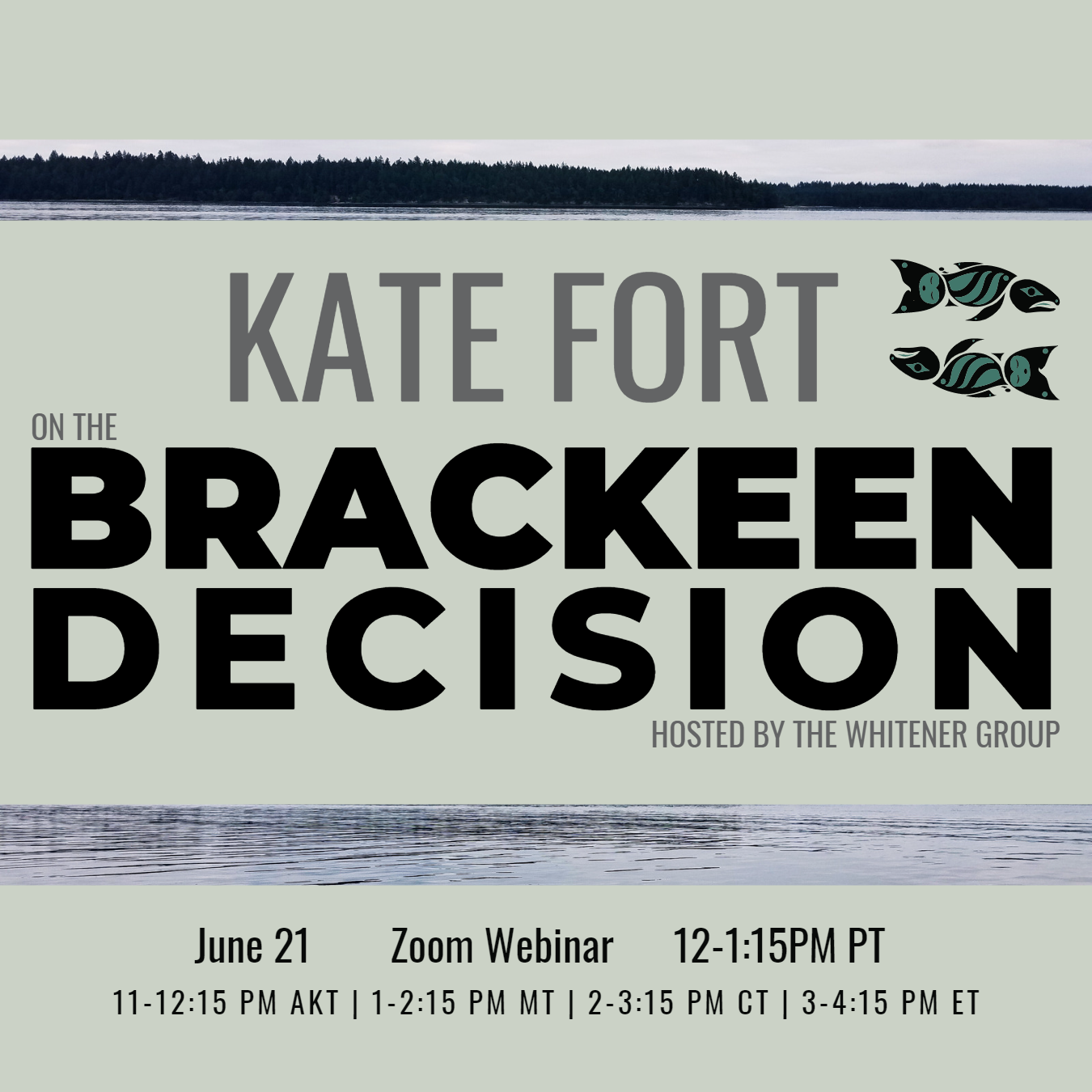
On June 15th, The United States Supreme Court has issued an opinion in the highly anticipated Haaland v. Brackeen case. The litigation involving three foster families, Texas, four intervening tribes and countless amici came to an end after nearly seven years. The Court’s holdings implicate both Indian Child Welfare Act practice and federal Indian law practice. Join Kate Fort for an overview of the decision.
Kate Fort on: Haaland v. Brackeen Decision
Wednesday, June 21st, 12-1:15pm PT
CLE pending*
Visit The Whitener Group Trainings for more information and to register
Click here for the save the date flyer, please share with your networks!
The decision was written by Justice Barrett with all but Justice Thomas and Alito joining her opinion. Justices Gorsuch and Kavanaugh wrote (very different) concurrences. Justices Thomas and Alito dissented.
Essentially the Court held that ICWA is not beyond the power of Congress to effectuate, and does not violate commandeering concerns by making states follow federal law. Neither the foster parents or the state of Texas had standing to bring the equal protection arguments related to the third placement preferences. They did not rule on any merits regarding equal protection and ICWA. Gorsuch’s concurrence laying out the history of federal Indian Law and ICWA is veritable who’s who of Indian law professors. Kavanaugh’s concurrence wants us to make sure we understand there was no ruling on equal protection, only on standing to bring the claim. Justices Thomas and Alito did their usual thing.
This is, without question, a massive win. It’s a stunning victory upholding both the foundations of federal Indian law and the Indian Child Welfare Act. The original district court decision finding ICWA unconstitutional, as well as the parts of the Fifth Circuit decision finding the same, are no longer good law. There is, at this time, no major change in ICWA practice. We can talk details in the coming weeks. So for now I’ll leave you with the last sentence of the Gorsuch concurrence while we all breath a sigh of relief:
In adopting the Indian Child Welfare Act, Congress exercised that lawful authority to secure the right of Indian parents to raise their families as they please; the right of Indian children to
grow in their culture; and the right of Indian communities to resist fading into the twilight of history. All of that is in keeping with the Constitution’s original design.
More to come:
C. J., and SOTOMAYOR, KAGAN, GORSUCH, KAVANAUGH, and JACKSON, JJ., joined. GORSUCH, J., filed a concurring opinion, in which SOTOMAYOR and JACKSON, JJ., joined as to Parts I and III. KAVANAUGH, J., filed a concurring opinion. THOMAS, J., and ALITO, J., filed dissenting opinions.
Here is the opinion in Lac du Flambeau Band of Lake Superior Chippewa Indians v. Coughlin.
Lower court materials here.
Ex re Delaware Tribe v. Hon. Nowicki-Eldridge
This is, as you might imagine, a description of a mess where the West Virginia agency never contacted the Tribe, and then didn’t respond to attempts by the Tribe to get in contact with the agency. Then foster parents were granted intervenor status as well. The decision doesn’t state who made the EIF argument, but the Indian Law Clinic has been hearing the argument more and more from foster parents seeking to deny transfer to tribal court. While the Clinic was not involved in this case, it is reminiscent current appeals the Clinic is working on. My sense from the opinion is that the tribal briefing was likely excellent. The West Virginia Supreme Court didn’t buy it:
This unequivocal statement plainly dispels any notion that the EIF exception is compatible with the ICWA. Accordingly, we join the “swelling chorus of [jurisdictions] affirmatively reject[ing] the EIF exception[,]” ICWA Proc., 81 Fed. Reg. 38778, 38802 (June 14, 2016), and hold that West Virginia does not recognize the Existing Indian Family exception to the Indian Child Welfare Act, 25 U.S.C. §§ 1901 to -1963 (2021). Accordingly, the circuit court erred in adopting the EIF exception and subsequently relying on that exception to determine that the ICWA was inapplicable to this case.
Another fun thing that has been happening a lot is parties arguing the 1979 Guidelines rather than the 7 year old 2016 Regulations and Guidelines:
Before this Court several of the parties cited this guidance as a basis for arguing that the Tribe is not entitled to transfer because it knew of these proceedings in December 2021 but did not move to transfer until eight months later in August 2022. What the circuit court and the parties fail to recognize is that the 1979 Guidelines were explicitly abrogated and replaced by the BIA when it promulgated the 2016 Guidelines. See Guidelines for Implementing the Indian Child Welfare Act, 81 Fed. Reg. 96476 (Dec. 30, 2016) (“The [2016] guidelines replace the 1979 and 2015 versions[.]”). Therefore, we do not find the 1979 Guidelines persuasive, nor do we rely upon any guidance contained therein.
***
The proceeding regarding termination of the parental rights of Respondent Father was not at all advanced at the time the Tribe filed its motion to transfer the proceeding. Respondent Father had not been adjudicated; indeed, neither a preliminary nor adjudicatory hearing had even been scheduled. While five months passed between March 2022 and the Tribe’s motion to transfer in August 2022, the record reveals that those months were devoted to ascertaining whether the ICWA applied to this case, and not to any consideration of the merits of the amended petition. In short, there was nothing “advanced” about this proceeding when the Tribe moved to transfer.
Finally, this Court did not just send the case back for reconsideration, but rather ordered the lower court to transfer jurisdiction to the Delaware Tribe.
Here is the press coverage on the case: https://www.courthousenews.com/delaware-tribe-of-indians-applauds-west-virginia-supreme-court-decision-affirming-its-jurisdiction-in-child-welfare-case/
Here.


August 2-4, 2023 in-person and online
Hosted at the Bay Mills Resort & Casino, Brimly, MI
Register today for this tuition free training
CLE and CEU credits are pending submission and approval.
—–
Full Press Release:
BAY MILLS — Bay Mills Indian Community will host its annual Noojimo’iwewin: The Violence Against Women Act (VAWA) and Indian Child Welfare Act (ICWA) Training on Aug. 2-4. In its 5th year, Noojimo’iwewin will focus on Best Practices In Motion: Growing Into our Best Systems. Registration is open and this training is free of charge.
Each year BMIC strives to bring national experts and timely content to this training. “Really great information” said a 2022 attendee about this domestic violence and child welfare training, “I loved the opportunity to have the starting conversations on this topic and on what to bring back to my organization for our community.”
The 2023 Noojimo’iwewin will feature several hands-on units for attorneys, judges, court clerk personnel, social workers, victim advocates, law enforcement and anyone who works in areas involving violence against women. Attendees can anticipate being surrounded by fellow professionals and community members all with the same undertaking: Growing into our best systems to heal our communities from family violence.
Each unit is designed to assess and refine attendees’ effective service strategies for community safety. The training units are facilitated by engaging, expert faculty and panelists from around Michigan and the United States.
Tentative topics include:
BMIC, located in the Upper Peninsula of Michigan, is home to Bay Mills Resort & Casino, the site of this training. While in the area, attendees can enjoy local activities such as the Farmer’s Market, Mission Hill Overlook, Whitefish Point Lighthouse, and the fresh waters of Lake Superior.
If you cannot attend the training in-person, Noojimo’iwewin continues to be available virtually.
Both in-person and online attendees will be asked to connect by using the interactive event platform, Whova. Whova holds all training details. Attendees can register and sign in to see the agenda, speaker details, and presentation materials, plus get to know each other through Community discussion boards, group chats, and more. Be sure to download Whova to your mobile device to learn more.
This training is pending approval for Minnesota Continuing Legal Education and Michigan Social Work Continuing Education Units. Registration is free and still open. When registering, be sure to accurately note if you will attend in-person or online. In-person attendees must book their room at the Bay Mills Resort & Casino by July 15–mention the VAWA ICWA Training to hold your spot. Contact trainings@whitenergroup.biz with questions.
Here are the materials in Buena Vista Rancheria of Me-Wuk Indians v. Pacific Coast Building Products Inc. (E.D. Cal.):

 Turtle Talk
You must be logged in to post a comment.