Here (PDF):
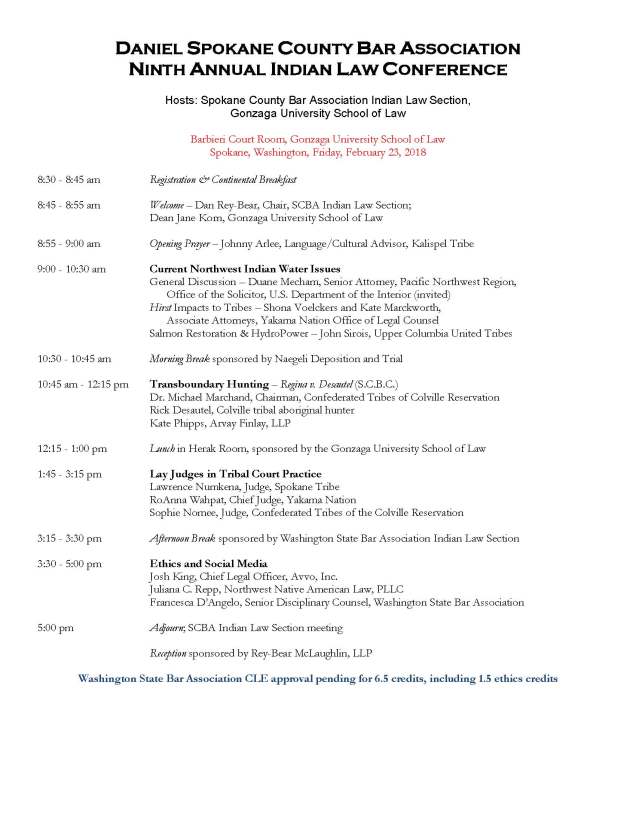
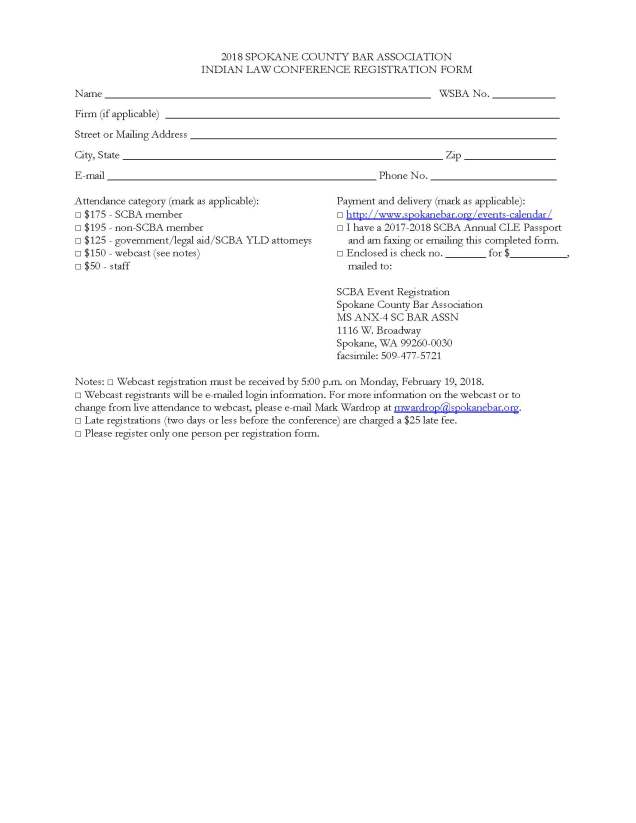
Here is the pleading in Hopi Tribe v. Trump (D.D.C.):
Doc. 26 Plaintiffs’ Opposition to Federal Defendants’ Motion to Transfer 2018-02-01
The motion is here.
Here.
Carla Fredericks, Kathleen Finn, Erica Gajda and Jesse Heibel have posted “Responsible Resource Development: A Strategic Plan to Consider Social and Cultural Impacts of Tribal Extractive Industry Development,” forthcoming in the Harvard Journal of Gender and Law.
Here is the abstract:
This paper presents a strategic, solution-based plan as a companion to our recent article, Responsible Resource Development and Prevention of Sex Trafficking: Safeguarding Native Women and Children on the Fort Berthold Reservation, 40 HARV. J.L. GENDER 1. (2017). As a second phase of our work to combat the issues of human trafficking and attendant drug abuse on the Mandan, Hidatsa and Arikara Nation (MHA Nation), we developed a strategic plan to better understand the time, scale, and capacity necessary to address the rising social problems accompanying the boom of oil and gas development there. During our process, we discovered, through multiple engagements with tribes, that similar negative impacts of rapid economic development are occurring throughout the United States. In particular, many tribes are deeply concerned about the rapid increase in human trafficking on and near their reservations coincident with the entrance or re-entrance of the extractive industries.
The paper is a generalized strategic plan for tribes and other stakeholders to consider in combating the social impacts of extractive industry development. Although the plan is designed to be universal in scope and aspires to assist tribes throughout the country, it does not purport to take into account the unique complexities of individual Indian communities. The history, values, and research are examined to develop a process that will best suit a Native approach to each of the solutions presented, informed foremost by our relationship with the tribal community on Fort Berthold, as well as other tribes nationally. A cornerstone of the plan is that services that center on cultural identity and draw upon family connections are a preferred approach for Native peoples. Further, any approach to trafficking of Native women and children must take account of the colonial genesis of trafficking, generational trauma, and other risk factors.
Job vacancies are posted on Friday. Some announcements might still appear throughout the week. If you would like your Indian law or leadership job posted on Turtle Talk, please email indigenous@law.msu.edu.
Indian Law Resource Center
Executive Director, supervises staff in both the Helena, Montana, and Washington, D.C., offices. Additionally, the Executive Director works closely with and provides leadership and support to the Board of Directors and especially the Board Chair. The Executive Director is actively involved in fund raising with the support of the Development Director and the Board’s Fund Raising Committee. Send a cover letter and resume or curriculum vitae via email to Melanie Dayton Mt@indianlaw.org. The position will be open until filled. Applications will be considered on a rolling basis.
Sidley Summer 2018 Fellowship, Washington, D.C. The Terrance A. Sidley Fellowship is a competitive Fellowship awarded each year to a law student who shows particular promise for a career in federal Indian law and international indigenous human rights issues. The deadline for receipt of applications for summer 2018 is March 16, 2018.
Wisconsin Judicare’s Indian Law Office
Staff Attorney, Wausau, W.I. Key responsibilities: (1) Maintain caseload on behalf of Indian individuals and groups; (2) Educate and serve Native American Elders; (3) Provide backup services and education to Tribal Benefit Specialists; (4) Participate in tribal court development and community education projects; and (5) Carry out training and back-up assistance to private attorneys.
Muscogee (Creek) Nation
Judge, Civil Division, Trial Court, Okmulgee, O.K. Exercise jurisdiction over any person or subject matter on any basis consistent with the Constitution and law of the Nation and not prohibited by federal law, including over the territorial and political boundaries of the Muscogee (Creek) Nation which includes; Creek, McIntosh, Okfuskee/Seminole, Tulsa, Hughes/Seminole (Tukvpvtce), Muskogee, Okmulgee and Wagoner/Roger/Mayes Districts.
Anishinabe Legal Services
Staff Attorney, White Earth Reservation, M.N. Provides civil legal assistance and court representation to program clients before area Tribal Courts, State Courts and Administrative Forms on or near the White Earth Reservation.
Jill Grant & Associates LLC
Summer Law Clerk, Washington, D.C. Experience and/or demonstrated interest in environmental law is required. Applicants should have excellent research and writing skills, a strong academic record, and have completed their first or second full year of law school. The position is full-time for 10-12 weeks at $1,000 per week, with the possibility of a part-time position continuing into the school year. The Summer Law Clerk will gain practical environmental law experience in a small firm setting and work closely with our attorneys on matters for our clients. Jill Grant & Associates provides environmental counsel and representation to Indian tribes, tribal entities, and environmental organizations, and represents tribes on jurisdictional and administrative law issues. We are an equal opportunity employer. Native Americans are encouraged to apply. To apply, please submit: (1) a cover letter describing your interest in and qualifications for the position, (2) a resume, (3) a legal writing sample, (4) three references, and (5) a current law school transcript by email to lawclerkposition@jillgrantlaw.com.
Department of the Interior
Supervisory Attorney-Adviser, Office of the Solicitor, Division of Indian Affairs, Branch of Environment and Lands, Washington D.C. Overseeing the Branch of Environment and Lands, incumbent will be the first line supervisor of attorneys assigned to the Branch. Closes 2/12/18.
Other jobs recently posted:
Senior Attorney, Muckleshoot Tribe, Seattle, W.A. (2/1/2018)
Previous Friday Job Announcements: 2018/01/26
Michalyn Steele has posted “Congressional Power and Sovereignty in Indian Affairs” on SSRN. The paper is forthcoming in the Utah Law Review.
Here is the abstract:
The doctrine of inherent tribal sovereignty — that tribes retain aboriginal sovereign governing power over people and territory — is under perpetual assault. Despite two centuries of precedential foundation, the doctrine must be defended afresh with each attack. Opponents of the doctrine of tribal sovereignty express skepticism of the doctrine, suggesting that tribal sovereignty is a nullity because it is not unfettered. Some pay lip service to the doctrine while undermining tribes in their exercise of inherent sovereignty. Underlying many of these legal fights is confusion about both the nature of tribal sovereignty and the justifications for its continuing existence. Under current federal law, tribes are domestic, rather than international sovereigns. Tribes retain significant powers but are subject to the ultimate sovereignty of the United States. The sui generis status of Indian tribes in the American legal landscape generates important and difficult questions: which governing powers do tribes retain and where does the power to answer that question reside in the federal system? How are disputes about the scope of tribal authority to be resolved?
As the debate about what powers tribes may exercise (and over whom) continues into its third century, it is critical to reexamine the origins of the doctrine of inherent tribal sovereignty as a settled principle of federal law and to articulate the principles that ought to guide the development of that principle in the future. Setting the metes and bounds of the doctrine of tribal sovereignty in federal law and policy belongs to the political branches. This Article suggests legal principles that ought to guide the federal political branches in the exercise of the Indian Affairs power and the trust responsibility to address the scope of tribal inherent authority. First, this Article examines the legal roots and branches of the doctrine of inherent tribal sovereignty, demonstrating that the doctrine remains a vital principle of federal law. Second, this Article analyzes the nature of contemporary assaults on the doctrine of inherent tribal authority by all three branches of the federal government, states, and private actors. Third, this Article suggests principles that ought to guide Congress in exercising its Indian affairs power to clarify and affirm the bounds of tribal sovereignty in federal law and in carrying out the federal trust responsibility to tribes.
Highly recommended.
The Muckleshoot Indian Tribe, located in the Greater Seattle Metropolitan Area, is looking for a senior attorney. At least eight years of federal Indian law experience is required. More information available here. For more information, contact Rob Otsea at rob@muckleshoot.nsn.us.
Here:
Here is the complaint in Coyote Valley Band of Pomo Indians v. McKesson Corp. (Cal. Super.):
Here is the complaint in Coyote Valley Band of Pomo Indians v. McKesson Corp. (Cal. Super.):
 Turtle Talk
You must be logged in to post a comment.