Here.


Here.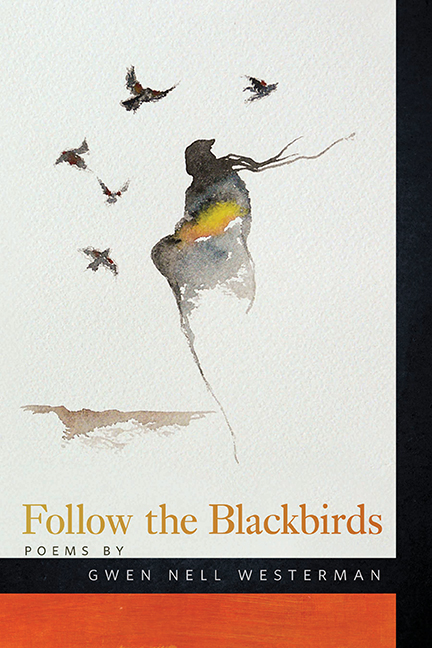 Gwen is a brilliant writer and thinker, and one of my favorite people. Buy her book.
Blurb:
In language as perceptive as it is poignant, poet Gwen Nell Westerman builds a world in words that reflects the past, present, and future of the Dakota people. An intricate balance between the singularity of personal experience and the unity of collective longing, Follow the Blackbirds speaks to the affection and appreciation a contemporary poet feels for her family, community, and environment. With touches of humor and the occasional sharp cultural criticism, the voice that emerges from these poems is that of a Dakota woman rooted in her world and her words. In this moving collection, Westerman reflects on history and family from a unique perspective, one that connects the painful past and the hard-fought future of her Dakota homeland. Grounded in vivid story and memory, Westerman draws on both English and the Dakota language to celebrate the long journey along sunflower-lined highways of the tallgrass prairies of the Great Plains that returns her to a place filled with “more than history.” An intense homage to the power of place, this book tells a masterful story of cultural survival and the power of language.
Website here. 
Centering Anishinaabeg Studies
Understanding the World through Stories
Edited by
Jill Doerfler
Niigaanwewidam James Sinclair
Heidi Kiiwetinepinesiik Stark
For the Anishinaabeg people, who span a vast geographic region from the Great Lakes to the Plains and beyond, stories are vessels of knowledge. They are bagijiganan, offerings of the possibilities within Anishinaabeg life. Existing along a broad narrative spectrum, from aadizookaanag (traditional or sacred narratives) to dibaajimowinan (histories and news)—as well as everything in between—storytelling is one of the central practices and methods of individual and community existence. Stories create and understand, survive and endure, revitalize and persist. They honor the past, recognize the present, and provide visions of the future. In remembering, (re)making, and (re)writing stories, Anishinaabeg storytellers have forged a well-traveled path of agency, resistance, and resurgence. Respecting this tradition, this groundbreaking anthology features twenty-four contributors who utilize creative and critical approaches to propose that this people’s stories carry dynamic answers to questions posed within Anishinaabeg communities, nations, and the world at large. Examining a range of stories and storytellers across time and space, each contributor explores how narratives form a cultural, political, and historical foundation for Anishinaabeg Studies. Written by Anishinaabeg and non-Anishinaabeg scholars, storytellers, and activists, these essays draw upon the power of cultural expression to illustrate active and ongoing senses of Anishinaabeg life. They are new and dynamic bagijiganan, revealing a viable and sustainable center for Anishinaabeg Studies, what it has been, what it is, what it can be.
“Centering Anishinaabeg Studies is a path-breaking book that features fascinating contributions from many of the finest scholars working in the field today. Ranging widely across methodological perspectives and the breadth of the Anishinaabe world, this book is indispensible for the field and a model for future work in Indigenous Studies.”
—Jean M. O’Brien, University of Minnesota
Available February 2013.
American Indian Studies Series
World rights; for sales to Canada, contact University of Manitoba Press
436 pp., 6.00″ x 9.00″, February 2013
Paper, $29.95,
Here. An excerpt:
The Eagle Returns: The Legal History of the Grand Traverse Band of Ottawa and Chippewa Indians (Michigan State University Press, 2012) is a governmental, legal and political history of the tribe. The volume focuses on their status as a treaty tribe and as the first tribe to be recognized—or, perhaps more accurately, re-recognized—by the federal government under the Bureau of Indian Affairs’s administrative recognition process.
“It is the story of survival against the arrival and savage intervention of several European nations—and the United States—in the affairs and property of the Anishinaabek of the Grand Traverse Bay region,” Fletcher writes in his introduction. Professor of law and director of the Indigenous Law & Policy Center at Michigan State University College of Law, Fletcher also runs Turtle Talk, the Indigenous Law & Policy Center’s legal blog and an unrivaled source of court documents pertaining to Indian casework and law.
In The Eagle Returns, Fletcher takes on the guise of storyteller, and that role is reflected in the chapter headings: “The Story of the 1836 Treaty of Washington,” “The Story of the 1855 Treaty of Detroit” and “The Story of the Dispossession of the Grand Traverse Band Land Base” are just some of the entries.
Although the chapter titles are specific to the Grand Traverse Band, in a more general sense they could serve as a template for any number of indigenous nations. The book is a reminder that so many of them have followed the same post-European settlement trajectory of cultural and economic erosion, genocide, dispossession and poverty, up to the brink of legal extinction—only to survive through resilience and resourcefulness to emerge strong and prosperous in the latter part of the 20th century.
The Eagle Returns is not just a legal history. It is also filled with details about the material lives of the pre-treaty Anishinaabek peoples. At one point Fletcher writes deftly of their renowned birchbark canoes: They were “the finest canoes in the northern hemisphere, capable of carrying over a ton of people and equipment for two-year treks, creating an ability to travel over all of the Great Lakes and their major tributaries.”
Other compelling passages detail episodes like the negotiations between the Anishinaabek leaders, who were called ogemuk, and Henry Schoolcraft, the Indian Commissioner for the United States and “an ardent land speculator prone to fits of deep ethnocentrism.” On March 28, 1836, Schoolcraft signed off on the Treaty of Washington, whereby the tribes ceded an area of 13,837,207 acres—more than one-third of Michigan’s land area. The treaty provided for permanent reservations and prohibited the ethnic cleansing of Michigan Indians. But within months the Senate rewrote it to limit the reservations to five years and provide an option to remove Indian communities to the south and west.
“The Senate added the carrot of $200,000 to the bands that chose to remove to these lands in exchange for their reservations lands,” Fletcher writes. The president agreed to the amended treaty on May 27, 1836, but the Anishinaabek were not notified of the changes until July.
Still other chapters detail the further dispossession of the Grand Traverse Band and its “administrative termination” beginning in the 1870s. The story brightens with the band’s re–recognition on May 27, 1980; its famous victorious battle for treaty rights to hunt, fish and gather on public lands; its successful gaming enter-prises; and the modernization of the tribe’s ancient law and justice systems.
Fletcher says that he intends The Eagle Returns to serve as a reference for policymakers, lawyers and Indian people and for an educated general audience. But for the author, the book is also a considerable labor of love.
“It is written for the people of the Grand Traverse Band,” writes the author, “who have not had the benefit of drawing upon one source for the bulk of their legal and political history.”
Here.
Here, from Bill Castinier [for more on People v. Hildabridle, see this — People v Hildabridle]:
John D. Voelker, former Michigan Supreme Court justice (1956-1960) and author of The New York Times bestseller Anatomy of a Murder, called his book Laughing Whitefish “the toughest job of writing I ever tackled.”
First published in 1965 and out of print for decades, Whitefish also has been one of the toughest of Voelker’s 10 books to find. Writing under his pen name, Robert Traver, Voelker wrote five novels, three books on fishing and two books of essays and short stories.
But thanks to a chance meeting between Grace Voelker Wood, one Voelker’s sisters, and a board member of the MSU Press during a celebration of the 50th Anniversary of Anatomy, a new edition of Whitefish will be published in June by the Press.
The new edition also contains an introduction written by Matthew L. M. Fletcher, associate professor of law and director of the Indigenous Law & Policy Center at Michigan State University’s College of Law, that puts the seminal historical fiction novel in context by detailing how the book was based on actual Michigan Supreme Court cases regarding Indian property rights and tribal law and customs. Fletcher is a member of the Grand Traverse Band of Ottawa and Chippewa Indians.
In a presentation to the Michigan Historical Society in 1970 about the novel, Voelker called the “basic story…rather simple.” He continued, “Most simply put, it was all about iron ore, Indians and infidelity to one’s promises.”
In the book, Voelker, writing as Traver, told the story of Charlotte Kawbawgam (in real life Kobogum), whose father, Marji Gesick, had been promised a “wee fractional interest” for his assistance in leading a group of businessmen to North America’s largest iron ore deposit. Problems resulted when neither Gesick nor Gesick’s heirs were compensated as promised.
Voelker told how he had learned of the fascinating story, which involves tribal customs, including polygamy, long before he wrote his blockbuster. But he had been derailed by his successful career and the amazing success of Anatomy, which was made into a movie shot on location in Marquette and Ishpeming.
Voelker said he adopted a pen name while he was a prosecuting attorney (1935-50) in Marquette. He was often quoted as saying, “I didn’t want the voters to think I was an author on company time.”
The lawyer and author had spent most of his life in the Upper Peninsula, when in 1957 he was tapped by Governor G. Mennen Williams to be a Supreme Court justice. He became noted for his literary-like decisions and dissents. His writing for the Court was also punctuated with his trademark sense of humor (if there is any doubt, read his writing inPeople vs Hildabride about police invading a nudist camp).
He later wrote that his “neglected Indian story receded even farther into the background.”
Not often we promote Cooley Law programs, but it is an MSU Press book. 🙂
From here:
Please join us for a 2010 Michigan Notable Books program featuring Dr. James M. McClurken, author ofOur People, Our Journey: The Little River Band of Ottawa Indians.
This important and well-researched history of the Little River Band of Ottawa Indians traces the tribe’s migration into Michigan’s Grand River Valley, its later settlement on reservations in Mason, Muskegon and Oceana counties, the difficult relationship between the tribe and the U.S. government and successful efforts to maintain the tribe’s unique cultural identity through the present day.
The book is available for purchase and signing the day of the event and at Cooley’s Lansing campus bookstore.
The events are free and open to the public. For more information, visit Cooley’s website at cooley.edu. Join us at any one of our four campuses on:
WEDNESDAY, MAY 12
Grand Rapids, Noon
111 Commerce Avenue, SW
Lansing, 5 p.m.
Brennan Law Library
330 S. Washington Sq.
THURSDAY, MAY 13
Auburn Hills, Noon
2630 Featherstone
Ann Arbor, 5 p.m.
3475 Plymouth Rd.
Michigan State Press just published this fantastic book. Here are the details from the Press:
Our People, Our Journey
The Little River Ottawa Band of Indians
 Our People, Our Journey is a landmark history of the Little River Band of Ottawa Indians, a Michigan tribe that has survived to the present day despite the expansionist and assimilationist policies that nearly robbed it of an identity in the late nineteenth century.
In his thoroughly researched chronicle, McClurken documents in words and images every major lineage and family of the Little River Ottawas. He describes the Band’s struggles to find land to call its own over several centuries, including the hardships that began with European exploration of what is now the upper Midwest. Although the Little River Ottawas were successful at integrating their economic and cultural practices with those of Europeans, they were forced to cede land in the face of American settlements.


 Turtle Talk
You must be logged in to post a comment.