Maurisa Bell, NNALSA 3L of the Year


Bell
National NALSA 3L of the Year Award recipient, Maurisa Bell (right).

Maurisa Bell grew up on the Wind River Reservation in Riverton, Wyoming. She is an enrolled member of the Eastern Shoshone Tribe and was also raised around her Northern Arapaho family. In 2015, she graduated from Montana State University in Bozeman, MT and completed the Pre-Law Summer Institute program during the summer of 2016. While in law school, Maurisa served as Vice President and Treasurer for the MSU-NALSA, an Area representative for National-NALSA, and volunteered as a student mentor for the Indigenous Law and Policy Center.

She spent her summers in Washington, D.C. working for the Department of Justice’s Office of Tribal Justice; the National Indian Gaming Commission; and Dentons, US LLP in their Native American Law and Policy practice group. She is a dedicated and driven leader who, in just a few weeks, will graduate from the Michigan State University College of Law.

Maurisa will work for Dentons upon graduation, pursuing her passion in helping tribes and tribal communities.

Congratulations, Maurisa!

Call for Art

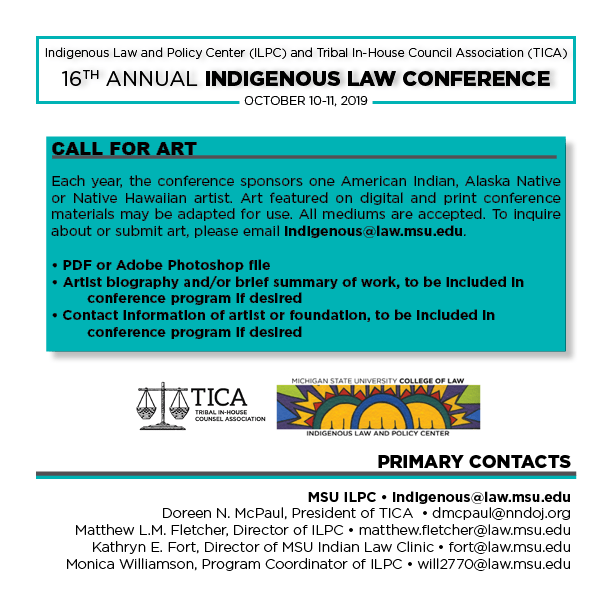
Last call for the 16th Annual ILPC/TICA Conference Call for Art! Please email your submissions to indigenous@law.msu.edu by today, March 15, 2019.

Call for Art 2019

2019 ILPC/TICA Conference – Call for Art

Interested artists, please email indigenous@law.msu.edu to submit or inquire.

Call for Art 2019

ILPC/TICA 15th Annual Indigenous Law Conference: Pre-Conference Activities

If you’re headed to the banks of the Red Cedar for our Indigenous Law Conference, consider coming early for exciting pre-conference activities!

The Tribal Intern Recruitment & Information Session is a chance for students to network with Tribal In-House Counsel. After, all registrants are welcome to join us downtown East Lansing for a full dinner reception at Beggar’s Banquet.

Register for the conference today!


Agenda Promo Pre Conference

13th Annual ILPC/TICA Indigenous Law Conference: Now With Webcasting!

Indigenous Law Conference at Michigan State College of Law
Thursday and Friday, November 3-4, 2016

Online and in-person attendees can register here.

Registration includes TICA membership, continental breakfast and lunch both days along with the reception Thursday night at the East Lansing Marriott. We’ve also applied for 11.25 CLEs from the Minnesota State Bar Association, and will provide forms for those seeking credits in other states.

The current agenda is here.

If you, your firm, or organization would like to be a conference sponsor, please see the form here for more information, and our deepest thanks for making the conference possible.

Oakland County Legal News Interview with Fletcher

Here.

Excerpts:

Pursglove: Is Indigenous Law a good field for law students?

Fletcher: For many Native students, Indian law is the reason they chose law school. Few other students have a chance to take classes where the history of their tribes and families is embedded in the cases and statutes we teach. For any student, it’s a good field, too. Indian gaming is a $30 billion a year business. Indian country natural resources extraction is probably even larger than that, or soon will be. Tribal governments routinely are the largest employers of their regional economies. We never have much trouble placing our alums in Indian law jobs if they want to do that work. It’s a hugely growing field.

Pursglove: Why are attorneys that understand Native American culture, and how it impacts legal issues, in high demand?

Fletcher: Tribal government and enterprise clients usually are American Indian people, and they want to hear the views and advice of people who have shared many of their same experiences. Also, the tribal client differs from the fundamental goals of corporate and state or federal governmental clients. Tribes are not wealth-maximizing entities with pressures from shareholders to prioritize profit; tribes may pass up opportunities for revenues because of the social or environmental costs. And tribes are governments, so their goals are similar to those of other governments, to maximize governmental revenue and services. But tribal governmental constituencies are more narrow than other governmental constituencies. In other words, there is no Citizens United-inspired relationship between tribes and business entities, and no Tea Party-inspired efforts to gut government services. And tribes must do all of this without a tax base similar to that enjoyed by states and the federal government.

Pursglove: What were the main issues in this field in the past year?

Fletcher: The main issues always involve tribal efforts to expand their governmental revenue. This past year saw the beginnings of a backlash against tribal efforts to engage in what they’re calling e-commerce, which includes things like payday lending, internet gaming, and other electronic business activities. Tribes usually try to avoid state regulation by asserting their immunity from state authority, and the Supreme Court decided a case affirming tribal immunity this year captioned Michigan v. Bay Mills Indian Community.

Lunching with the ILPC

Here:

Legal Career Opportunities in Indigenous Law

Thursday, November 21 – 12:00 p.m. to 12:55 p.m., EST

Individuals who are interested in legal career opportunities focusing on issues that affect indigenous peoples and tribes are invited to our “Lunch and Learn” presentation featuring remarks by faculty and staff members of the MSU Law Indigenous Law and Policy Center.  There is no cost to attend and undergraduates at all levels of their education – freshmen through seniors – are welcome to attend.  College graduates and graduate students are also welcome.  A complimentary lunch will be served.

Please confirm your attendance by contacting the Admissions Office at admiss@law.msu.edu or 517.432.0222.  Please RSVP on or before November 18 at 5:00 p.m.

This event will be held at the College of Law, 648 N. Shaw Lane.

MSU 7th Annual Indigenous Law Conference Poster Artist – Jonathan Labillois

Jonathan Labillois is a member of the Listuguj Migmaq First Nation Band in Gaspé, Quebec.  His talent was recognized early in childhood and further nurtured by attending the Fine Art Program at Dawson College in Montreal.  He also attended the Nova Scotia College of Art and Design, where he majored in print making and painting.  His art has been on display throughout Canada and is on permanent display at the Gallery of Fine Art in Halifax, NS. 

His cultural heritage and strong focus on his art draw together a sense of colour and style distinctive in method and view.  Emphasizing aboriginal stereotypes and native art in modern culture, his art attempts to examine where native art fits into society in addition to where a native artist fits into the art world. His larger than life depictions of indigenous peoples speak to his passion for both art and his native heritage.

He currently resides in Victoria BC, Canada where he continues to expand his body of work and subject matter.

www.jonlabillois.com

MSU 7th Annual Indigenous Law Conference Poster — Persuasion and Ideology: Politically Divisive Cases in Appellate Courts

Conference details here.

MSU ILPC Spring 2011 Speaker Series

This spring, we’re hosting events for new books on radical thinkers in American law and policy (including Vine Deloria), Loving v. Virginia, and the Indian Child Welfare Act.

Tentative speakers here:

January 24th

Author: Michael Lawrence (MSU)

Radicals in their Own Time: Four Hundred Years of Struggle for Liberty and Equal justice in America

Commentators:

Alfred Brophy (North Carolina)

John Petoskey (Fredericks Peebles)

Heidi Kiiwetinepinesiik Stark (Minnesota-Duluth)

February 22nd

Kevin Maillard (Syracuse) and Rose Villazor  (Hofstra)

Co-Editors, Loving v. Virginia in a Post-Racial World

Commentators and Co-Author:

Carla Pratt (Penn State)

Addie Rolnick  (UCLA)

March 24

Author: Barbara Ann Atwood (James E. Rogers College of Law)

Children, Tribes and States

Commentators:

Hon. Michael Petoskey (Chief Judge, Pokagon Band of Potawatomi Indians and others)

Hon. Tim Connors (22nd Circuit Court, Washtenaw County)