Here:
Here:
Link: Announcement(PDF), Registration
NCJFCJ & NAICJA will host the webinar Thursday, October 5 2017, at 3PM ET.
Inviting Tribal Court Clerks and Court Personnel to join us for the National American Indian Court Judges Association’s (NAICJA) Tribal Court Clerks Certification & Court Personnel Training during NAICJAs’ Annual Conference! This is a great training to get certification, learn court clerk best practices, managing and reducing your backlog, and more! We have wonderful trainers as well as tribal judicial faculty. The networking is invaluable. We would love to see you there!
Tuesday, October 10, 2017 6:00 PM – Friday, October 13, 2017 12:00 PM (MST)
Isleta Casino & Resort
(505) 724-3800
11000 Broadway Boulevard Southeast
Albuquerque, New Mexico 87105
Registration fee covers all scheduled events and includes food and beverage for:
Questions:
Contact Bridget McCleskey, NAICJA Conference Coordinator at:
Phone: (907) 854-9470
Email: confcoor@gmail.com
https://www.regonline.com/builder/site/Default.aspx?EventID=1984503
The National American Indian Court Judges Association (NAICJA) in collaboration with the National Council of Juvenile and Family Court Judges (NCJFCJ) have joined together to develop a free tribal justice webinar series! Working closely with partners, the Tribal Law and Policy Institute (TLPI) on the Healing to Wellness webinars and the Native American Rights Fund’s Indigenous Peacemaking Initiative (IPI) for the Peace Circles webinar. See naicja.org for more information on upcoming training and the NAICJA National Tribal Judicial and Court Personnel Conference.
Tribal Justice Webinar – Planning a Healing to Wellness Court: Inspiration and Vision (8/22/17)
Tribal Healing to Wellness Courts bring together community-healing resources with the tribal justice process, using a team approach to achieve the physical and spiritual healing of the participant and the well-being of the community. This webinar will walk participants through the visioning and foundation planning process to begin the development and implementation of a Healing to Wellness Court. Focus will be given to the key partners needed, as well as primary components that should eventually be reflected in your policies and procedures. You’ll hear firsthand from seasoned tribal judges who will share reflections, tips, and lessons learned about their experience with developing their own Healing to Wellness Court.
Tribal Justice Webinar – Trauma-Informed Court Systems: A Webinar for Tribal Communities (7/27/17)
Research continues to clarify how traumatic experiences negatively impact the way traumatized people interact with the world. When an individual becomes court-involved it is highly likely that they have experienced some level of trauma. If the court system is not trauma-informed they can be re-traumatized, often triggering harmful reactions. Tribal communities have the challenge of addressing the traumatic experiences of individuals while at the same time dealing with the after effects of historical and intergenerational traumatic patterns that have affected entire communities. However, tribes also have strengths found in their traditional teachings that provide inspiration for strategies to address trauma in all its forms. This webinar will explain what is meant by the phrase trauma-informed courts, provide data about challenges facing tribes around the country, discuss how trauma looks in the court setting, and then provide practical ideas about how to incorporate both traditional values and research-based strategies to make tribal court systems not only trauma-informed but trauma-responsive.
Tribal Justice Webinar – Healing to Wellness Courts Key Components and Standards (5/25/17)
The Tribal Key Components form the foundation of all tribal drug courts. The Adult Drug Court Standards represent the latest research-based best practices for what works within the drug court setting. Applicants for Wellness Court federal funding are now being asked to abide by both documents. This webinar overviews both the key components and the Standards, and discuss how they inter-relate. This webinar is designed for those less familiar with the Wellness Court model and those seeking to use these documents to apply for federal funding and/or integrate into their own Wellness Court.
Tribal Justice Webinar – Peace Circles: A Virtual Circle on Peacemaking (4/26/17)
Peacemaking is not alternative dispute resolution to Native communities – it is the original, traditional way our communities managed to work through disputes for centuries before tribal courts were created. Because of natural limitations inherent in tribal courts, there is increasing interest in the continuation and revitalization of those traditional ways.
This webinar explains how tribal traditions may hold a solution to some problems that have proven especially difficult in tribal court, provide some examples of how other tribes have had success, and explain how this movement is part of a bigger picture, even internationally, of how indigenous communities are using their own wisdom to solve their problems. Speakers include well known and seasoned Peacemakers including NARF Indigenous Peacemaking Initiative staff and advisory committee members.
Link: Announcement and registration
Planning a Healing to Wellness Court: Inspiration and Vision to Get Started
Tuesday, August 22, 2017 at
12 pm PT/1 pm MT/2 pm CT/3 pm ET (90 minutes)
Download(PDF): Announcement
Link: Registration
Trauma-Informed Court Systems
Thursday, July 27, 2017 at
12 pm PT / 1 pm MT / 2 pm CT / 3 pm ET
Full press release impact_innovation-pr edit
From the press release:
The National Council of Juvenile and Family Court Judges (NCJFCJ) announced two honorees of the 3rd annual Justice Innovation Awards recognizing the national Innovator of the Year and the Impact of the Year recipients: the Honorable Timothy Connors of the 22nd Circuit Court in Washtenaw County, Mich. and the Latin American Youth Center in Washington, D.C. The honorees were recognized at the NCJFCJ’s 80th Annual Conference highlighting informative presentations on current and cutting edge topics that inspired, provoked and precipitated discussions about issues facing the juvenile and family court system.
The Innovator of the Year Award honors an active, in-good-standing NCJFCJ member who has inspired, sponsored, promoted or led an innovation or accomplishment of national significance in juvenile justice, child abuse and neglect, family law and/or domestic violence. The Impact of the Year Award recognizes, from the Annual Conference-host state (Washington, D.C.), an individual, state/local court, law firm, advocacy group or service provider who has been instrumental in leading or implementing significant improvements or innovations which advance the mission of the NCJFCJ.
“It is our privilege to recognize the outstanding work of both Judge Connors and the team at the Latin American Youth Center,” said Judge Anthony (Tony) Capizzi, NCJFCJ president. “We honor their tireless commitment to improving the lives of children and families, especially those in our justice system. We hope that we can continue to raise awareness of the core issues that affect our nation’s families.”
Judge Connors serves as co-chair of the Michigan Tribal-State-Federal Forum, instrumental in drafting the Michigan Indian Family Preservation Act. In 2013, he was awarded a grant by the Michigan Supreme Court to determine whether tribal peacemaking values and practices could be implemented in a state court system. As presiding judge of the Washtenaw County Peacemaking Court, he has fostered the healing of important relationships among litigants in child welfare, family and probate cases by incorporating Native American peacemaking principles and philosophies in conflict resolution.
“I am forever grateful to the Michigan Supreme Court, the University of Michigan Law School, and now the NCJFCJ for opening this path of Peacemaking and restorative justice in state court systems,” said Judge Connors. “This path is the creation of the collaborative effort of the National American Indian Court Judges Association, the Native American Rights Fund Indigenous Peacemaking Initiative and the Michigan Tribal State Federal Forum to find common ground. This common ground greatly benefits our youth, our families and our communities. I hope all of our states will choose to walk this path together.”
“This is a great national honor that Judge Connors has received, and it is well deserved,” said Bridget M. McCormack, Michigan Supreme Court. “For many years, Judge Connors has shown a remarkable dedication to implementing tribal and community court peacemaking principles to resolve cases. In fact, his court was the first in Michigan to adopt the use of these principles, and his success in this area has prompted other states to take notice. His passion for applying justice in collaborative and innovative ways is nothing short of inspiring.”
“Judge Connors honors and respects the traditions of the tribes and tribal justice systems that provided the foundational knowledge and peacemaking principles for his court,” said Nikki Borchardt Campbell, Executive Director, National American Indian Court Judges Association. “We believe these restorative principles can be beneficial to participants when applied correctly and in the exact manner that Judge Connors has applied them in his court. His court and his approach are shining examples. We are proud of his work and his contribution to both state and tribal courts.”
Congratulations Judge Connors
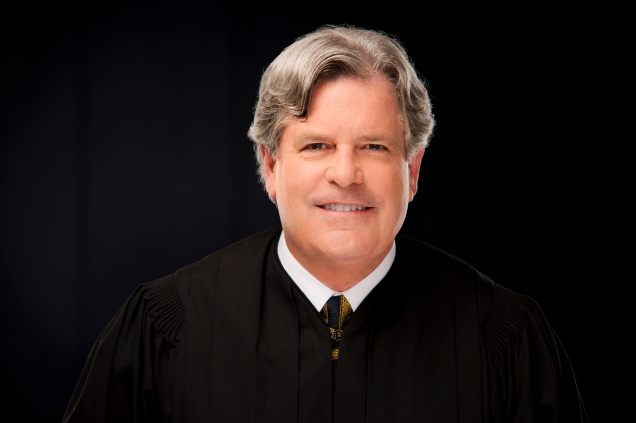
The National American Indian Court Judges Association (NAICJA) invites presentation proposals for the 48th Annual National Tribal Judicial and Court Personnel Conference which will be held October 10-13, 2017, at the beautiful Isleta Resort & Casino in Albuquerque, NM. NAICJA’s Annual Conference offers innovative and timely tribal justice information through high quality presentations by national experts.
The theme of this year’s conference is, “Tribal Justice: Building and Strengthening Relationships and Partnerships.” NAICJA is featuring topics that highlight ways in which American Indian, Alaska Native, Native Hawaiian and First Nations justice systems are building and strengthening relationships between tribes, states, federal agencies, and organizations including the philanthropic sector. We are especially interested in presentations that focus on collaboration and partnerships, tribal sovereignty, international frameworks for understanding indigenous principles and topics, promising Indian child welfare practices, court security, and other areas of interest to court clerks and court personnel.
Full details available here: NAICJA 2017 Presentation RFP Final.
This is your opportunity to share your expertise and display your creativity by developing an original program for presentation. Proposals specifically tailored to meet the needs of the 300-person NAICJA audience are strongly preferred. Proposals are due on or before Monday, May 1, 2017 at 9:00 a.m. (MST).
The Central Council Tlingit & Haida Indian Tribes of Alaska Child Dependency Court under the leadership of Judge Debra O’Gara been selected by the National Council of Juvenile and Family Court Judges (NCJFCJ) as one of six new courts to join their Implementation Sites Project, which helps to improve outcomes for abused and neglected children and their families.
Full press release available here alaska-implementation-pr-final-02232017.
From the release:
The NCJFCJ Implementation Sites Project, which is funded by the Office of Juvenile Justice and Delinquency Prevention, provides child abuse and neglect courts with training, technical assistance and support to guide program improvement, sustainability and performance. As part of their involvement in this project, Implementation Sites are expected to implement meaningful change, evaluate progress as well as share challenges and successes with other courts across the country.
“Tribal justice systems are growing and evolving to address to the needs and issues of tribal communities. It is vitally important that tribal courts continue to learn, benefit, and share information through the NCJFCJ’s Implementation Site Project,” said Nikki Borchardt Campbell, Executive Director of the National American Indian Judges Court Association.
The Central Council Tlingit & Haida Indian Tribes of Alaska Child Dependency Court, in Juneau, Alaska, began last year through an extensive partnership with the Tribal and Youth Services and the State of Alaska Office of Children Services. In the last decade, the Tribe’s court system has grown quickly beginning with child welfare including child support and paternity cases. Recently, the Tribal court has begun to hear domestic violence protection orders, custody, divorce, guardianship, and adoption cases. The Tribal court is also developing a juvenile wellness court, focused primarily on early intervention and prevention for youth whom are at risk of being involved in the criminal justice system.
“Being a part of the NCJFCJ’s Implementation Sites Project will not only help grow and expand our Tribal court in the child welfare area of services, but would greatly benefit our court’s needs for technical assistance, practical tools, and collaborative assessment,” said the Honorable Debra O’Gara, lead judge of the project.
“We look forward to collaborating with the NCJFCJ to strengthen the court’s infrastructure through data collection, forms and templates, staff training, and greater access to current research and trends in child and family needs to build up the infrastructure to handle the growing case load. I firmly believe that we have much to learn from the knowledge and experience of other judges and courts around the nation on how to best expand and improve the court’s outcomes for our children and families.”
From the National American Indian Court Judges Association (NAICJA) Facebook Page:
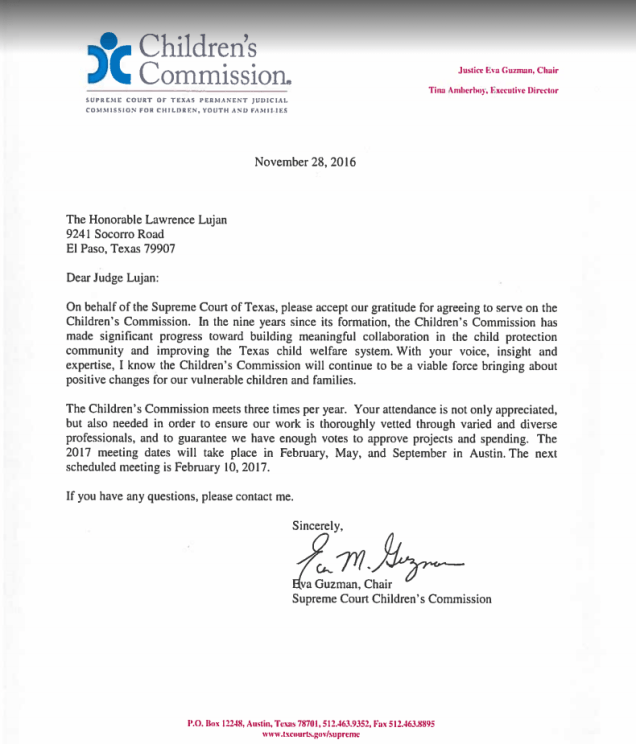
NAICJA Vice President Appointed Commissioner to the Texas Supreme Court’s Permanent Judicial Commission for Children, Youth and Families
Our Tribal Courts not only serve our sovereign communities but also seek partnerships at the state and federal level. These partnerships enhance Indian Country legal services and most importantly put our tribal nations in key leadership positions that promote the welfare of our community members and the sovereignty of all Tribal Courts.
Congratulations on your new appointment Chief Judge Lawrence Lujan of the Ysleta del Sur Pubelo!

 Turtle Talk
You must be logged in to post a comment.