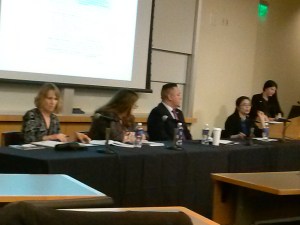
Here’s a picture from Seattle University School of Law’s very inspiring VAWA Panel tonight. Left to right, the panelists were Molly Cohan, Sharon Jones Hayden, Alfred Urbina, and Ye-Ting Woo. Most of the handouts are here.
Among the many things I learned is that the one of the Pascua Yaqui Tribe’s first VAWA cases involved a same-sex couple. It was originally thought that this case might turn out to be the first tribal VAWA case to go through the federal habeas process and to eventually reach the Supreme Court, but the jury was uncertain as to whether the victim and defendant were in an intimate relationship as required by VAWA and so the defendant was acquitted. Given that the defendant and victim lived together and had a sexual relationship, this skepticism is troubling and, sadly, may reflect unconscious homophobia. There are still many positives, however. Despite the acquittal, the case helps shed light on a hidden problem–same-sex domestic violence is still a little-known and rarely mentioned phenomenon. Kudos to Pascua Yaqui for bringing the case. The prosecutorial response on its own was undoubtedly meaningful to the victim. And, given the jury’s acquittal, the case stands as a strong example of a tribal jury’s impartial treatment of a non-member.
There was also an important discussion of the holes in VAWA, including the lack of tribes’ ability under VAWA to prosecute crimes against children as well as stranger rape. Many of the more serious recent domestic violence crimes committed by nonmembers at both Tulalip and Pascua Yaqui involved crimes against children, but tribes cannot prosecute crimes against children under VAWA, so they must depend on the federal government (or the state in Public Law states) for prosecution of these crimes.


 Turtle Talk
You must be logged in to post a comment.