NPR’s Coverage of the South Dakota Summit on Indian Children

Here.

Federal officials met with South Dakota’s nine Sioux tribes on Wednesday for a historic summit in Rapid City. A year in the making, it was an effort to address long standing concerns over the high number of Native American children the state places in white foster homes. State officials, however, didn’t show up for the meeting.

NPR on ICWA in South Dakota

From tonight’s All Things Considered: here.

This week, officials from the Crow Creek Sioux Nation and seven other tribes in the state sent an extensive report to Congress accusing South Dakota of systematically violating the federal Indian Child Welfare Act. The federal law says that, with some exceptions, if the state removes a Native American child, the state must place that child with relatives, tribal members or other Native Americans.

The report, which the officials wrote with the help of the nonprofit Lakota People’s Law Project, concludes that in many instances the state does not have the authority to remove native children from tribal land. When the state does have that authority, through a tribal court order or tribal council agreement, the report says the state is failing to place the majority of those children according to the law.

Cheyenne River Sioux Tribe and South Dakota Reach Agreement on Sex Offender Registry

The news article is here.

Tribal and Federal Authorities Cooperate to Arrest 17 on Standing Rock

The article from the Bismarck Tribune is here. An excerpt:

Besides the FBI and BIA, the U.S. Marshal’s Service, Homeland Security Investigations, Drug Enforcement Administration, Sioux County Sheriff’s Department and U.S. Parole and Pre-Trial Services also were involved in the investigation and arrests Tuesday morning on the reservation that straddles North Dakota and South Dakota.

Operation Prairie Thunder resulted in 10 people being charged in U.S. District Court in North Dakota, two people being charged in U.S. District Court in South Dakota and five people charged in Standing Rock Tribal Court.

and

In another unusual move, U.S. Magistrate Judge Charles Miller traveled to Standing Rock Reservation south of Mandan on Tuesday morning to hold first appearances for the 10 people charged in U.S. District Court in North Dakota.

“It’s very, very rare” for a federal judge to travel to a reservation for court hearings, Purdon said. “I’m aware of it at least once in North Dakota, many, many years ago.”

Coverage of the 44th Annual Dakota Conference in the Argus Leader

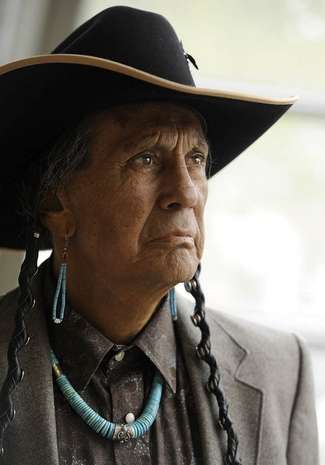
Here are some links to articles on, and photos of, the 44th Annual Dakota Conference that was held this weekend at Augustana College.  The theme was Wounded Knee 1973.  Unsurprisingly, Russell Means’ comments and keynote address got the most coverage.  The highlight for me was a panel on Native Women’s role in Wounded Knee, which included presentations by Professor Elizabeth Castle, Marcella Gilbert, and Danyelle Means.  I also really enoyed a talk by Professor Emerita Elizabeth Cook-Lynn and a talk and poetry reading by Allison Hedge Coke and Renee Sans Souci.  Finally, a panel discussion by Dennis Banks, Clyde Bellecourt, and Senator James Abourezk was very illuminating, as was a talk by journalist Kevin McKiernan, who covered the occupation from the inside for NPR. 

Articles

http://www.argusleader.com/apps/pbcs.dll/article?AID=2012304280008

http://www.argusleader.com/viewart/20120429/NEWS/304290038/Means-lashes-out-during-look-back-AIM

http://www.argusleader.com/apps/pbcs.dll/article?AID=2012304280010

Photos
http://www.argusleader.com/apps/pbcs.dll/gallery?Site=df&Date=20120427&Category=news&ArtNo=204270804&Ref=ph&Item=0&odyssey=mod|mostpopphotos

Image


US Officials Announce Meeting on South Dakota Indian Foster Care

Here.

NPR: Part 3 of ICWA Series — “Native Survivors of Foster Care Return Home”

Here. Excellent reporting.

NPR: Part 2 of ICWA Series–“Tribes Question Foster Group’s Power and Influence”

Here.

Part One of Three Part NPR Investigation in ICWA Compliance

Utterly devastating.

Here. An excerpt:

Key Findings Of This Investigation

* Each year, South Dakota removes an average of 700 Native American children from their homes. Indian children are less than 15 percent of state’s the child population, but make up more than half the children in foster care.

* Despite the Indian Child Welfare Act, which says Native American children must be placed with their family members, relatives, their tribes or other Native Americans, native children are more than twice as likely to be sent to foster care as children of other races, even in similar circumstances.

* Nearly 90 percent of Native American children sent to foster care in South Dakota are placed in non-native homes or group care.

* Less than 12 percent of Native American children in South Dakota foster care had been physically or sexually abused in their homes, below the national average. The state says parents have “neglected” their children, a subjective term. But tribe leaders tell NPR what social workers call neglect is often poverty; and sometimes native tradition.

* A close review of South Dakota’s budget shows that they receive almost $100 million a year to subsidize its foster care program.

Derrin Yellow Robe, 3, stands in his great-grandparents' back yard on the Crow Creek Reservation in South Dakota. Along with his twin sister and two older sisters, he was taken off the reservation by South Dakota's Department of Social Services in July of 2009 and spent a year and a half in foster care before being returned to his family.

John Poole/NPR Continue reading

New Census Figures Allow South Dakota to Avoid Offering Language Support Services to Indian Voters

Here:

2011_notice

Here is a news article on the issue. An excerpt:

State Rep. Kevin Killer, whose district represents the Pine Ridge Indian Reservation, said people do use the language services.

“We do have fluent Lakota speakers that do vote, and their preference is to have an interpreter there,” said Killer, D-Pine Ridge. “It’s better to err on the side of caution rather than make an assumption that nobody speaks Lakota.”

Fewer than 6,000 of the 120,000 members of Sioux tribes, who often identify themselves as Lakota, speak the language or its less common but closely related Dakota dialects. The average age of a Lakota speaker is 60, according to the Lakota Language Consortium.

But tribal schools such as Oglala Lakota College, Sinte Gleska University and Sitting Bull College have been reintroducing Lakota to a new generation through the schools’ language immersion programs, Killer said.

“So they’re going to be, at some point, hopefully fluent speakers,” he said.

Poll workers on Todd County’s Rosebud Indian Reservation have had to publish ballots in both English and Lakota and reprogram the AutoMark voting machines for each election, said Tripp County Auditor Kathleen Flakus, who also supervises the neighboring county.

Read more at the Washington Examiner: http://washingtonexaminer.com/news/2011/10/election-language-help-waived-sd-counties#ixzz1bKYV4wKo