Here.
DOJ Procedures for Tribes to Request Assumption of Federal Concurrent Criminal Jurisdiction in PL 280 States
Here.
Here.
Here. A snippet:
Boozhoo!
To the Honorable Troy A. Eid, Chairman of the Indian Law and Order Commission, and Jeff Davis, Executive Director of the Commission, and the rest of Commission members, we offer greetings and a chi-miigwetch for the opportunity to offer our views on the Tribal Law and Order Act (the Act or TLOA), Pub. L. 111-211, Title II, July 29, 2010, 124 Stat. 2263, and the future of Indian country criminal law and jurisdiction.
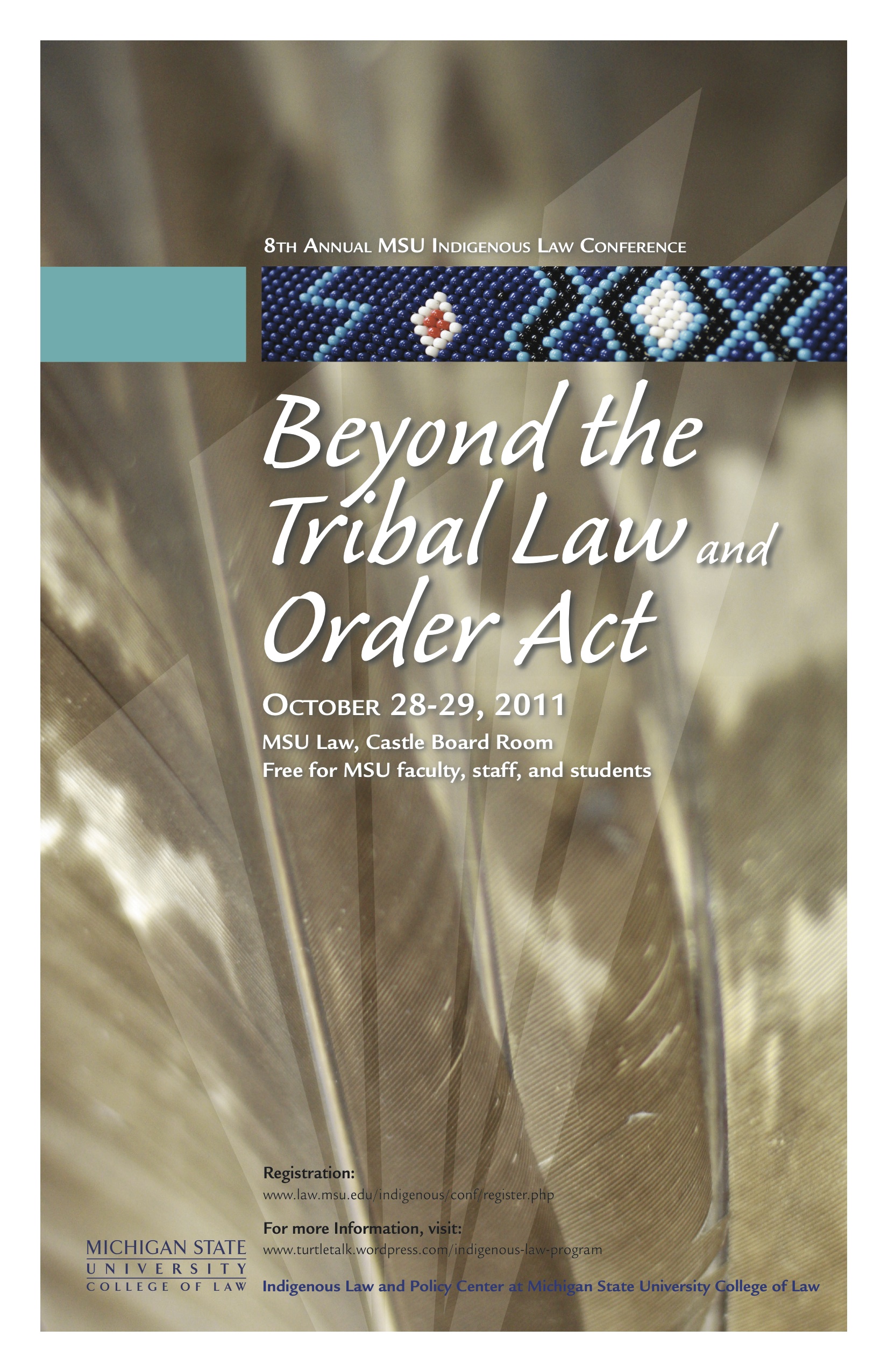
As you know, Mr. Chairman, our 8th Annual Indigenous Law and Policy Conference, held on October 28-29, 2011 in East Lansing, MI, was titled, “Beyond the Tribal Law and Order Act: Can (Should) Congress Enact an Oliphant Fix?” We invited a wide segment of speakers, including members of the Indian Law and Order Commission, federal government officials, tribal court and elected government officials, and American Indian law scholars to discuss the ongoing issues with the Tribal Law and Order Act and Indian country criminal law and jurisdiction. Much of our commentary here is guided by the knowledgeable, profound, and wise statements and opinions expressed in that conference.
The training kicks off the U.S. Attorney’s Office -Tribal Special Assistant United States Attorney (SAUSA) program. This cross-commissioning is encouraged by the Tribal Law and Order Act and mandated by the District of Arizona’s Operational Plan for Public Safety in Indian Country click.
The goal of the Tribal SAUSA program is to train eligible tribal prosecutors in federal law, procedure and investigative techniques to increase the likelihood that every viable criminal offense is prosecuted in tribal court, federal court or both. The program also allows the tribal prosecutors to co-counsel with federal prosecutors on felony investigations and prosecutions of offenses arising out of their respective tribal communities. After completing training, each tribal SAUSA will be mentored by an experienced federal prosecutor assigned to the District of Arizona’s Violent Crime Section
The District of Arizona’s SAUSA program currently has 13 participants from 8 participating tribes – the Salt River Pima-Maricopa Indian Community, the Gila River Indian Community, the Fort McDowell Yavapai Nation, the Pascua Yaqui Tribe, the Colorado River Indian Tribes, the Tohono O’odham Nation, the Hopi Tribe, and the White Mountain Apache Tribe — and is expected to grow.
Seven tribal prosecutors participated in the training course this week, which included classroom work and participation in proceedings before the federal court and grand jury. The remaining participants will attend an identical training planned for January 2012.
RELEASE NUMBER: 2011-247(Tribal SAUSAs)
# # #
For more information on the U.S. Attorney’s Office, District of Arizona, visithttp://www.justice.gov/usao/az
M. Brent Leonhard has posted his paper, “Closing a Gap in Indian Country Justice: Oliphant, Lara, and DOJ’s Proposed Fix,” on SSRN.
Here is the abstract:
This paper analyzes whether DOJ’s proposed legislative fix to allow tribes to prosecute limited non-Indian domestic violence crimes is legally permissible by closely analyzing the decisions in Oliphant and Lara. Given the closely circumscribed requirements for the exercise of such power, and past decisions of various justices, this article concludes that it is within Congress’ power to recognize the inherent power of tribes to prosecute non-Indians for domestic violence crimes against Indians.
Douglas Payne, Benewah County Prosecutor, responds to the notion that non-Indians can get away with crime in Indian country because no one will prosecute them in his short paper, “Criminal Jurisdiction in Indian Country: Complicated by Design, but Not Lawless.” It’s available on page 48 here.
He is responding to Brian McClatchey’s paper in the August issue — “The Tribal Law and Order Act of 2010: Toward Safe Tribal Communities” — available on page 24 here.
The Indian Law and Order Commission, created under the Tribal Law and Order Act, has just introduced a new website here:
http://www.indianlawandordercommission.com/
It has materials about the Commission and its members, the TLOA, and other resources.
Description here.
Enough acronyms?
Here is the link to the witness list, and the list is reproduced here:
Mr. Tom Perrelli
Associate Attorney General
United States Department of Justice, Washington, DC
Mr. Larry Echo Hawk
Assistant Secretary – Indian Affairs
United State s Department of the Interior, Washington, DC
Mr. Brendan Johnson
U.S. Attorney
District of South Dakota, United State s Department of Justice, Sioux Falls , SD
Ms. Pamela S. Hyde
Administrator
Substance Abuse and Mental Health Services Administration, United States Department of Health and Human Services, Washington, DC
Dr. Rose Weahkee
Director
Division of Behavioral Health (DBH) in the Office of Clinical and Preventive Services, Indian Health Service. Rockville, MD
Mr. Troy A. Eid
Chair
Indian Law and Order Commission, Denver, CO
 Turtle Talk
You must be logged in to post a comment.