Winters Rights Today in Federal Indian Law Class
Here. Here is the description:
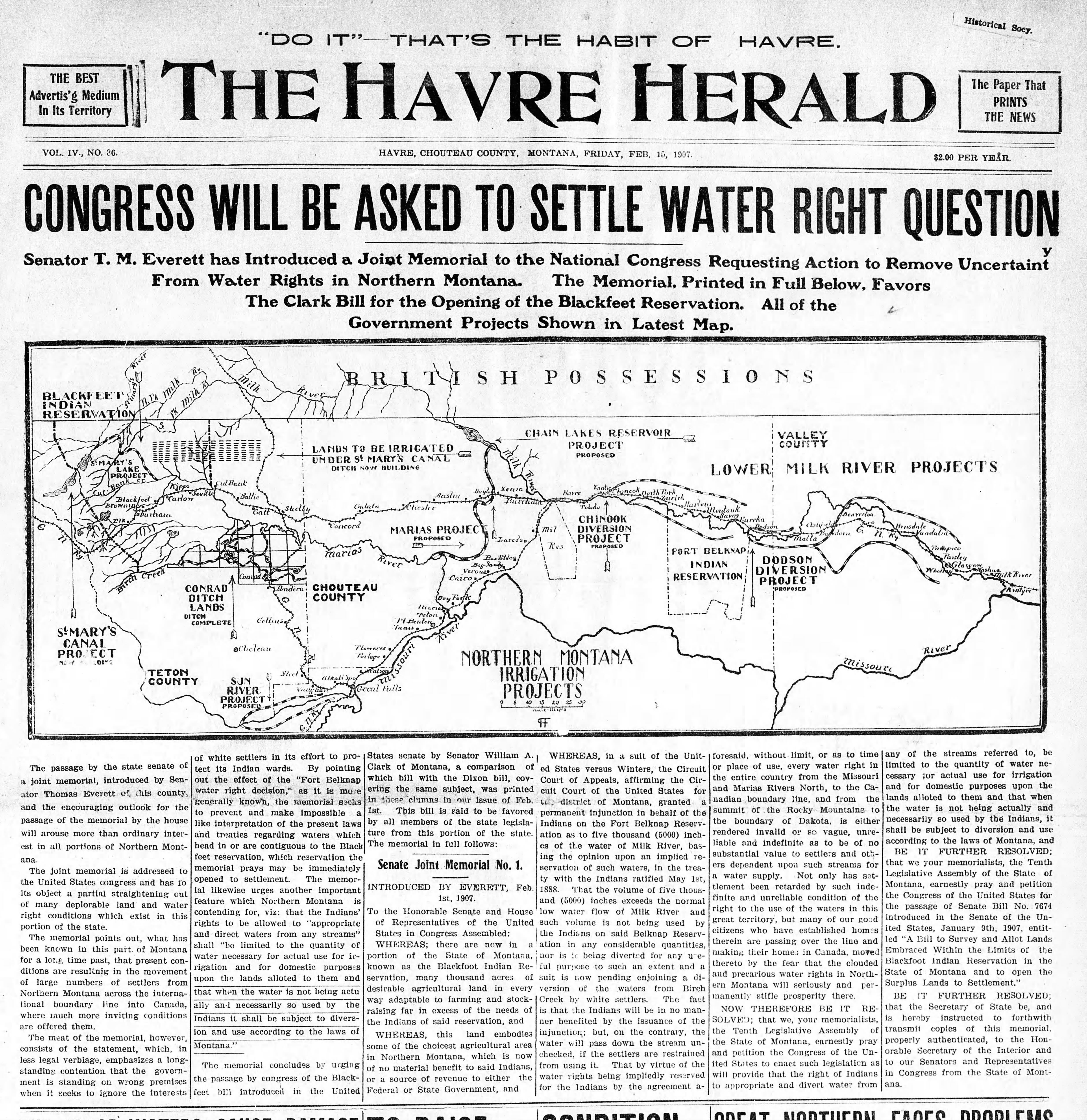
As a result of tribes’ sovereign status and federally recognized water rights, they have an important place in the management and allocation of California’s water resources. While most water rights are based on state law, federal law recognizes a special type of water right commonly known as “federal reserved rights.” This right was first recognized in 1906 by the United States Supreme Court in Winters v. United States and applies to certain federal lands, including tribal reservations. Many California tribes have established reserved rights or are in the process of asserting them. This class will cover the legal foundation and policy behind Indian water rights and how these rights fit in California’s water allocation system. Students will review recent developments involving Indian water rights, including quantification through litigation and congressionally approved water rights settlement. They will also review Indian water rights issues in the Klamath, Lake Tahoe and Colorado River Basins. This unique class is a continuation of the California Water Law and Policy offered by the UC Davis Extension and would be of interest to policy executives, water and environmental officials, and tribal representatives who wish to better understand California water.
Here is the opinion in … oh, we’ll call it Johns v. United States.
An excerpt:
Under the particular and complicated facts of this case, there is no practical benefit to placing issue remarks on Claimants’ water rights stating that lands within their place of use were once within a former Indian reservation. Although the remark is historically accurate, it serves no useful purpose. Waters in Basin 41QJ are not physically available for diversion or use by the Blackfeet Nation, and any aboriginal water rights once in existence there have been terminated. The Blackfeet Tribe sued and recovered compensation for this termination. The Blackfeet have not made a claim to water from Basin 41QJ in their Compact with the State of Montana and the United States. The Tribe has not objected to the water rights in this case. No injury has been demonstrated to the Tribe or its members if these or any water rights in Basin 41QJ are diverted in accord with their actual priority dates. The United States concedes the priority dates of Claimants’ water rights are valid and enforceable against other non-Indian water rights.
The long list of articles from the symposium, titled “‘As If Equity Mattered’ in Natural Resources,” is here.
A few articles in particular would appear to be of particular interest:
The Virtual Reservation: Land Distribution, Natural Resource Access, and Equity on the Yurok Forest 341
Lynn Huntsinger & Lucy Diekmann
Tribal Justice and Property Rights: The Evolution of Winters v. United States 471
A. Dan Tarlock
THE WINTERS CENTENNIAL:
WILL ITS COMMITMENT TO JUSTICE ENDURE?
June 9-12, 2008
Hyatt Regency Tamaya — Santa Ana Pueblo, New Mexico
The year 2008 marks the centennial of Winters v. United States, in which the Court formulated the reserved water rights doctrine now broadly asserted by Indian tribes and federal agencies. The decision, because of its enduring promise of justice to Native Americans, marks one of the great achievements of American jurisprudence. The decision made possible the continuity of many Indian communities and non-Indian communities alike, along with the protection of important environmental resources. Now, one hundred years later, the question is whether the promise of Winters will be fulfilled. In celebration of the Winters Centennial, the Utton Transboundary Resources Center and the American Indian Law Center will convene a major symposium in June 2008 along the waters of the Rio Grande near Albuquerque. The symposium will review the legal and cultural history of the decision, assess the contemporary consequences of the reserved water rights doctrine (both nationally and internationally), and project the significance of Indian water rights into the 21st Century. The goal of the symposium is to assemble Indian reserved rights policy makers and decision makers at all levels in order to deepen the understanding of the effect of Winters and to advance the dialogue regarding the future role of reserved rights.
 Turtle Talk
You must be logged in to post a comment.