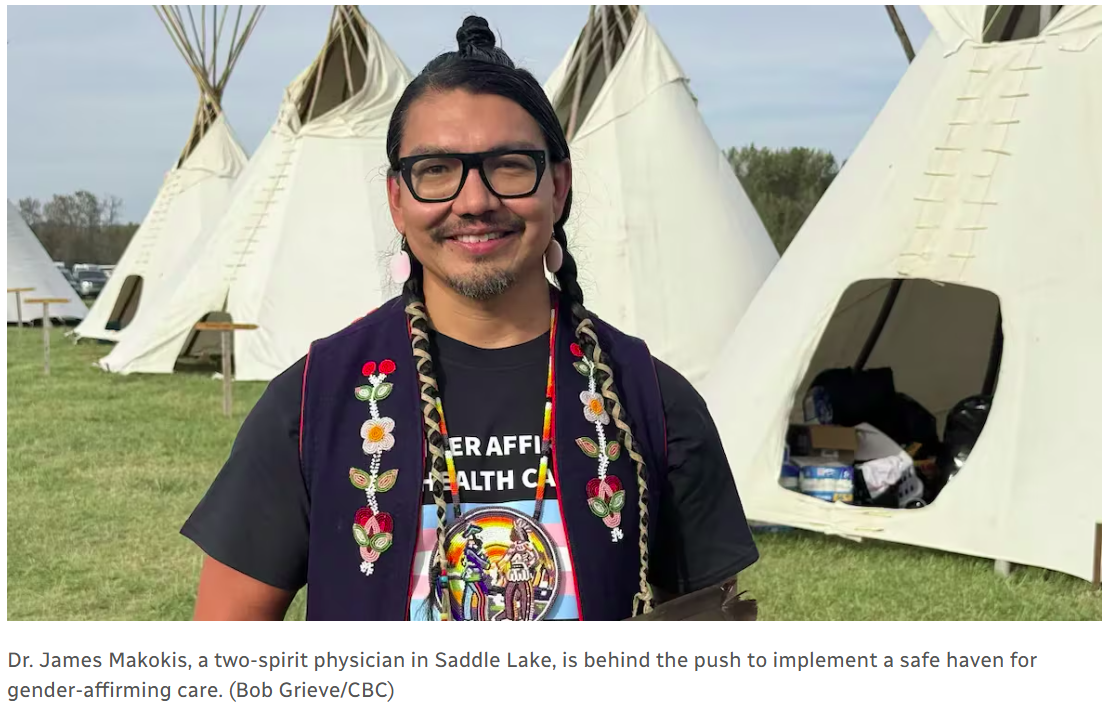
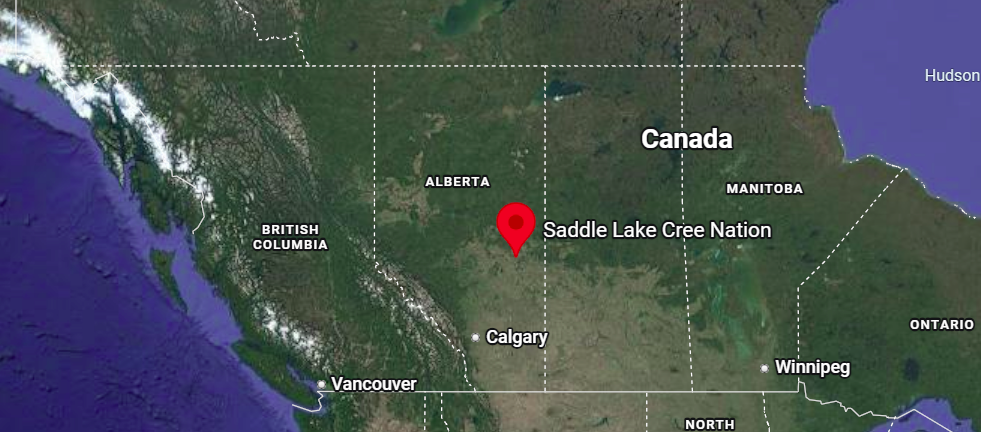
Alberta has restricted access to puberty blockers and hormone therapy for transgender youth, and it’s invoked a provision of the Canadian Constitution called the “notwithstanding clause” that allows governments temporarily to override certain constitutional rights. Saddle Lake Cree Nation is responding with reliance on Treaty 6, a source of authority that Alberta can’t override with the clause.
On September 9, during a gathering marking Treaty 6’s 150th anniversary, Chief Dale Steinhauer announced that Saddle Lake would assert its inherent and treaty-protected authority to provide gender-affirming health care on its reserve lands. The Nation is working to recruit clinicians and raise funds for legal defense and to develop its own health law.
“No longer will our children and families have their rights taken away,” Steinhauer said. “When one group’s rights are removed, we are all affected.”
Saddle Lake is grounding its position partly in Treaty 6’s “medicine chest” clause. First Nations have long understood the clause as a continuing commitment to provide comprehensive health care, not a promise frozen around the contents of a nineteenth-century medicine box.
In an interlocutory ruling in Wuskwi Sipihk Cree Nation v. Canada, a Federal Court prothonotary concluded that the First Nations’ claim could proceed and observed that, understood in its contemporary context, the medicine chest clause “may well require a full range of contemporary medical services.” The court did not finally decide the scope of that right, and the question remains unsettled.
Alberta prohibits regulated health professionals from prescribing puberty blockers or hormone therapy to patients under 16 for treating gender dysphoria or gender incongruence, subject to limited exceptions. Youth ages 16 and 17 require parental or guardian consent and approval from a physician and psychologist.
Saddle Lake’s announcement doesn’t settle whether Alberta’s regulation of health professionals applies on reserve. That question implicates provincial law, treaty rights, and the Nation’s asserted inherent jurisdiction. Saddle Lake says that clinicians working under its law will be protected from professional sanctions, but that claim may be tested if provincial regulators attempt enforcement.
Saddle Lake’s actions show that Alberta can’t invoke its own authority to abandon trans and Two-Spirit children and expect a Treaty Nation to do the same.
Additional Resources
Alberta First Nation wants to set up safe haven for gender-affirming care, Lexi Freehill and Lisa Johnson for CBC News (Sept. 10, 2026)
Treaty 6, with medicine chest clause
Section 33 of the Canadian Charter of Rights and Freedoms, commonly called the “notwithstanding clause”
Section 35, Part II of the Constitution Act, 1982, “Rights of the Aboriginal Peoples of Canada”
Section 1.92(1) of the Health Professions Act, prohibiting prescriptions for minors for the purposes of hormone therapy, including puberty suppression and hormone replacement therapy for the treatment of gender dysphoria or gender incongruence except in accordance with an order of the Minister.
Alberta Ministerial Order 31/2025, detailing circumstances where access to hormone therapy, including puberty suppression and hormone replacement therapy for the treatment of gender dysphoria or gender incongruence is permitted for a minor
The Governance of Indigenous Health, Constance MacIntosh, in Joanna Erdman, Vanessa Gruben & Erin Nelson, eds., Canadian Health Law and Policy, 5th ed. (LexisNexis Canada 2017)
 Turtle Talk
You must be logged in to post a comment.